
1. Background
Traumas are among the serious life-threatening events that can have direct and serious adverse effects on patient mortality. There are various types of trauma, and the prevalence of each type affects the outcome of these patients. Traumatic brain injuries (TBIs) include a variety of mild reversible lesions to severe life-threatening lesions (1-3). Trauma affects all age groups and causes a lot of economic and psychological burdens for patients. This disease decreases patients’ quality of life and mental health (4-6), affecting all aspects of health and leading to short-term and long-term complications (7, 8).
One of the clinical manifestations and complications of these patients is traumatic intracranial hemorrhages, divided into primary and secondary hemorrhages. In primary hemorrhages, the patient's computed tomography (CT) scan showed hemorrhage in the first 6 hours after the trauma, while no evidence of hemorrhage was found in the initial CT scan in secondary hemorrhages. Also, new symptoms may be created by reperforming a CT scan (6 hours after the initial CT scan) (9-11).
A subarachnoid hemorrhage (SAH) is a type of hemorrhagic stroke that usually occurs in the sixth decade of life and has the worst prognosis in the subgroup of strokes. Subarachnoid hemorrhage is a serious disease with high morbidity and mortality. This disease affects about 30,000 to 40,000 people in the United States and 60,000 people in the world (12-14). Patients with SAH may suffer from various complications, such as systemic inflammation, myocardial damage, or cardiac dysfunction (15, 16). Various factors contribute to the development of SAH, including arteriovenous abnormalities, intracranial aneurysm rupture, and traumatic events, so intracranial aneurysm rupture accounts for about 85% of SAH cases (17, 18).
Various risk factors are known for SAH, including smoking, family history, heavy drinking, and hypertension, each of which can affect the mortality rate of these patients (19, 20). More than 30% of patients with SAH die within the first days to the first weeks after SAH. Also, if these patients survive, most of them suffer from cognitive disorders or disability (14, 21). This disease has significant complications and mortality, and knowing the prognostic predictors and investigating related factors are of special importance. One of these factors is electrolyte imbalances, which are observed in the acute stage of the disease (22, 23).
2. Objectives
Considering the importance of traumatic hemorrhages, particularly SAH, the present study was conducted to determine the prevalence of SAH in TBI patients.
3. Methods
3.1. Study Design
The present cross-sectional study was conducted on all TBI patients with SAH for one year.
3.2. Inclusion and Exclusion Criteria
Inclusion criteria included being hospitalized in Ilam and providing informed consent by companions to participate in the study. In order to comply with the ethics of the research, permissions were obtained from the Research Ethics Committee of the university. The sampling began in accordance with the university’s guidelines, including the confidentiality of the information and imposing no costs on the patient.
3.3. Data Collection
Data collection tools include a demographic profile form and a researcher-made checklist containing questions on age, marriage, gender, level of education, body mass index (BMI), history of diabetes, hypertension, coagulation disorders, and skull fracture status. The severity of TBI is divided according to the Glasgow Coma Scale (GCS) score. Scores of 13 - 15, 9 - 12, and 3 - 8 indicate mild, moderate, and severe TBI, respectively (24).
3.4. Procedure
The patient’s history and clinical examinations were considered when admitting to the hospital. The consciousness level was measured at 6-to-24-hour intervals, a CT scan was performed, and any abnormal SAH-related clinical findings and symptoms were recorded. If the patient had other hemorrhages besides SAH, the hematoma volume was recorded. The need for surgery was determined by a neurosurgeon based on clinical examinations, radiological and paraclinical findings, and consultation with other specialists.
This study was conducted in accordance with the university’s ethical research guidelines, and all patient information was kept confidential.
3.5. Data Analysis
The collected data were entered into and analyzed by SPSS version 16 software (descriptive statistics, including frequency and percentage).
4. Results
A total of 534 patients were investigated, of whom 84 (15.3%) had intracranial hemorrhage. Out of 84 patients with intracranial hemorrhage, 12 (2.2%) had SAH, of whom ten were male and 2 were female. Also, SAH occurred to traffic accidents, falls, and other related reasons in 7 (58.3%), 4 (33.3%), and 1 (8.3%) patients, respectively. It was also shown that 1 (8.3%), 2 (16.6%), and 9 (75%) patients with SAH had mild, moderate, and severe consciousness, respectively (Table 1).
Table 1.
Investigating the Relationship Between Subarachnoid Hemorrhage and Demographic Variables a
| Variables | Total Patients with TBI (N = 534) | Types of Cerebral Hemorrhages (N = 84) | SAH (N = 12) |
|---|---|---|---|
| Age | |||
| < 50 | 313 (57.1) | 54 (64.3) | 6 (50) |
| > 50 | 235 (42.9) | 30 (35.7) | 6 (50) |
| Gender | |||
| Male | 413 (75.4) | 62 (73.8) | 10 (83.3) |
| Female | 135 (24.6) | 22 (26.2) | 2 (16.7) |
| Education | |||
| Illiterate | 143 (26.1) | 14 (16.7) | 2 (16.7) |
| Cycle | 212 (38.7) | 28 (33.3) | 6 (50) |
| Diploma | 155 (28.3) | 31 (36.9) | 3 (25) |
| Bachelor's degree and higher | 38 (6.9) | 11 (13.1) | 1 (8.3) |
| Marital status | |||
| Single | 306 (55.8) | 26 (31) | 2 (16.7) |
| Married | 242 (44.2) | 58 (69) | 10 (83.3) |
| BMI | |||
| 22 and lower | 353 (64.4) | 37 (44) | 5 (41.7) |
| More than 22 | 195 (35.6) | 47 (56) | 7 (58.3) |
| History of blood pressure | |||
| Yes | 246 (44.9) | 22 (26.2) | 4 (33.3) |
| No | 302 (55.1) | 62 (73.8) | 8 (66.7) |
| Coagulation disorders | |||
| Yes | 269 (49.1) | 2 (2.4) | 0 (0) |
| No | 279 (50.9) | 82 (97.6) | 12 (100) |
Abbreviations: TBI, traumatic brain injury; SAH, subarachnoid hemorrhage; BMI, body mass index.
a Values are expressed as No.
Regarding the causes of trauma in patients, it was shown that 228 patients due to traffic accidents, 169 patients due to sports injuries, 103 patients due to falls, 44 patients due to invasion, and four patients due to other causes had TBI (Table 2).
Table 2.
Distribution of Traumatic Brain Injury Patients According to Season and Type of Trauma a
| Seasons | Invasion | Traffic Accidents | Sports | Falls | Other Causes | Total |
|---|---|---|---|---|---|---|
| Spring | 3 | 53 | 36 | 11 | 0 | 103 |
| Summer | 16 | 59 | 79 | 34 | 1 | 189 |
| Fall | 15 | 73 | 34 | 48 | 3 | 173 |
| Winter | 10 | 43 | 20 | 10 | 0 | 83 |
| Total | 44 | 228 | 169 | 103 | 4 | 548 |
a Values are expressed as No.
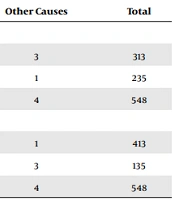
Concerning the relationship between patients’ age and the type of trauma, it was shown that most injuries leading to TBI in individuals under 50 years of age were related to traffic accidents. Also, in terms of male gender, 174 people were hospitalized due to traffic accidents, and 125 were hospitalized due to sports injuries (Table 3).
Table 3.
Investigating the Relationship Between Patients’ Age and Gender with the Mechanism of Trauma a
| Variables | Invasion | Traffic Accidents | Sports | Falls | Other Causes | Total |
|---|---|---|---|---|---|---|
| Age | ||||||
| < 50 | 23 | 148 | 86 | 53 | 3 | 313 |
| > 50 | 21 | 80 | 83 | 50 | 1 | 235 |
| Total | 44 | 228 | 169 | 103 | 4 | 548 |
| Gender | ||||||
| Male | 33 | 174 | 125 | 80 | 1 | 413 |
| Female | 11 | 54 | 44 | 23 | 3 | 135 |
| Total | 44 | 228 | 169 | 103 | 4 | 548 |
a Values are expressed as No.
5. Discussion
According to the results, most patients (n = 413, 75.4) were male. According to Perel et al.’s study in England and Wales, 10,229 (73.3%) males and 3,733 (26.7%) females had intracranial hemorrhages, respectively. Concerning the type of hemorrhage, it was shown that the prevalence of intraparenchymal hemorrhage (IPH), epidural hematoma (EDH), SAH, and subdural hematoma (SDH) were equal to 2187 (73.1%) and 803 (26.9%), 2352 (74.9%) and 788 (25.1%), 2257 (74.6%) and 768 (25.4%), and 3050 (72.5%) and 1154 (27.5%) for males and females, respectively (25), which is consistent with the results of the present study.
Regarding the causes of trauma, it was shown that most causes of trauma were related to traffic accidents with 228 patients, sports accidents with 169 patients, falls with 103 patients, and invasions with 44 patients, respectively. In Rahimi-Movaghar et al.’s study (26) in Tehran, 7110 patients were examined, and TBI was observed in only 21 patients. Also, out of 21 patients with TBI, the causes of TBI included traffic accidents in 10 patients, falls in 8 patients, and sports accidents in 2 patients. In Reihanian et al.’s study (27) in the north of Iran, out of 166 patients with TBI, traffic accidents were observed in 99 patients, falls in 53 patients, and sports accidents in 4 patients. In Alavi et al.’s study (28) in Bandar Abbas, traffic accidents in 30 patients and falls in 13 patients were observed as causes of TBI.
According to the results, most TBIs occurred due to traffic accidents. In this regard, it was shown in studies by Rahimi-Movaghar et al. (26) in Tehran, Alavi et al. (28) in Bandar Abbas, and Zandi and Seyed Hoseini (29) in Hamedan that traffic accidents accounted for 10 (47.6%), 30 (55.6%), and 90 (29.8%) of TBIs, respectively, which is consistent with the results of the present study.
One of the symptoms in TBI patients may include hemorrhage. In this regard, Shahhosseini et al. showed that CT scan changes were observed in only 20 out of 1395 patients referring to the hospital due to TBI. Also, 40%, 35%, and 25% of these 20 studied patients had decreased hemorrhage, increased hemorrhage, and new hemorrhage (11), respectively, indicating the presence of hemorrhage in TBI patients. Moustafa et al. also found intracranial hemorrhage in 26 (8.9%) out of 993 TBI patients under investigation (30). Perel et al. also reported that approximately 46% of 13,962 TBI patients were in the intracranial hemorrhage stage. Also, subdural hemorrhage was observed in about 30% of these patients, and the risk of death increased with increasing intracranial hemorrhage (25).
According to the findings, most patients had low GCS. In different studies, TBI led to patients decreased GCS. In Sadegh et al. (31), Samadi Rad et al. (32), and Chabok et al.’s (33) studies, TBI led to decreased GCS in patients, which is consistent with the results of this study. Also, regarding the GCS status and mortality rate, it was shown in Hayati et al.’s study that in patients with GCS scores of 3 to 8, the mortality rate was equal to 28 (66.70%), and in patients with GCS scores of 9 to 12, the mortality rate equal to 7 (18.40%) was reported, which is consistent with the results of this study (34).
5.1. Conclusions
The prevalence of intracranial hemorrhage and SAH in TBI patients is significantly high, which should be taken into consideration when performing diagnostic and therapeutic procedures for these patients.