
1. Introduction
Sodium thiopental, also known as thiopentone, is a short-acting barbiturate anesthetic agent discovered in the early 1930s by Ernest H. Volwiler and Donalee L. Tabern at Abbott Laboratories and first introduced clinically in 1934 by John S. Lundy at the Mayo Clinic. It acts primarily by enhancing the inhibitory effects of gamma-aminobutyric acid (GABA) at the GABAA receptor, leading to central nervous system depression (1, 2). Sodium thiopental is commonly used for the rapid induction of general anesthesia because of its high lipid solubility, which allows rapid penetration across the blood-brain barrier, resulting in an onset of action within 30 - 60 seconds and a brief duration of hypnotic effect, typically 5 - 15 minutes, primarily mediated by redistribution from the brain to peripheral tissues rather than metabolism. The standard induction dose of sodium thiopental in adults is typically 3 - 6 mg/kg intravenously, administered over 10 - 40 seconds, with adjustments based on patient response and clinical context (2).
Several patient-specific factors influence the induction dose of sodium thiopental, including age, sex, and body weight. Advancing age is associated with reduced dose requirements; patients aged 60 - 70 years require approximately 70% of the per-kilogram dose required by younger adults aged 20 - 40 years because of an increased volume of distribution and a prolonged terminal half-life. Sex differences include higher initial venous concentrations in males, which may require slight dose adjustments; however, overall pharmacokinetics show minimal sex-based variation beyond this. Body weight significantly affects dosing, as lean body mass (LBM) and total weight correlate strongly with induction requirements; higher weights generally necessitate larger absolute doses, with consideration of obesity-related changes (3, 4).
The volume of distribution (Vd) of sodium thiopental, a highly lipophilic drug, plays a critical role in induction dosing because it determines the extent of drug dispersion into tissues and influences the amount needed to achieve therapeutic concentrations in the central compartment. In obese patients, Vd is significantly increased, approximately 4 - 8 L/kg compared with 1.4 - 2 L/kg in lean individuals, because of enhanced distribution into adipose tissue. This results in a prolonged elimination half-life, up to 27.85 hours versus 6.33 hours in lean patients, and may require higher initial doses to achieve rapid induction, although clearance may remain similar or slightly elevated when normalized for weight. This relationship with patient weight highlights that Vd expands disproportionately with obesity, complicating traditional weight-based dosing and increasing the risk of overdose or underdose if dosing is not adjusted appropriately (5, 6).
Despite these descriptors, the optimal weight-based approach for sodium thiopental induction in overweight and obese patients remains undetermined, with limited direct comparative studies available. Current evidence suggests using total body weight (TBW) for loading doses because of the increased Vd, whereas lean body weight (LBW) may be preferable for maintenance dosing to align with clearance. However, no randomized trials have specifically evaluated TBW, ideal body weight (IBW), adjusted body weight (ABW), or LBW for thiopental in this population. Consequently, it remains unclear which descriptor provides the best anesthetic depth with the fewest adverse effects, such as hemodynamic instability or the need for supplemental drug administration (6, 7).
2. Methods
2.1. Study Design and Ethics
This single-center, parallel-arm randomized controlled trial was conducted in accordance with the Declaration of Helsinki and approved by the Institutional Review Board of Tehran University of Medical Sciences (IR.TUMS.IKHC.REC.1402.174). The trial was prospectively registered in the Iranian Registry of Clinical Trials (IRCT20230825059254N1). Each participant provided written informed consent before enrollment. Patient enrollment and data collection were conducted from May 2025 to February 2026.
2.2. Participants
Adult patients aged 20 - 60 years with a body mass index (BMI) > 25 kg/m2 and American Society of Anesthesiologists (ASA) physical status I - II, or III solely for BMI > 40 kg/m2, were eligible for inclusion. Height and weight were measured using a fixed stadiometer and a calibrated scale, respectively. The main exclusion criteria were hemodynamic instability, chronic opioid use, porphyria, a difficult airway, and allergy to the study drugs.
2.3. Randomization and Interventions
Patients were randomly allocated to one of three groups using block randomization with a fixed block size of 6. The random allocation sequence was generated by an independent statistician using a computer-generated randomization list in SPSS. To ensure allocation concealment, sequentially numbered, opaque, sealed envelopes (SNOSE) were used. The independent statistician generated the random sequence, the attending anesthesiologist enrolled participants, and a study nurse not involved in patient care assigned participants to their respective groups according to the allocation sequence.
Because of the nature of the intervention, the attending anesthesiologists who prepared and administered the study drugs were not blinded to group allocation. However, to mitigate performance bias and standardize bolus decisions across groups, strict objective criteria were applied. The outcome assessors, data collectors, and the statistician performing the final data analysis were blinded to group allocation.
Groups were defined according to the method used to calculate the initial sodium thiopental induction dose: 1) TBW, defined as the patient’s actual body weight measured on the day of surgery; 2) IBW; or 3) ABW. IBW was calculated using the Devine formula: for males, IBW (kg) = 50 + 2.3 × (height in inches over 60); for females, IBW (kg) = 45.5 + 2.3 × (height in inches over 60). ABW was calculated as IBW + 0.4 × (TBW - IBW).
Patients were placed in the supine position, and standard bedside monitoring was applied, including pulse oximetry, electrocardiography (ECG), noninvasive blood pressure (NIBP), bispectral index (BIS) monitoring with a target range of 40 - 60, and heart rate (HR) assessment. Two intravenous lines were established using 16- and 18-gauge cannulas. Baseline vital signs were then recorded. Approximately 5 mL/kg of crystalloid fluid was infused, and patients received 100% oxygen via face mask for 3 minutes. Fentanyl (2 µg/kg IBW) was then administered intravenously, followed by recording of HR and mean arterial pressure (MAP) after 3 minutes.
Subsequently, sodium thiopental (Thiopental Jaber, 500 mg powder for injection; Jaber-Pharma Co., Karaj, Iran; reconstituted and diluted to a final concentration of 25 mg/mL) was administered at an initial dose of 5 mg/kg based on the assigned weight descriptor and infused over 30 seconds. The need for supplemental 50 mg boluses was assessed using a two-step sequence. First, the eyelash reflex was checked 30 seconds after the initial injection; if present, 50 mg boluses were administered until the reflex was abolished. After confirming the absence of the eyelash reflex, rocuronium (0.5 mg/kg IBW) was administered. Second, laryngoscopy was performed only after BIS < 50 was achieved; if BIS remained ≥ 50, additional 50 mg boluses were administered at 30-second intervals until the target BIS < 50 was reached. For this study, supplemental thiopental boluses were defined as any additional 50 mg doses administered after completion of the assigned initial thiopental dose, whether due to persistence of the eyelash reflex or failure to achieve BIS < 50 before laryngoscopy. The final total dose was calculated as the sum of the initial calculated dose and all supplemental 50 mg boluses. To ensure patient safety and prevent excessive barbiturate exposure, a predetermined maximum total dose of 500 mg was established. If a patient reached the 500 mg limit and still exhibited BIS ≥ 50, no further thiopental was administered; instead, induction proceeded at the clinician’s discretion using alternative agents or volatile anesthetics, and failure to achieve the target BIS was documented.
2.4. Monitoring and Data Collection
Standard ASA monitors were applied and supplemented with BIS monitoring (Aspect A-2000). Data on BIS, MAP, and HR were recorded at the following time points: patient arrival (baseline), 1 minute after completion of the initial thiopental injection, and 3 minutes after intubation. To minimize detection bias, all intraoperative data, including BIS, MAP, HR, and the need for supplemental boluses, were recorded by an independent outcome assessor, a trained study nurse who was strictly blinded to group allocation.
2.5. Outcomes
The primary outcome was BIS measured 1 minute after completion of the initial sodium thiopental dose. This time point was selected to assess the early hypnotic response to the assigned induction dose before laryngoscopy, supplemental dosing, and intubation-related sympathetic stimulation could substantially influence BIS and hemodynamic measurements. Secondary outcomes included MAP and HR at the same time point; BIS, MAP, and HR 3 minutes after tracheal intubation; total thiopental dose administered; and the need for supplemental thiopental boluses.
2.6. Statistical Analysis
Continuous data are presented as mean ± standard deviation (SD), and categorical data are presented as frequencies and percentages. Before analysis, the normality of continuous variables was assessed using the Shapiro-Wilk test, and the homogeneity of variances was evaluated using Levene’s test. Normally distributed continuous variables were compared among the three groups using one-way analysis of variance (ANOVA). If assumptions of normality or homogeneity of variances were violated, the Kruskal-Wallis H test was planned. When ANOVA indicated a statistically significant difference, post hoc pairwise comparisons were performed using Tukey’s Honestly Significant Difference (HSD) test to adjust for multiple comparisons. Accordingly, Tukey-adjusted 95% confidence intervals (CIs) are reported for pairwise mean differences.
Categorical variables were compared using the Pearson χ2 test; however, Fisher’s exact test was used for variables with sparse expected cell frequencies, defined as > 20% of expected cell counts being less than 5. When a global significant difference was detected among the three groups for categorical variables, post hoc pairwise comparisons were conducted using Fisher’s exact test with a Bonferroni correction to control the family-wise error rate (adjusted significance level, α = 0.0167).
To account for the baseline imbalance in ASA physical status, an analysis of covariance (ANCOVA) was performed for the primary outcomes, with ASA class included as a covariate. Estimated marginal means with Bonferroni adjustments were evaluated for any post hoc comparisons following ANCOVA. A two-sided P < 0.05 was considered statistically significant before any post hoc adjustments. All analyses were performed using SPSS version 27 by an independent statistician blinded to the treatment assignments.
The sample size was calculated a priori based on the primary outcome, BIS measured 1 minute after completion of the initial sodium thiopental dose. Based on a pilot study, we assumed a mean difference in BIS values of 10 units among the groups, with an estimated standard deviation of 12. To achieve 80% power with a two-sided alpha level of α = 0.05 and an equal allocation ratio of 1:1:1, a minimum of 27 patients per group was required. To account for a potential dropout rate of 10%, the target enrollment was set at 90 patients. The trial was adequately powered for the primary endpoint, and the final sample size of 91 patients closely matched the planned enrollment target. The study was not explicitly powered to detect differences in secondary hemodynamic outcomes or sex-stratified comparisons, which were considered exploratory.
3. Results
Ninety-one patients were enrolled: 30 in the TBW group, 32 in the IBW group, and 29 in the ABW group. No significant differences were observed among the groups in sex distribution, height, weight, or BMI. ASA physical status differed significantly among the groups (P = 0.04), although the absolute imbalance was small, with a slightly higher proportion of ASA I patients in the TBW group (Table 1). Although patients with ASA physical status III solely because of BMI > 40 kg/m2 were eligible according to the inclusion criteria, no such patients were enrolled. All participants included in the final analysis were ASA class I or II.
Table 1.
Demographic Characteristics a
| Variables | TBW (n = 30) | IBW (n = 32) | ABW (n = 29) | P-Value |
|---|---|---|---|---|
| Gender | 0.48 | |||
| Male | 4 (13.3) | 8 (25.0) | 7 (24.1) | |
| Female | 26 (86.6) | 24 (75.0) | 22 (75.9) | |
| Height (cm) | 164.60 ± 8.36 | 164.00 ± 10.68 | 166.59 ± 8.87 | 0.555 |
| Weight (kg) | 84.95 ± 9.96 | 88.19 ± 17.06 | 88.21 ± 8.71 | 0.624 |
| BMI | 31.26 ± 3.05 | 32.42 ± 3.66 | 31.77 ± 2.90 | 0.453 |
| ASA class | 0.04 | |||
| I | 25 (83.3) | 25 (78.1) | 23 (79.3) | |
| II | 5 (16.6) | 7 (21.9) | 6 (20.7) |
a Values are expressed as No. (%) or mean ± SD. Abbreviations: ASA, American society of anesthesiologists; BMI, Body Mass Index.
Parameters were measured at three time points (Table 2). Baseline MAP, HR, and BIS were similar among the groups (P > 0.05). After the initial thiopental dose, BIS differed significantly among the groups (P < 0.001), with the IBW group showing the highest BIS value (59.81 ± 14.2) compared with the TBW group (38.75 ± 12.66) and the ABW group (44.21 ± 12.53). After intubation, MAP was highest in the ABW group (117.76 ± 16.98 mm Hg; P = 0.035), and BIS remained elevated in the IBW group (53.58 ± 13.61; P = 0.015).
Table 2.
Physiological Parameters and BIS Scores a
| Time point and Variables | TBW | IBW | ABW | P-Value |
|---|---|---|---|---|
| Before premedication | ||||
| MAP (mm Hg) | 102.90 ± 12.13 | 101.72 ± 11.77 | 105.17 ± 14.78 | 0.582 |
| HR (bpm) | 78.05 ± 13.38 | 85.69 ± 15.51 | 82.90 ± 11.75 | 0.156 |
| BIS | 97.17 ± 1.84 | 97.78 ± 2.10 | 98.21 ± 0.67 | 0.097 |
| After initial dose | ||||
| MAP (mm Hg) | 96.70 ± 12.75 | 95.72 ± 13.74 | 103.55 ± 14.71 | 0.071 |
| HR (bpm) | 82.40 ± 11.92 | 81.94 ± 12.48 | 83.24 ± 11.21 | 0.912 |
| BIS | 38.75 ± 12.66 | 59.81 ± 14.20 | 44.21 ± 12.53 | < 0.001 |
| After intubation | ||||
| MAP (mm Hg) | 103.25 ± 16.36 | 112.48 ± 21.78 | 117.76 ± 16.98 | 0.035 |
| HR (bpm) | 89.15 ± 11.40 | 94.68 ± 18.61 | 95.28 ± 12.19 | 0.319 |
| BIS | 42.55 ± 12.75 | 53.58 ± 13.61 | 49.48 ± 12.40 | 0.015 |
a Values are expressed as mean ± SD. Abbreviations: BIS, Bispectral Index; TBW, total body weight; IBW, ideal body weight; ABW, adjusted body weight; MAP, mean arterial pressure.
The need for supplemental thiopental boluses differed markedly among the groups, occurring in 3.3% of patients in the TBW group, 24.1% in the ABW group, and 78.1% in the IBW group (P < 0.001). Post hoc pairwise comparisons with Bonferroni adjustment showed that the requirement for supplemental boluses was significantly higher in the IBW group than in the TBW group (P = 0.016). In addition, 15.6% of patients in the IBW group did not achieve BIS < 50 despite receiving a total thiopental dose of 500 mg (Table 3).
Table 3.
Supplemental Thiopental Bolus Requirement a
| Outcomes | TBW (n = 30) | IBW (n = 32) | ABW (n = 29) | P-Value (Fisher's) |
|---|---|---|---|---|
| ≥ 1 supplemental bolus | 1 (3.3) | 25 (78.1) | 7 (24.1) | < 0.001 |
| Failure to achieve BIS < 50 despite 500 mg | 0 (0) | 5 (15.6) | 0 (0) | 0.151 |
a Abbreviations: BIS, Bispectral Index; TBW, total body weight; IBW, ideal body weight; ABW, adjusted body weight.
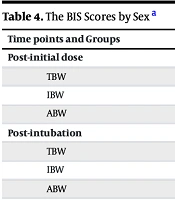
Sex-stratified exploratory analysis showed no statistically significant differences in BIS values between male and female patients within each dosing group (Table 4). Among female patients, BIS values differed across weight-based dosing strategies after the initial thiopental dose and after intubation, with the highest values observed in the IBW group and the lowest values generally observed in the TBW group (Table 5). These subgroup findings should be interpreted cautiously because of the small and imbalanced number of male patients across groups.
Table 4.
The BIS Scores by Sex a
| Time points and Groups | Males | Females | P Value (Male vs Female) |
|---|---|---|---|
| Post-initial dose | |||
| TBW | 39.75 ± 5.90 | 38.75 ± 12.66 | 0.621 |
| IBW | 58.75 ± 15.52 | 60.16 ± 14.07 | 0.800 |
| ABW | 39.28 ± 10.35 | 45.77 ± 12.96 | 0.346 |
| Post-intubation | |||
| TBW | 48.25 ± 15.88 | 41.12 ± 11.79 | 0.789 |
| IBW | 52.57 ± 19.06 | 53.87 ± 12.10 | 0.823 |
| ABW | 54.00 ± 14.95 | 48.04 ± 11.50 | 0.200 |
a Abbreviations: BIS, Bispectral Index; TBW, total body weight; IBW, ideal body weight; ABW, adjusted body weight.
Table 5.
Exploratory BIS Values Among Female Patients According to Weight-Based Dosing Strategy a
| Time Points | TBW (Female) | IBW (Female) | ABW (Female) | P-Value b |
|---|---|---|---|---|
| Post-initial dose BIS | 38.75 ± 12.66 | 60.16 ± 14.07 | 45.77 ± 12.96 | < 0.001 |
| Post-intubation BIS | 41.12 ± 11.79 | 53.87 ± 12.10 | 48.04 ± 11.50 | 0.006 |
a Values are expressed as mean ± SD. Abbreviations: BIS, Bispectral Index; TBW, total body weight; IBW, ideal body weight; ABW, adjusted body weight.
b P values represent exploratory comparisons among the three dosing groups in female patients and were not adjusted for multiple comparisons. Abbreviations are defined in the List of Abbreviations.
When the components of the total administered thiopental dose were analyzed, the mean initial calculated dose was 422.25 ± 44.14 mg in the TBW group, 290.31 ± 57.66 mg in the IBW group, and 342.97 ± 51.52 mg in the ABW group.
The median number of supplemental 50 mg boluses required per patient was 0 (IQR, 0 - 0) in the TBW group, 0 (IQR, 0 - 0.5) in the ABW group, and 2.5 (IQR, 1 - 4.5) in the IBW group.
Consequently, the mean final total dose was 427.25 ± 44.17 mg in the TBW group, 433.75 ± 125.25 mg in the IBW group, and 371.93 ± 69.96 mg in the ABW group, with the ABW dose significantly lower than the IBW dose (P = 0.028) (Table 6).
Table 6.
Comparison of Total Dose, Post-Initial Dose BIS, Post-Intubation BIS, and Post-Intubation MAP Among Groups a
| Variables | TBW (n = 30) | IBW (n = 32) | ABW (n = 29) | P Value (ANOVA) | Pairwise Mean Difference (Tukey-adjusted 95% CI) |
|---|---|---|---|---|---|
| Total dose (mg) | 427.25 ± 44.17 | 433.75 ± 125.25 | 371.93 ± 69.96 | 0.024 | TBW vs IBW: -6.50 (-69.17 to 56.17) / TBW vs ABW: 55.31 (-8.59 to 119.22) / IBW vs ABW: 61.81 (5.45 to 118.19) |
| Post-initial dose BIS | 38.75 ± 12.66 | 59.81 ± 14.20 | 44.21 ± 12.53 | < 0.001 | TBW vs IBW: -21.06 (-30.09 to -12.40) / TBW vs ABW: -5.45 (-14.66 to 3.75) / IBW vs ABW: 15.60 (7.49 to 23.72) |
| Post-intubation BIS | 42.55 ± 12.75 | 53.58 ± 13.61 | 49.48 ± 12.40 | 0.015 | TBW vs IBW: -11.03 (-19.89 to -2.17) / TBW vs ABW: -6.93 (-15.92 to 2.05) / IBW vs ABW: 4.09 (-3.89 to 12.08) |
| Post-intubation MAP | 103.25 ± 16.36 | 112.48 ± 21.78 | 117.76 ± 16.98 | 0.035 | TBW vs IBW: -9.23 (-22.17 to -1.40) / TBW vs ABW: -14.50 (-27.61 to -1.40) / IBW vs ABW: -5.27 (-16.92 to 6.37) |
a Values are expressed as mean ± SD. Abbreviations: BIS, Bispectral Index; TBW, total body weight; IBW, ideal body weight; ABW, adjusted body weight.
After intubation, 45.16% of patients in the IBW group had BIS > 50, compared with 31.03% in the ABW group and 10% in the TBW group. Optimal BIS, 40 - 50, was achieved in 35.49% of patients in the IBW group, 55.22% in the ABW group, and 50.0% in the TBW group.
To account for the baseline imbalance in ASA physical status, ANCOVA was performed. After adjustment for ASA class as a covariate, the dosing method remained a significant determinant of post-initial-dose BIS (P < 0.001) and post-intubation BIS (P = 0.006). However, the adjusted analysis showed no significant differences among the groups in post-intubation MAP (P = 0.786) or total thiopental dose (P = 0.690).
4. Discussion
ABW dosing appeared to provide a favorable balance between hypnotic efficacy and total thiopental exposure. Although TBW dosing achieved adequate BIS suppression in many patients, ABW dosing resulted in a lower total thiopental requirement while maintaining a comparable proportion of patients within the optimal BIS range (55.22% vs 50.0% in the TBW group). Supplemental thiopental boluses were required in 24.1% of patients in the ABW group, compared with 3.3% in the TBW group and 78.1% in the IBW group. From a pharmacologic perspective, ABW may partially account for the increased volume of distribution associated with excess body weight by incorporating a proportion of weight above IBW, thereby providing an intermediate descriptor between IBW and TBW (9). In contrast, although TBW dosing was effective in achieving hypnotic depth, 40% of patients in this group had BIS values < 40, suggesting a tendency toward excessive hypnotic depth. Therefore, the lower total thiopental requirement observed with ABW dosing may be clinically relevant by reducing unnecessary drug exposure, particularly in patients with excess body weight (6).
The use of BIS at 1 minute after thiopental administration was intended to capture the immediate hypnotic response to the assigned initial dose before laryngoscopy, supplemental boluses, and intubation-related sympathetic stimulation could modify BIS and hemodynamic responses. This time point is clinically relevant because tracheal intubation requires adequate hypnotic depth, and inadequate suppression before laryngoscopy may increase the need for additional induction medication. Nevertheless, BIS remains a surrogate physiological marker of anesthetic depth rather than a direct patient-centered outcome; therefore, our findings should be interpreted as pharmacodynamic and dose-efficiency signals rather than evidence of improved clinical outcomes.
IBW dosing appeared insufficient for this population, with 45.16% of patients having BIS > 50 after intubation, suggesting inadequate hypnotic depth. The high supplemental bolus requirement (78.1%) and total dose (433.75 ± 125.25 mg) indicate that many patients assigned to IBW dosing required compensatory thiopental supplementation; nevertheless, 15.6% still failed to reach BIS < 50. In the exploratory sex-stratified analysis, a similar pattern was observed among female patients, with higher BIS values in the IBW group after the initial thiopental dose and after intubation. Although sex-related differences in anesthetic drug effects have been reported previously (10), the present subgroup analysis was not powered to establish sex-specific dosing recommendations. Although intraoperative awareness was not assessed in this study, the higher BIS values observed with IBW dosing may indicate a greater likelihood of insufficient hypnotic depth during induction, a clinically relevant concern given the recognized importance of avoiding inadequate anesthesia depth (8).
Regarding the baseline imbalance in ASA physical status (P = 0.04), we acknowledge its theoretical potential to influence induction requirements. However, our adjusted analysis (ANCOVA) demonstrated that the weight-based dosing strategy remained the primary significant determinant of the achieved depth of anesthesia, as measured by BIS. After adjustment for ASA class, the total administered thiopental dose did not differ significantly among groups (P = 0.690). This finding aligns with our clinical observations: although the IBW group received a lower initial dose, these patients required a significantly higher rate of supplemental boluses, ultimately bringing their total dose closer to that of the other groups. Thus, the baseline ASA imbalance did not appear to confound our main findings regarding the initial dosing strategies.
These findings are consistent with some prior pharmacokinetic recommendations but differ from others. Previous pharmacokinetic reviews have emphasized that obesity alters the distribution of many intravenous anesthetic agents and that Ramirez et al. (6) also endorsed TBW dosing for thiopental because of its lipid solubility, consistent with the efficacy observed in the TBW group but not with its higher dose requirement. However, Ingrande and Lemmens (12) advocated LBM-based dosing to avoid overdosing because fat accumulation can prolong recovery, a concern less relevant to single-dose induction but supportive of ABW's balanced approach. Amaranath et al. suggested a higher thiopental induction dose of 7.5 mg/kg based on IBW in morbidly obese patients, attributing this requirement to increased cardiac output and lower peak plasma thiopental concentrations (13). In contrast, our findings suggest that IBW-based dosing at 5 mg/kg was frequently insufficient in patients with BMI > 25 kg/m2, although direct comparison is limited by differences in patient population, dose, and obesity severity.
The exploratory sex-stratified findings should be interpreted with caution. Although previous studies have reported sex-related differences in anesthetic drug effects and recovery profiles (10, 14), the present study was not designed or powered to evaluate sex-specific thiopental dosing. Therefore, the observed pattern among female patients should be considered hypothesis-generating and requires confirmation in larger studies with balanced sex distribution and direct assessment of body composition.
4.1. Limitations
This study has several limitations. First, BIS is a surrogate physiological marker of hypnotic depth rather than a patient-centered clinical outcome. Although BIS at 1 minute after thiopental administration was selected to capture the early hypnotic effect of the assigned induction dose before laryngoscopy and intubation, the study did not assess clinical outcomes such as awareness, recall, recovery quality, recovery time, or postoperative adverse events. Second, this was a single-center trial with a modest sample size, and the sex-stratified analyses were exploratory and underpowered because of the small and imbalanced number of male participants. Third, patients with BMI > 25 kg/m2 were analyzed as a single cohort; therefore, clinically relevant differences between overweight patients and different obesity classes may have been masked. Fourth, plasma thiopental concentrations and direct body-composition measures were not obtained, limiting pharmacokinetic interpretation. Finally, lean patients and patients with extreme obesity were not adequately represented, limiting generalizability across the full body-weight spectrum. Further studies with larger samples, predefined BMI-class subgroup analyses, pharmacokinetic measurements, and balanced sex distribution are warranted.
4.2. Conclusions
In adults with BMI > 25 kg/m2 undergoing BIS-guided induction of anesthesia under this single-center protocol, ABW-based dosing of sodium thiopental at 5 mg/kg appeared to provide a balanced pharmacodynamic profile. Compared with IBW dosing, it reduced the frequent need for supplemental thiopental boluses and achieved more consistent BIS suppression; compared with TBW dosing, it achieved clinically acceptable hypnotic depth with a lower total thiopental requirement and a lower tendency toward excessive hypnotic depth. Because the primary endpoint was BIS, a surrogate measure of anesthetic depth, these findings should be interpreted cautiously and confirmed in larger studies that evaluate BMI-class subgroups, pharmacokinetic measurements, and patient-centered clinical outcomes.