
1. Background
The peripheral nervous system, which encompasses the spinal and cranial nerves and peripheral ganglia, connects the central nervous system to systemic organs. Neurons, the primary signaling units, and supporting neuroglial cells form the structural basis of this network (1-4). Research continues to advance therapeutic strategies for the complex process of peripheral nerve regeneration (1-3, 5). Regeneration involves profound changes in both neurons and Schwann cells. Severe peripheral nerve injury that disrupts axonal continuity with the neuronal cell body initiates Wallerian degeneration, which provides the microenvironment required for axonal sprouting and eventual target reinnervation (6-8).
Peripheral nerves are susceptible to mechanical and physical trauma. Common causes include occupational and construction accidents, vehicular collisions, natural disasters, combat-related trauma, iatrogenic surgical injury, underlying neuropathological conditions, and postoperative complications. Spontaneous functional recovery after peripheral nerve injury is almost always incomplete and rarely restores baseline neurophysiological integrity. Neural damage also triggers deleterious cellular events, including neuronal apoptosis, axonal degradation, and reactive gliosis (9-12).
Peripheral nerve injury can be severely debilitating, reducing functional capacity and impairing activities of daily living (13). Chronic neuropathic pain conditions following trauma or surgery are clinically classified as complex regional pain syndrome (CRPS). When no major nerve trunk lesion is identifiable, the condition is categorized as CRPS type I, historically termed reflex sympathetic dystrophy. When an identifiable partial or complete nerve lesion is accompanied by persistent burning pain, autonomic dysfunction, or trophic changes, the condition is designated CRPS type II, formerly termed causalgia. These neuropathic sequelae often result in substantial work disability, markedly reduced health-related quality of life, and a considerable socioeconomic burden on families and healthcare systems (14-16).
Regenerative outcomes after nerve injury depend on multiple factors, including patient age, cognitive status, perikaryal survival, the rate of axonal elongation, injury severity and subtype, the timing of surgical repair, and the extent of cortical and functional reorganization. Although pain is usually a transient, protective physiological experience, it persists beyond the expected period of tissue healing in some patients. This persistence exceeds the normal adaptive response to acute injury and may lead to severe emotional distress, mood disturbances, and excessive healthcare use (17-22). Neuropathic pain arising from peripheral nerve trauma typically presents as continuous, dull, burning, or throbbing pain, often accompanied by cold hyperalgesia and episodes of sharp or lancinating pain (23-25).
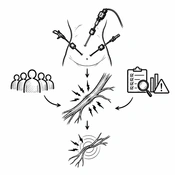
Nerve injury and neuropathic pain may also occur after insertion of abdominal laparoscopic ports and trocars. Complications at these entry sites depend on several clinical factors, including patient age, the number and diameter of trocars, surgical site, operative duration, tissue characteristics, and the techniques used for insertion and closure (26, 27).
2. Objectives
This study aimed to assess the incidence, risk factors, and clinical patterns of peripheral nerve injury and persistent neuropathic pain at laparoscopic port insertion sites.
3. Methods
3.1. Study Design
This prospective cohort study investigated risk factors for abdominal wall peripheral nerve injury and persistent neuropathic pain at port insertion sites after laparoscopic surgery.
3.2. Study Population and Period
The study population comprised all patients who underwent abdominal laparoscopic procedures and were admitted to Imam Hossein Educational, Research, and Treatment Center, Tehran, Iran, between 2021 and 2024.
3.3. Inclusion and Exclusion Criteria
3.3.1. Inclusion Criteria
The inclusion criteria were age 18 to 75 years, being fully conscious and able to communicate verbally, and candidacy for elective or urgent abdominal laparoscopic surgery.
3.3.2. Exclusion Criteria
The exclusion criteria were a history of open abdominal surgery (laparotomy), preexisting peripheral neuropathy, intraoperative conversion from laparoscopy to open surgery, use of medications that could interfere with study outcomes (including neuromodulators or centrally acting pain-modifying agents), and withdrawal at any point during follow-up.
3.4. Pain Scales and Neurological Outcome Assessment Protocol
The following validated tools and protocols were used to measure pain, distinguish pain phenotypes, and confirm the neurogenic origin of pain.
3.4.1. Numerical Rating Scale
3.4.2. Carnett's Test
Carnett's test was performed at all trocar insertion sites. First, the point of maximal localized tenderness was identified with the abdominal wall relaxed. Patients were then instructed to contract the anterior abdominal muscles by raising the head and shoulders or performing a bilateral straight-leg raise. The examiner palpated the same tender point again. Increased or persistent tenderness during muscle contraction, indicating a positive Carnett's test, confirmed an abdominal wall source, such as anterior cutaneous nerve entrapment syndrome. Decreased tenderness, indicating a negative test, indicated an intra-abdominal visceral source (30-32).
3.4.3. Douleur Neuropathique 4 Questionnaire
3.5. Data Collection and Follow-Up
Baseline demographic characteristics, comorbidities, surgical indications, and technical details were recorded using a structured data collection sheet. A trained physician conducted prospective follow-up at four predefined intervals. The Numerical Rating Scale, Carnett's test, and DN4 questionnaire were administered at all four visits, along with the following additional assessments and visit-specific objectives:
Before discharge: Baseline pain assessment and surgical wound evaluation were performed.
Postoperative week 1: The early recovery trajectory and sensory screening findings were documented.
Postoperative month 1: A comprehensive neurological examination was performed to screen for subacute neuropathic involvement.
Postoperative month 6: A final evaluation distinguished chronic postsurgical pain from transient surgical pain and confirmed definite, persistent iatrogenic nerve injury.
3.6. Statistical Analysis
Data were analyzed using SPSS software, version 19. Group comparisons were performed using t tests or Mann-Whitney tests and chi-square or Fisher's exact tests.
4. Results
Among 346 patients, the mean age was 44.3 ± 11.8 years, and the Body Mass Index (BMI) was 26.4 ± 3.6 kg/m2. Trocar-site peripheral neuropathy was diagnosed in 19 patients (5.5%), and baseline characteristics were comparable between groups (Table 1).
Table 1.
Baseline Demographic and Clinical Characteristics Stratified by Nerve Injury Status (N = 346) a
| Variables | Total Cohort (n = 346) | No Neuropathy (n = 327) | Neuropathy (n = 19) | P-Value |
|---|---|---|---|---|
| Age (y) | 44.3 ± 11.8 | 44.2 ± 11.7 | 44.8 ± 11.7 | 0.835 |
| Gender | 0.672 | |||
| Female | 198 (57.2) | 188 (57.5) | 10 (52.6) | |
| Male | 148 (42.8) | 139 (42.5) | 9 (47.4) | |
| BMI (kg/m2) | 26.4 ± 3.6 | 26.3 ± 3.6 | 27.9 ± 3.8 | 0.078 |
| Trocar count ≥ 4 | 214 (61.8) | 199 (60.9) | 15 (78.9) | 0.124 |
a Values are expressed as mean ± SD or No. (%).
Pain scores were significantly higher in the neuropathy group than in the group without neuropathy at every follow-up interval. At 6 months, patients in the neuropathy group had chronic postsurgical pain, whereas those without neuropathy remained clinically asymptomatic (Table 2).
Table 2.
Longitudinal Comparison of Pain Trajectory (NRS 0 - 10) Between Groups Across Follow-Up Stages (N = 346) a
| Follow-Up Interval | No Neuropathy (n = 327) | Neuropathy Group (n = 19) | t Statistic | P-Value |
|---|---|---|---|---|
| Pre-discharge | 3.1 ± 1.2 | 4.6 ± 1.3 | -4.91 | < 0.001 |
| Postoperative Week 1 | 2.1 ± 1.2 | 4.2 ± 1.1 | -8.05 | < 0.001 |
| Postoperative Month 1 | 1.4 ± 1.1 | 5.5 ± 1.3 | -13.47 | < 0.001 |
| Postoperative Month 6 | 0.3 ± 0.2 | 3.4 ± 0.9 | -14.99 | < 0.001 |
a Values are expressed as mean ± SD. NRS, Numerical Rating Scale.
The most frequent complaints were burning sensations (n = 12, 63.2%), followed by tingling/paresthesia (n = 11, 57.9%) and electric shock sensations (n = 7, 36.8%) (Table 3).
Table 3.
Sensory Neurological Profiles and DN4 Symptom Breakdown in Symptomatic Patients (N = 19)
| Rank | Clinical Symptom / Sign (DN4 criteria) | Frequency (n = 19) | Percentage (%) |
|---|---|---|---|
| 1 | Burning sensation | 12 | 63.2 |
| 2 | Tingling (Paresthesia) | 11 | 57.9 |
| 3 | Electric shocks | 7 | 36.8 |
| 4 | Hypoesthesia to touch (Numbness) | 6 | 31.6 |
| 5 | Dynamic mechanical allodynia | 3 | 15.8 |
The incidence of trocar-site neuropathy was 5.5%. Four or more trocars were used in 15 of 19 patients with neuropathy (78.9%) and 199 of 327 patients without neuropathy (60.9%); the between-group comparison yielded P = 0.124.
5. Discussion
This study found a 5.5% incidence of trocar-site neuropathy. Nerve injuries are a major concern for health care providers and patients because they may cause functional deficits, pain, and disability during therapeutic interventions (36). These concerns motivated the present study.
Shin et al. conducted a retrospective study over 3 years involving 317 women who underwent laparoscopic surgery. None of the 173 patients who did not undergo port-site fascial closure developed nerve injury. Among the 144 patients who underwent fascial closure, 7 developed nerve injury, corresponding to a reported 5% incidence of postoperative neuropathic pain (37).
Nguyen et al. reviewed 28 articles involving 555 men and 316 women with a mean age of 54.4 years. Their meta-analysis found a lower incidence of peripheral nerve injury after laparoscopic surgery than after open surgery (5.3% vs 47.5%). The injuries mainly involved neuromas and nerve compression, which generally required surgical intervention for symptom management (38).
Chen et al. prospectively assessed the ilioinguinal, genitofemoral, and iliohypogastric nerves at an academic medical center. The study included 20 patients who were followed for at least 90 to 180 days. No intraoperative complications were observed. Postoperative pain and opioid requirements decreased significantly by postoperative day 90, and physical activity levels improved. The retroperitoneal approach was considered effective and superior to open surgical methods for the definitive management of chronic, refractory groin pain (39).
5.1. Limitations
The single-center design and the lack of ultrasound and electrodiagnostic testing were limitations of this study; electrodiagnostic testing was not performed because of its invasiveness. Further studies involving larger samples across additional academic medical centers are recommended.
Operative duration, surgical complexity, and patient positioning were not evaluated and may be potential confounders. Future studies should adjust for these variables in their statistical analyses.
5.2. Conclusions
Patients undergoing laparoscopic surgery experience pain during the first postoperative month, which may persist as chronic postsurgical pain by the sixth month. Careful screening during the first postoperative month is recommended to enable early identification of this complication.