
1. Background
Posterior lumbar spine surgery frequently produces severe acute postoperative pain, often necessitating opioid administration during the first few days after the procedure (1). The consequences of inadequate pain control go beyond immediate patient discomfort: heightened pain diminishes patient satisfaction, delays postoperative ambulation and mobilisation, and prolongs hospital stay, all of which can impede early functional recovery (2). In addition, high-dose opioid use is associated with adverse events such as postoperative nausea and vomiting, respiratory depression, ileus, and sedation, which further slow recovery. Given the ongoing opioid epidemic, approaches that lower perioperative opioid consumption while preserving effective analgesia are increasingly important (3).
Enhanced Recovery After Surgery (ERAS) protocols for spinal surgery advocate multimodal analgesic strategies that include nonopioid medications and regional anaesthetic techniques (4). Regional anaesthesia for lumbar spine surgery helps maintain stable perioperative haemodynamics and reduce opioid requirements, consistent with ERAS principles (5).
Several regional analgesic techniques, including caudal block and quadratus lumborum plane block, have been described for lumbar surgery (6). The erector spinae plane block (ESPB) has attracted considerable interest since it was first reported in 2016 (7).
The erector spinae plane block is a relatively straightforward, ultrasound-guided technique in which local anaesthetic is injected between the erector spinae muscle and the transverse processes, with spread to the dorsal and ventral rami of the spinal nerves (8). It has been used successfully in thoracic and abdominal procedures, including video-assisted thoracoscopic surgery and upper abdominal laparoscopic surgery (9-11), and is increasingly studied in lumbar spine surgery because of its favourable safety profile and ease of performance (9).
A growing number of systematic reviews and meta-analyses have summarised the evidence on ESPB analgesia in patients undergoing lumbar spine surgery. A 2023 meta-analysis of 16 randomised controlled trials (RCTs) reported that ESPB significantly decreased 24-hour opioid consumption (mean difference of −12.68 mg morphine equivalents, 95% confidence interval [CI] −18.09 to −7.28) and reduced pain scores at rest at 4 - 6 h, 8 - 12 h, and 24 h, while extending the time to first analgesic request by a mean of 5.26 h (12). Another 2023 meta-analysis of 11 RCTs (775 patients) reached a similar conclusion, finding that ESPB reduced 24-hour opioid consumption by a weighted mean difference of −8.70 mg (95% CI −10.48 to −6.93) and lowered postoperative pain scores and the incidence of postoperative nausea and vomiting (1). A comprehensive 2024 meta-analysis of 22 RCTs (1,327 patients) confirmed that ESPB reduced cumulative pain scores during the first 48 h, decreased opioid consumption, prolonged the time to first analgesic rescue, and improved patient satisfaction scores (13). More recently, a 2026 meta-analysis of 15 RCTs (1,035 patients) focusing specifically on lumbar fusion surgery reported that ESPB reduced intraoperative opioid use (mean difference −31.70 mg morphine equivalents, 95% CI −41.69 to −21.71) and 24-hour postoperative opioid consumption (mean difference −11.02 mg, 95% CI −14.42 to −7.63), and lowered the risk of postoperative nausea and vomiting (14). Taken together, these findings support ESPB as an effective component of multimodal analgesia pathways for lumbar spine surgery.
However, the available evidence is not entirely consistent. Some RCTs have found no clinically meaningful benefit of ESPB when added to a contemporary ERAS protocol. For instance, a 2026 blinded placebo-controlled trial of bilateral ESPB with ropivacaine in lumbar spinal fusion detected no significant difference in early postoperative pain or opioid consumption compared with placebo, prompting the authors to question the routine use of ESPB in all patients (15). This variability in results highlights the need for further refinement of the technique, including optimisation of local anaesthetic concentration and volume, as well as the possible addition of adjuvants that could enhance block characteristics and extend analgesic duration.
Adding adjuvants to local anaesthetics is a well-established approach to prolonging peripheral nerve blocks. A wide range of adjuvant substances has been investigated, including α2-adrenergic agonists (clonidine, dexmedetomidine), corticosteroids (dexamethasone), opioids (fentanyl, buprenorphine), and vasoconstrictors (epinephrine) (16). Sub-antagonist doses of naloxone have also been tested as adjuvants to ropivacaine in axillary brachial plexus block (17).
Epinephrine acts chiefly through local vasoconstriction, which decreases systemic absorption of the local anaesthetic and thereby extends its presence at the target nerve site (18). A systematic qualitative review (16) identified three clinical trials examining epinephrine as an adjuvant to prolong analgesic duration in peripheral nerve blocks.
Nevertheless, evidence on the efficacy of epinephrine added to ropivacaine specifically for interfascial plane blocks such as ESPB remains scarce, and most available data are derived from other surgical settings. For example, in major gynaecological surgery, bilateral ESPB with 20 mL of 0.5% ropivacaine and 100 μg of epinephrine did not reduce 24-hour opioid consumption but attenuated early pain intensity (19). In paediatric cardiac surgery via midline sternotomy, bilateral ESPB with ropivacaine and adrenaline delayed the need for postoperative analgesia and reduced 24-hour fentanyl consumption. In laparoscopic major upper abdominal surgery, a mixture containing ropivacaine, epinephrine, and dexamethasone significantly prolonged analgesia compared with plain ropivacaine (20). Despite these encouraging findings in other surgical fields, no published randomised controlled trial has specifically compared ropivacaine with and without epinephrine for erector spinae plane block in patients undergoing lumbar spine surgery.
2. Objectives
Given the lack of evidence in this population, we designed this randomized controlled trial to compare the analgesic efficacy of ropivacaine with epinephrine versus ropivacaine alone when administered for bilateral ultrasound-guided erector spinae plane block in patients undergoing 1- to 3-level lumbar spine surgery. We hypothesized that the addition of epinephrine would improve early postoperative pain control, reduce perioperative opioid and volatile anesthetic consumption, and prolong the time to first opioid request without increasing bleeding or other adverse events.
3. Methods
3.1. Study Design
The Institutional Ethics Committee of Shahid Beheshti University of Medical Sciences approved the study protocol (IR.SBMU.MSP.REC.1404.038), and the trial was prospectively registered with the Iranian Registry of Clinical Trials (IRCT20210415050983N12). The investigation adhered to the Declaration of Helsinki and the Consolidated Standards of Reporting Trials (CONSORT) guidelines. All participants provided written informed consent before enrolment. Figure 1 presents the CONSORT participant flow diagram.
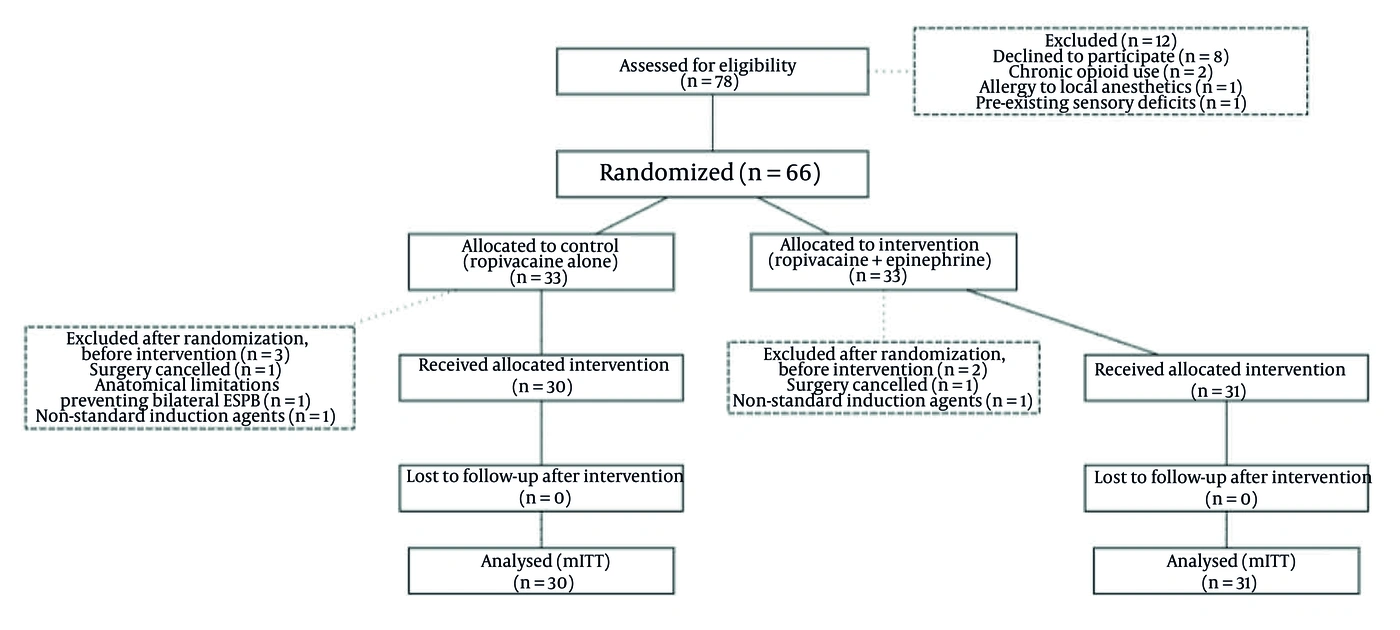
Figure 1.
Consolidated Standards of Reporting Trials (CONSORT) 2010 participant flow diagram. Sixty-six patients were randomised (33 Control, 33 Intervention). After randomisation but before administration of the allocated intervention, 5 patients were excluded: Control (n = 3)—surgery cancelled (n = 1), anatomical limitations preventing bilateral ESPB (n = 1), non-standard induction agents (n = 1); Intervention (n = 2)—surgery cancelled (n = 1), non-standard induction agents (n = 1). Received allocated intervention: Control n = 30; Intervention n = 31. Lost to follow-up after intervention: n = 0 in each group. Analysed (mITT): Control n = 30; Intervention n = 31. Footnote: Exclusions occurred after randomisation but before administration of the allocated intervention. All exclusions were determined before outcome data were collected. A sensitivity analysis including all randomised patients was not feasible because excluded patients had no outcome measurements. mITT = modified intention-to-treat; ESPB (erector spinae plane block).
3.2. Participants
Eligible patients were 18 - 70 years old, had an American Society of Anesthesiologists (ASA) physical status of 1 or 2, were scheduled for elective 1- to 3-level lumbar spine surgery, had a body mass index of 16 - 35 kg·m-2, had normal renal and hepatic function, had no significant cardiac disease, and had no preexisting sensory deficits. Exclusion criteria included allergy to local anaesthetics or epinephrine, substance abuse, chronic opioid use (> 3 months), or patient refusal.
Detailed classification of the specific surgical procedure (for example, decompression alone versus decompression with instrumented or interbody fusion) and the extent of tissue dissection were not prospectively recorded. The number of surgical levels and total surgery duration were used as available proxies for surgical complexity.
3.3. Randomisation and Blinding
Participants were allocated in a 1:1 ratio to either the control group (ropivacaine alone) or the intervention group (ropivacaine plus epinephrine). A computer-generated sequence with variable block sizes (4 and 6) was used to ensure allocation concealment. Randomisation was not stratified by surgical procedure type, number of surgical levels, anticipated surgical duration, surgeon, or centre. A statistician not otherwise involved in the trial generated the allocation sequence, which was stored in sequentially numbered, opaque, sealed envelopes. These envelopes were opened just before block performance by the anaesthesiologist performing the ESPB. This individual was responsible solely for block performance and had no involvement in any other aspect of patient management or outcome assessment.
The substantial baseline imbalances observed despite randomisation likely reflect several factors: the modest sample size (n = 61) limited the ability of randomisation to balance all clinically important characteristics; randomisation was not stratified by surgical procedure type, number of levels, or anticipated surgical duration; the block sizes used (4 and 6) may have been insufficient to ensure balance across numerous baseline variables; and chance imbalance may have occurred.
3.3.1. Blinding and Role Separation
To minimise performance bias, we enforced a strict separation of clinical roles, with clearly defined responsibilities:
Unblinded block-performing anaesthesiologist: This person knew the group assignment but did not participate in intraoperative anaesthetic management, postoperative care, or outcome assessment. After completing the ESPB and the 30-minute observation period, this anaesthesiologist left the operating theatre and had no further contact with the patient or clinical team during the perioperative period.
Blinded attending anaesthesiologist: A separate attending anaesthesiologist, unaware of group allocation, was responsible for all intraoperative anaesthetic management. This individual made all decisions concerning fentanyl and isoflurane administration according to the standardised protocol described below (Section 3.4.1). This blinding ensured that intraoperative analgesic and anaesthetic requirements were not influenced by knowledge of group assignment.
Blinded postoperative outcome assessors: Trained investigators who were unaware of group allocation performed all postoperative outcome assessments, including pain scores at post-anaesthesia care unit (PACU) admission and at 12 hours, time to first opioid request, and adverse-event recording.
Blinded patients and surgeons: Patients were blinded to their group assignment. The surgical team (surgeons and operating room nurses) was also blinded to the allocation because its members were not present during block performance and had no access to information about the study solution.
Blinded statistician: The statistician who performed the final analysis received a de-identified dataset with group codes that remained unbroken until the analysis was complete.
3.3.2. Study Solution Preparation and Blinding
To preserve blinding integrity, study solutions were prepared by an independent research nurse who was not otherwise involved in patient care or outcome assessment. This nurse drew the assigned local anaesthetic into identical 20-mL syringes labelled only with the patient's study number. Epinephrine was added to the intervention syringes by the same nurse, ensuring that the final solutions were visually indistinguishable (both were clear, colourless solutions). The identity of the study solution was recorded in a sealed log that was inaccessible to any blinded personnel until the final analysis was complete.
3.3.3. Safeguards Against Allocation Knowledge Influencing Intraoperative Management
The following safeguards were implemented to prevent allocation knowledge from affecting intraoperative anaesthetic administration:
Physical separation: The unblinded block-performing anaesthesiologist left the operating theatre immediately after completing the ESPB and the 30-minute observation period and did not return until the patient was transferred to the PACU.
Standardised intraoperative protocol: Fentanyl and isoflurane administration followed a prespecified, standardised protocol (detailed in Section 3.4.1), with decisions made solely by the blinded attending anaesthesiologist based on haemodynamic parameters and bispectral index monitoring.
Blinded anaesthesia team: All other members of the anaesthesia team (residents and nurse anaesthetists) involved in intraoperative care were blinded to group allocation.
Documentation of compliance: The research coordinator monitored compliance with the role separation protocol and documented that the unblinded anaesthesiologist had no intraoperative contact with any patient.
3.3.4. Assessment of Blinding Success
At the end of the study, we evaluated blinding success by asking patients and outcome assessors to guess their group assignment (or, for assessors, the patient's group assignment). Guesses were recorded on a standardised data-collection form. The accuracy of the guesses was calculated and compared with chance expectation (50%). The proportion of correct guesses was 52% (95% CI 42 - 62%) for patients and 53% (95% CI 43 - 63%) for outcome assessors, consistent with successful blinding (no better than chance). The exact timing of guess recording relative to database lock was not prospectively documented.
3.4. Interventions
After written informed consent was obtained and baseline assessments were completed in the preoperative holding area, the patient was transferred to the operating theatre. General anaesthesia was induced with the patient in the supine position. After tracheal intubation, the patient was turned prone, and bilateral ultrasound-guided ESPB was performed before surgical incision. Because the block was performed under general anaesthesia, formal sensory assessment of block success was not feasible.
The patient was positioned prone on the operating table. A high-frequency linear probe (6 - 13 MHz, SonoSite X-Porte, Fujifilm, Bothell, WA, USA) was placed longitudinally 3 cm lateral to the spinous process at the target vertebral level. After the transverse process was identified, the skin was infiltrated with 2 mL of 1% lidocaine. A 22-gauge, 80-mm block needle (Pajunk, Geisingen, Germany) was then inserted in-plane until it contacted the transverse process. After negative aspiration for blood, the study solution was injected in 5-mL aliquots, with visual confirmation of hydrodissection of the erector spinae muscle plane. The identical procedure was performed on the contralateral side.
Control group: 20 mL of 0.25% ropivacaine (50 mg) per side.
Intervention group: 20 mL of 0.25% ropivacaine with epinephrine 5 μg·mL-1 (total 100 μg epinephrine per side).
The volume (20 mL per side) was selected based on previous ESPB studies in lumbar spine surgery that demonstrated adequate spread with this volume. The concentration of epinephrine (5 μg·mL-1, equivalent to 1:200,000) was selected because it is among the most extensively studied concentrations for prolonging peripheral nerve blocks and provides a reproducible vasoconstrictive effect at a fixed injectate volume without requiring a larger injection volume (16, 17). At the protocol volume of 20 mL per side, this concentration yielded 100 μg of epinephrine per side and 200 μg for bilateral blocks. This total dose is consistent with doses used in previous ESPB and peripheral nerve block studies (16-18, 21). A dose of 100 μg per side has been used in a previous ESPB trial in major gynaecologic surgery (19), and a lower concentration (2 μg·mL-1) has been used for ESPB in lumbar spine surgery (21). The optimal concentration and total dose of epinephrine for ESPB remain uncertain, and this is acknowledged as a limitation.
Surgical incision commenced approximately 30 minutes after block completion.
The block was performed after induction of general anaesthesia and tracheal intubation, with the patient in the prone position. The unblinded block-performing anaesthesiologist remained in the operating theatre only for the block procedure and the subsequent 30-minute observation period, after which they departed and had no further role in patient management.
All subsequent intraoperative decisions regarding fentanyl and isoflurane administration were made by a separate, blinded attending anaesthesiologist.
3.4.1. Anaesthesia and Perioperative Management
General anaesthesia was standardised in both groups. Induction consisted of fentanyl 2 μg·kg-1, midazolam 0.02 mg·kg-1, lidocaine 1 mg·kg-1, propofol 2 mg·kg-1, and atracurium 0.5 mg·kg-1. After tracheal intubation, anaesthesia was maintained with isoflurane in a 50% air–50% oxygen mixture (total fresh gas flow, 3 L·min-1) under volume-controlled ventilation. Tidal volume was set at 6 - 8 mL·kg-1 ideal body weight, with the respiratory rate adjusted to maintain end-tidal carbon dioxide (EtCO2) between 35 - 45 mm Hg.
Depth of anaesthesia was monitored using the bispectral index (Covidien, Boulder, CO, USA) and maintained between 45 and 55. Intraoperative fentanyl consumption was recorded as the total dose administered (μg) during surgery. Fentanyl dose per kilogram of body weight and dose per hour of surgery were not calculated. Fentanyl boluses (25 μg) were administered by the blinded attending anaesthesiologist when heart rate or mean arterial pressure exceeded 20% of baseline values, after other potential causes, such as hypovolaemia, bleeding, or hyperthermia, had been excluded. No predefined maximum dose was set; however, the protocol specified that persistent haemodynamic instability despite repeated fentanyl boluses should prompt consideration of alternative causes (e.g., hypovolaemia, inadequate anaesthetic depth) before further opioid administration. The decision to administer fentanyl was based on predefined haemodynamic criteria, and all administrations were recorded by the blinded anaesthesiologist. If hypertension or tachycardia persisted after three consecutive fentanyl boluses (total 75 μg), the protocol required reassessment of volume status, surgical bleeding, and anaesthetic depth before additional fentanyl was administered.
Isoflurane consumption was estimated from the vaporizer dial setting and duration of administration because no direct gas analyzer was available. The vaporizer dial setting (%) was recorded at 15-minute intervals throughout surgery, and the average dial setting was calculated for each patient. Fresh gas flow was maintained at 3 L/min (50% air / 50% oxygen) during volume-controlled ventilation. Total isoflurane consumption (mL of liquid isoflurane) was estimated from the average dial setting, fresh gas flow, and duration of administration using the institutional conversion method for the vaporizer used in our operating rooms. This method assumes a constant fresh gas flow, constant vaporizer output determined by the dial setting, and no leakage or circuit losses. It does not account for changes in vaporizer output over time, variations in ambient temperature and pressure, or residual isoflurane in the breathing circuit at the end of surgery. The exact conversion factor used to translate the dial setting, fresh gas flow, and duration into milliliters of liquid isoflurane was not documented in sufficient detail to permit independent replication; this is acknowledged as a limitation.
All patients underwent electrocardiography, noninvasive and invasive arterial blood pressure monitoring, pulse oximetry, and capnography.
At the end of surgery, neuromuscular blockade was reversed with neostigmine 50 μg·kg-1 and atropine 20 μg·kg-1. Patients were extubated in the operating room and transferred to the PACU.
3.4.1.1. Postoperative Analgesia Protocol
Scheduled intravenous paracetamol 1 g every 6 h was initiated in the PACU and continued on the ward. In the PACU, rescue analgesia consisted of intravenous fentanyl 25 μg administered by the blinded PACU nurse when the Numeric Rating Scale (NRS) pain score was ≥ 4. The dose was repeated after clinical reassessment as required, with no protocol-specified maximum. Rescue analgesia was nurse-administered rather than patient-controlled. NSAIDs, COX-2 inhibitors, gabapentinoids, and patient-controlled analgesia were not part of the standard postoperative protocol at our institution during the study period and were therefore not administered. A standardised ward-level rescue protocol after PACU discharge was not specified for this trial, and the exact agents, doses, and triggers used on the ward were not systematically recorded. This limited analgesic regimen was selected to standardise postoperative pain management across both groups and isolate the analgesic effect of the ESPB intervention. The limited multimodal regimen also allowed clearer interpretation of the block-specific effects. Although we acknowledge that a more comprehensive multimodal approach would better reflect contemporary ERAS practice, it would have introduced additional confounding variables, potentially diluting the observed differences between groups.
3.4.2. Safety Monitoring
Safety monitoring consisted of continuous electrocardiography, noninvasive and invasive arterial blood pressure monitoring, pulse oximetry, and capnography throughout surgery and in the PACU. After block performance, patients were observed for 30 minutes before surgical incision. During this period and throughout the perioperative course, the clinical team monitored for signs of local anaesthetic systemic toxicity, vascular puncture, pneumothorax, and other block-related complications. However, heart rate and blood pressure were not recorded at standardised, protocol-specified intervals specifically before and after block performance to attribute haemodynamic changes to epinephrine. Episodes of hypertension, tachycardia, arrhythmia, or other potentially epinephrine-related adverse events were not prospectively defined, systematically recorded, or adjudicated. Therefore, the safety data are limited to clinically apparent complications noted during routine monitoring and are insufficient to establish the cardiovascular safety profile of epinephrine in this context.
3.5. Outcomes
3.5.1. Primary Outcome
The primary outcome was pain intensity, measured using the NRS (0 = no pain, 10 = worst imaginable pain), immediately after arrival in the PACU. PACU pain was assessed within 15 minutes of arrival and before administration of any rescue analgesia. PACU pain was selected as the primary outcome for the following reasons: 1) it captures the period of maximum block effect, as ropivacaine with epinephrine peaks within 30 - 60 minutes and begins to wane after 6 - 8 hours; 2) it is assessed before administration of any rescue analgesia, minimising confounding; 3) it occurs at a standardised, predictable time point; and 4) it reflects the period when patients are most vulnerable to severe pain and when opioid requirements are highest (22, 23).
The primary outcome was interpreted against a prespecified minimal clinically important difference (MCID) of 1.5 - 2 NRS points for acute pain (24).
3.5.2. Secondary Outcomes
Pain at 12 h after surgery (assessed at 12 hours ± 30 minutes post-surgery)
Intraoperative fentanyl consumption (μg)
Isoflurane consumption (mL)
Time to the first postoperative opioid request (hours)
Intraoperative blood loss (mL)
All outcome assessments were performed by a trained investigator blinded to group allocation.
Cumulative postoperative opioid consumption at 12 or 24 hours was not measured in this study. The only postoperative opioid-related outcome was the time to the first opioid request. Intraoperative fentanyl consumption was recorded separately and is reported as a distinct outcome. These outcomes should not be conflated: a longer time to the first opioid request does not necessarily indicate a reduction in total postoperative opioid exposure.
3.6. Sample Size Calculation
Based on a pilot study conducted at our institution (n = 10 per group; data not published), we observed mean PACU NRS scores of 5.2 (standard deviation [SD], 1.6) in the ropivacaine group and 3.7 (SD, 1.9) in the ropivacaine + epinephrine group, corresponding to a difference of 1.5 points and a pooled standard deviation of 1.8. These pilot estimates were consistent with previously published data on ESPB in lumbar surgery (1, 9). Using a two-sided α of 0.05 and power of 80%, the required sample size was 30 patients per group. After accounting for a 10% dropout rate, we aimed to enroll 33 patients per group (total 66). The sample size calculation was performed using G*Power (version 3.1).
3.7. Statistical Analysis
All analyses followed a modified intention-to-treat principle and included all randomized patients who received the allocated intervention and had at least one outcome measurement. This was not a full intention-to-treat analysis. Of the 66 patients initially randomized, 5 were excluded after randomization but before administration of the allocated intervention: 2 had surgery canceled (1 Control, 1 Intervention), 1 had anatomical limitations that prevented bilateral ESPB (Control), and 2 received nonstandard induction agents, constituting a protocol deviation in anesthetic management (1 Control, 1 Intervention). The final analysis therefore included 61 patients (30 Control, 31 Intervention). All exclusions were determined before the allocated intervention was administered and before any outcome data were collected. The clinical team made these decisions on clinical and logistical grounds, without knowledge of outcome data or treatment effects. The two patients who received nonstandard induction agents were excluded because the standardized anesthetic regimen was a prerequisite for valid comparisons of the primary and secondary outcomes, particularly intraoperative fentanyl consumption and PACU pain. A sensitivity analysis including all 66 randomized patients was not feasible because the excluded patients did not receive the allocated intervention and had no outcome measurements. The potential for bias arising from these postrandomization exclusions is acknowledged and discussed in the Limitations.
The primary outcome (PACU pain) was the sole confirmatory endpoint. All other outcomes—pain at 12 hours, intraoperative fentanyl consumption, isoflurane consumption, time to first opioid request, and intraoperative blood loss—were secondary and exploratory. The secondary outcomes were prespecified in the protocol and statistical analysis plan before data examination, as were the multivariable regression models for the major secondary outcomes (fentanyl consumption, time to first opioid request, and 12-hour pain). However, no adjustment for multiplicity was prespecified or applied. Because several secondary outcomes were tested and multiple regression models were fitted, the risk of false-positive findings is increased. Therefore, all secondary findings should be interpreted as supportive or hypothesis-generating, not as independent confirmation of efficacy. Effect estimates and 95% confidence intervals are reported for all principal outcomes (Table 1, 2, and 3), and the interpretation emphasizes effect sizes and confidence intervals rather than P values alone.
Table 1.
Unadjusted Comparisons for Primary and Secondary Outcomes a
| Outcome | Control (n = 30) | Intervention (n = 31) | Hodges–Lehmann Median Difference, Control – Intervention (95% CI) | P value | Effect Size (95% CI) |
|---|---|---|---|---|---|
| Pain (NRS) in PACU | 4.5 (1.5); 5.0 [4.0 - 6.0] | 3.4 (1.2); 4.0 [3.5 - 4.5] | 1.00 (0.00 to 2.00) | 0.0038 | r = 0.42 (0.16 - 0.63) |
| Pain (NRS) at 12 h | 3.4 (1.7); 3.0 [1.6 - 4.4] | 5.3 (1.2); 5.0 [4.5 - 5.5] | −2.00 (−3.00 to −1.00) | < 0.0001 | r = −0.64 (−0.78 to −0.44) |
| Intraoperative fentanyl (μg) | 74.2 (66.8); 50.0 [12.5 - 87.5] | 30.6 (30.8); 50.0 [25.0 - 75.0] | 50.00 (0.00 to 50.00) | 0.0052 | r = 0.40 (0.13 - 0.61) |
| Isoflurane consumption (mL) | 29.0 (7.9); 27.5 [22.5 - 32.5] | 18.0 (2.7); 18.0 [15.5 - 20.5] | 10.00 (7.00 to 15.00) | < 0.0001 | r = 0.85 (0.75 - 0.91) |
| Time to first opioid (hours) | 2.7 (4.8); 0.0 [0 - 1.5] | 17.6 (6.7); 18.0 [12.0 - 24.0] | −12.00 (−24.00 to −12.00) | < 0.0001 | r = −0.89 (−0.95 to −0.79) |
| Intraoperative blood loss (mL) | 511.0 (407.9); 400.0 [162.5 - 637.5] | 471.0 (177.8); 500.0 [400.0 - 600.0] | −0.00 (−200.00 to 100.00) | 0.5610 | r = −0.09 (−0.36 to 0.20) |
a Values are expressed as mean (SD); median [IQR]. Between-group contrasts are Hodges–Lehmann median differences (Control − Intervention) with 95% CIs. All comparisons used the Mann–Whitney U test. The Hodges–Lehmann estimate is the median of all pairwise differences between groups and is not simply the difference in medians; it may be non-zero when medians are identical if the rank distributions differ. The Mann–Whitney U test compares rank distributions, not medians alone. The 95% CI lower bound for intraoperative fentanyl is reported as 0.00 after rounding; the unrounded value was a small positive number. Effect size = rank-biserial correlation (r) with 95% CI. Abbreviations: NRS, Numeric Rating Scale; PACU, post-anaesthesia care unit; SD, standard deviation; IQR, interquartile range; CI, confidence interval.
Table 2.
Adjusted Linear Regression for Pain in the Post-Anaesthesia Care Unit (Numeric Rating Scale) a
| Predictor | Model 1 β (95% CI) | Model 1 P | Model 2 β (95% CI) | Model 2 P |
|---|---|---|---|---|
| Group (Intervention vs Control) | −1.35 (−2.30 to −0.39) | 0.007 | −1.25 (−2.47 to −0.03) | 0.045 |
| Age (per year) | −0.01 (−0.04 to 0.02) | 0.584 | −0.02 (−0.05 to 0.02) | 0.311 |
| Sex (female vs male) | −0.15 (−0.84 to 0.54) | 0.667 | −0.13 (−0.82 to 0.57) | 0.711 |
| Surgery duration (per minute) | 0.003 (−0.006 to 0.012) | 0.474 | 0.002 (−0.008 to 0.011) | 0.733 |
| ASA class | — | — | 0.43 (−0.22 to 1.07) | 0.189 |
| Number of levels | — | — | 0.22 (−0.54 to 0.98) | 0.560 |
a Model 1: group, age, sex, surgery duration (R2 = 0.161; F(4, 56) = 2.68; P = 0.041). Model 2: Model 1 + ASA class + number of levels (R2 = 0.193; F(6, 54) = 2.16; P = 0.061). Model assumptions assessed as described in Methods. Abbreviations: ASA, American Society of Anesthesiologists; CI, confidence interval; β, coefficient; CI, confidence interval.
Table 3.
Adjusted Linear Regression for Secondary Outcomes a
| Outcome | Adjusted β (95% CI) | P | R2 | Model P |
|---|---|---|---|---|
| Pain (NRS) at 12 h | 1.48 (0.14 to 2.82) | 0.031 | 0.375 | < 0.001 |
| Intraoperative fentanyl (μg) | −68.94 (−114.5 to −23.4) | 0.004 | 0.275 | 0.006 |
| Time to first opioid (h) | 17.60 (11.70 to 23.49) | < 0.001 | 0.662 | < 0.001 |
| Intraoperative blood loss (mL) | −219.93 (−503.4 to 63.5) | 0.126 | 0.098 | 0.451 |
a All models adjusted for group, age, sex, ASA class, number of levels, and surgery duration. β = Intervention − Control. Secondary, exploratory outcomes; no multiplicity adjustment. For time to first opioid, censoring was not modelled (see Limitations). Abbreviations: ASA, American Society of Anesthesiologists; NRS, numeric rating scale; CI, confidence interval.
Continuous variables were summarised as mean (standard deviation [SD]) and median (interquartile range [IQR]); categorical variables were summarised as frequency (percentage). Normality was assessed using the Shapiro–Wilk test and visual inspection of Q–Q plots. Homogeneity of variances was tested using Levene's test. For normally distributed continuous variables with equal variances, the independent t-test was used. For non-normally distributed or heteroscedastic continuous variables, the Mann–Whitney U test was applied. Categorical variables were compared using Pearson's chi-square test or Fisher's exact test when expected cell counts were < 5. For t-tests, Cohen's d with 95% CIs was calculated. For Mann–Whitney U tests, the rank-biserial correlation coefficient (r) with 95% CI was reported.
For Mann–Whitney U tests, the Hodges–Lehmann estimate is reported as the median of all pairwise differences between groups (Control minus Intervention). The Hodges–Lehmann estimate measures the shift in the distribution between groups and is not simply the difference in medians. When group medians are identical, the Hodges–Lehmann estimate may still be nonzero if the rank distributions differ. Similarly, the Mann–Whitney U test compares rank distributions rather than medians alone; therefore, a statistically significant result can occur even when the medians are identical. The rank-biserial correlation coefficient (r) is reported as an effect size.
Model assumptions were assessed for all linear regression models. Linearity was assessed by plotting residuals against fitted values and against each continuous covariate. Normality of residuals was assessed using Q–Q plots and the Shapiro–Wilk test. Homoscedasticity was assessed by plotting residuals against fitted values and using Levene's test. For the primary outcome (PACU pain), residuals were approximately normally distributed and homoscedastic. For intraoperative fentanyl consumption and time to first opioid request, the distributions were right-skewed; therefore, we also report the unadjusted Mann–Whitney comparisons alongside the adjusted linear regression estimates. For 12-hour pain, residuals were approximately normally distributed. For intraoperative blood loss, residuals were approximately normally distributed, but the model fit was poor (R2 = 0.098, adjusted R2 = −0.003), indicating that the included covariates did not explain blood loss.
To account for potential baseline imbalances and evaluate the robustness of the treatment effect, we fitted two nested linear regression models (analysis of covariance [ANCOVA]) for the primary outcome (PACU pain). Model 1 adjusted for group assignment, age, sex, and surgery duration. Model 2 (the fully adjusted model) additionally included ASA class and number of surgical levels as covariates to address baseline imbalances observed in these variables. Adjustment for baseline imbalances using ANCOVA was prespecified in the statistical analysis plan because imbalances were anticipated due to potential variation in surgical complexity despite randomisation. For the major secondary outcomes (fentanyl consumption and time to first opioid request), we performed multivariable regression using the same covariates as in Model 2 to adjust for potential confounding.
Surgical duration was included as a covariate in all multivariable regression models for intraoperative fentanyl consumption. Because total fentanyl dose is a cumulative measure that increases with surgical duration, adjustment for duration in a regression model does not fully account for the fact that longer procedures provide more opportunities for fentanyl administration. Total isoflurane consumption is likewise cumulative, with longer procedures resulting in greater total anaesthetic exposure. Normalised outcomes (e.g., fentanyl μg/kg/h or isoflurane mL/h) were not analysed; this is acknowledged as a limitation.
Time to first postoperative opioid request was defined as the interval from PACU arrival to the first administration of rescue opioid. The observation period was 24 hours after surgery. Time to first opioid request was analysed as a continuous outcome using linear regression. A formal time-to-event analysis (e.g., Cox proportional hazards regression or Kaplan–Meier estimation) was not performed. Consequently, if any patients did not request opioids within the 24-hour observation period, the linear model would not distinguish them from patients who first requested opioids at 24 hours. Whether any patients were censored at 24 hours was not recorded as a distinct variable.
Post hoc power was not calculated. Observed (post hoc) power is a deterministic function of the observed P value and provides no information beyond the effect estimate and its confidence interval. The a priori power calculation is reported in Section 3.6, and 95% confidence intervals are reported for all principal outcomes.
All tests were two-sided, and a P < 0.05 was considered statistically significant. No adjustment for multiple comparisons was made because the secondary outcomes were predefined and hypothesis-driven; results were interpreted cautiously, with emphasis on effect sizes and CIs. Statistical analyses were performed using R version 4.3.1 with the packages tidyverse, rstatix, effectsize, gtsummary, and ggplot2.
4. Results
4.1. Baseline Characteristics
The CONSORT participant flow diagram is presented in Figure 1. Between 25 June 2025 and 30 December 2025, 78 patients were assessed for eligibility; 12 were excluded (8 declined participation, 2 had chronic opioid use, 1 had an allergy to local anaesthetics, and 1 had pre-existing sensory deficits). Sixty-six patients were randomised (33 Control, 33 Intervention). After randomisation but before administration of the allocated intervention, 5 patients were excluded: in the control group, 1 surgery was cancelled, 1 patient had anatomical limitations that prevented bilateral ESPB, and 1 received a non-standard induction agent; in the intervention group, 1 surgery was cancelled and 1 received a non-standard induction agent. The final mITT analysis therefore included 61 patients (30 Control, 31 Intervention). No patient was lost to follow-up after receiving the allocated intervention.
Baseline demographic and clinical characteristics are summarised in Table 4. The two groups were comparable with respect to age (P = 0.220) and sex distribution (P = 0.896). However, significant differences were observed in ASA class (P = 0.026), the number of surgical levels (P < 0.001), and surgery duration (P < 0.001). The intervention group had a higher proportion of ASA 2 patients (67.7% vs 40%), more single-level surgeries (32% vs 0%), and longer operative times (mean 232.3 min vs 161.3 min). These imbalances were accounted for in the multivariable analysis of the primary outcome.
Table 4.
Clinical and Demographic Characteristics of Participants a
| Variables | Overall (n = 61) | Control (n = 30) | Intervention (n = 31) | P value |
|---|---|---|---|---|
| Age (y) | 50.1 (12.2); 51.0 [46.0 - 57.0] | 52.1 (12.2); 52.5 [45.0 - 58.8] | 48.2 (12.0); 49.0 [43.0 - 53.0] | 0.220 |
| Gender | 0.896 | |||
| Male | 30 (49) | 14 (47) | 16 (52) | |
| Female | 31 (51) | 16 (53) | 15 (48) | |
| ASA class | 0.026 | |||
| 1 | 28 (46) | 18 (60) | 10 (32.26) | |
| 2 | 33 (54) | 12 (40) | 21 (67.74) | |
| Number of levels | < 0.001 | |||
| 1 | 10 (16) | 0 (0) | 10 (32) | |
| 2 | 35 (57) | 16 (53) | 19 (61) | |
| 3 | 16 (26) | 14 (47) | 2 (6.5) | |
| Surgery duration (min) | 197.4 (53.6); 190.0 [160.0 - 220.0] | 161.3 (37.0); 180.0 [135.0 - 187.5] | 232.3 (43.1); 240.0 [200.0 - 240.0] | < 0.001 |
a Values are expressed as mean (SD); median [IQR] or No. (%). Abbreviations: SD, standard deviation; IQR, interquartile range; ASA, American Society of Anesthesiologists.
4.2. Primary Outcome: Pain in the Post-Anaesthesia Care Unit
Pain scores on the 0 - 10 NRS at PACU admission were significantly lower in the intervention group (median 4.0 [IQR 3.5 - 4.5]) than those in the control group (median 5.0 [IQR 4.0 - 6.0]; Hodges–Lehmann median difference, Control − Intervention, 1.00, 95% CI 0.00 to 2.00, P = 0.0038; Figure 2A). The effect size was moderate (rank-biserial correlation r = 0.42, 95% CI 0.16 - 0.63; Table 1). The observed 1-point difference is below the prespecified MCID of 1.5 - 2 points; accordingly, the trial did not meet its primary clinically anchored endpoint.
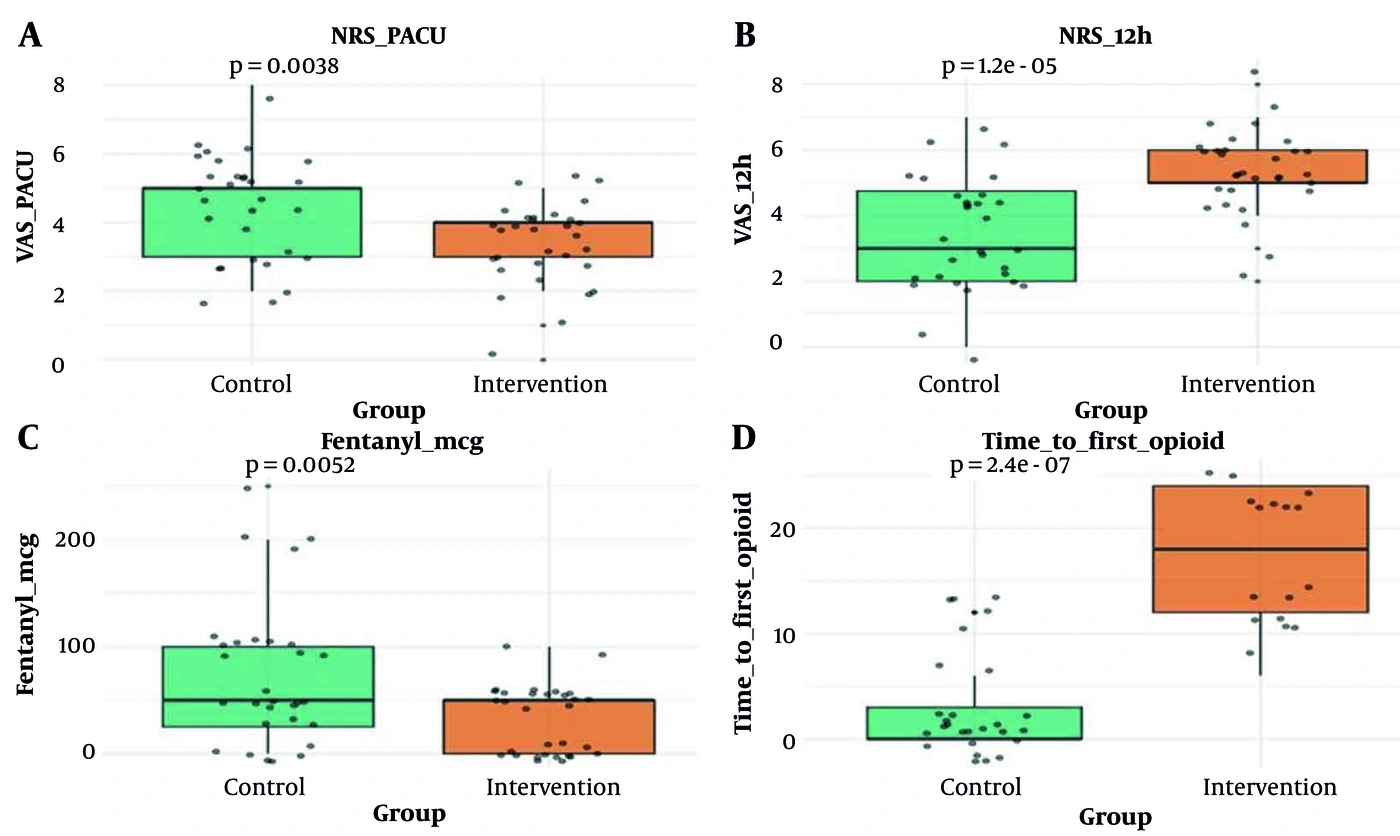
Figure 2.
Box plots comparing (A) pain scores in the post-anaesthesia care unit, measured using the Numeric Rating Scale, (B) pain scores at 12 h after surgery (Numeric Rating Scale), (C) intraoperative fentanyl consumption (μg), and (D) time to first postoperative opioid request (hours) between the Control (ropivacaine alone) and Intervention (ropivacaine + epinephrine) groups.
4.3. Secondary Outcomes
The following secondary outcomes are exploratory and were not adjusted for multiplicity. They should be interpreted as supportive or hypothesis-generating findings, not as independent confirmation of efficacy.
4.3.1. Pain at 12 Hours
In contrast, pain scores at 12 h after surgery were higher in the intervention group (median 5.0 [IQR 4.5 - 5.5] vs 3.0 [IQR 1.6 - 4.4]; Hodges–Lehmann median difference, Control − Intervention, −2.00, 95% CI −3.00 to −1.00, P < 0.0001; Figure 2B), with a large effect size (r = −0.64, 95% CI −0.78 to −0.44).
The 12-hour pain assessment was performed 12 hours (± 30 minutes) after surgery. In the control group, the median time to the first postoperative opioid request was 0 h (IQR 0 - 1.5), indicating that most control patients had received rescue opioids well before the 12-hour assessment. In the intervention group, the median time to the first opioid request was 18 h (IQR 12 - 24), indicating that most intervention patients had not received rescue opioids before the 12-hour assessment. The number of patients receiving rescue analgesia specifically before the 12-hour assessment, the exact timing of rescue opioid administration relative to the 12-hour pain score, and whether the 12-hour NRS was obtained before or after the scheduled paracetamol dose were not systematically recorded and are therefore unavailable for analysis.
4.3.2. Intraoperative Fentanyl Consumption
The intervention group received significantly less fentanyl during surgery based on the mean and rank-based comparisons, although the medians were tied (median 50.0 μg [IQR 25.0 - 75.0] vs 50.0 μg [IQR 12.5 - 87.5]; Hodges–Lehmann median difference, Control − Intervention, 50.00, 95% CI 0.00 to 50.00, P = 0.0052; r = 0.40, 95% CI 0.13 - 0.61; Figure 2C). Because the medians were identical, the reported contrast is the Hodges–Lehmann estimate, not a difference in medians; it reflects a shift in the rank distribution rather than a difference in median fentanyl dose. The Mann–Whitney U test compares rank distributions, not medians alone. The 95% CI lower bound is reported as 0.00 after rounding; the unrounded value was a small positive number.
Fentanyl consumption was analysed only as total dose (μg); dose per kilogram and dose per hour of surgery were not calculated. Because the mean surgical duration was substantially longer in the intervention group (232.3 min vs 161.3 min), the total-dose comparison is confounded by surgical duration, and the adjusted estimate in Table 3 should be interpreted with this in mind.
4.3.3. Isoflurane Consumption
Estimated volatile anaesthetic consumption was markedly lower in the intervention group (median 18.0 mL [IQR 15.5 - 20.5] vs 27.5 mL [IQR 22.5 - 32.5]; Hodges–Lehmann median difference, Control − Intervention, 10.00, 95% CI 7.00 to 15.00, P < 0.0001), with a very large effect size (r = 0.85, 95% CI 0.75 - 0.91). This is an exploratory outcome; it was not adjusted for multiplicity and is based on vaporiser-derived estimates.
Isoflurane consumption was estimated from the vaporiser dial setting and duration of administration rather than measured directly with a gas analyser. This estimate is therefore approximate and confounded by the difference in surgical duration between groups.
4.3.4. Time to First Opioid Request
The intervention group had a substantially prolonged time to the first opioid request (median 18.0 h [IQR 12.0 - 24.0] vs 0.0 h [IQR 0 - 1.5]; Hodges–Lehmann median difference, Control − Intervention, −12.00, 95% CI −24.00 to −12.00, P < 0.0001; Figure 2D; r = −0.89, 95% CI −0.95 to −0.79).
The observation period was 24 hours after surgery. The analysis treated time to the first opioid request as a continuous outcome; a formal time-to-event analysis was not performed. Therefore, patients who did not request opioids within the 24-hour observation period were not distinguished from those who first requested opioids at 24 hours. Whether any patients were censored at 24 hours was not recorded as a distinct variable.
4.3.5. Intraoperative Blood Loss
No significant difference was observed between groups (median 500.0 mL [IQR 400.0 - 600.0] in the intervention group vs 400.0 mL [IQR 162.5 - 637.5] in the control group; Hodges–Lehmann median difference, Control − Intervention, −0.00, 95% CI −200.00 to 100.00, P = 0.561; Table 1).
4.3.6. Safety Outcomes
No clinically apparent local anesthetic systemic toxicity, vascular puncture, pneumothorax, or block-related complications were observed during the 30-minute observation period or at any time during the perioperative course. However, because episodes of hypertension, tachycardia, arrhythmia, or other potentially epinephrine-related adverse events were not prospectively defined or systematically recorded, incidence rates for these events cannot be reported. The absence of observed major complications in this sample should therefore be interpreted as reassuring but not as definitive evidence of cardiovascular safety.
Cumulative postoperative opioid consumption at 12 and 24 hours was not recorded. Therefore, the postoperative opioid data are limited to time to the first opioid request, which reflects the interval until the first rescue opioid but does not capture the total amount of opioid administered after surgery.
4.4. Adjusted Analysis
To assess the robustness of the treatment effect and account for potential baseline imbalances, we fitted two nested linear regression models (ANCOVA) for the primary outcome (PACU pain). Model 1 adjusted for group assignment, age, sex, and surgery duration. Model 2 additionally adjusted for ASA class and number of surgical levels (Table 2).
Model 1 was statistically significant (F(4, 56) = 2.68, P = 0.041, R2 = 0.161). After adjustment, the intervention group remained independently associated with lower PACU pain scores (β = −1.345, 95% CI −2.30 to −0.39, P = 0.007). Age (β = −0.008, P = 0.584), sex (β = −0.149, P = 0.667), and surgery duration (β = 0.003, P = 0.474) were not significant predictors.
Model 2 (fully adjusted) was not statistically significant overall (F(6, 54) = 2.16, P = 0.061, R2 = 0.193). However, the intervention group remained significantly associated with lower PACU pain scores (β = −1.250, 95% CI −2.47 to −0.028, P = 0.045). ASA class (β = 0.427, P = 0.189), number of levels (β = 0.222, P = 0.560), age (β = −0.017, P = 0.311), sex (β = −0.129, P = 0.711), and surgery duration (β = 0.002, P = 0.733) were not significant predictors in the fully adjusted model.
4.5. Adjusted Analysis of Secondary Outcomes
To address baseline imbalances in ASA class, number of surgical levels, and surgery duration, we performed multivariable linear regression analyses for the secondary outcomes reported in Table 3, adjusting for group assignment, age, sex, ASA class, number of levels, and surgery duration (Table 3).
Pain at 12 hours — After adjustment, the intervention group remained significantly associated with higher pain scores at 12 h (β = 1.48, 95% CI 0.144 to 2.815, P = 0.031). The model explained 37.5% of the variance (R2 = 0.375, adjusted R2 = 0.306, model P < 0.001).
Intraoperative fentanyl consumption — The intervention group had significantly lower fentanyl requirements after adjustment (β = −68.94 μg, 95% CI −114.5 to −23.37, P = 0.004). The model had an R2 of 0.275, an adjusted R2 of 0.195, and a model P = 0.006.
Time to first opioid request — After adjustment, the intervention group showed a significantly prolonged time to the first opioid request (β = 17.60 hours, 95% CI 11.70 to 23.49, P < 0.001). The model had an R2 of 0.662, an adjusted R2 of 0.605, and a model P < 0.001.
Intraoperative blood loss — No significant difference was observed after adjustment (β = −219.93 mL, 95% CI −503.37 to 63.51, P = 0.126). The model fit was poor (R2 = 0.098, adjusted R2 = −0.003, model P = 0.451), indicating that the included covariates did not explain blood loss.
These adjusted analyses suggest that the associations with reduced fentanyl consumption, prolonged time to the first opioid request, and higher 12-hour pain are not solely attributable to the measured baseline imbalances. However, because these are secondary outcomes analyzed without multiplicity adjustment and the sample size is small relative to the number of covariates, these findings should be regarded as exploratory and require confirmation in future studies. They do not independently confirm efficacy.
5. Discussion
In this prospective, double-blind, randomized controlled trial of 61 patients undergoing lumbar spine surgery, supplementing ropivacaine with epinephrine for bilateral ultrasound-guided ESPB produced a statistically significant difference in the primary endpoint, with lower NRS pain scores at PACU admission in the intervention group (median, 4.0 vs 5.0; P = 0.0038; r = 0.42).
The 1-point absolute reduction is below the commonly cited MCID of approximately 1.5 - 2 points for acute pain (24), and the appropriateness of this threshold for pain measured immediately after surgery in the PACU is itself uncertain. The threshold is derived largely from chronic pain and emergency department settings and may not be directly transferable to acute postoperative pain, although some postoperative studies suggest a threshold closer to 1 point. The observed difference may therefore lie, at best, at the lower boundary of clinical relevance. The fully adjusted analysis was borderline (β = −1.250, 95% CI −2.47 to −0.028; P = 0.045), with a wide confidence interval approaching the null. Accordingly, the trial should be regarded as negative for its primary, clinically anchored endpoint, with the statistically significant difference reported for completeness; a clinically unimportant effect cannot be excluded. The secondary outcomes are exploratory and cannot substitute for a clinically important effect on the primary endpoint. Although sensory block duration was not measured, the lower intraoperative opioid consumption and longer time to first rescue analgesia are consistent with prolonged blockade, but this mechanism is inferred rather than demonstrated.
The intervention group received less intraoperative fentanyl and was estimated to have consumed less isoflurane. These findings may indicate improved intraoperative analgesia, but several factors complicate their interpretation. Surgical duration differed substantially between groups (mean, 232.3 min vs 161.3 min), and longer procedures both increase total anesthetic consumption and provide more opportunities for fentanyl administration. Fentanyl was analyzed as total dose only, and adjustment for duration in a regression model does not remove confounding when the outcome is cumulative. Fentanyl administration was triggered by hemodynamic thresholds; therefore, consumption may reflect factors other than nociceptive input. Isoflurane consumption was estimated from vaporizer settings and duration rather than measured by gas analysis. The estimate assumes constant fresh gas flow and vaporizer output, does not account for temperature and pressure effects or circuit losses, and depends on a conversion method that was not documented in sufficient detail for independent replication. We did not measure emergence times or recovery outcomes, and the lower estimated isoflurane consumption should not be interpreted as evidence of faster emergence or improved recovery. These secondary, exploratory findings were unadjusted for multiplicity and confounded by surgical duration; they are not robust enough on their own to support a clinical benefit beyond the primary pain outcome and require confirmation in larger studies with standardized protocols, direct gas analysis, and normalization to body weight and surgical duration.
A major limitation is the absence of cumulative postoperative opioid consumption data at 12 or 24 hours. Although time to first opioid request was markedly prolonged (median, 18 h vs 0 h; P < 0.0001), this does not necessarily indicate reduced total opioid exposure: intervention patients may have required substantial rescue analgesia once the block resolved, particularly given their higher 12-hour pain scores. Intraoperative fentanyl consumption and postoperative opioid consumption are distinct outcomes with different clinical implications, and only the former was measured. The opioid-sparing claim is therefore restricted to the intraoperative period, and future studies should include cumulative opioid consumption at 12, 24, and 48 hours.
Our results align with the broader literature on adjuvant use in ESPB and provide data specifically on epinephrine augmentation. Ye and colleagues analysed 15 RCTs (1,035 patients) and found that ESPB reduced intraoperative opioid use by a mean difference of −31.70 mg morphine equivalents (95% CI −41.69 to −21.71) and 24-hour postoperative opioid consumption by −11.02 mg (95% CI −14.42 to −7.63), and reduced the risk of postoperative nausea and vomiting (14); a 2025 umbrella review reached concordant conclusions (9). The efficacy of epinephrine as an ESPB adjuvant has been investigated only to a limited extent. Mogahed and colleagues compared ESPB with modified thoracolumbar interfascial plane block using 20 mL of 0.5% ropivacaine mixed with 2 μg/mL adrenaline in lumbar spine surgery. They reported that both techniques reduced postoperative fentanyl requirements, with comparable pain scores over 24 hours, but did not include a plain ropivacaine control group, precluding direct assessment of the epinephrine effect (21). Our study contributes a direct comparison of ropivacaine with and without epinephrine in an otherwise identical protocol. Not all trials have shown benefit: van de Wijgert et al. found no significant difference in 1-hour pain (NRS 3.8 ± 3 vs 4.2 ± 2.6, P = 0.56), 12-hour opioid consumption (median 11.3 vs 12.5 mg), or time to first opioid (64 vs 41 min, P = 0.09) when comparing bilateral ESPB with ropivacaine alone versus saline in lumbar fusion (15). In that trial, the block was performed postoperatively and without epinephrine, whereas ours was performed preoperatively and with epinephrine; timing and adjuvant use may both explain the divergent results. Comparable adjuvant data are available for dexmedetomidine, which prolonged block duration and time to first rescue analgesia in ESPB for spine surgery (25), and for dexamethasone or dexmedetomidine, which extended time to first opioid from 6.2 ± 0.8 h to 12.7 ± 2.7 h and 15.5 ± 2.0 h, respectively (26). Our median time of 18 h is comparable to the best of these adjuvant results. A Cochrane review of 69 RCTs, including 64 in the meta-analysis, confirmed benefit but noted marked protocol heterogeneity, including frequent adjuvant use, which limits pooled inference for any single adjuvant (27). Our study addresses this gap with a standardised head-to-head comparison.
Epinephrine has been characterised as an adjuvant in perineural blocks, where local vasoconstriction reduces systemic absorption of the local anaesthetic and prolongs its presence at the target nerve (16, 17). The erector spinae plane block is an interfascial plane block rather than a true perineural block: the injectate spreads between the erector spinae muscle and the transverse processes over a large, highly vascular surface, and analgesia depends on spread to the dorsal and ventral rami rather than delivery to a discrete nerve. The pharmacokinetics of vasoconstrictor adjuvants may therefore differ, and the dose–response relationship established for peripheral nerve blocks cannot be assumed to apply directly to ESPB. Pharmacokinetic modelling of levobupivacaine with and without epinephrine in transversus abdominis plane and erector spinae plane blocks indicates that epinephrine lowers peak plasma concentration and prolongs absorption in these compartments (28), supporting a vasoconstrictive mechanism in interfascial planes. However, the magnitude of this effect and its translation into sensory block prolongation have not been established for lumbar ESPB. Our observation is consistent with this mechanism, but we did not measure plasma ropivacaine concentrations or sensory block duration; therefore, extrapolation from perineural to interfascial pharmacokinetics remains inferential.
The higher pain scores at 12 hours in the intervention group (median NRS 5 vs 3; P < 0.0001; adjusted β = 1.48, 95% CI 0.144 - 2.815, P = 0.031) are clinically important and complicate, rather than simply qualify, the interpretation of the early analgesic benefit. We originally proposed that this might represent rebound pain after resolution of a prolonged block. Rebound pain is a well-described phenomenon after long-acting peripheral nerve blocks (21, 25), and the 12- to 16-hour duration of ropivacaine with epinephrine makes this biologically plausible. However, this explanation was not directly tested: sensory block duration was not measured, rebound pain was not systematically assessed, and no prespecified definition was applied. Rebound pain is therefore one possible explanation among several. Control patients received their first opioid substantially earlier (median 0 h vs 18 h), and this earlier and more frequent analgesic exposure may have provided better pain control at 12 hours, whereas the intervention group may have had less analgesic coverage as the block waned. In the control group, the shorter block may also have allowed a more gradual return of pain, smoothed by earlier oral analgesia (29, 30). However, the number of patients receiving rescue analgesia before the 12-hour assessment, the cumulative number of rescue doses, and the timing of rescue relative to the 12-hour score were not recorded, so the contribution of differential analgesic exposure cannot be quantified. Differences in surgical procedure mix and complexity, as well as inter-individual variability in block duration and pain trajectories, may also have contributed, and the absence of cumulative opioid data precludes distinguishing a true rebound phenomenon from inadequate analgesic coverage. This finding is exploratory; regardless of mechanism, it indicates that the early analgesic benefit must be weighed against worse pain at 12 hours, and the net clinical benefit remains uncertain.
Several secondary outcomes were tested without adjustment for multiplicity, and multiple regression models were fitted, increasing the risk of false-positive findings. The secondary findings are therefore described as supportive or exploratory and are not used as independent confirmation of a broad analgesic benefit; the primary confirmatory outcome remains PACU pain, and even that result was modest and of uncertain clinical importance. For intraoperative fentanyl, the group medians were identical (50.0 μg), yet the Mann–Whitney test was significant (P = 0.0052), which is possible because the test compares rank distributions rather than medians alone. The Hodges–Lehmann estimate of 50.00 (95% CI 0.00 to 50.00 after rounding; the unrounded lower bound was a small positive number) reflects a shift in the rank distribution, not a difference in medians. Time to first opioid request was analyzed as a continuous outcome, and censoring was not modeled; a formal time-to-event analysis was not performed.
No clinically apparent local anesthetic systemic toxicity, vascular puncture, pneumothorax, or block-related complications were observed. However, given the vasoconstrictive and cardiovascular effects of epinephrine, the absence of observed complications in 61 patients is insufficient to establish comprehensive safety. Detailed hemodynamic changes attributable to epinephrine were not systematically recorded, and episodes of hypertension, tachycardia, arrhythmia, or other potentially epinephrine-related events were not prospectively defined or adjudicated, so broad safety claims should be avoided. Patients with significant cardiac disease were excluded, so the findings cannot be extrapolated to patients with cardiovascular comorbidities, who may be at greater risk of hypertension, tachycardia, or arrhythmia. The total bilateral dose of 200 μg is modest and consistent with doses used in regional anesthesia (16, 17, 31), but systemic absorption from two injection sites may be additive; plasma epinephrine concentrations and hemodynamic responses were not measured. Future studies should record hemodynamic parameters at standardized intervals before and after block performance, prospectively define and adjudicate epinephrine-related adverse events, and include patients with controlled cardiovascular comorbidity.
5.1. Clinical Implications
First, adding epinephrine to ropivacaine for ESPB is a simple, low-cost intervention that produced a statistically significant but modest early reduction in pain and prolonged the time to the first opioid request; however, the net clinical benefit is uncertain given the higher pain at 12 hours and the absence of cumulative opioid data. Whether this 1-point reduction is clinically important is uncertain, and the intervention should not yet be recommended as definitively effective on the basis of this primary outcome alone. Second, the lower estimated isoflurane consumption is an exploratory finding that should be interpreted cautiously given the vaporiser-based estimation and the difference in surgical duration; it does not establish faster emergence or improved recovery, which were not measured. Third, the higher pain scores at 12 hours are clinically important and complicate the interpretation of the early benefit; this trial did not test any strategy to prevent or mitigate late pain. Therefore, we cannot recommend a specific preventive approach, although future studies should evaluate whether proactive multimodal analgesia before anticipated block regression reduces late pain. Fourth, epinephrine reduces systemic absorption of ropivacaine, offering an additional potential safety advantage, although this was not directly measured in our study.
5.2. Limitations
Several limitations must be acknowledged. Detailed data on surgical procedures—decompression alone versus fusion and the extent of soft tissue dissection—were not collected; therefore, we could neither compare surgical complexity between groups nor adjust for it. The number of levels and surgery duration are incomplete proxies, and residual confounding from unmeasured aspects of surgical complexity remains. The substantial baseline imbalances in ASA class, number of levels, and surgery duration despite randomisation likely reflect the modest sample size and the absence of stratified randomisation by surgical complexity. The fully adjusted model for the primary outcome was borderline (β = −1.250, 95% CI −2.47 to −0.028; P = 0.045), with a wide confidence interval approaching the null. Thus, the adjusted results provide some reassurance but do not exclude residual confounding; the small sample size relative to the number of covariates also raises concerns about model overfitting.
Propensity score matching and inverse probability weighting were considered but not performed. With 61 patients and six covariates, propensity score models would be unstable, and matching would discard a substantial proportion of the sample, reducing precision without removing bias. Moreover, in a randomised trial, treatment assignment is unconfounded by design; the observed imbalances reflect finite-sample chance rather than confounding by indication, and multivariable regression was the appropriate prespecified adjustment. Stratified randomisation in future trials would prevent such imbalances.
Intraoperative fentanyl was analysed as total dose (μg) only; dose per kilogram and dose per hour of surgery were not calculated. Isoflurane consumption was estimated from vaporiser dial settings and duration rather than measured directly with a gas analyser. This method is imprecise, assumes constant fresh gas flow and vaporiser output, and does not account for temperature and pressure effects, circuit losses, or residual agent at the end of surgery. The exact conversion method was not documented in sufficient detail to permit full independent replication. The significant difference in surgery duration (mean 232.3 min vs 161.3 min) may have influenced total fentanyl dose and total isoflurane consumption independently of the intervention effect; normalised analyses (μg/kg/h, mL/h) were not performed. The observed reductions in anaesthetic requirements should therefore be interpreted as approximate and exploratory and are not robust enough, on their own, to support a clinical benefit beyond the primary pain outcome.
The study was not designed to assess rebound pain. Sensory block duration was not measured, rebound pain was not systematically assessed, and cumulative opioid consumption at 12 and 24 hours was not recorded. In addition, the number of patients receiving rescue analgesia before the 12-hour assessment, the exact timing of rescue opioid administration relative to the 12-hour pain score, and whether the 12-hour NRS was obtained before or after the scheduled paracetamol dose were not systematically recorded. Therefore, we cannot determine whether the higher 12-hour pain scores reflect rebound pain, differential exposure to rescue analgesia, differences in surgical complexity, or other factors; this finding should be considered exploratory.
Cumulative postoperative opioid consumption at 12 and 24 hours was not measured. The only postoperative opioid-related outcome was time to first opioid request, which does not capture the total amount of opioid administered after surgery; moreover, patients in the intervention group may have required substantial rescue analgesia after the block resolved. Thus, the findings do not establish a reduction in total postoperative opioid exposure, and the term “opioid-sparing” should be restricted to the intraoperative period. A standardized ward-level rescue analgesic protocol after PACU discharge was not specified for this trial, and the exact agents, doses, and triggers used on the ward were not systematically recorded. Future trials should include cumulative opioid consumption at 12, 24, and 48 hours as key secondary outcomes.
The post-randomization exclusion of 5 patients (7.6% of randomized participants) is a potential source of bias. Although the exclusions were determined before outcome data were collected and were not influenced by treatment effects, excluding participants after randomization can introduce bias. Therefore, the analysis is a modified intention-to-treat analysis, not a full intention-to-treat analysis. The exclusion of patients receiving nonstandard induction agents is particularly relevant because the standardized anesthetic regimen was essential for a valid comparison of intraoperative fentanyl consumption and PACU pain; however, this exclusion may limit generalizability. A sensitivity analysis including all randomized participants was not feasible because the excluded patients had no outcome measurements. Future trials should minimize post-randomization exclusions and prespecify sensitivity analyses, such as worst-case or multiple-imputation analyses.
Several secondary outcomes were tested without adjustment for multiplicity, and multiple regression models were fitted, increasing the risk of false-positive findings. The secondary findings are exploratory rather than confirmatory, and their convergence should not be interpreted as independent confirmation of efficacy. Future studies should prespecify a multiplicity-control strategy.
Time to first opioid request was analyzed using linear regression, which treats the outcome as continuous and does not account for censoring. The observation period was 24 hours, and a formal time-to-event analysis was not performed. If any patients did not request opioids within the observation period, the linear model would not distinguish them from patients who first requested opioids at 24 hours. Whether any patients were censored at 24 hours was not recorded as a distinct variable. Future studies should use formal time-to-event methods.
The safety assessment has several limitations. Although standard intraoperative monitoring (electrocardiography, invasive and noninvasive arterial blood pressure, pulse oximetry, and capnography) was used in all patients, heart rate and blood pressure were not recorded at standardized, protocol-specified intervals specifically before and after block performance to attribute hemodynamic changes to epinephrine. Episodes of hypertension, tachycardia, arrhythmia, or other potentially epinephrine-related adverse events were not prospectively defined, systematically recorded, or adjudicated. Safety monitoring was limited to the perioperative period, and long-term outcomes were not assessed. Therefore, the absence of observed major complications in 61 patients is insufficient to establish the cardiovascular safety profile of epinephrine in this context. In addition, patients with significant cardiac disease were excluded, so the findings cannot be extrapolated to patients with cardiovascular comorbidity. Broad safety claims should be avoided.
The optimal concentration and total dose of epinephrine for ESPB remain uncertain. We studied a single concentration (5 μg·mL-1) at a fixed volume of 20 mL per side, yielding 100 μg per side and 200 μg bilaterally. We did not compare concentrations or doses and therefore cannot determine whether a lower concentration (e.g., 2.5 μg·mL-1) would provide similar prolongation with fewer hemodynamic effects, or whether a higher concentration would provide greater benefit. The dose was extrapolated from peripheral nerve block practice, and the pharmacokinetics of vasoconstrictors in interfascial planes may differ. Plasma ropivacaine and epinephrine concentrations were not measured, and the magnitude of systemic epinephrine absorption from bilateral ESPB is unknown.
Additionally, the sample size (n = 61) was modest, although the study was powered to detect a 1.5-point difference in NRS scores. Post hoc power was not calculated because observed power is a deterministic function of the observed P value and adds no information beyond the confidence interval. We did not measure plasma ropivacaine concentrations to assess whether epinephrine reduced systemic absorption, although the pharmacokinetic effects of epinephrine in ESPB have been characterized previously (28). Because the block was performed under general anesthesia, formal sensory assessment of block success was not feasible; the lower intraoperative opioid and anesthetic requirements and the prolonged time to first opioid request provide indirect evidence of successful blockade. The exact timing of blinding-guess recording relative to database lock was not documented prospectively. The study was single-center, which may limit generalizability, and data on patient satisfaction, functional recovery, or hospital length of stay were not collected.
5.3. Future Directions
Several avenues for further research emerge. First, future trials should directly measure sensory block duration (e.g., using pinprick or cold sensation testing) to confirm the prolongation inferred from clinical outcomes and use stratified randomisation by surgical complexity to avoid baseline imbalance. Second, longer follow-up (48 - 72 h) should characterise rebound pain after adjuvant-augmented blocks and assess whether pre-emptive multimodal analgesia before block waning mitigates it. Third, given epinephrine’s vasoconstrictive properties, haemodynamic parameters should be recorded systematically at standardised intervals, and patients with controlled cardiovascular comorbidity should be included. Fourth, head-to-head randomised comparisons of epinephrine with dexamethasone and dexmedetomidine are needed to identify the optimal adjuvant for ESPB in spine surgery. Fifth, trials should incorporate patient-reported outcomes, functional recovery metrics, and economic analyses. Sixth, dose-finding studies should define the optimal epinephrine concentration for ESPB. Multicentre trials with larger samples, cumulative opioid endpoints, direct gas analysis, and standardised protocols would improve generalisability and enable robust subgroup analyses.
5.4. Conclusions
In this trial, adding epinephrine to ropivacaine for bilateral ESPB in lumbar spine surgery produced a statistically significant but clinically modest reduction in PACU pain that fell below the prespecified MCID; therefore, the trial was negative for a clinically important primary endpoint. Exploratory secondary analyses suggested lower intraoperative fentanyl use and estimated isoflurane consumption, as well as a longer time to first opioid request; however, these outcomes were not adjusted for multiplicity, isoflurane was estimated without gas analysis, and cumulative postoperative opioid consumption was not measured. Pain was higher at 12 hours in the intervention group, a finding that complicates the early benefit and was not explained by the available data. The analysis followed a modified intention-to-treat principle (five post-randomisation exclusions); detailed surgical procedure data were not collected, and the safety and optimal dose of epinephrine were not comprehensively assessed. The intervention uses a simple, inexpensive, and widely available adjuvant, but its safety profile—particularly regarding epinephrine-related haemodynamic effects—requires further investigation. Larger confirmatory trials with stratified randomisation, cumulative opioid endpoints, direct gas analysis, and systematic haemodynamic monitoring are required before routine adoption can be recommended.