


1. Introduction
Necrotizing fasciitis (NF) is a severe soft tissue infection characterized by rapidly progressing necrosis of the fascia and surrounding tissues. Compared to adult cases, NF is rare in children, with an incidence between 0.02 to 0.08 cases per 100,000 per year (1). The global prevalence of NF is estimated to be around 0.4 per 100,000 per year (2). This condition is a significant complication of chickenpox in immunocompetent children (3). Chickenpox and even shingles are important risk factors for this disease, especially with the simultaneous use of nonsteroidal anti-inflammatory drugs (NSAIDs) (4). Necrotizing fasciitis may occur in immunocompetent children following umbilical vein catheterization, inguinal hernia repair, circumcision, surgery, intramuscular injection, insect bite, and even muscle strain. In 25% of cases, there is no history of trauma (5). The condition is polymicrobial (type 1) (6) and oligomicrobial (type 2) in 15% of cases, primarily caused by group A beta-hemolytic streptococcus (GAS) (more common) and Staphylococcus species, especially following varicella (7). In 50% of cases, NF caused by GAS can be associated with toxic shock syndrome (5). Prompt recognition and aggressive management are essential for improving outcomes. In these cases, intravenous immunoglobulin (IVIG) neutralizes bacterial toxins and antigens and facilitates bacterial opsonization, serving as standard therapy (8). Here, we present a case of NF complicating chickenpox in a pediatric patient and discuss the successful use of fresh frozen plasma (FFP) plus heparin as adjunctive therapy.
2. Case Presentation
A 7-year-old previously healthy boy presented to the emergency department with a 3-day history of fever, malaise, and spreading rash following an episode of chickenpox. At the time of admission, the lesions were crusted, and there were no active lesions. He was the second child of the family, with no history of hospital admission or surgery. The parents have no consanguinity. No history of chickenpox was noted in family members. His birth weight was 2830 g, and he was delivered via cesarean section (C/S). He has a normal growth and development history. Upon admission, his temperature was 38°C, blood pressure was 105/55 mm Hg, heart rate was 127 beats/min, respiratory rate was 30/min, and SpO2 was 98%. His weight was 25 kg. His vaccination history was complete, but he did not receive the varicella vaccination. He used acetaminophen for fever before admission.
On examination, he was conscious and febrile, with erythematous lesions over his trunk and extremities, spreading to his neck and head. The lesions on the left neck, chest, and face were tender, warm to touch, and showed signs of early tissue necrosis (Figure 1). He had no organomegaly. Laboratory investigations revealed leukocytosis and elevated inflammatory markers (Table 1). A clinical diagnosis of NF was made. The patient developed advanced respiratory distress, necessitating intubation and artificial ventilation. Triple therapy with meropenem, vancomycin, and clindamycin was initiated alongside short-term low-dose inotropes and standard fluid resuscitation. He was promptly transferred to the operating room for surgical exploration and extensive subcutaneous tissue and fascia debridement, confirming the diagnosis of NF. Tissue debridement was repeated twice a day for 5 days. The result of the tissue culture was negative.
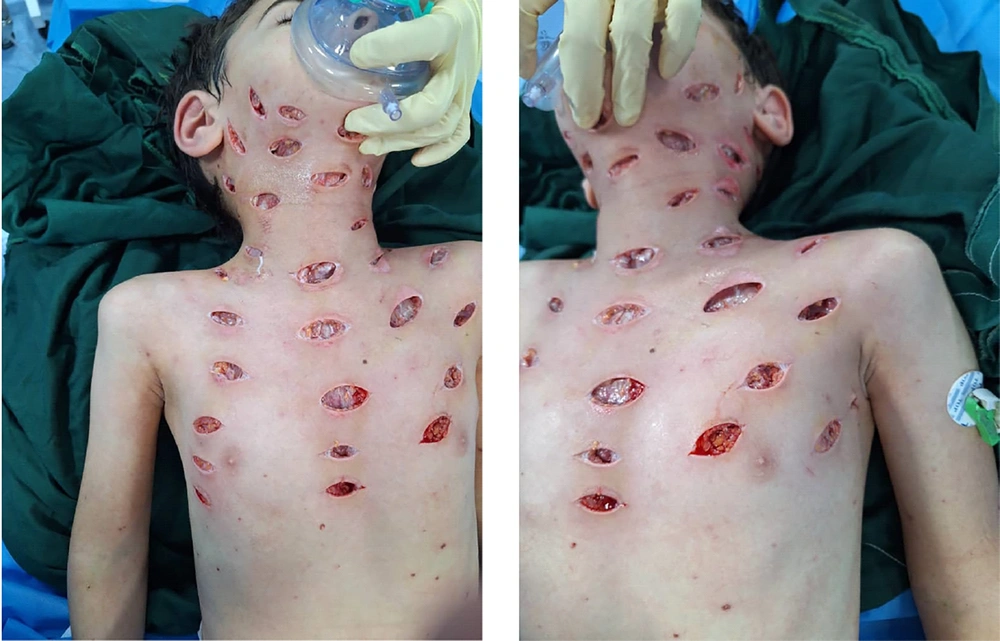
Figure 1.
The lesions on the left neck, chest and face showed signs of early tissue necrosis
Table 1.Laboratory Findings in Child with Necrotizing Fasciitis
| Lab Finding | Admission | Discharge |
|---|---|---|
| Hb (gr/dL) | 12.4 (12 - 16) | 9.9 |
| WBC/mm3 | 8,300 (4,800 - 10,800) | 9,100 |
| Neut/mm3 | 6,200 (1,500 - 8,500) | 7,000 |
| Lym/mm2 | 1,200 (3,200 - 5,200) | 1,800 |
| Plt/mm3 | 64,000 (150,000 - 450,000) | 282,000 |
| AST (IU/mL) | 98 (10 - 40) | 38 |
| ALT (IU/mL) | 96 (10 - 40) | 28 |
| D-dimer (ng/mL) | 400 (220 - 500) | - |
| Fibrinogen (mg/dL) | 81 (200 - 400) | - |
| Cr (mg/dL) | 0.7 (0.74 - 1.35) | 0.39 |
| LDH (U/L) | 1,135 (143 - 370) | 240 |
| CPK (U/L) | 204 (24 - 229) | - |
| ESR (mm/h) | 2 (3 - 13) | 2 |
| CRP (mg/L) | 3 (< 10) | 1 |
| PT (s) | 13.3 (12.5 - 13.5) | 13.5 |
| PTT (s) | 33 (up to 48) | 31 |
| Total pro (Gr/dL) | 4.2 (6 - 8.3) | - |
| Alb (Gr/dL) | 2.7 (4 - 5.3) | - |
| Wound culture | Neg | - |
| Blood culture | Neg (BACTEC) | - |
| PCR COVID and influenza | Neg | - |
Pediatric infectious diseases consultation did not recommend acyclovir treatment, and IVIG at 600 mg/kg/day (2 g/kg total) was started with no obvious improvement. Immunology consultation recommended immunoglobulin measurement and nitroblue tetrazolium (NBT) test, which were normal (Table 2). Despite the administration of IVIG and antibiotics, the patient did not demonstrate a discernible improvement within the initial three-day period. Consequently, the treatment plan was modified to include the administration of FFP at a dose of 10 cc/kg and heparin at a dose of 10 IU/kg/hr following each surgical procedure, with the heparin being discontinued four hours prior to each surgical intervention. Following two days of heparin and FFP therapy and ongoing surgical and pharmacological management, the progression of fasciitis ceased, and the child subsequently made a full recovery without complications in hand and chest movement (Figure 2). No specified immunologic disease was diagnosed, and the temporary abnormality of IgG and IgA levels never recurred.
Table 2.Immunologic Markers
| Immunologic Markers | Values |
|---|---|
| NBT, % | 100 |
| I gG (mg/dL) | 362 (443 - 1095) |
| IgM (mg/dL) | 60 (39 -240) |
| IgA (mg/dL) | 26 (36 - 204) |
| IgE (IU/mL) | 29 (0 - 90) |
| Anti diphteria Ab | > 0.15 |
| Anti tetanus Ab | > 1 |
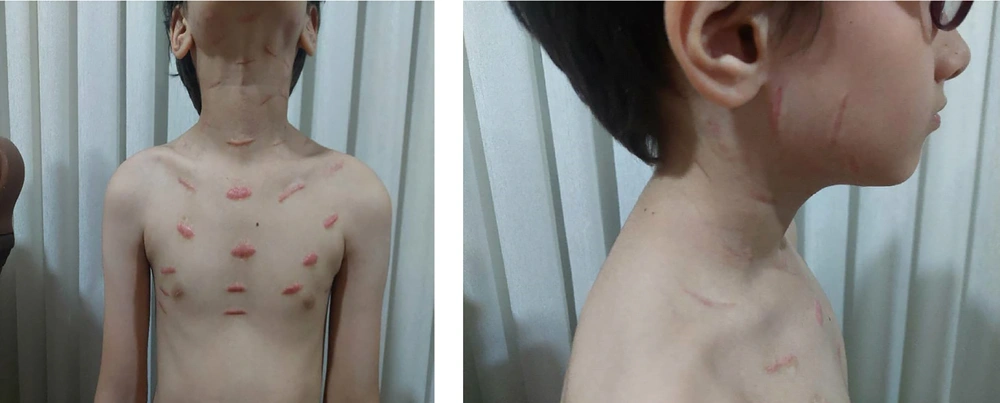
Figure 2.
The patient after full recovery
3. Discussion
Necrotizing fasciitis complicating varicella, although rare, can lead to significant morbidity and mortality, particularly in pediatric patients. Necrotizing fasciitis most commonly occurs in the abdomen, perineum, and extremities; head and neck involvement is rare (9). Recent literature suggests an increasing incidence of NF (10). Four types of NF exist: Polymicrobial (type 1), which accounts for 80% of cases and is bowel flora-derived; type 2, which is monomicrobial and throat or skin-derived, accounting for 20% of cases, caused by GAS and Staphylococcus aureus — our case is probably this type; type 3, which is seafood or water-related by Vibrio spp.; and type 4, which is trauma-associated and of fungal origin (11). Unlike other types, type 2 can occur at any age without any medical history (12). We were unable to identify the organism responsible, but with possible NF type 2, IVIG was used to inactivate the toxin and prevent toxic shock syndrome.
A previously healthy 5-year-old child reported from the USA (2012) developed neck and chin NF after minor trauma from his bike. Marked tense edema caused respiratory distress. A tracheotomy was placed, and deep fasciotomy was performed (13). Four infants with head and neck NF were reported from India (2022). Their management involved surgical debridement and antibiotic therapy without mortality (14). Necrotizing fasciitis is associated with a high mortality rate, 25% in children (15). Cervical involvement is devastating due to mediastinal extension (13). Prompt surgical debridement, along with broad-spectrum antibiotics targeting both aerobic and anaerobic pathogens, forms the cornerstone of management. Debridement continues until bleeding occurs, and re-evaluation in the operating room after 24 hours is mandatory (9). In our case, debridement was performed ten times until complete cure. However, in cases of severe systemic toxicity or refractory disease, or as in this case with fast progression to the face and eye, adjunctive therapies such as IVIG and FFP plus heparin may be considered. Necrotizing fasciitis in hypervascular tissues adjacent to the airway may cause vascular thrombosis; to decrease the risk of vasculitis and thrombosis, heparin is recommended (16). Fresh frozen plasma contains a diverse range of coagulation and anticoagulation factors and circulating proteins that can modulate tissue healing and neutralize toxins, potentially limiting tissue damage and improving outcomes in NF. Fresh frozen plasma is an adjunctive treatment in patients with sepsis or deep-seated cervical tissues (12). It has its highest therapeutic effect in patients with NF and coagulopathy (17). Factor XII was decreased during the first week in NF. The treatment of NF consists of high doses of appropriate antibiotics instituted early in its course. A beneficial effect of 300 - 500 IU heparin/kg/day was suggested, and the hard induration preceding the appearance of skin gangrene was inhibited if heparin was given early in the course of NF (18). The novel point in this article is the use of FFP and heparin in the treatment of NF in the neck and chest area, which can effectively prevent complications such as thrombosis and airway obstruction.
3.1. Conclusions
Necrotizing fasciitis complicating chickenpox is a rare but potentially life-threatening condition in pediatric patients. Prompt recognition, aggressive surgical debridement, and broad-spectrum antibiotics are essential for successful management. In select cases, adjunctive therapies such as FFP plus heparin may play a beneficial role in attenuating the inflammatory response, enhancing tissue healing, and improving outcomes. Further research is needed to elucidate the optimal use of FFP plus heparin in the management of NF complicating viral infections in pediatric populations.




