
1. Background
College athletes have multiple issues regarding their diets: lack of nutritional knowledge (1) and lack of energy and nutrient intake (2). These problems should be addressed when aiming for performance improvement. However, athletes have few opportunities to receive guidelines from a dietitian because most nutritional information comes from their coaches or athletic trainers (1). The creation of a behavioral change is important for establishing proper dietary habits for those who do not receive expert support.
We focused on the transtheoretical model (TTM), which is useful for understanding an individual’s current state of preparation for action and the need for a corresponding intervention method. The TTM consists of four theoretical constructs: stages of change, processes of change, decisional balance, and self-efficacy (3). Stages of change, the main theory of TTM, are said to change behavior more effectively by classifying participants into a stage according to each preparation situation. Decisional balance represents the balance between benefit (pros) and burden (cons) associated with change in the target behavior and is used to predict early behavior change (3). Prochaska has reported that shifting from the precontemplation to the contemplation stage by strengthening perception of pros and reducing perception of cons after shifting is effective for transitions between change stages (4). Paying attention to decision-making balance in promoting behavior change in TTM is considered effective because stages of change and decisional balance are closely related (5). In an intervention using TTM, evaluating the intervention’s effect necessitates clarifying the current state of preparation for action and the scale to do so. Several decisional balance scales for dietary behavior have been developed (5-9). However, many of them are scales for a single behavior, such as fruit and vegetable consumption (6, 7), making it difficult to assess athletes who require specific nutritional strategies.
2. Objectives
Therefore, this study was conducted to develop a decisional balance scale for dietary behavior appropriate for college athletes and to examine the scale’s reliability and validity.
3. Methods
3.1. Participants and Study Design
This cross-sectional study was performed with a self-written questionnaire for college athletes who belonged to the sports club of the University of Tsukuba (Ibaraki, Japan) from October to December 2014. Details of the study design and participant characteristics have been reported elsewhere (10).
A total of 1043 students answered the questionnaires. Subjects for whom data regarding gender, stages of change, or decisional balance were missing (n = 28) and those aged over 23 years (n = 33) were excluded. The final sample comprised 982 students, including 704 males and 278 females, aged 18 - 22 years.
This study was performed in accordance with the Declaration of Helsinki, and informed consent was obtained from all subjects. This study was conducted after receiving approval from the research ethics committee of the Faculty of Health and Sport Sciences, University of Tsukuba (No. 26 - 49).
3.2. Questionnaire
Stages of change for dietary behavior appropriate for college athletes were classified into five stages by TTM as described by Prochaska et al. (4); (1) Precontemplation (PC): the stage in which people are not interested in taking action in the dietary habits appropriate for an athlete, not planning to practice it. (2) Contemplation (C): the stage in which people are interested in taking action in dietary habits appropriate for an athlete but not planning to practice it. (3) Preparation (P): the stage in which people are interested in taking action in dietary habits appropriate for an athlete and planning to practice in the next month. (4) Action (A): the stage in which people have already started the dietary habits appropriate for an athlete (not more than 6 months from the beginning). (5) Maintenance (M): the stage in which people are having dietary habits appropriate for an athlete (over 6 months and continued). The subjects were asked the following question: “Please circle the numbers of choice that apply to you with regards to your regular dietary habits”, we asked the participants to select one. In addition, we added the sentence to the questionnaire that “Dietary habits appropriate for athletes refer to dietary habits suitable for your current purpose or need such as maintaining health, improving strength and competitiveness”, and as per the reference of Sakai et al. (11).
We selected 10 benefit items (pros) and 10 burden items (cons) on dietary habits appropriate for an athlete based on the interviews with six college athletes about dietary habits and nutrition knowledge and previous reports (12). The subjects were asked the following question: “What kind of benefit or burden do you think you will receive in the dietary habits appropriate for an athlete?”, and presented 20 items. We used the five-point scale; score 1: “I do not think so at all”, score 2: “I do not think so much”, score 3: “Neither”, score 4: “Slightly so”, score 5: “I think so very much”.
We asked about gender and age.
3.3. Statistical Analysis
In the item analysis, we deleted items showing a ceiling (mean + standard deviation ≥ 5) or floor (mean - standard deviation ≤ 1) effect. Next, we performed exploratory factor analysis based on the method of maximum likelihood promax rotation, and we deleted items with factor loadings of less than 0.4, and again performed factor analysis. To verify the model's validity from these results, confirmatory factor analysis was conducted with reference to the relevance index. We adopted the following as indicators of goodness of fit: goodness of fit index (GFI), adjusted GFI (AGFI), comparative fit index (CFI), and root mean square error of approximation (RMSEA). A good fit is indicated by a GFI ≥ 0.90 an AGFI ≥ 0.90, a CFI ≥ 0.90, and a RMSEA value < 0.10 (13).
Reliability was examined according to internal consistency and the retest method. To measure internal consistency, we calculated the Cronbach alpha coefficient as the reliability measure. In most applied studies, the lowest acceptable level of internal consistency reliability is 0.7 for the group level and 0.9 or higher for individual analysis (14). For the questionnaire’s temporal stability, we used the retest method. The decisional balance scale examined the correlation that the decisional balance score had between pre-and post- with the intra-class correlation. We randomly extracted target groups from among groups that did not have competitions before and after the survey, requested cooperation for participation, and obtained cooperation from 15 organizations, that is, 376 people. We conducted the retest from October to December 2014, at about 3-week intervals.
The relationship between the transformation stage and the decisional balance scale was analyzed by one-way analysis of variance (ANOVA) for each stage, with stage of change as the independent variable and decisional balance score as the dependent variable. We used the Kruskal-Wallis test if homoscedasticity was not confirmed after ANOVA. Inter-group comparisons were adjusted by the Bonferroni and the Mann-Whitney tests.
All statistical analysis was performed using IBM SPSS version 21 (IBM Corp, Armonk, NY) and Amos version 22, and P < 0.05 was considered statistically significant.
4. Results
In the present study, 982 subjects participated, which included 704 men (71.7%: age; mean = 20.0, SD = 1.2) and 278 women (28.3%: age; mean = 20.0, SD = 1.1).
Stages of change in dietary behavior appropriate for an athlete were distributed as follows; 56 (5.7%) at PC, 399 (40.8%) at C, 215 (22.0%) at P, 208 (21.2%) at A, and 104 (10.6%) at M.
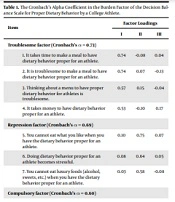
Since the ceiling effect appeared in nine benefit items of the 20 decision balance scale items, they were excluded from subsequent analysis. As a result of exploratory factor analysis, one benefit item (“Doing dietary behavior proper for an athlete increases motivation for competition.”) was excluded, and one burden item (“You have to study nutrition and cooking in order to have the dietary behavior proper for an athlete.”) with a factor loading of less than 0.4 was also excluded. As a result of again conducting factor analysis, nine items of three factors were adopted. The first factor was named the “troublesome factor” in four items because they concerned inconveniences. The second factor was termed the “repressed factor” in three items because they concerned repression. The third factor was named the “compulsory factor” in two items because they concerned compulsion. Since all three factors concerned burdens, the total score was used as the burden score in subsequent analysis. That result is shown in Table 1.
Table 1.
The Cronbach’s Alpha Coefficient in the Burden Factor of the Decision Balance Scale for Proper Dietary Behavior by a College Athlete a
| Item | Factor Loadings | ||
|---|---|---|---|
| I | II | III | |
| Troublesome factor (Cronbach’s α = 0.73) | |||
| 1. It takes time to make a meal to have dietary behavior proper for an athlete. | 0.74 | -0.08 | 0.04 |
| 2. It is troublesome to make a meal to have dietary behavior proper for an athlete. | 0.74 | 0.07 | -0.13 |
| 3. Thinking about a menu to have proper dietary behavior for athletes is troublesome. | 0.57 | 0.15 | -0.04 |
| 4. It takes money to have dietary behavior proper for an athlete. | 0.53 | -0.10 | 0.17 |
| Repression factor (Cronbach’s α = 0.69) | |||
| 5. You cannot eat what you like when you have the dietary behavior proper for an athlete. | 0.10 | 0.75 | 0.07 |
| 6. Doing dietary behavior proper for an athlete becomes stressful. | 0.08 | 0.64 | 0.05 |
| 7. You cannot eat luxury foods (alcohol, sweets, etc.) when you have the dietary behavior proper for an athlete. | 0.03 | 0.58 | -0.08 |
| Compulsory factor (Cronbach’s α = 0.60) | |||
| 8. You have to eat what you dislike when you have the dietary behavior proper for an athlete. | -0.04 | 0.07 | 0.69 |
| 9. You have to eat without an appetite while you practice dietary behavior proper for an athlete. | 0.09 | -0.05 | 0.62 |
| Factor contribution (%) | 23.6 | 11.8 | 9.35 |
| Cumulative contribution ratio (%) | 23.6 | 35.5 | 44.8 |
| Eigenvalue | 2.12 | 1.06 | 0.84 |
| Factor correlations | |||
| I | 0.30 | 0.10 | |
| II | 0.17 | ||
a Participants were asked the following question: “Please circle the number of the choice that applies to you with regard to your regular dietary habits.”.
As a result of the retest, we observed a moderate consistency of 0.50. In addition, the result showed moderate consistency: The troublesome factor's intra-class correlation was 0.50, the repressed factors were 0.61, and the compulsory factors were 0.52.
As a result of one-way ANOVA, men and women showed significant differences in the troublesome factor (Table 2). In the multiple comparisons, M was significantly lower than PC, C, and P overall and in men and women (P < 0.05). In the case of the repressed factor as well, there were significant differences in the troublesome factor. M was significantly lower than PC, C, and P overall and in males (P < 0.05). In females, A and M showed a significantly lower value compared to PC and C (P < 0.05). In the compulsory factor, no significant difference was observed (P = 0.17). Therefore, as a result of again conducting factor analysis without the compulsory factor, we obtained higher goodness of fit with GFI = 0.99, AGFI = 0.97, CFI = 0.97, and RMSEA = 0.06. All factor loadings were significant (P < 0.001).
| Variables | Stage of Changes | P-Value | Multiple Comparisons | ||||
|---|---|---|---|---|---|---|---|
| PC | C | P | A | M | |||
| Total | |||||||
| All | 31.9 ± 6.2 | 31.5 ± 5.1 | 30.2 ± 4.6 | 29.1 ± 4.6 | 27.4 ± 5.5 | 0.00 | PC>A,M; C>P,A,M; P>M |
| Men | 32.1 ± 6.6 | 31.6 ± 5.1 | 30.7 ± 4.6 | 29.6 ± 4.3 | 27.9 ± 5.7 | 0.00 | PC>A,M; C>A,M |
| Women | 31.2 ± 5.3 | 31.2 ± 5.2 | 29.1 ± 4.4 | 27.4 ± 5.2 | 25.5 ± 4.3 | 0.00 | PC>M; C>A,M; P>M |
| Troublesome | |||||||
| All | 15.5 ± 2.5 | 16.3 ± 2.8 | 15.5 ± 2.6 | 14.8 ± 2.7 | 13.9 ± 3.5 | 0.00 | PC>M; C>P,A,M; P>M |
| Men | 15.5 ± 2.7 | 16.7 ± 2.7 | 16.0 ± 2.4 | 15.3 ± 2.4 | 14.2 ± 3.6 | 0.00 | PC>M; C>P,A,M; C>A,M |
| Women | 15.6 ± 2.0 | 15.3 ± 2.9 | 14.2 ± 2.6 | 13.2 ± 2.8 | 12.6 ± 2.8 | 0.00 | PC>A,M; C>A,M |
| Repressed | |||||||
| All | 9.7 ± 3.0 | 8.8 ± 2.7 | 8.0 ± 2.6 | 7.5 ± 2.4 | 7.1 ± 2.3 | 0.00 | PC>P,A,M; C>P,A,M |
| Men | 9.8 ± 3.1 | 8.4 ± 2.2 | 7.9 ± 2.6 | 7.3 ± 2.3 | 7.0 ± 2.2 | 0.00 | PC>M; C>A,M; P>M |
| Women | 9.6 ± 2.7 | 9.5 ± 2.7 | 8.4 ± 2.6 | 7.9 ± 2.8 | 7.3 ± 2.4 | 0.00 | C>P,A,M |
| Compulsory | |||||||
| All | 6.5 ± 1.8 | 6.3 ± 2.1 | 6.7 ± 2.0 | 6.7 ± 2.0 | 6.3 ± 2.3 | 0.17 | n.s |
| Men | 6.7 ± 1.7 | 6.4 ± 2.2 | 6.7 ± 2.1 | 6.9 ± 2.0 | 6.6 ± 2.2 | 0.12 | n.s |
| Women | 5.9 ± 2.1 | 6.2 ± 1.8 | 6.3 ± 1.8 | 6.2 ± 1.9 | 5.5 ± 2.3 | 0.48 | n.s |
Abbreviations: PC, precontemplation; C, contemplation; P, preparation; A, action; M, Maintenance.
a Values are expressed the mean ± SD.
b The final sample comprised 982 college athletes, 704 males and 278 females, aged 18 - 22. The Kruskal-Walls test followed by the Bonferroni and the Mann-Whitney test if homoscedasticity was not confirmed.
5. Discussion
The present study was conducted to develop a decisional balance scale for dietary behavior appropriate for college athletes and to examine the scale’s reliability and validity. In fact, a decisional balance scale for dietary behavior has been developed (5-9), but not for college athletes—although a scale for dietary behavior targeting college students has been developed (8, 11). In the present study, this scale’s development makes it possible to evaluate the intervention effect of nutrition education and nutritional guidance for college athletes.
In a previous study, the reliability coefficient showed higher reliability than in the present study, with profit at 0.77 and loss at 0.74, retested at two-week intervals on the decisional balance scale for reducing weight and targeting female college students (5). However, many studies on the development of the decisional balance scale have not conducted retests (8, 9, 12). This was perhaps influenced by its longer period (maximum of 3 weeks) than that of previous research. In addition, using TTM to clarify target behavior is considered important (15). In a previous study that used TTM for dietary behavior, the target behavior was clearly defined: increasing intake of calcium-rich foods (16) and increasing intake of fruits and vegetables (6, 7, 17). Because the present study’s target behavior is not clearly defined, it possibly showed a lower value than the previous study. In the present study, the target behavior was not clearly defined; however, we clarified the stage of change based on TTM and showed that burden factor scores decreased as the stage of change shifted to later stages. This study showed a result similar to the Cronbach alpha coefficient of a previous study, targeting college students in general that focused on the whole of dietary behavior (11). Consequently, this scale is considered to have obtained sufficient reliability, and results above confirm this.
Furthermore, in this study, the ceiling effect was indicated in nine benefit items. Previously, college athletes have been reported more aggressive toward dietary behavior to improve performance (18). Another study reported that 71% of college athletes responded, “eating healthy meals improves performance” (19). From these reports, it is surmised that benefit items did not affect behavior change for diet appropriate for athletes since this research’s benefit items are what many participants already feel.
In the burden factors’ scale by stage of changes, it was confirmed that the scores in PC or C were highest and lowest in M for the total, repressed, and troublesome scores. These results were consistent with the TTM theory (3).
The current study has several limitations. First, participants had higher education and high competition levels, competing nationally and internationally. Not all young Japanese adults have high academic backgrounds and high competition levels. Therefore, our results cannot be readily extrapolated to the general population of college athletes. Second, there was bias in the number of male and female subjects. Males were about two and a half times the number of females. The cause seems to lie in the fact that three and half times more men than women were in the undergraduate department of the investigated subject. Therefore, whether this research’s result can be replicated even in universities with little difference in gender ratio is uncertain. Finally, whether reducing the perception of burden promotes behavioral change could have been evaluated. Whether the burden scale is the predictor variable for progress in stages of change in TTM is not clear since this study is cross-sectional.
In conclusion, the present findings suggest that sufficient reliability and validity were confirmed in the burden scale for dietary behavior proper for college athletes. Consequently, this scale seems usable as a measure for evaluating the burden of dietary behavior proper for college athletes.