1. Background
Extreme accumulation of adipose tissue may cause some chronic diseases and is defined as obesity or overweight (1). Indeed, based on the results of previous studies, body mass index (BMI) along with abdominal circumference are used as indicators of disease risk (2, 3). Obesity and overweight can increase fat concentration in the central area and is known as adiposopathy (4, 5). More importantly, previous studies have shown that central obesity correlates with an increasing risk of cardiometabolic diseases such as diabetes, metabolic syndrome, hypertension, and coronary heart disease independent of weight and body mass index (6-8). It is estimated that overweight and obesity will reach 89% and 85% in males and females, respectively, until 2030 (9-11). It has been shown that central obesity is prevalent in Asian adults, particularly in older adults and women (12). In addition, according to previous studies in Iran, the range of overweight and obesity prevalence in national studies in adults was 27.0 - 38.5% (95% CI: 26.8 - 27.1, 37.2 - 39.8), and 12.6 - 25.9% (95% CI: 12.2 - 13.0, 24.9 - 26.8), respectively (1).
Based on previous guidelines, a number of medical strategies such as daily calorie intake restriction, drugs, and exercise training are available to treat obesity and overweight (13).
In recent years, the popularity of supplementation for weight loss and body fat has increased. Due to the high prevalence of overweight in the US, many people use supplements to help lose weight (14, 15). Caffeine is currently one of the most consumed dietary supplements in the world. Some previous studies have shown that caffeine has a positive effect on weight loss and fat percentage reduction (16-18). Caffeine increases both noradrenaline and dopamine release, and therefore stimulates the neuronal activity in several brain regions, which in turn can decrease weight and body fat (18). Caffeine may increase fat oxidation through inhibiting phosphodiesterase and the suppression of the adverse effects of adenosine on increased noradrenaline release. Few previous studies did not show any positive effect of caffeine on body weight reduction (19, 20). On the other hand, the effect of aerobic exercise on body fat reduction has been considered in the last decade, and it seems that this exercise program can decrease body fat percentage and insulin resistance in overweight people (21). Also, it has been previously shown that caffeine intake can improve exercise performance (22); however, it is not yet clear whether caffeine intake with or without exercise can effectively reduce fat in the central body (23, 24). Adding effective supplements to routine daily diets to increase the rate of fat reduction among overweight individuals has always been the main goal in weight reduction clinics (25). The novelty of this randomized clinical trial study was assessing the effect of aerobic exercise concurrent with caffeine supplementation on weight and body fat reduction among overweight women.
2. Objectives
Previous research has failed to do a comparison between exercise alone and exercise enhanced by caffeine supplementation. Therefore, the novelty of this study is related to the concurrent effect of caffeine supplementation and moderate-intensity aerobic exercise on overweight women, a growing population in developing countries, especially in Asia. Therefore, the main aim of the present study was to determine the concurrent effects of 6-week caffeine supplementation and moderate-intensity aerobic exercise on weight, total and central body fat in overweight women.
3. Methods
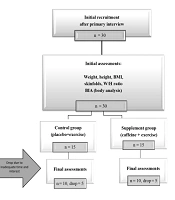
At first, in this single-blinded randomized clinical trial, thirty overweight females (age: 36.47 ± 6.48 y; BMI: 27.61 ± 1.54 kg/m2; mean ± SD) with a sedentary lifestyle were recruited to the study. Secondly, thirty participants were randomly divided into the experimental group, EC (exercise + caffeine) (n = 15) or control group, EP (exercise + placebo) (n = 15). Then, after initial assessments and exercise prescription, 5 participants in each group were taken out of the study because of not returning at follow-ups (Figure 1). Furthermore, participants signed consent forms before participating in the study, and they were aware of the aims of the study. Besides, this study was approved by Tehran University of Medical Sciences (ID: IRCT20111025007903N11).

Figure 1.
Flow chart of how participants progressed through the study and how many contributors completed each stage.
Above all, the EC group took 100 milligrams of caffeine branded "API" supplement 30 minutes before exercise training, and the EP group took similar tablets in appearance without caffeine as a placebo and did the same exercise protocol.
3.1. Participants
Participants were recruited from those who refer to the Imam Khomeini Hospital's Sports Medicine clinic for weight management. Inclusion criteria were: BMI of 25 to 29.8 kg/m2, age range 20 - 45 years, and weekly activity of fewer than 90 minutes of moderate-intensity physical activity for more than three months. Participants were excluded if they had uncontrolled diabetes, severe cardiovascular disease, pregnancy, musculoskeletal limitations, exercise-restricting neurological disorder, uncontrolled hypertension, chronic obstructive pulmonary disease, migraine, any drug affecting weight or appetite as well as taking any medications or nutritional supplements affecting exercise performance in the last three months.
3.2. Assessments
A body impedance analyzer (AVIS33 body composition analyzer, Jawon Medical Co. Ltd, South Korea) was used for evaluating body composition, including weight, fat mass (FM), fat free mass (FFM), and body fat percentage (PBF) (26). Also, before the analysis, participants were advised to refrain from eating or drinking for four hours before the test as well as not exercising for 12 hours before testing. Moreover, participants were supposed to avoid diuretic agents such as caffeine and chocolate before testing, and they were requested to do urination for half an hour before analysis. Finally, body adiposity index (BAI) was calculated by the following formula (27):
Height was measured by a standard tape at the first visit. Besides, the waist (immediately above the bony prominence of the iliac crest) and hip circumferences were measured in a standing position with light clothing (28). Measurements were repeated two times, and the third measurement was done if the difference was more than 0.5 cm. A standard caliper (Slim Guide) was used for measuring skin folds on the abdominal point (5 cm right side of the umbilicus) and suprailiac point (intersection of the anterior axillary line and supra-iliac line). Each part was measured two times, and the third measurement was done if the difference was further than 3 mm (29).
All the measurements were done by a trained specialist. Also, during their first visit, participants were trained to have healthy nutrition such as selecting low-fat dairy products, white meat, greater consumption of fruits and vegetables as well as avoiding fast foods. Then, during the next visit, participants were assessed with a baseline exercise test, and this test was performed by the Bruce ramp protocol on a treadmill. So, according to the heart rate which was achieved in the exercise test, moderate-intensity aerobic exercise was defined between 40 and 60% of heart rate reserve for 30 minutes with a rating of perceived exertion (RPE) of 13 on a Borg scale of 6 to 20. Hence, they were scheduled to do brisk walking with the mentioned intensity three days a week for six weeks.
3.3. Statistical Analysis
IBM SPSS version 19 was used to analyze data. A normality test was done before doing data analysis. Means and SD were presented as descriptive statistics. t-test and K2 regression were used for data analysis.
4. Results
On the whole, 30 participants were initially entered into the study. The mean age of participants was 36.5 ± 6.5 years with a BMI of 27.6 ± 1.5 kg/m2. The mean fat mass of participants was 24.6 ± 3.4 kg (Table 1). Twenty participants completed the study, and the main reason for drop-out was due to participants who came from a far distance and had difficulties with their transportation to our center. The baseline measurements of 20 final participants were not significantly different between experimental and control groups (Table 2). After six weeks of moderate aerobic exercise training concurrent with caffeine consumption, there were no significant differences between experimental and control groups related to weight (P = 0.22), BMI (P = 0.62), total body fat mass changes (P = 0.51) (Table 3). Similarly, none of the abdominal skin fold (P = 0.73), suprailiac skinfold (P = 0.47), waist to hip circumferences ratio (P = 0.97) measurements were significantly different between experimental and control groups after six weeks.
Table 1.
Participants’ Demographic Details (N = 30)
| Demographic Data | n | Minimum | Maximum | Mean | Std. Deviation |
|---|---|---|---|---|---|
| Age (y) | 30 | 20 | 45 | 36.5 | 6.5 |
| Height (cm) | 30 | 145 | 172 | 159.6 | 6.2 |
| BMI (kg/m2) | 30 | 25 | 29.8 | 27.6 | 1.5 |
| PBF (%) | 30 | 29.8 | 38.5 | 34.6 | 2.4 |
| WC (cm) | 30 | 83.5 | 109.5 | 94.3 | 7.0 |
| Abdominal SF (mm) | 30 | 18 | 47 | 33.1 | 7.1 |
| Supra iliac SF (mm) | 30 | 12.5 | 40 | 27.4 | 6.7 |
| FM (kg) | 30 | 18 | 31 | 24.6 | 3.4 |
| FFM (kg) | 30 | 36.1 | 54.8 | 46 | 4.4 |
| W/H ratio | 30 | 0.9 | 1 | 0.9 | 0.1 |
| BAI | 30 | 30.2 | 42.9 | 34.8 | 3.0 |
Abbreviations: BMI, body mass index; PBF, percentage of body fat; WC, waist circumference; SF, skinfold; FM, fat mass; FFM, fat-free mass; W/H ratio, waist to hip ratio; BAI, body adiposity index.
Table 2.
Participants’ Initial Assessments (N = 20)
| Characteristics; n = 20 | Mean ± SD | Range | P-Value a |
|---|---|---|---|
| Age (y) | 0.68 | ||
| EC | 35.6 ± 9.2 | 20 - 45 | |
| EP | 37.0 ± 5.5 | 29 - 45 | |
| Height (cm) | 0.17 | ||
| EC | 161.9 ± 6.6 | 150 - 172 | |
| EP | 158.3 ± 4.5 | 152 - 166 | |
| Weight (kg) | 0.17 | ||
| EC | 73.6 ± 7.6 | 60.5 - 82.6 | |
| EP | 69.5 ± 4.7 | 63.6 - 76.9 | |
| BMI (kg/m2) | 0.79 | ||
| EC | 28.1 ± 1.4 | 26.2 - 29.7 | |
| EP | 27.8 ± 1.8 | 25.1 - 29.8 | |
| FM (kg) | 0.36 | ||
| EC | 25.7 ± 4.2 | 18 - 31.7 | |
| EP | 24.3 ± 2.2 | 20.8 - 27.8 | |
| FFM (kg) | 0.15 | ||
| EC | 47.9 ± 4 | 41.6 - 52.1 | |
| EP | 45.2 ± 3.8 | 39.1 - 52.7 | |
| W/H ratio | 0.89 | ||
| EC | 0.9 ± 0.1 | 0.8 - 1 | |
| EP | 0.9 ± 0.1 | 0.8 - 0.9 | |
| BAI | 0.61 | ||
| EC | 34.8 ± 2.3 | 30.2 ± 38.2 | |
| EP | 35.4 ± 0.9 | 31.5 ± 39.5 |
Abbreviations: FM, fat mass; FFM, fat-free mass; W/H ratio, waist to hip ratio; BAI, body adiposity index.
a P-value is between-group comparison and significant at the 0.05 level.
Table 3.
Baseline and Changes in Anthropometric Measurements after 6 Weeks (N = 20)
| Variables and Groups | Mean ± SD; Before | Mean ± SD; After | Mean Difference (After - Before) | 95% Confidence Interval of the Difference | P-Value Within Groups a | P-Value Between Groups |
|---|---|---|---|---|---|---|
| Weight (kg) | 0.22 | |||||
| EC | 73.6 ± 7.6 | 72.4 ± 7.4 | 1.23 | -0.34 to 2.80 | 0.11 | |
| EP | 69.5 ± 4.7 | 69.4 ± 5.4 | 0.13 | -1.02 to 1.28 | 0.80 | |
| BMI (kg/m2) | 0.62 | |||||
| EC | 28.1 ± 1.4 | 27.6 ± 1.9 | 0.49 | -0.14 to 1.12 | 0.12 | |
| EP | 27.8 ± 1.8 | 27.5 ± 1.9 | 0.30 | -0.25 to 0.85 | 0.25 | |
| PBF (%) | 0.88 | |||||
| EC | 34.9 ± 2.8 | 34.6 ± 2.8 | 0.31 | -0.63 to 1.25 | 0.48 | |
| EP | 35 ± 2.5 | 34.8 ± 1.5 | 0.20 | -1.15 to 1.55 | 0.75 | |
| Waist C (cm) | 0.65 | |||||
| EC | 96 ± 7.1 | 94.9 ± 7 | 1.08 | -0.87 to 3.03 | 0.24 | |
| EP | 93.3 ± 5.8 | 92.7 ± 5.7 | 0.60 | -0.75 to 1.95 | 0.34 | |
| Abdominal SF (mm) | 0.73 | |||||
| EC | 33.2 ± 6.6 | 31.9 ± 6.6 | 1.25 | -0.34 to 2.82 | 0.11 | |
| EP | 33.5 ± 5.9 | 31.7 ± 5.4 | 1.80 | -1.34 to 4.94 | 0.23 | |
| Supra iliac SF (mm) | 0.47 | |||||
| EC | 28.5 ± 6.2 | 28 ± 7.5 | 0.55 | -1.84 to 2.94 | 0.62 | |
| EP | 26.9 ± 4.5 | 27.8 ± 6 | -0.90 | -4.61 to 2.81 | 0.60 | |
| FM (kg) | 0.51 | |||||
| EC | 25.7 ± 4.2 | 25.1 ± 4.1 | 0.58 | -0.49 to 1.65 | 0.25 | |
| EP | 24.3 ± 2.2 | 24.1 ± 2.2 | 0.15 | -1.17 to 1.47 | 0.8 | |
| FFM (kg) | 0.25 | |||||
| EC | 47.9 ± 4 | 47.2 ± 3.8 | 0.65 | -.27 to 1.57 | 0.14 | |
| EP | 45.2 ± 3.8 | 45.3 ± 3.5 | -0.02 | -0.68 to 0.64 | 0.95 | |
| W/H ratio | 0.97 | |||||
| EC | 0.9 ± 0.1 | 1 ± 0.1 | 0.00 | -0.02 to 0.01 | 0.84 | |
| EP | 0.9 ± 0.7 | 1 ± 0.1 | -0.01 | -.0.02 to 0.005 | 0.22 | |
| BAI | 0.71 | |||||
| EC | 34.8 ± 2.3 | 34.2 ± 3 | 0.65 | 0.02 to 1.27 | 0.04 | |
| EP | 35.4 ± 0.9 | 34.7 ± 3 | 0.73 | 0.19 to 1.28 | 0.01 |
Abbreviations: BMI, body mass index; PBF, percentage of body fat; Waist C, waist circumference; SF, skinfold; FM, fat mass; FFM, fat-free mass; W/H ratio, waist to hip ratio; BAI, body adiposity index.
a P-value within-group is significant at the 0.05 level.
5. Discussion
In fact, this study examined the concurrent effect of 6-week caffeine supplementation together with moderate-intensity aerobic exercise on central body fat and BMI in overweight women. Also, it should be noted that the drop-out was equal in both groups, and it was not related to the prescribed exercise or caffeine supplement, yet, it was related to lack of time for doing exercise or being away from our center. Further, it is interesting to know that this intervention was not significantly effective on the weight, central or total body fat of overweight women in the short term (6 weeks).
In particular, there are some studies about the effects of caffeine intake on weight management. Some of them found a positive effect of caffeine supplementation on body weight, and some of them, along with the present study, did not find any effect of caffeine on weight loss (30-32). As an illustration, the latest critical review, which was done in 2019, confirmed the positive effect of caffeine intake on BMI and body fat reduction (18). However, with a closer look at some research articles with the positive effect of caffeine on weight loss, it was identified that caffeine was used in combination with other ingredients such as ephedrine or green tea (30-32). On the other hand, in some studies, dietary intervention and calorie deficit were performed (30). Yet, in the present study, we prescribed caffeine alone in a low dose of 100 mg without any dietary intervention. Therefore, it seems that other ingredients or calorie restriction are important factors for the positive effect of caffeine on weight or body fat reduction. The study of Coffey et al. in 2004, which was a randomized clinical trial of consuming 12 weeks of a supplement of combined caffeine with ephedrine showed greater reductions in BMI and waist circumference without any differences in the percentage of body fat, fat mass, diastolic or systolic blood pressure in the experimental group (31). In the study of Hackman et al. in 2006, which also was a randomized clinical trial, the experimental group consumed 40 mg/day ephedra alkaloids, plus 100 mg/day caffeine over nine months, and this group lost significantly more body weight and body fat than the control group (33). None of these studies assessed pure caffeine plus aerobic exercise, and this might be the reason for these different results from our study.
Moreover, improvement of body composition with physical activity and exercise were shown by various researches. In fact, an exercise program may decrease body fat percentage and diminish insulin resistance in overweight people (34, 35), especially in the long term (36). However, the time of the intervention in the present study was short (6 weeks). On the other hand, according to a Cochrane review, exercise alone without a "calorie-restricted diet" did not have a significant effect on weight reduction (37). Since in the present study, participants did not receive a calorie-restricted diet, the effect of exercise during six weeks was not significant on their weight reduction and their body composition.
Above all, existing evidence reported that some natural ergogenic agents could be useful to increase the tolerance of physical activity and reduce the perceived level of exertion during exercise (RPE), especially in overweight and obese people (38-40). For instance, improving the level of physical activity followed by beta-alanine supplementation was shown among sedentary overweight women in 2018 (38). Also, several studies reported that caffeine intake could be a useful method for the reduction of RPE during exercise and improvement of performance in athlete and nonathlete populations (39-41). However, in the present study, we did not evaluate the RPE because the exercise was not supervised.
In sum, adding caffeine supplementation to exercise programs could not be an effective method to reduce weight and body fat in the short term without dietary intervention. Therefore, physicians, trainers, and others in the obesity treatment team should be aware that caffeine alone should not be used in weight management without diet and exercise, and subsequently not to expose patients to the side effects of this supplement such as insomnia and increased heart rate.
5.1. Limitations
The present study was performed without dietary intervention for evaluating the exact effect of caffeine on central fat loss. Therefore, further studies with careful diet control, a larger sample size as well as a longer period of intervention are recommended. However, the present study was the first study in the field of caffeine’s effect on central body fat and the evaluation of the concurrent effect of caffeine with exercise.
5.2. Conclusion
Based on the results of this study, six weeks of caffeine supplementation combined with moderate-intensity aerobic exercise in overweight women couldn’t make a significant reduction in weight, BMI, or any of the body composition components such as central, total body fat, and skinfolds measures. The main part of the weight reduction program should be diet interventions through intake calorie deficits.