
1. Background
Early childhood is a critical period for the development of motor skills. The development of motor skills progresses rapidly during this time, and children become proficient in developing the most fundamental movement skills (FMS) by combining different movement patterns (1, 2). Developmental models and theories emphasize the importance of individual and environmental factors in influencing the development of motor skills (3, 4). Newell’s developmental model (1989) emphasizes the importance of the interactive role of structural features (i.e., arm and leg length) and individual’s functional features (i.e., motivation), tasks, and environmental constraints in the development of human motor skills (4). In this regard, a key functional and intrapersonal characteristic that has recently been associated with the development of motor skills is movement motivation (5, 6).
Researchers have considered the role of motivation in influencing infant development (5, 6) and child development (7, 8), but research is still limited. Studies demonstrate an important link between motivation and the development of early motor skills (6, 8, 9). Developmental theorists have considered motivation as an important variable influencing the discovery of new patterns of behavior (5, 10). Von Hofsten (9) highlights the importance of motivation when linking cognition and action in the development of adaptive behaviors. Thelen (10) describes a motivational cascade whereby motivation stimulates action, and gaining success, in turn, creates more motivation in the individual. Motivation drives one's internal force to reach a goal (11). Researchers have emphasized the importance of motivation to move and used it to explain how to create new strategies for children to discover tools and toys (12), have linked it to cognitive delay (13), as well as the potential to facilitate children's motor development (9) and promote physical activity strategies for lifelong health (14). Practical evidence has shown a reciprocal relationship between motivation and motor development in infants aged 7 to 12 months (6).
In addition to individual factors, environmental factors, such as the living environment, can also affect the development of motor skills in children (2). The concept of affordances (15) emphasizes that the structure of the environment provides opportunities for children to play and move, which can have an impact on motor development. Moreover, access to a rich environment for physical activity has been linked to the development of early motor skills in childhood (16). A multitude of family features, such as socioeconomic status, the mother's educational level, and the presence of siblings, could also affect children's FMS and motor competence (17). Given that these features can vary among urban and rural environments, it suggests that the setting has the potential to influence the development of FMS. This idea is further supported by the fact that these two environments differ based on many key factors such as geographical area, status and type of economic activity, degree of employment and social stratification, degree of complexity of relations, access to facilities, training, and educational opportunities (18). Given this, researchers have investigated differences in development amongst children raised in rural compared to urban areas, although the findings are mixed (19). Urban areas, despite having greater access to education, health facilities, and modern sports facilities, might have fewer open areas for play, mobility, and leisure activities due to the volume of residential buildings and high population density. In contrast, rural areas with lower population density are known to have access to larger play areas outside the home, increased opportunities for less organized leisure activities, and overall, more opportunities for play, mobility, and activity (17). Some studies have reported high levels of obesity (20, 21) and lower levels of physical activity and physical fitness in rural populations compared to urban counterparts (21-23). While others report more physical activity in rural populations (24-27) and that children resident in rural areas have higher levels of locomotor and object control skills than urban children (17). Further differences have been noted in motor skills, such that rural children have higher levels of strength and endurance relative to urban children, although they have lower scores for speed and flexibility (28). This work highlights that there are critical differences in these environments that affect motor skills that require further consideration and investigation. To address this gap in the literature, the objective of this work is to investigate differences in motor skills in a sample of urban and rural children and further relate this to differences in the motivation to move.
The concept of motivation relating specifically to movement, or movement motivation, is still developing, and, to the best of our knowledge, its relationship to the development of FMS has not yet been studied (5, 6). In addition, an understanding of how urban and rural environments influence children's motor development is still limited, as well as how motivation might differ in these two groups of children. Given the key differences between these two environments mentioned earlier, it is expected that these environments potentially have different effects on movement motivation and the development of FMS in children.
2. Objectives
The present study aimed to investigate the overall relationship between movement motivation and the development of FMS in children, as well as differences in motivation and FMS development in urban and rural children.
3. Methods
3.1. Participants
A sample of 400 parent and child dyads was recruited from preschool centers in Khorramabad City from April 2019 to December 2019. This sample was stratified by each urban and rural area. A total of 400 dyads participated in the study, with 198 participants from rural and 202 participants from urban areas. Children were between 4 - 6 years of age. The sample size was calculated using the G*power software set at α = 0.05 and (1-β) = 0.95. Inclusion criteria included the child living with both parents and the parents' ability to read and write in Persian. Exclusion criteria included a history of physical, mental, and motor illness for parents or their children or if the child participated in organized sports activities.
3.2. Measurement/Tools
3.2.1. Demographic Questionnaire
This questionnaire includes the level of education of parents, socioeconomic status, history of any physical, mental, and movement problems for parents and children, as well as the history of the child's participation in organized sports activities. At the end of the questionnaire, the consent form for participation in the research was presented to parents and their children.
3.2.2. Test of Gross Motor Development–Third Edition
This measures the development of gross motor skills in children with and without disabilities. It consists of two subscales, including locomotor skills (running, galloping, hopping, skipping, horizontal jump, and sliding) and ball skills (two-hand strike of a stationary ball, forehand strike to a self-bounced ball, one-hand stationary dribble, two-hand catch, kicking a stationary ball, overhand throw, and underhand throw). This test provides two raw scores for each subscale, calculated by summing the scores for each item, as well as a total measurement score. The reliability and internal validity of the (Test of Gross Motor Development–Third Edition) TGMD-3 were confirmed for use in this study (29).
3.2.3. Children Movement Motivation Questionnaire
This questionnaire was developed in 2018 for children ages 3 - 6 years and is based on the current literature relating to motivation and movement (3, 6) and the Infant Movement Motivation Questionnaire (IMMQ), (5). The face and content validity of the questionnaire items were evaluated, and an exploratory factor analysis yielded 34 items classified into four factors: activity, exploration, motivation, and adaptation. These four factors align with those in the IMMQ (5). These four factors account for 64% of the total variance. The Cronbach’s alpha coefficient of 0.84 indicates high internal consistency. A 5-point Likert scale is used to grade each item from "to a large extent" to "never" (30).
3.3. Procedure
After obtaining an agreement from the Education Department of Khorramabad city and receiving a letter of introduction, the researcher began to collect information. The ethics committee of Lorestan University of Medical Sciences approved this study. A list of urban and rural preschool centers was used to recruit parents and children for the study in coordination with the managers of the centers. During an initial visit, the researcher explained the goals and research process to parents and their children. All participants were informed that their participation was voluntary in this study and that all information collected was confidential. The demographic questionnaire was provided along with the consent form to be completed at home. These questionnaires were returned to the preschool centers. A total of 400 dyads were recruited, with children 4-6 years old, from urban (n = 202) and rural (n = 198) preschool centers. The TGMD-3 was administered to the child by the researcher, and the parents completed the Children Movement Motivation Questionnaire (CMMQ).
3.4. Data Analysis
Data was analyzed using descriptive and inferential statistics via SPSS software (V.23). Normality of the data was confirmed by using Shapiro-Wilk's test. For equality of variances, the Levene test was used. Pearson's correlation coefficient and t-tests were used with a significance level of P < 0.05. Cohen’s d was used to report effect sizes.
4. Results
The final sample of children consisted of 50.25 % boys and 49.75 % girls. The age range was 4 to 6 years, with an average of 4.71 years. Body Mass Index (BMI) was 15.51 on average. The average BMI of urban children was significantly higher in comparison to rural children (P < 0.03). Forty-three percent reported education level at the university level, and an economic status of 'relatively appropriate' was reported by 49% of participants. No statistically significant differences were found between groups among the remaining demographic characteristics of urban and rural children (Table 1).
Table 1.
Frequency Distribution of Demographic Characteristics of the Participant
| Demographic Characteristics | Total | Rural | Urban | P-Value a |
|---|---|---|---|---|
| Gender | 0.485 c | |||
| Boy | 201 (50.2) | 96 (48.5) | 105 (52) | |
| Girl | 199 (49.8) | 102 (51.5) | 97 (48) | |
| Age | 4.71 ± 0.72 | 4.75 ± 0.74 | 4.68 ± 0.71 | 0.378 b |
| BMI | 15.51 ± 2.29 | 15.25 ± 2.3 | 15.75 ± 2.26 | 0.03 b |
| Education | 0.294 c | |||
| Elementary | 86 (21.5) | 48 (24.2) | 38 (18.8) | |
| Diploma | 143 (35.8) | 72 (36.4) | 71 (35.2) | |
| Academic | 171 (42.7) | 78 (39.4) | 93 (46) | |
| Economic | 0.409 c | |||
| Inappropriate | 91 (22.8) | 48 (24.2) | 43 (21.3) | |
| Relatively appropriate | 194 (48.5) | 99 (50) | 95 (47) | |
| Appropriate | 115 (28.7) | 51 (25.8) | 64 (31.7) |
a Significance level: P < 0.05.
b Independent sample t-test.
c Pearson’s chi-square test.
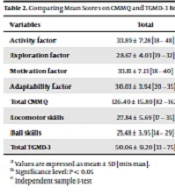
Significant differences were found between urban and rural children on both total scores on the CMMQ (P < 0.001) and three of the individual factors, specifically activity (P < 0.001), motivation (P < 0.001), and exploration (P < 0.001). Overall, children in rural areas scored higher on average compared to those in urban areas.
In terms of performance on the TGMD-3, children in rural areas scored higher overall compared to those in urban areas (P < 0.001). These differences were also noted for each of the two factors, locomotor skills (P < 0.001) and ball skills (P < 0.001) on the TGMD-3. The results are highlighted in Table 2.
Table 2.
Comparing Mean Scores on Children Movement Motivation Questionnaire (CMMQ) and TGMD-3 Between Rural and Urban Children
| Variables | Total | Rural | Urban | P-Value b | ^d (95% CI) |
|---|---|---|---|---|---|
| Activity factor | 33.89 ± 7.28 [18 – 48] | 35.66 ± 6.24 [25 – 45] | 32.15 ± 7.81 [18 – 39] | <0.001 c | 0.5 (0.3, 0.69) |
| Exploration factor | 28.67 ± 4.03 [19 – 32] | 30.08 ± 4.02 [20 – 31] | 27.29 ± 3.55 [19 – 33] | <0.001 c | 0.74 (0.53, 0.94) |
| Motivation factor | 33.81 ± 7.13 [18 – 40] | 35.82 ± 5.77 [25 – 42] | 31.66 ± 7.41 [18 – 45] | <0.001 c | 0.63 (0.42, 0.83) |
| Adaptability factor | 30.03 ± 3.94 [20 – 35] | 30.08 ± 3.88 [20 – 35] | 29.99 ± 4.01 [20 – 35] | <0.809 c | 0.02 (-0.17, 0.22) |
| Total CMMQ | 126.40 ± 15.80 [82 – 162] | 131.81 ± 13.34 [101 – 158] | 121.09 ± 16.25 [82 – 153] | <0.001 c | 0.72 (0.52, 0.92) |
| Locomotor skills | 27.84 ± 5.69 [17 – 35] | 30.42 ± 4.58 [19 – 39] | 25.32 ± 5.548 [17 – 38] | <0.001 c | 1 (0.79, 1.21) |
| Ball skills | 21.48 ± 3.95 [14 – 29] | 27.14 ± 5.61 [17 – 39] | 23.19 ± 5.84 [14 – 36] | <0.001 c | 0.69 (0.49, 0.89) |
| Total TGMD-3 | 50.06 ± 9.20 [33 – 75] | 53.61 ± 7.98 [37 – 74] | 46.58 ± 9.01 [33 – 75] | <0.001 c | 0.83 (0.62, 1.03) |
a Values are expressed as mean ± SD [min-max].
b Significance level: P < 0.05.
c Independent sample t-test.
Pearson's correlation coefficient was used to illustrate the relationship between scores on the CMMQ and the TGMD-3. The results (refer to Table 3) show a significant correlation between the total CMMQ and the total TGMD-3. This effect was found for both rural and urban children (P < 0.001).
Table 3.
Pearson Correlation Coefficients Among Children Movement Motivation Questionnaire (CMMQ) Factors and TGMD-3 Scores in Locomotor and Ball Skills in Rural and Urban Children a
| Factor | All Children | Rural Children | Urban Children | ||||||
|---|---|---|---|---|---|---|---|---|---|
| Locomotor | Ball | Total | Locomotor | Ball | Total | Locomotor | Ball | Total | |
| Activity | r = 0.368, P < 0.001 | r = 0.525, P < 0.001 | r = 0.386, P < 0.001 | r = 0.276, P < 0.001 | r = 0.580, P < 0.001 | r = 0.338, P < 0.001 | r = 0.315, P < 0.001 | r = 0.419, P < 0.001 | r = 0.321, P < 0.001 |
| Exploration | r = 0.285, P < 0.001 | r = 0.239, P < 0.001 | r = 0.306, P < 0.001 | r = 0.31, P < 0.001 | r = 0.168, P = 0.018 | r = 0.267, P < 0.001 | r = 0.017, P = 0.811 | r = 0.117, P = 0.096 | r = 0.139, P = 0.049 |
| Motivation | r = 0.392, P < 0.001 | r = 0.534, P < 0.001 | r = 0.405, P < 0.001 | r = 0.273, P < 0.001 | r = 0.565, P < 0.001 | r = 0.327, P < 0.001 | r = 0.318, P < 0.001 | r = 0.422, P < 0.001 | r = 0.330, P < 0.001 |
| Adaptability | r = 0.083, P = 0.098 | r = 0.030, P = 0.555 | r = 0.163, P = 0.001 | r = 0.088, P = 0.220 | r = 0.093, P = 0.193 | r = 0.203, P = 0.004 | r = 0.087, P = 0.221 | r = -0.033, P = 0.644 | r = 0.144, P = 0.040 |
| Total CMMQ | r = 0.440, P < 0.001 | r = 0.552, P < 0.001 | r = 0.480, P < 0.001 | r = 0.373, P < 0.001 | r = 0.608, P < 0.001 | r = 0.448, P < 0.001 | r = 0.322, P < 0.001 | r = 0.412, P < 0.001 | r = 0.371, P < 0.001 |
a *Significance level: P < 0.05; Pearson correlation coefficient.
The factors of exploration, motivation, and activity were positively and significantly related to both locomotor and ball skills in rural children (P < 0.001).
The factors of motivation and activity were related to locomotor and ball skills in urban children (P < 0.001). The details of these results are listed in Table 3.
5. Discussion
The aim of this study was to investigate the relationship between motivation to move and FMS development in urban and rural children. Our study highlights a significant and positive relationship between the motivation to move and the development of FMS in children. Further, this relationship was significant in both populations of urban and rural children. These results support previous findings (5, 6, 9) and are in line with theories that emphasize the importance of motivation in the acquisition of new movement patterns and milestones in children (3, 6, 9, 10). Many developmental theories include the motivation to move as a motor driver through which children acquire new movement patterns. Although, in some cases, it may appear easy to move from one activity to another or to acquire new movement patterns without investing a great deal of expense and energy, individuals need sufficient energy, motivation, and external reinforcements to perform many movements and sports skills (6, 9, 10, 13). In this regard, many researchers cite motivation as one of the reasons why children abandon successful motor postures, such as crawling and the quadruped position, which they perform skillfully, and try to adopt new postures and movement patterns, such as cruising and walking (31). Earlier work has shown a positive relationship between movement motivation and motor development in infants with a description of the characteristics of children with different levels of motivation (6). It is important to note that this relationship is likely bidirectional in nature. Our work suggests that children who score low on the CMMQ might be less likely to move, have less intensity, and have fewer periods of physical activity. These children might appear more passive as per their movement repertoire. However, children who score mid-range on the CMMQ might move in gentle sequences and not demonstrate high or low-energy activities. Children who score high on the CMMQ might appear very motivated for mobility and locomotion and not need an external stimulus to start moving and continue their movement for a longer period of time. These children might often demonstrate high-energy activities (such as going up the stairs) and appear very active and mobile. Moreover, their movements are fast, frequent, and intense and do not require external encouragement (6, 12). Therefore, it appears that children with high CMMQ scores might seek out opportunities more readily, which lends to more practice and, theoretically, further development of their motor skills and FMS development. These theories are supported by the results of the present study (6, 11, 12). Further, it provides evidence to support the incorporation of motivation into clinical practice for those who work with both typically developing children and children with disabilities or special needs. The positive and significant relationship between CMMQ and FMS development can be of theoretical importance and applicable to the implementation of rehabilitation plans. According to the clinical experience of specialists, focusing on movement motivation in children can potentially improve the effectiveness of movement intervention programs (32). In addition, therapists should consider the importance of movement motivation when considering the factors influencing the acquisition of motor skills. Children with higher motor motivation might be more likely to participate and continue with a given intervention program. The importance of motivation is further highlighted by recommendations to include this in the goal-setting process during treatment (6, 32).
The results of this work also suggest that the development of FMS in rural children might be different. It appears that this might be in part due to the increased presence of opportunities in the rural environment that promote FMS development. Rural children have higher scores of FMS development in both dimensions of locomotor and ball skills compared to urban children. These results are consistent with previous findings (17, 20, 24-26), although others have found no differences (28). The results of this work emphasize the importance of considering these unique circumstances in which children develop. Urban children often have limited physical space inside the house, absent parents for long hours at home, and generally less opportunity for mobility, activity, and exploration, which translate into fewer developmental opportunities. In addition, these children often attend school with a large number of other children, which often results in a lack of sufficient suitable space. In contrast, rural kindergartens often have a larger and more suitable learning space than urban centers. Urban kindergartens mainly use buildings that are not dedicated to kindergartens and are often converted houses with little change to optimize the space for learning. This is in stark contrast to rural kindergartens that have dedicated and large spaces for games and movement activities (17). The activity preferences of rural and urban children also differ, which might also contribute to the difference in FMS development found in this study. Ozdirenc and colleagues reported that rural children prefer to play football and volleyball, compared to urban children who prefer to exercise at home and spend more time watching television during the week (33). In urban life, children travel to school by their parents’ car or a school service; however, in rural areas, due to the smaller number of preschool centers, children travel longer distances to school and are more active overall. Although these differences in rural and urban areas might not be as pronounced in developed countries, these differences are still quite significant in developing countries. Further, the difference between rural and urban environments is often attributed to differences in the distribution of economic, educational, nutritional, and health facilities (18). However, even in some European countries, such as the United Kingdom, rural areas are considered a better place for children to grow up because they are closer to the natural world, and their main features are freedom and the opportunity to explore the outdoors (17-19). Again, the results of this study further support that the lived experience of rural and urban children is different and that the experiences of rural children appear to facilitate the development of FMS. Ultimately, the rural environment appears to provide a more positive environment for motor development.
Finally, the results of this study highlight that preschool children resident in rural areas have higher levels of movement motivation compared to urban children. No study to date has investigated the level of movement motivation among children resident in urban and rural areas. Van Hofsten (9) considers exploratory motivation and social motivation as two important sources of motivation to move. From birth, these two sources of motivation act as motor drivers and provide a driving force for actions and motor behaviors throughout life. Exploratory motivation is enhanced by curiosity to discover new and interesting objects as well as to understand one's own functional abilities. However, social motivation facilitates a wider range of human interactions (9). Taking these ideas together within the context of the findings of this work, it can be suggested that rural environments provide more opportunities for exploring objects than urban environments through opportunities available in wider and more open spaces for play and leisure activities. In addition, rural environments provide more opportunities for interactions with peer groups and participation in group games, which can further increase children's exploratory motivation and social attachment. It appears that rural environments provide a better context for movement motivation due to the prevailing conditions and lack of strict parental control, as well as increased independence overall.
5.1. Limitations
Due to the large population of children and the large area of urban and rural areas of Iran, this study was limited to children aged 4 to 6 years in urban and rural areas of Lorestan province. Data was not collected on variables such as children's nutrition and sleep, as well as additional individual characteristics outside of the demographics listed for subjects that might affect the results or interpretation of the study. This study did not assess how factors that relate to the parents or siblings, such as parental or sibling engagement in physical activity, might be implicated in the relations examined. However, due to the difference in the amount and type of physical activity of parents in urban and rural areas, there is a possibility of children modeling their level of physical activity and movement. In this regard, it is possible that living in rural areas results in a different pattern of engagement in physical activity for children due to the type of work and daily activities of parents or siblings, as well as the closer relationship of rural children with their parents than their urban counterparts. This might lead to increased movement motivation and, subsequently, further development of FMS in rural children compared to urban children. Another limitation is that this study does not investigate the possible influence of social interactions on motivation.
5.2. Conclusions
Motivation appears to be an important variable for the development of motor skills and is influenced by the environment. The development of motor skills is different in urban and rural children. Further, motivation appears to be an important consideration in this regard, as it also differs between urban and rural children and is associated with the development of motor skills. As such, this supports the inclusion of these factors in the development and implementation of programs for both typically developing children and those with special needs.