Fulltext
Full-text is available in PDF format.
Journal of Nursing and Midwifery Sciences
The Official Journal of Mazandaran University of Medical Sciences
Authors
 5, George A. Morgan6
Context: The Dimensions of Mastery Questionnaire has been widely used to assess children's motivation to master skills and solve problems.
Aims: The present study examined Iranian parents' views on the mastery motivation of their children compared with the children's views of their own mastery motivation.
Setting and Design: This analytic cross-sectional and psychometric study was done in 2017-2018 in Iranian governmental regular schools in Sari, Babol (Mazandaran) and Tehran. 11 schools (5 Tehran, 3 Sari and 3 Babol) were selected based on cooperation and acceptance of the study.
Materials and Methods: A convenience sampling of 114 families with schoolage children was invited to participate in the present study. Fathers (33.7%) or mothers (69.7%) and their 1115 yearold children (67% boys) filled the questionnaires; 42 parents and 33 children were asked to refill questionnaires after 2 weeks.
Statistical Analysis Used: All data were analyzed using descriptive statistics, inferential internal consistency, and testretest reliability.
Results: There was no difference between parent and child views on 3 out of 4 persistence subscales, but for all the emotional subscales plus general competence, children rated themselves higher than the parents rated them. The intraclass correlation coefficient of all domains and total score were significant (P ˂ 0.01).
Conclusions: Pediatric rehabilitation professionals need to be aware that children and adults may differ in their view of the children's motivation. Disagreements should be discussed with parents and students. Specific treatment goals should be developed for the dimensions on which both parents and their children agree.
© 2021, Author(s). This open-access article is available under the Creative Commons Attribution 4.0 (CC BY 4.0) International License (https://creativecommons.org/licenses/by/4.0/), which allows for unrestricted use, distribution, and reproduction in any medium, provided that the original work is properly cited.
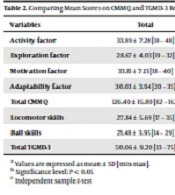
Nazarpouri S, Doralp S, Bahram A, Sayarifard A, Haqqani S. The Relationship Between Motivation to Move and the Development of Fundamental Movement Skills Among Urban and Rural Preschool Children in Iran. Asian J Sports Med. 2023;14(4):e123635. doi: https://doi.org/10.5812/asjsm-123635
Ganji J, Merghati Khoei E, Maasoumi R, Keramat A, Emamian MH. Knowledge and attitude and practice of parents in response to their children's sexual behavior. J Nurs Midwifery Sci. 2022;9(1):e140684. doi: https://doi.org/10.4103/jnms.jnms_45_20
Farahani M, Bassaknejad S. The Relationship Between Attitude Towards Oneself, the World and the Future, and Parental Stress in Mothers of Children With Learning Disabilities. Jentashapir J Cell Mol Biol. 2016;7(4):e30951. doi: https://doi.org/10.17795/jjhr-30951
Sadeghi M, Parsa Moghadam A, Ahmadi SM, Sadeghi K, Parvizifard A. Factors Affecting Students’ Academic Motivation and Achievement Motivation in Kermanshah University of Medical Sciences. Educ Res Med Sci. 2016;5(1):e79180. doi:
Aliakbarzade Arani Z, Khari Arani M. Evaluation of the self-concept of mothers with educable mentally retarded (EMR) children. J Nurs Midwifery Sci. 2016;3(1):e141264. doi: https://doi.org/10.18869/acadpub.jnms.3.1.23
Last Update: 1 month ago
Last Update: 1 month ago
Last Update: 1 month ago
Last Update: 6 days ago
Last Update: 1 day ago
Last Update: 4 days ago

