1. Background
As an intermittent high-intensity sport, badminton involves repeated acceleration and deceleration, abrupt changes in direction, jumping, and dynamic stroke execution (1, 2). These demands necessitate repeated intensive training sessions within a microcycle to maintain physical capacity and technical performance, thereby increasing the need for adequate recovery before the subsequent session (3-5).
Strenuous exercise increases oxygen utilization and metabolic activity, thereby stimulating the generation of reactive oxygen species (ROS) (6). When endogenous antioxidant systems cannot neutralize ROS, oxidative stress develops and may promote lipid peroxidation (7). As a primary marker of lipid peroxidation, malondialdehyde (MDA) is widely used to evaluate oxidative stress responses during exercise and post-exercise recovery (8, 9).
Nutritional interventions have received attention in sports science as strategies to reduce post-exercise oxidative stress. Curcumin, the principal bioactive constituent of Curcuma longa, has documented antioxidant and anti-inflammatory effects through the modulation of inflammatory pathways and antioxidant defenses and may support recovery after intense exercise (10, 11). However, oxidative stress biomarker responses to supplementation may vary according to dose, duration, participant characteristics, and exercise protocol (12).
High-intensity interval training (HIIT) is an efficient and relevant model for intermittent sports because it involves repeated high-intensity work-recovery intervals. On an ergocycle, HIIT can be standardized using a target heart rate, such as 90% of maximal heart rate, and controlled cadence parameters, thereby providing a reproducible physiological stimulus (13).
Current evidence regarding the effectiveness of a single 500 mg dose of curcumin in badminton athletes after an acute ergocycle HIIT session remains limited, particularly when oxidative stress outcomes are assessed during recovery, such as 24 hours after exercise (14-16). Immediate post-exercise administration was selected to determine whether curcumin intake during early recovery could modulate the subsequent oxidative stress response, particularly the changes in MDA observed 24 hours after the standardized HIIT stimulus. This information is needed to clarify whether acute post-exercise curcumin supplementation can meaningfully influence oxidative stress recovery in badminton athletes.
2. Objectives
This study evaluated whether changes in plasma MDA levels from immediately after exercise and before supplementation (T1) to 24 hours after supplementation (T2), following a single ergocycle HIIT session at 90% of maximal heart rate, differed between the curcumin and placebo groups. Given the acute design and small preliminary sample, the study was intended to provide initial evidence regarding the 24-hour MDA response to post-exercise curcumin supplementation rather than definitive conclusions about the broader efficacy of curcumin in reducing exercise-induced oxidative stress.
3. Methods
This quasi-experimental pretest-posttest control-group study examined the effect of curcumin supplementation on plasma MDA levels during the 24-hour recovery phase after HIIT. The protocol was approved by the Health Research Ethics Committee of Universitas Negeri Malang (KEPK UM) under approval code 27.08.10/UN32.14.2.8/LT/2025. Written informed consent was obtained from all participants.
3.1. Participants and Group Allocation
The study was conducted at the Physiology Laboratory, Universitas Brawijaya, from August to September 2025. Participants were recruited from a university badminton club. The final analysis included 13 male badminton athletes or students aged 18 - 25 years: 6 participants in the group receiving 500 mg of curcumin without piperine and 7 participants in the placebo group. As this was a preliminary acute intervention study, no formal a priori sample size calculation was performed; all eligible participants available during the study period were recruited. Participants had a normal Body Mass Index (BMI), with comparable BMI values between groups, and none were classified as overweight.
The inclusion criteria were male sex, age 18 - 25 years, regular participation in badminton training, apparently healthy status, no current musculoskeletal injury, normal BMI, and the ability to complete the ergocycle-based HIIT protocol. Participants were excluded if they had a history of cardiovascular, metabolic, hepatic, renal, or other chronic disease; were currently taking antioxidant, anti-inflammatory, herbal, turmeric, or curcumin supplements; had a recent acute illness or injury; were unable to complete the exercise protocol; or declined to provide written informed consent. Eligibility was confirmed through interview-based screening, a health history assessment, and a baseline non-exercise assessment.
3.2. Exercise Protocol
Before the intervention session, participants completed a 12-hour fast and then performed a single HIIT session on an ergocycle. The session lasted 20 minutes and was performed at approximately 90% of maximal heart rate. Maximal heart rate was estimated using the formula 220 - age, and heart rate was monitored throughout the session (17, 18).
The HIIT protocol consisted of repeated 10-second high-intensity cycling bouts at 100 rpm followed by 50 seconds of active recovery at 45 - 55 rpm. This cycle was repeated continuously until the total exercise duration reached 20 minutes.
3.3. Supplementation and Blood Sampling
The first blood sample (T1) was collected immediately after the HIIT session and before capsule ingestion. Thus, T1 represented post-exercise plasma MDA levels before supplementation. After T1 blood sampling, participants consumed a capsule according to their group allocation: either 500 mg of curcumin without piperine or placebo. The placebo capsules were prepared to resemble the curcumin capsules in physical appearance to reduce expectancy-related bias. During the 24-hour recovery period, participants were instructed not to perform additional exercise or strenuous physical activity.
The second blood sample (T2) was collected 24 hours after capsule ingestion following an approximately 10-hour fast. Thus, T2 represented plasma MDA levels during the 24-hour recovery phase after HIIT and supplementation (19). At each sampling point, 3 mL of venous blood was collected into ethylenediaminetetraacetic acid tubes and processed to obtain plasma. Plasma MDA levels were analyzed using a commercially available MDA assay kit from BT LAB, Shanghai Korain Biotech Co., Ltd., Shanghai, China (catalog No. 1007/96S), according to the manufacturer's protocol. Results were expressed in nmol/mL.
3.4. Statistical Analysis
Statistical analyses were performed using analysis of covariance (ANCOVA) within a general linear model. MDA at T2 was the dependent variable, treatment group was the between-subject factor, and MDA at T1 was the covariate. This approach compared MDA levels during the 24-hour recovery phase between the curcumin and placebo groups while controlling for post-exercise, pre-supplementation MDA. The homogeneity-of-regression-slopes assumption was assessed using the interaction between group and T1 MDA. Results were reported using F values, P values, partial eta squared (ηp2), and adjusted means. Statistical significance was set at α = 0.05.
4. Results
Thirteen male badminton athletes aged 18 - 25 years completed the acute protocol and provided complete MDA data at T1 and T2. Participants were allocated to the 500 mg curcumin group (n = 6) or the placebo group (n = 7). No missing data or adverse events were recorded during the 24-hour follow-up. As shown in Table 1, MDA increased from T1 to T2 in both groups, and within-group tests indicated significant increases in both groups.
Table 1.
Malondialdehyde Levels at T1 and T2 and Within-Group Changes a
| Group | n | T1 (nmol/mL) | T2 at 24 h (nmol/mL) | Mean Change (nmol/mL) | P Value, Paired t Test | P Value, Wilcoxon Test | Cohen dz |
|---|---|---|---|---|---|---|---|
| Curcumin, 500 mg | 6 | 0.65 ± 0.13 | 1.16 ± 0.44 | 0.51 (0.16 - 0.86) | 0.0127 | 0.0313 | 1.55 |
| Placebo | 7 | 1.03 ± 0.58 | 1.37 ± 0.47 | 0.33 (0.20 - 0.46) | 0.00068 | 0.0156 | 2.36 |
a Values are expressed as mean ± SD or 95% CI.
Figure 1 shows the mean MDA at T1 and T2 for each group.
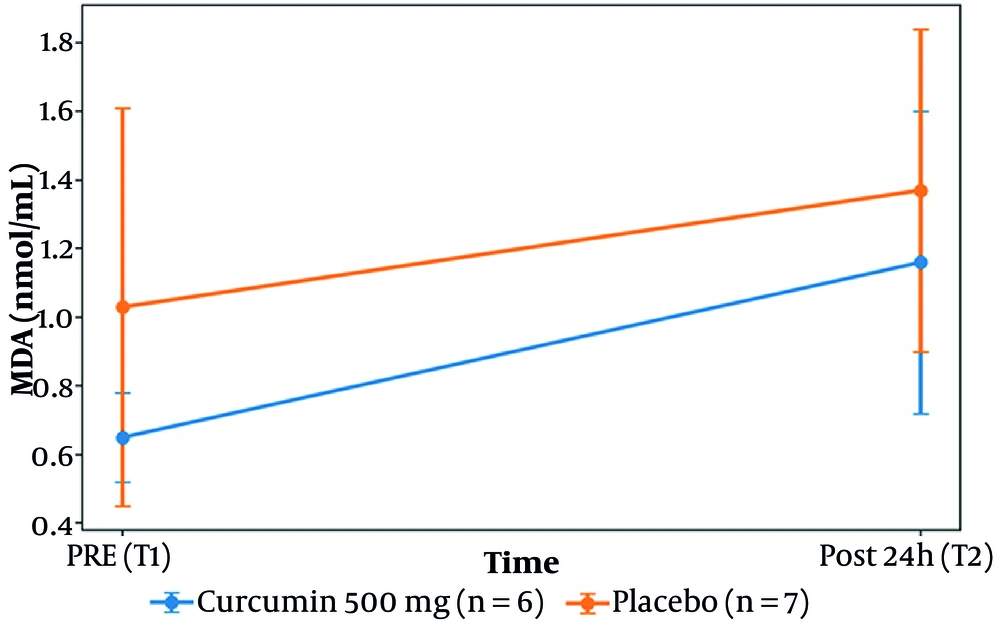
Figure 1.
Mean (± SD) MDA at T1 and T2 for Each Group
Figure 2 shows the mean change in MDA for each group.
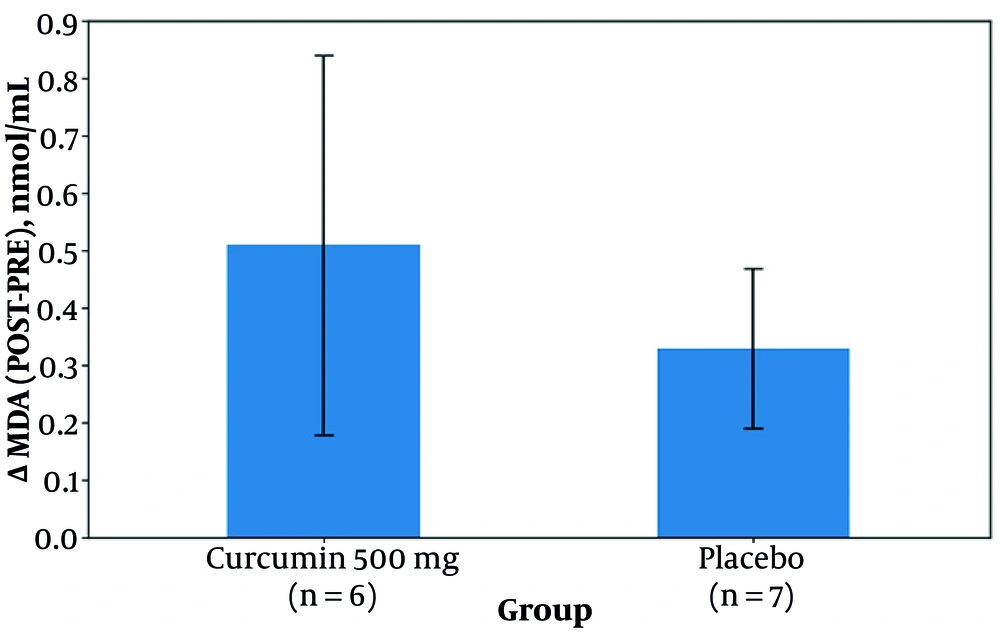
Figure 2.
Mean (± SD) Change in MDA (Δ = T2 - T1) for Each Group
Between-group analyses showed no significant difference in the change in MDA between the curcumin and placebo groups. The mean difference in change was +0.17 nmol/mL (95% CI, -0.17 to +0.52), and neither the Welch test (P = 0.268) nor the Mann-Whitney test (P = 0.445) was significant (Table 2; Figure 3). The Time × Group interaction was also not significant (P = 0.163); therefore, these data provide no strong evidence that a single 500 mg dose of curcumin administered after exercise altered the magnitude of the MDA increase during the 24-hour recovery period. A baseline-adjusted sensitivity analysis was conducted with T2 MDA as the dependent variable, group as the fixed factor, and T1 MDA as the covariate. The Group × T1 MDA interaction was significant, F(1, 9) = 25.826, P = 0.001, partial η2 = 0.742, indicating a violation of the homogeneity-of-regression-slopes assumption. Therefore, a standard ANCOVA model without an interaction term was not considered appropriate for primary inference, and no single overall adjusted group effect was interpreted. In the same model, T1 MDA was a significant covariate, F(1, 9) = 70.800, P < 0.001, partial η2 = 0.887.
Table 2.
Primary Between-Group Inference and Baseline-Adjusted Sensitivity Analysis
| Analysis | Result | P Value | Effect Size | Interpretation |
|---|---|---|---|---|
| Difference in change (curcumin - placebo) | +0.17 nmol/mL (95% CI, -0.17 to +0.52) | Welch P = 0.268; Mann-Whitney P = 0.445 | Hedges g = 0.66 | Not significant |
| Time × Group interaction (mixed ANOVA) | - | 0.163 | - | Not significant |
| Group × baseline interaction | F(1, 9) = 25.826 | 0.001 | Partial η2 = 0.742 | Significant; standard ANCOVA without an interaction term was not appropriate |
| Baseline covariate (T1 MDA) | F(1, 9) = 70.800 | < 0.001 | Partial η2 = 0.887 | Significant covariate |
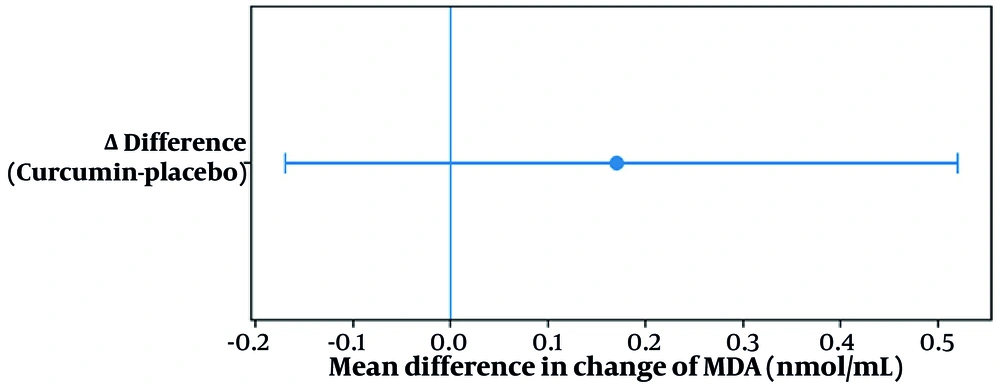
Figure 3.
Between-Group Difference in MDA Change With 95% CI
5. Discussion
The present study evaluated whether a single 500 mg dose of curcumin administered immediately after acute ergocycle HIIT was associated with a different plasma MDA response during the 24-hour recovery period in badminton athletes. MDA increased from T1 to T2 in both groups, and no inferential evidence supported a between-group difference in the change in MDA (Table 2). In this preliminary sample, acute post-exercise curcumin supplementation had no detectable effect on the 24-hour MDA response.
The elevation in MDA 24 hours after exercise indicates that oxidative stress likely persisted during recovery. Acute high-intensity exercise substantially increases adenosine triphosphate turnover, oxygen flux, and mechanical loading, which may promote ROS formation in working skeletal muscle. When endogenous antioxidant defenses are insufficient to counter this oxidative challenge, ROS can damage polyunsaturated fatty acids in cell membranes and trigger lipid peroxidation. Because MDA is a downstream product of this process, its elevated concentration 24 hours after exercise supports the interpretation that the HIIT session induced a measurable oxidative disturbance rather than only a short-lived metabolic response (20).
The biological relevance of curcumin derives from its reported ability to regulate redox-related mechanisms, including nuclear factor kappa B and nuclear factor erythroid 2-related factor 2, thereby exerting antioxidant and anti-inflammatory effects. However, the present results suggest that the oxidative load induced by the HIIT session was not detectably altered by a single 500 mg dose administered only after exercise. The timing of supplementation may not have coincided optimally with the onset of lipid peroxidation, and the low oral bioavailability of curcumin without an absorption enhancer may have limited its systemic effect. Thus, in this preliminary sample, acute post-exercise curcumin at this dose and timing had no detectable effect on the 24-hour oxidative stress response reflected by MDA (21, 22).
This finding is consistent with previous literature showing heterogeneous effects of curcumin on acute exercise responses (23). Several studies reporting beneficial effects have used different supplementation strategies, including administration before exercise or repeated dosing over several days, which may provide greater biological exposure than a single post-exercise dose (24). Evidence concerning oxidative stress markers is also more limited than that concerning inflammatory or muscle-damage markers. Curcumin effects may be more difficult to detect for oxidative outcomes because these outcomes are strongly influenced by sampling time, analytical approach, and the exercise protocol.
A notable methodological issue was the lower T1 MDA value in the curcumin group than in the placebo group. A baseline-adjusted sensitivity analysis was therefore conducted. However, the significant Group × T1 interaction indicated that the relationship between T1 and T2 MDA differed by group, violating the homogeneity-of-regression-slopes assumption required for a standard ANCOVA without an interaction term. This finding increases uncertainty in the interpretation of adjusted between-group comparisons in this small preliminary sample and supports cautious interpretation of the results (25).
From a practical perspective, these findings do not support recommending a single 500 mg dose of curcumin as a stand-alone strategy to attenuate the 24-hour MDA response after intense interval exercise. Future studies should examine larger samples, repeated or preload supplementation strategies, and broader biomarker panels.
5.1. Study Limitations
Several limitations should be acknowledged, including the small sample, the absence of a pre-exercise baseline measurement, and the use of a single biomarker. Additional sampling points, including a pre-exercise baseline and 48 hours after exercise, would help clarify the temporal pattern of the MDA response.