1. Background
Karate represents one the most popular combat sports around the world. It has been well established by several studies that the overall metabolic profile is predominantly aerobic, although the decisive actions are maintained by anaerobic processes (1-3). Thus, it has been suggested that to achieve high-level competitive performance, karatekas (i.e. karate practitioners) need a development of both anaerobic and aerobic fitness (1, 4). Consequently, the assessment of aerobic fitness on a regular basis is important for monitoring the effectiveness of the physical training program and the preparedness of karatekas to compete. The progressive treadmill laboratory test constitutes the main laboratory test that has been employed to evaluate the aerobic fitness level of karatekas (2, 4, 5). While the use of laboratory based tests usually provides good internal validity and reliability, the procedures involved are time consuming and require highly trained personnel (6). Moreover, laboratory treadmill testing requires the karateka to perform in an exercise mode (linear running) that is not sport-specific. In this context, for a kind of sport such as karate, the exercise is intermittent and performance is exclusively related to the karateka’s ability to repeatedly perform extremely high-intensity sport-specific actions (1-3, 7). Thereafter, continuous laboratory tests appear to be unsuitable for precisely assessing the oxidative profile of intermittent sports as karate (8).
Thereby, for such a sport it looks logical to assess the ability of karatekas to perform high-intensity actions as well as their potential to recover from intensive exercise. Additionally, field tests are considered as a sustainable alternative to laboratory testing (9), with some proposals being presented for karate (8, 10, 11). In accordance with this, the karate specific aerobic test (KSAT) has been proposed (10). This test consists of repeated sequential sets involving straight punch and roundhouse kick combinations on a heavy punch/kick bag suspended from a wall mounted bracket, interspersed with recovery periods. Its aim is to progressively elicit a karateka’s maximal physiological response while performing karate specific techniques by means of reducing the recovery periods between exercise bouts (10). Recently, the reliability as well as the construct validity of the KSAT has been established (8). The preliminary study established by Nunan (10) revealed that there was a significant correlation between peak oxygen consumption measured through portable gas analysis and KSAT’s time to exhaustion (TE) (R2 = 0.77, P < 0.001). However, the criterion related validity of KSAT with a gold standard test (i.e. treadmill laboratory test) has not yet been established.
Therefore, the next step to verify the validity of this test would be to establish its criterion related validity, which represents one of the most important characteristics of a test, before it could be properly used. Apart from the laboratory VO2max test, endurance is also assessed on the field. During the last decade, intermittent endurance has extensively been evaluated through non-continuous field tests. In this context, the YoYo intermittent recovery test (YoYoIRT), which consists of increasing speed multiple shuttle-runs interspersed with recovery periods, has been shown to present not only criterion validity with respect to the reference VO2max test, but also logical validity for a myriad of sports (12). Indeed, this test, composed of intermittent efforts, seems to be closer to karate than the classical continuous effort endurance tests. In some sports, as soccer, the YoYo intermittent recovery test (level 1) has also shown to display direct validity as correlated to some on-field match variables (13).
2. Objectives
Thus, the main purposes of the present study was to determine: a) the relationship between KSAT’s time to exhaustion (TE) and parameters of aerobic fitness measured through the continuous treadmill laboratory test and b) the relationship between TE’s KSAT and parameters of intermittent endurance measured through YoYoIRTL1 in a sample of high-level karatekas. Our hypothesis was that KSAT’s TE performance would be correlated with both laboratory endurance factors (i.e. VO2max and vVO2max) and YoYoIRTL1 parameters.
3. Patients and Methods
3.1. Subjects
This study included a total of fifteen healthy (12 males and 3 females) volunteered karatekas providing their signed informed consent to participate in this investigation. Subjects’ characteristics are shown on Table 1. Percentage of body fat was determined by a qualified anthropometrist using the formula of Siri (14). All subjects competed at national and international level under different weight categories (four male athletes at -60 kg category, three male athletes at -67 kg category, two male athletes at -75 kg category, two male athletes at -84 kg category, one male athlete at + 84 kg category, and one female athlete at each of the -55 kg, -61 kg, and at -68 kg categories). Ten karatekas performed both the treadmill laboratory test and KSAT test (8 males and 2 females) to establish the criterion related validity of the KSAT. Another experiment has been conducted with eleven karatekas (9 males and 2 females) in order to establish the relationship between performances from YoYoIRTL1 and TE’s KSAT.
Table 1.
Participants’ Physical Characteristics a
| Variable | Treadmill Group, n = 10 | YoYo Test Group, n = 11 | Overall, n = 15 |
|---|---|---|---|
| Age, y | 20.4 ± 2.1 | 24.2 ± 5.7 | 22.2 ± 4.3 |
| Height, cm | 174.6 ± 6.5 | 175.2 ± 9.2 | 175.4 ± 7.5 |
| Body mass, kg | 67.75 ± 9.2 | 71.7 ± 10.6 | 70.3 ± 9.7 |
| Body Fat, % | 14.3 ± 6.5 | 13.1 ± 6.4 | 13.2 ± 6 |
| Body mass index, kg/m2 | 21.68 ± 1.67 | 22.5 ± 1.4 | 22 ± 1.7 |
a Data are presented as mean ± SD.
All karatekas regularly trained at the national center for elite athletes for ~16 hours per-week, divided in ~4 ± 2 hours per-week for strength and conditioning and ~12 ± 2 hours per week dedicated to technique and tactic training. All karatekas were at the competitive phase of their training periodization. None of them were taking any medications that might interfere with their physiological responses, and none had any limitations to strenuous exercise as determined by a medical certification. Subjects were informed of the potential experimental risks and gave their written informed consent to participate in this study. The university ethics committee approved the study protocol.
3.2. Experimental Design
Karatekas were familiarized with the KSAT testing procedures as well as the YoYo test during a control day one week before the actual measurements. As they performed the laboratory treadmill test twice a year as usual physiological follow-up we did not include a new session for familiarization for this test. Before the beginning of the KSAT test, karatekas completed a warm-up of 15 minutes which included self-selected intensity jogging and dynamic stretching (hip extensors, hamstrings, hip flexors, and quadriceps femoris). After ~5 minutes of rest after the end of the warm-up, subjects performed the KSAT. Karatekas were asked to follow their normal diet, to consume a light meal at least 3 hours before each test protocol and to stop any vigorous fitness activity in the last 24 hours prior to the tests. Data from the two test protocols were collected at approximately the same time of day (between 16:00 - 18:00 P.M). Karatekas’ heart rate (HR) was recorded every 5 seconds (Polar S610, Kempele, Finland) to assess the cardiovascular strain associated with KSAT as it has been reported that heart rate measurement produced a reliable index of exercise intensity during different intermittent exercise situations (12, 15). Capillary blood samples were drawn at 3 minutes post-test from the earlobe. Blood lactate [La] was determined using the Lactate Pro-analyzer (Arkray, Tokyo, Japan). During the KSAT test, one of the researchers was asked to hold a heavy punch/kick bag to avoid unwanted movement during the execution of different kicks and punches.
The test finished when the subject reached volitional exhaustion at which time to exhaustion (TE), exercise level, and the number of cycles performed during the test were registered. Subjects ran on a 3% slope motorized treadmill (Ergo XELG 90; Woodway, Weil, Germany). Cardiorespiratory variables were determined using a breath by breath system (ZAN 680; Oberthulba, Germany). Prior to the test, the gas analyzers were calibrated with gases of known concentrations and the ventilatory membrane calibrated with a 1-L syringe (16).
3.3. KSAT
The test protocol consisted of sequential sets of straight punch and roundhouse kick combinations on a heavy punch/kick bag suspended from a wall mounted bracket. The combination included a leading straight punch (Figure 1 A) followed by a rear leg roundhouse kick (Figure 1 B), a rear straight punch (Figure 1 C) and a leading roundhouse kick (Figure 1 D), repeated twice (10). The time to complete this set of movement accurately and without haste was set at 7 seconds. This allowed sufficient time to execute and prepare each strike in controlled and proper manner. The progression in intensity of the exercise during the test was based on a similar sequence of emitted audio beeps as the multistage fitness test (17). The test was designed with two auditory signals, the first to let the participants know when to begin the bout of exercise and the second sound to indicate when they should rest (7 seconds later). The time to complete the exercise bout remained the same, 7 seconds, whilst the recovery time between bouts progressively decreased. Participants had to perform each punch and kick with maximum power. The aim here was to maintain maximal exercise intensity whilst progressively making the test more demanding by reducing the recovery between exercise bouts (10). When the participant failed to complete the set of movements in the 7 seconds interval twice or when there was clear decrease in the power of techniques according to the recommendations provided in the original article from Nunan (10), the time to exhaustion was recorded and represented the final test result. It has been recently shown that KSAT presents very good relative and absolute reliability (ICC > 0.90 and SEM < 5%, respectively) as well as a good discriminative ability to differentiate between national and regional level karate practitioners (8, 18).
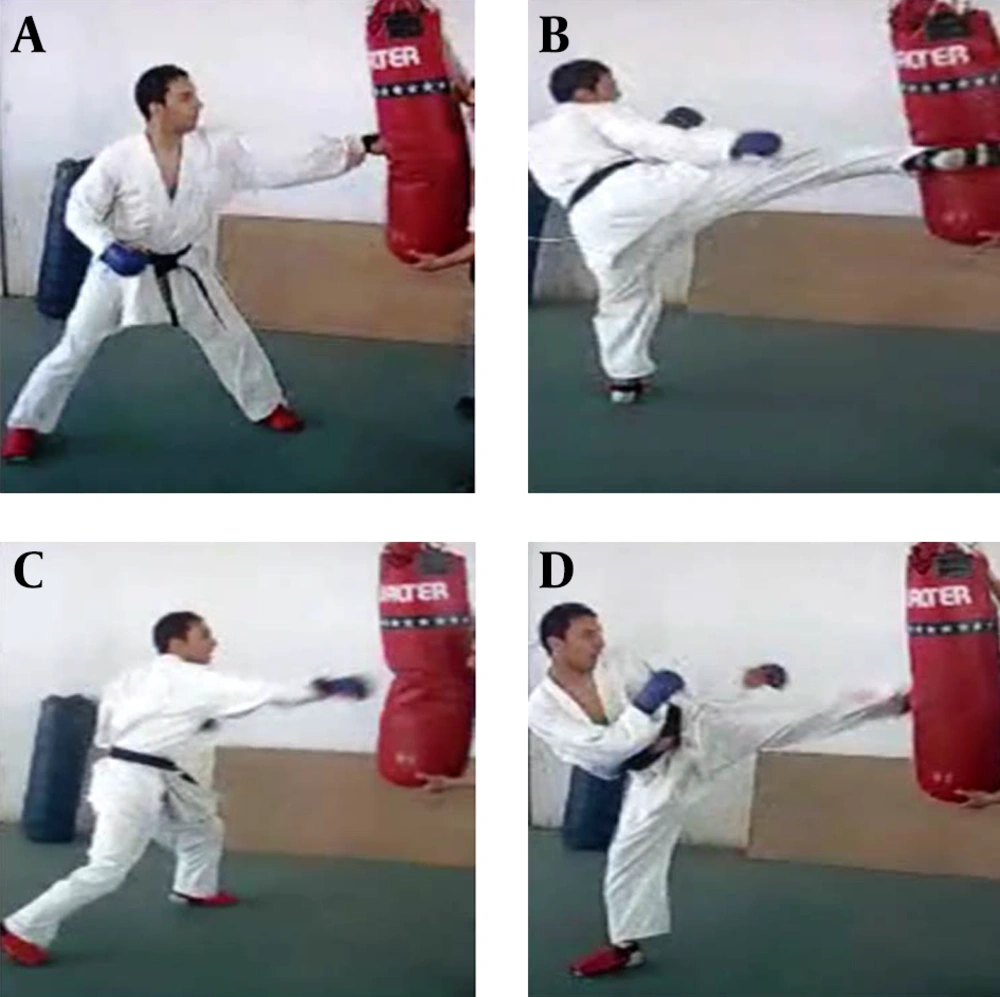
Figure 1.
A, kizami-tsuki (straight punch); B, mawashi-geri (rear leg roundhouse kick); C, kyaku-zuki (rear straight punch); and D, kiza-mawashi-geri (leading roundhouse kick).
3.4. Treadmill Running Test
After 5 minute of warm up at 8 km.h-1 with a slope of 0%, VO2max test was performed using an incremental protocol at 3% inclination with 1 km.h-1 increment every minute until exhaustion. Maximum oxygen consumption (VO2max; mL. kg. min-1), first and second ventilatory threshold determined through the visual inspection method (19) as well as heart rate (HR, bpm) were measured during the treadmill laboratory test. The highest running velocity associated with VO2max was also established (vVO2max) from the protocol. Each karateka was verbally encouraged to give maximal effort during the test. The VO2max test terminated at voluntary fatigue by the subjects. HR (> 90% predicted HRmax), RER (≥ 1.1), and a possible plateau of the VO2 curve, was used to evaluate if VO2max was obtained (20).
3.5. YoYoIRTL1
The protocol used consisted of repeating 2 × 20 m runs back and forth between the starting, turning, and finishing line at a progressively increased speed controlled by audio beeps from a laptop. Between each running bout, the subjects had a 10 second active rest period, consisting of 2 × 5 m of decelerating and walk-coming back to the starting line. When the subjects failed to reach the finishing line in time twice, the distance covered was recorded and represented the test’s final result. The level 1 of this protocol consisted of one running bout at both 5 and 9 km/h (0 - 80 m), two, three and four running at 11, 12, and 13 km/h, respectively; where after it continues with stepwise 1 km.h-1 speed increments after every 8 running bouts (i.e. after 760, 1080, 1400, 1720 m, etc.) until exhaustion (13, 21).
3.6. Statistical Analysis
Data analysis was performed using SPSS version 19.0 for windows. Means ± SD were calculated for each variable. As the variables were normally distributed (Kolmogorov-Smirnov test and visual inspection) the relationships between field and laboratory test protocols were examined using Pearson moment correlations. According to Hopkins (22) the magnitude of correlation coefficient was considered as trivial (r < 0.1), small (0.1 ≤ r < 0.3), moderate (0.3 ≤ r < 0.5), large (0.5 ≤ r < 0.7), very large (0.7 ≤ r < 0.9), nearly perfect (r ≥ 0.9) and perfect (r = 1). The level of significance was set at P ≤ 0.05.
4. Results
Karatekas’ performances in the treadmill laboratory test and KSAT as well as cardiovascular responses are presented in Table 2. There was no significant difference (P = 0.64) between maximal heart rate (HRmax) recorded during the treadmill test and KSAT. Peak HR obtained during KSAT was about the same as maximal heart rate registered from the treadmill test (98. 9% HRmax). [La] observed at 3min post-KSAT was 6.23 ± 1.03 mmol/L. There was no significant correlation between TE’s KSAT and maximal oxygen uptake (r = 0.14; P = 0.69; [small]). The same result was found between TE’s KSAT and VO2 corresponding to the second ventilatory threshold (VO2 VAT) (r = -0.06; P = 0.86; [trivial]). However, there was a significant relationship between TE’s KSAT and the velocity associated with VO2max (vVO2max) (r = 0.67; P = 0.03; [large]) as well as the velocity at VO2 corresponding to the second ventilatory threshold (vVO2 VAT) (r = 0.64; P = 0.04; [large]).
| Sessions | TE, s | HRpeak, bpm | VO2max, mL/min kg | vVO2max, km/h | VO2 VT2 | vVO2 VT2 | Total Distance Covered, m |
|---|---|---|---|---|---|---|---|
| Session 1 | |||||||
| KSAT | 896 ± 133 | 190 ± 11 | |||||
| Treadmill test | 192 ± 7 | 53.0 ± 6.62 | 15.2 ± 1.6 | 48.54 ± 6.70 | 13.7 ± 1.6 | ||
| Session 2 | |||||||
| KSAT | 924 ± 126 | 186 ± 6 | |||||
| YOYO test | 192 ± 5 | 54.67 ± 5.36 c | 17.2 ± 1.7 c | 2186 ± 643 |
a Data are presented as mean ± SD.
b Abbreviations: HRpeak, Peak heart rate; KSAT, karate specific aerobic test; TE, time to exhaustion; VO2max, maximal oxygen uptake; VT2, second ventilatory threshold; and vVO2max, velocity associated with VO2max.
c Estimated value.
Karatekas’ performances in the YoYo test and KSAT as well as cardiovascular responses are presented in Table 2. No significant difference between peak HR recorded during the YoYoIRTL1 and KSAT test (Table 2) was noted (P = 0.10). KSAT’s peak HR represented 97.1% of YoYo IRTL1 peak HR. [La] at 3 minute post-KSAT was 6.01 ± 1.51 mmol/L. A statistically significant relationship was found between TE’s KSAT and both the total distance covered and parameters of aerobic performance measured through YoYoIRTL1. TE’s KSAT correlated significantly to the distance covered during YoYoIRTL1 (r = 0.65; P = 0.02; [large]). Additionally, TE’s KSAT correlated significantly to both YoYoIRTL1 estimated VO2max (r = 0.67; P = 0.02; [large]) and YoYoIRTL1 estimated vVO2max (r = 0.64; P = 0.03; [large]).
5. Discussion
This study aimed to determine whether a relationship existed between KSAT’s time to exhaustion performance (TE) and parameters of aerobic performance from continuous laboratory test. The other aim was to establish the correlation between KSAT’s performance and parameters of intermittent endurance measured through the YoYoIRTL1. Surprisingly, results showed that vVO2max correlated significantly with TE’s KSAT while VO2max did not. However, there was a significant relationship between KSAT’s TE and YoYoIRTL1 test performance.
Aerobic fitness has been shown to play a major role in karate’s top level performance (1-3). The direct assessment of VO2max requires sophisticated instruments, competent personnel and relatively expensive equipment. Moreover, such measurements are generally unavailable to most teams/athletes. Therefore, an attempt has been made by Nunan (10) in order to develop a simple specific field test to evaluate the aerobic power of karatekas. The first attempt to validate KSAT by this author revealed that there was a significant correlation between peak oxygen consumption measured through portable gas analysis during KSAT and KSAT’s TE (time to exhaustion) with a sample of 5 karatekas. However, to be widely accepted and then used as an accurate test, this field fitness test needs to be validated for the sports scientists to give athletes and coaches accurate and relevant feedback after the assessment and then enhancing the quality of the training process to optimize performance. In this context, it seems extremely important to establish criterion related validity of KSAT by identifying the relationship between KSAT’s TE and parameters of laboratory aerobic performance (gold standard test). This, as well as comparing this specific field test’s cardiovascular responses and treadmill laboratory test’s maximal cardiovascular responses is needed for the validation process, otherwise the measured TE’s KSAT will be meaningless. The VO2max recorded during the present study was similar to the values reported in previous study (3) but lower than those established in other studies (4, 5). However, it would be suggested that the difference in the running protocol adopted might explain the difference as VO2max can be affected by the protocol design (23).
Results from the present study showed a significant correlation between KSAT’s TE and vVO2max, explaining 44% of the total variance in KSAT’s final performance, but not between KSAT’s TE and VO2max (mL/minkg). In this context, Castagna et al. (21) postulated that vVO2max represents the best predictor of aerobic performance because it includes both maximal aerobic power and work economy among well trained subjects. Then, the correlation between KSAT’s TE and vVO2max is of great importance. On the other hand, the lack of correlation between TE’s KSAT and VO2max can be considered as an unexpected result, since the relationship between the two laboratory parameters (i.e. vVO2max and VO2max) were significant across a wide range of studies (24). The YoYoIRTL1 has been originally developed to assess the intermittent endurance ability of soccer players (25). It has been revealed that the YoYo test’s performance is related to the ability of the athlete to perform repetitive high-intensity action during the match, in other words to his intermittent endurance (13). In this context, karate is a high-intensity intermittent activity (1, 3, 7) and KSAT is an intermittent specific field test which contains periods of high-intensity actions and repetitive recovery pauses (8, 10, 18). Thus, the significant relationship between KSAT’s performance and YoYoIRTL1 may indicate the meaningful value of KSAT, which represents the only available specific protocol to assess a karateka’s aerobic power.
Cardiovascular responses have been widely considered as a reliable index of exercise intensity during different intermittent exercise situations (15). Difference between HR recorded during KSAT and treadmill test were not statistically significant showing that KSAT elicited very high HR responses in elite karatekas. HRpeak obtained during KSAT was about 99% of HR max recorded during treadmill test showing KSAT’s very high physiological demands. HR values recorded during the present study were very similar to those reported by Nunan (10) during the test-retest session (190 ± 11 bpmvs 191 ± 7 and 188 ± 7 bpm, respectively). Additionally, HR during KSAT as well as YoYoIRTL1 has been determined, and KSAT’s HR represented about 97% of YoYo’s HR. Thus, this finding clearly shows again that KSAT can be considered as a very demanding test and imposes high exercise load on top-level karatekas.
Blood lactate concentration after KSAT’s completion was relatively low (~6 mmol/L). These values are similar to those reported by Beneke et al. (1) (5.9 ± 1.6 mmol/L after the first match of a karate competition) and largely above those of Iide et al. (3) (3.4 ± 1 mmol/L) during simulated karate fighting. [La] observed 3 min after the end of KSAT might indicate a moderate contribution of the glycolytic metabolism in energy transfer during this test in view of the fact that [La] has been considered as a simple method which can be used to estimate the glycolytic system contribution during exercise (26). This low concentration may be due to the intermittent nature of the test. Indeed, according to Ballor and Volovsek (27) [La] is lower during intermittent exercise compared to continuous exercises at the same intensity. Hence, the low [La] may be due to its possible partial clearance during recovery periods. The intermittent nature of KSAT may be the cause of the low [La] 3 minutes after the end of this protocol. Unfortunately, [La] was not recorded at the completion of both treadmill laboratory test and YoYoIRTL1, so comparing [La] post KSAT and values at the end of these two tests was not possible. Moreover, from a methodological point of view, the site (earlobe, fingertip) of blood sampling may have affected the result. In this context, samples taken from the earlobe have been shown to result in lower [La] than samples taken from the fingertip (28). Therefore, in view of the fact that blood was taken from the earlobe, it may be that [La] determined after the KSAT during the present study is underestimated.
The results of the present study showed that the KSAT can be used as an indicator of karateka’s specific endurance as it is correlated with laboratory vVO2max and to the performance of YoYoIRTL1. These results were similar to those established by Castagna et al. (12), studying soccer players. The latter authors did not find a significant relationship between YoYoIRT’s total distance covered and treadmill VO2peak and concluded that YoYoIRT cannot be considered a valid test for aerobic power assessment in moderately trained young soccer players, but that it remains an independent specific intermittent test with validity with respect to laboratory vVO2max. One limitation of the present study is the small sample size and the use of karatekas of both genders. However, it hasn’t been possible to find more karate athletes of such level of practice. Future work with a bigger sample size seems to be needed. Another limitation of this study is the absence of VO2 measured directly during KSAT through a portable gas analyzer. In spite of the previous limitations, the present study can constitute the first step towards the validation of this specific karate test. However, further studies directly measuring VO2 during the execution of the test are certainly needed to identify more precisely the criterion validity of this test. The results of the present study could constitute the basis towards introducing some modifications in KSAT’s protocol in terms of the sequences of exercise bout duration, recovery duration between exercises, and the number of exercises and even the number of cycles within each exercise.
In summary, laboratory treadmill vVO2max performance correlated significantly with KSAT’s TE while VO2max did not. Additionally, it has been shown that TE correlates significantly to the parameters of intermittent endurance measured through YoYoIRTL1. Then, the KSAT may be regularly used by karate coaches to monitor training programs directed toward improving karateka’s aerobic performance. Further studies should be conducted to confirm these results.