1. Background
Based on International Handball Federation rules (1), Milanese et al. (2) defined team-handball (HB) as a fast-paced game involving two teams of seven players each. Recently, investigations have reported differences amongst player position groups in elite HB players when comparing physiological and physical tests (3, 4). However, it is not consensual. In fact, Chaouachi et al. (5) described no differences between elite HB athletes when comparing playing position groups. On the other hand, Milanese et al. (2) investigated body composition of 43 female HB players, according to two competitive levels and player position. The authors found significant differences amongst goalkeepers and wings, i.e. wing players were significantly lighter and shorter, with less lean and fat body mass than the goalkeepers. Researchers have explained that wing players rapidly sprint from the defensive to the offensive phase, and throw at goal without significant contact with the rival defensive players (mainly exploiting speed and agility). In contrast, the goalkeeper plays in a limited space (6 - m area), is relatively static and mainly exploits rapid simple movements (2). Massuca et al. (6) observed that top elite HB players were more robust than non-top elite HB players, and that five fitness results (30-m sprint time, CMJ height and average power, abdominal strength and the class of performance in the Yo-Yo IE2) can be useful to identify top elite HB players. Nevertheless, studies with normative physical fitness data of the HB playing positions at more than two different levels of male HB players have not been reported yet.
2. Objectives
Regarding these factors, the main purposes of this study were, 1) to describe and compare the physical fitness (PF) attributes of male HB players in different playing positions; 2) to determine which combination of PF measures best discriminate the performance level groups, in each one of the individual playing position groups.
3. Materials and Methods
3.1. Study Design and Subjects
Before their inclusion in the study, the objectives and procedures were explained to the participants, from whom written informed consent was obtained. The Scientific and Ethical University committees approved the protocol. One hundred and sixty-one male team-handball players participated in this cross-sectional study. The participants were divided into five playing position groups:
1) Goalkeeper (GK, n = 24)
2) Wing (W, n = 48)
3) Back left/right (BLR, n = 38)
4) Back center (BC, n = 29)
5) Pivot (Pi, n = 22). Complementarily, performance level was recorded for each participant according to the national HB association, i.e.
1) Top Elite (TE; n = 41, age, 26.2 ± 4.9 years; Professional Championship)
2) Moderate Elite (ME; n = 53, age, 26.3 ± 4.9 years; Non-Professional 1st Division)
3) Sub-Elite (SE; n = 35, age, 24.3 ± 4.2 years; Non-Professional 2nd and 3rd National Divisions)
4) Moderately Trained (MT; n = 32, age, 24.2 ± 5.1 years; Regional Championships).
All participants were tested during the 2008 - 2009 Portuguese HB season (February and March 2009).
3.2. Measuring Protocol
Participants were measured in two basic measures (stature and body mass), and performed six fitness tests, of which were recorded eleven variables for analysis (30 ms print time, handgrip-dominant, non-dominant, and difference between both; squat jump height-SJ, countermovement jump height-CMJ, leg power in jumps-Pavg, number of repetitions in 60 seconds sit-ups, and the distance and the position achieved in the Yo-Yo IE2).
Stature (cm) was measured using a portable anthropometer (GPM, Siber-Hegner, Switzerland), and body mass (kg) was measured, to the nearest 0.5 kg, using a scale (Secca model 761 7019009, Vogel and Halke, Germany).
Before the fitness tests, all participants performed a 20 minutes warm-up. Participants performed six fitness tests (following the order established in the description) and eleven variables were recorded for analysis. The tests included a 30 minute speed test. Participants completed three trials and the best score (time in seconds) was recorded for analysis. All sprint times were recorded using electronic timing lights (Wireless Sprint System, Brower Timing Systems, Salt Lake City, Utah, USA). The players performed two vertical jump tests, on an Ergojump (Bosco System, Globus, Italy) using the Bosco protocol, to determine lower body explosive strength. Three trials of each test (squat jump, SJ; countermovement jump, CMJ) were performed and, the best trial result of each was recorded (height; in cm). Leg power was also assessed (Pavg, in W), using a modified version of the Lewis formula. Abdominal strength (i.e. endurance) was assessed using the 60 s sit-up test. Handgrip was assessed using a grip strength dynamometer (Grip Takei Physical Fitness Test-T.K.K. 5001, Japan). Again, the participants completed three trials, with each hand. The best scores (in kgf) were recorded and the difference between dominant and non-dominant handgrip (Handgrip, D-ND) was calculated. The participants completed one trial and the number of repetitions (#) was recorded. Finally, to study intermittent endurance capacity, the Yo-Yo Intermittent Endurance Test-Level 2 (YYIE2) was used. The distance (in meters) and the position achieved (using a four point scale where 1, 2, 3, 4 represents respectively, < 1000 meters, greater or equal 1000 m and < 1300 meters, greater or equal 1300 meters and less than 1600 -m, ≥ 1600- meters) were recorded. Full methods, and the ICCR reliability of procedures, are reported elsewhere, see, Massuca et al. (6).
3.3. Statistical Analyses
Descriptive and comparative summary data are presented, and total and HB playing position group data are expressed as mean and standard deviation (Mean ± SD) for all dependent variables. The normality and homogeneity of variance assumptions was tested using the Shapiro-Wilk and the Levene tests, respectively. A one-way analysis of variance (ANOVA) was used to compare the HP playing position groups on each dependent variable. Following up, to determine which combination of measures best discriminated the performance level groups in each one of the individual playing position groups (GK, W, BLR, BC, and Pi), five discriminant function analysis (using a stepwise method for variable selection, i.e. Forward: LR), were performed. For all analyses, 5% was adopted as the significance level. All calculations were performed using the Statistical Package for the Social Sciences (SPSS Inc. version 21.0, Chicago, Illinois).
4. Results
Descriptive data showed that, 1) Wing players are shorter, lighter, faster, and less powerful in jumps, 2) Back left/right players were taller, had greater handgrip strength, and superior aerobic capacity, 3) Center back players performed higher jumps, 4) Pivot players were heavier, performed more powerful jumps, but have inferior aerobic capacity, and, 5) Goalkeepers were slow and less strong at the lower limb and handgrip. Based on analysis of variance (ANOVA) results, significant differences were observed between HB playing position groups in:
1) Body size measures (stature and body mass)
2) 30 -meters sprint time
3) Average power of vertical jumps (both, SJ and CMJ); and
4) Handgrip strength (dominant and non-dominant hand). Results are presented in Table 1.
Following up, the results of discriminant analysis showed that the performance in Yo-Yo IE2 was the best measure to discriminate the performance level groups when considering the, 1) HB goalkeeper group (52.4% of original group cases and 42.9% of cross-validated grouped cases were correctly classified), 2) HB center back group (classification results showed that 36.0% of original and cross-validated grouped cases were correctly classified), and, 3) HB pivot group (35.0% of original group cases and of cross-validated grouped cases were correctly classified).
A combination of two variables (i.e. average leg power in squat jump and the number of executions in sit up test) successfully discriminated HB wing performance level groups (42.5% of original group cases and 37.5% of cross-validated grouped cases were correctly classified), and, stature, countermovement jump (jump height) and the position in the Yo-Yo IE2, successfully discriminated HB left/right back performance level groups (67.7% of original group cases and 61.3% of cross-validated grouped cases were correctly classified). Results are presented in Table 2. Complementarily, the canonical discriminant functions of wing (A) and left/right back (B) groups are presented graphically (Scatter-plot) in Figure 1.
Table 1.
| Variables | Total (n = 161) | HB Playing Position | Anova | ||||
|---|---|---|---|---|---|---|---|
| GK (n =24) | W (n =48) | BLR (n = 28) | BC (n =29) | Pi, (n =22) | P Value | ||
| Stature, cm | 182.31 ± 7.07 | 183.71 ± 5.79 | 178.25 ± 6.50 | 186.02 ± 6.71 | 180.80 ± 5.53 | 185.19 ± 7-28 | < 0.001 |
| Body mass, kg | 82.24 ± 12.44 | 86.83 ± 11.92 | 73.86 ± 9.82 | 84.63 ± 10.13 | 79.84 ± 7.78 | 94.52 ± 13-59 | < 0.001 |
| 30 -m sprint time, s | 4.48 ± 0.31 | 4.70 ± 0.36 | 4.39 ± 0.25 | 4.41 ± 0.32 | 4.42 ± 0.24 | 4.63 ± 0 - 28 | < 0.001 |
| SJ, Jump height, cm | 36.08 ± 6.94 | 32.94 ± 5.93 | 36.34 ± 7.15 | 36.88 ± 6.80 | 37.01 ± 5.52 | 36.29 ± 9.03 | 0.262 |
| SJPavg1, W | 1057.93 ± 158.68 | 1060.35 ± 130.53 | 959.72 ± 146.27 | 1111.35 ± 147.57 | 1049.56 ± 113.95 | 1200.41 ± 148.83 | < 0.001 |
| CMJ, Jump height, cm | 38.55 ± 7.49 | 35.99 ± 6.57 | 39.03 ± 8.30 | 39.32 ± 7.54 | 40.17 ± 5.71 | 36.73 ± 8.23 | 0.266 |
| CMJPavg1, W | 1085.11 ± 181.45 | 1109.22 ± 148.72 | 971.52 ± 213.35 | 1146.08 ± 143.28 | 1093.20 ± 111.85 | 1208.28 ± 129.19 | < 0.001 |
| HG, Dominant, kgf | 52.61 ± 8.31 | 49.36 ± 7.14 | 49.46 ± 7.58 | 57.00 ± 8.47 | 52.11 ± 8.22 | 55.89 ± 6.66 | < 0.001 |
| HG, Non-dominant, kgf | 47.02 ± 7.74 | 44.14 ± 6.69 | 44.85 ± 7.42 | 50.22 ± 8.14 | 47.46 ± 8.31 | 48.64 ± 5.86 | 0.006 |
| HG, D-ND, kgf | 5.59 ± 5.57 | 5.22 ± 6.34 | 4.61 ± 4.06 | 6.78 ± 5.61 | 4.64 ± 6.53 | 7.25 ± 5.86 | 0.200 |
| Sit-Ups | 49.50 ± 10.72 | 47.43 ± 11.06 | 51.93 ± 12.61 | 51.22 ± 8.77 | 46.00 ± 7.89 | 48.00 ± 10.75 | 0.149 |
| YYIE2, Distance, m | 931.37 ± 474.91 | 842.86 ± 607.43 | 964.88 ± 424.47 | 1013.75 ± 428.36 | 958.40 ± 486.28 | 790.00 ± 477.34 | 0.445 |
| YYIE2, Level | 1.68 ± 1.02 | 1.71 ± 1.15 | 1.66 ± 0.94 | 1.81 ± 1.06 | 1.60 ± 1.00 | 1.60 ± 1.05 | 0.932 |
aAbbreviations: BC, Center back; BLR, Left/right back; GK, Goalkeeper; Pi, Pivot; W, Wing.
bFitness tests: SJ, squat jump; CMJ, countermovement jump; HG, handgrip; YYIE2, yo-yo intermittent endurance test-level 2.
c Pavg1, equation modified from Lewis formula (see Massuca et al. (6)).
Table 2.
| Variables | GK | W | BLR | BC | Pi | |||
|---|---|---|---|---|---|---|---|---|
| 1 | 1 | 2 | 1 | 2 | 3 | 1 | 1 | |
| Stature, cm | 0.647 | 0.775 | 0.352 | |||||
| SJ, Pavg1, W | 0.700 | 0.715 | ||||||
| CMJ, Jump height, cm | 0.432 | 0.875 | 0.554 | |||||
| Sit Up | 0.687 | 0.728 | ||||||
| YYIE2, Distance, m | 1.000 | 1.000 | ||||||
| YYIE2, Position | 1.012 | 0.303 | 0.415 | 1.000 | ||||
| Eigenvalue | 2.168 | 1.170 | 0.170 | 1.251 | 0.730 | 0.007 | 1.568 | 0.994 |
| % of Variance | 100.0 | 87.3 | 12.7 | 62.9 | 36.7 | 0.3 | 100.0 | 100.0 |
a Abbreviations: BC, Center back; BLR, Left/right back; GK, Goalkeeper; Pi, Pivot; W, Wing.
b Fitness tests: SJ, squat jump; CMJ, countermovement jump; HG, handgrip; YYIE2, yo-yo intermittent endurance test-level 2.
c Pavg1, equation modified from Lewis formula (see Massuça et al (6)).
d Functions: GK- 1st, Wilks’ Lambda = 0.316; χ2 (3) = 20.179; P < 0.001. W-Wilks’ Lambda = 0.394; χ2 (6) = 32.607; P < 0.001; 2nd, Wilks’ Lambda = 0.855; χ2 (2) = 5.498, p = 0.064. BLR- 1st, Wilks’ Lambda = 0.255; χ2 (9) = 36.201; P < 0.001; 2nd, Wilks’ Lambda = 0.574; χ2 (4) = 14.699; P = 0.005; 3th, Wilks’ Lambda = 0.994; χ2 (1) = 0.173; P = 0.678. BC-Wilks’ Lambda = 0.389; χ2 (3) = 16.506; p = 0.001. Pi-Wilks’ Lambda = 0.501; χ2 (3) = 10.010; P < 0.018.
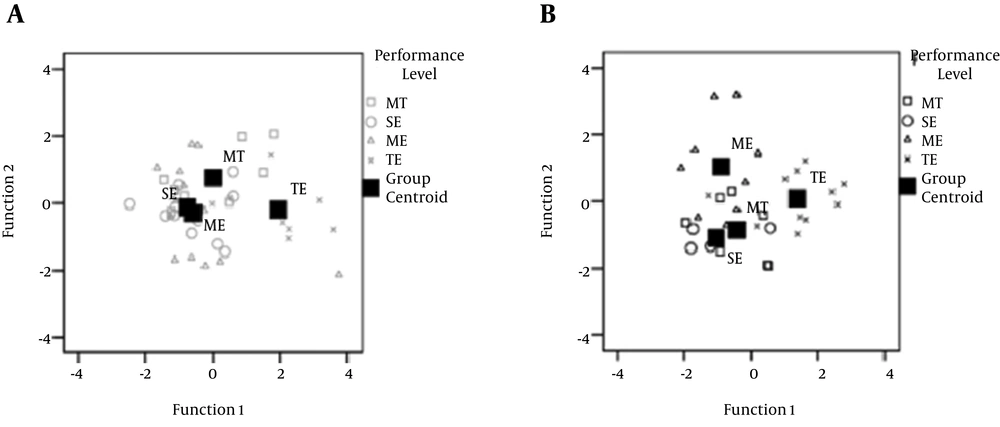
Figure 1.
Performance level groups: MT, Moderate Trained; SE, Sub Elite; ME, Moderate Elite; TE, Top Elite
5. Discussion
To the authors’ knowledge, this study provides a comprehensive comparison among performance HB level groups and HB playing position groups in European HB players. Regarding the stature measurement, pivot and left/right backs were taller than wing players. These findings correspond with Srhoj et al. (3) and Sporis et al. (7) who observed that wings were smaller than back players. The total mean of stature and body mass are similar to, 1) Moncef et al. (8) who demonstrated a mean of stature and body mass of 181.8 cm and 85.1 kg among 42 male Tunisian Elite HB players, 2) Of Mohamed et al. (9) who presented mean values of stature and body mass of 182 cm and 81.7 kg among West Asian players, and, 3) Nikolaidis et al. (10) who presented mean values of 185 cm and 87 kg among and adult players (n = 39, aged 26.6 ± 5.7 years, training experience 14.4 ± 6.1 years and weekly training volume of 8.4 ± 2.0 hours). Concerning to fitness measurements, results showed that goalkeepers were the slowest players and wing were the fastest. In fact, this attribute is a requirement of the wing athletic performance because they perform the most of the counterattacks during the game (11).
According to literature, the vertical jump is a frequent movement, in both defensive (e.g. blocking, rebounding, and stealing) and offensive (e.g. passing, rebounding, and shooting) actions (12, 13), and the present study showed a mean of 38.4 cm to the countermovement jump, which was similar to Moncef et al. (8), who demonstrated a mean of 39.7 cm among Elite male HB players. Nevertheless, both studies presented lower values than, 1) Buchheit et al. (14) who showed a mean of 44.9 cm among seven well-trained male HB players, and, 2) Nikolaidis et al. (10) who presented a mean of 43.6 cm among adult players with a weekly training volume of 8.4 ± 2.0 hours.
Chelly et al. (12) showed lower peak power (Ppeak) results to those of the present study. The authors aimed to compare the effects of an 8 -week, in-season, upper and lower limb heavy resistance training on the Ppeak and sprint performance of male HB players, and demonstrated:
1) In the countermovement jump, a Ppeak of 2.096 ± 559 W and 2.165 ± 381 W, and, 2) In the squat jump, a Ppeak of 3.056 ± 420 W and 3.523 ± 512 W (before and after the intervention, respectively). However, previous studies did not show results categorized by player position and the present research showed that the best average results concerning vertical jump power were detected among pivot players and, wing players performed the worse result.
In continuation, it was observed that back left/right players have greater handgrip strength. Also, central back and pivot players scored better in handgrip strength than goalkeeper and wing players. No other study with handgrip values of male adult HB players was found (considering individual HB playing positions and absolute values). However, 1) similar results (48.11 ± 11.01 kgf) are observed in boys between 16 - 17 years old (15), 2) lower results (dominant, 30.01 ± 3.86 kgf; non-dominant, 26.8 ± 3.69 kgf) are observed in Indian inter-university female HB players (16).
The results of the present study support the hypothesis that there were significant playing position differences in HB player’s body size and fitness performances. In fact, these results were expected, and it seems to be related to position specific physical effort characteristics.
Nevertheless, this study takes five playing position groups and four performance groups into consideration, and the statistical procedures showed that, 1) the performance in Yo-Yo IE2 distinguished goalkeeper performance level groups, center back performance groups, and pivot performance groups, 2) the leg power and abdominal resistance discriminated wing performance level groups (average leg power more clearly distinguished between groups), and, 3) the stature, explosive strength and the position in the Yo-Yo IE2, successfully discriminated left/right back performance level groups (stature and the position in the Yo-Yo IE2, more clearly distinguished between groups).
It seems that the stature and leg power are essential attributes for success in left/right back HB players’ performance. These results are logical when taking into consideration the fundament of explosive strength in specific playing positions that demands a superior number of fast movements, fast direction changes, jumps and throws. In association, the present study agrees that intermittent running endurance and aerobic capacity are important attributes for the success of HB players.
It is also true that anyone professionally involved in HB is aware of game’s high aerobic demands, but anaerobic power is also crucial for success in HB, and HB must be perceived as an aerobic-anaerobic sport. In fact, literature reposts that the anaerobic system provides speed and agility, explosive power and strength (9, 17) while the aerobic system contributes to the athlete’s ability to sustain effort for the duration of the HB match and to recover during the brief periods of rest or reduced effort (12, 18, 19). In other words, the most of actions in HB are performed in aerobic conditions by anaerobic activities, which make a difference between win and lose. It can be concluded that the HB player’s profile, 1) Differs according to HB playing position group, 2) For the same playing position group, it differs according to performance level. This study also demonstrated the influence of aerobic capacity for excellence according to playing positions in Portuguese (European) HB players. In fact, these findings can be a consequence of the differences that categorize each performance level (i.e. different levels have different technical requisites and tactical actions).
In accordance, these results can be useful for, 1) HB training optimization, and, 2) To adopt the best orientation (from the methodological and didactic points of view), in order to allow people to practice the game regardless of their purpose and skill.