
1. Background
Shooting is a competitive sport that relies on accuracy and agility, and it has a long history in the Olympic Games (1). It is highly esteemed worldwide and is notably successful in winning Olympic medals (2). Success in shooting requires proper technique, physical strength, mental fortitude, and strategic thinking (3). Shooters engage in more than two hours of static and dynamic activity, necessitating both physical strength and endurance (4). This complexity makes mastering the discipline challenging (4, 5). Understanding the various characteristics of elite shooters aids coaches and training specialists in identifying talent, recognizing suitable individuals, and planning and designing training programs (5). Access to anthropometric, biomechanical, physiological, and psychological profiles is crucial for predicting and determining success in shooting and any sport (6). Those who better understand the necessity of these characteristics can train with more motivation and effort (4).
Shooting, like many other Olympic disciplines, does not involve continuous movement, but it is a highly physical sport where specific physical conditions and psychological issues are important for both male and female shooters (3). Previous studies indicate that developing individual profiles for national and international champions, who are elite athletes with distinct physical and psychological characteristics, can help clarify the specific needs of each sport and highlight their evolution (7). In shooting, the training conditions — including physical, mental, and psychological preparation — as well as the type of clothing, equipment, and competition conditions, are identical for both men and women. However, some inherent physiological differences, such as hormonal changes and the menstrual cycle, are not taken into account. Studies indicate that the menstrual cycle can significantly affect women's sports performance, training, and overall success (8). In recent years, the women’s national shooting team has achieved remarkable success in terms of the number of titles in world championships, Asian Games, and qualifying for the Olympic selection competitions alongside the men’s national shooting team (9). Additionally, the study of shooting not only encompasses physical aspects but also places significant emphasis on psychological and psychomotor states. Researchers in the field have long been interested in psychological factors, as shooting requires a high level of concentration, often sustained over long periods. To excel in this discipline, individuals must possess robust psychological traits that effectively interact with their physical abilities (9). Therefore, examining and studying the physical characteristics and psychological issues of female and male shooters and comparing these sports characteristics between these two groups can be very important for planning their performance outcomes.
Based on a review of previous studies, Sobhani et al. examined anthropometric, physiological, and psychological variables among elite and non-elite female shooters (9). The study reported that elite female shooters demonstrated better dynamic balance, greater upper body strength, and lower resting heart rates compared to non-elite female shooters. Additionally, elite female shooters displayed higher intrinsic motivation. However, no differences were observed in anthropometric variables between the two groups.
Anindita et al. conducted a study on the anthropometric and physiological profiles of male and female Indian shooters (10). The study revealed that physical endurance levels in both male and female shooters were lower compared to international-class athletes in sprinting, soccer, and basketball (10). However, their maximum oxygen consumption capacity was close to and similar to that of weightlifters, shot putters, and throwers, as well as compared to non-athlete counterparts. Furthermore, this study concluded that female shooters exhibited higher anaerobic power than non-athletes in tests. In contrast, male shooters had much lower intercomparison compared to the same gender in the non-athletic group. Nevertheless, the only notable significance between the two genders, as it concluded, was in the breath-holding time (10).
Previous research has examined important factors related to male and female shooters, but these studies have not thoroughly compared all the main anthropometric, biomechanical, physiological, and psychological factors between genders. Additionally, the studies often focused on only a few factors within each category (10, 11). Despite the notable achievements of elite female shooters, their characteristics have been less studied. As male and female shooters typically train and compete under similar conditions, understanding their specific anthropometric, biomechanical, physiological, and psychological traits may be important for reaching the highest level in competitions (2, 12).
2. Objectives
The present study aims to compare key anthropometric (weight, height, limb length, limb height, limb widths, limb circumferences, body composition, and subcutaneous fat percentage), biomechanical (static balance, speed, acceleration, agility, leg power, abdominal muscle strength and endurance, reaction time, and flexibility), physiological (heart rate, cardiorespiratory fitness), and psychological (basic psychological skills, psychomotor skills, and cognitive skills) factors in male and female elite shooting athletes utilizing a principal component analysis (PCA) statistical approach (13). This analysis aims to assist coaches and training specialists in identifying talent, recognizing suitable individuals, designing training programs, and predicting success.
3. Methods
3.1. Participant and Research Design
The study is an applied research project that employs a cross-sectional design and a causal-comparative approach. Iranian national shooting team members, n = 32 (16 female shooters and 16 male shooters) out of 45, were recruited through a convenience sampling method (based on the limited population) and were willing and eligible to participate based on inclusion and exclusion criteria. Before the research, all players were provided with an individual consent form, and they all expressed their consent to participate. The study was reviewed and approved by the Ethics Committee of the Kinesiology Research Center of Kharazmi University with the ethics code (IR.KHU.KRC.1000.238). The sample included 16 male shooters and 16 female shooters.
The study included subjects who met specific criteria: A minimum of 5 years of membership in the national shooting team, a history of achieving first to third-place titles in national championships, participation in international competitions, and professional skill as confirmed by the federation and coach. In addition, all subjects were invited to the national team camp to participate in the Asian Championship. Subjects were excluded from the study if they were unwilling to continue the research process or had a history of surgery or underlying musculoskeletal, physiological, or psychological condition disorders.
The principal components (anthropometric, biomechanical, physiological, and psychological) were extracted and compared between the two male and female groups (Figure 1). An experienced examiner evaluated all subjects' information over five days. Due to the lengthy and tedious assessments in various fields, we assessed only about 6 - 7 shooters per day. However, each individual was evaluated comprehensively every day. The shooters were asked to go to the National Shooting Federation Academy in the national team’s gym in Tehran, as the researchers didn’t want to interrupt their lifestyle routine. They were there after their morning training session around 9 - 12 AM local time. During the offseason, their anthropometric evaluations would change significantly based on their diet. Also, it should be noted that females' menstrual cycles were on consistent cycles, so their hormonal change was not notable.
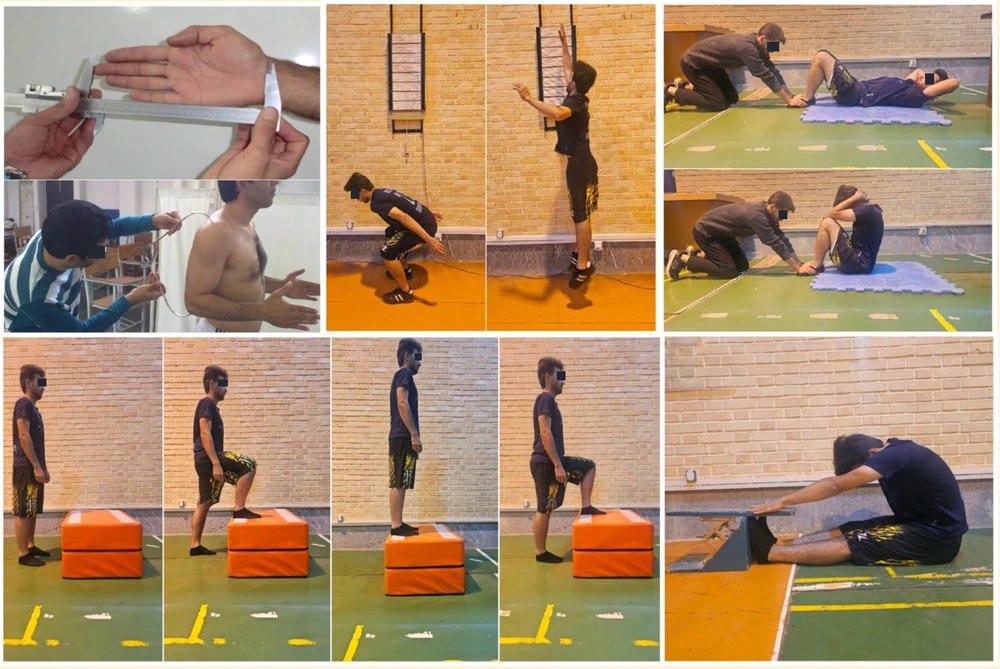
Figure 1.
A sample of main anthropometric, biomechanical, physiological, and psychological indicators evaluations of shooting players
3.2. Identifying and Measuring Research Variables
To evaluate and determine anthropometric indices, various components are considered, including weight, height, limb length, and limb height (including sitting height, arm length, hand length, palm length, forearm length, dominant leg length, foot length), limb widths (including elbow width, knee width, ankle width), limb circumferences (including head circumference, chest circumference, waist circumference, relaxed and contracted arm circumference, forearm circumference, wrist circumference, hip circumference, mid-thigh circumference, knee circumference, calf circumference, ankle circumference, arch circumference), body composition (waist-to-hip ratio), and subcutaneous fat percentage (in men: Abdomen, chest, thigh; in women: Thigh, triceps, suprailiac). All anthropometric variables were assessed using techniques validated by Lohman et al. (1998) (1, 14).
The equipment used for measurements included a Beurer Scale model BF66 for weighing, a Naser metal base chair model 327 for measuring sitting height, a flexible tape measure for limb lengths, heights, and circumferences, a 60 cm caliper for body composition (waist-to-hip ratio), a small caliper for limb widths, and a VOGEL caliper for assessing subcutaneous fat percentage (15).
To assess biomechanical indices, the study evaluated the static balance, speed, acceleration, agility, leg power, abdominal muscle strength and endurance, reaction time, and flexibility of elite male and female shooters. The stork test was used to evaluate static balance (1, 13), while the 36-meter (40-yard) sprint test was utilized to assess speed and acceleration (16). Agility was measured using the 9 × 4 test (17), and the Sargent jump test was employed to evaluate lower limb power (18). Abdominal muscle strength and endurance were assessed using the 60-second sit-up test (17). The Nelson ruler drop test was used to measure finger reaction time (18), and the sit and reach test was conducted to measure forward bending and flexibility (16).
To assess physiological indicators, we calculated the maximum heart rate using a stethoscope (19). Additionally, we evaluated cardiorespiratory fitness by measuring the maximum oxygen consumption using the Queen's step test (16). To assess the psychological aspects of shooters, we utilized the Ottawa-3 Questionnaire, which includes evaluations of basic psychological skills, psychomotor skills, and cognitive skills (20).
3.3. Data Analysis
In the final stage of the study, the variables and indices of both male and female shooters were evaluated, and the data was analyzed using SPSS software version 22. Descriptive statistics were used to analyze the variables, including mean and standard deviation. The Kolmogorov-Smirnov test was employed to test the normal distribution of the data. To identify the principal components of the evaluated indices in both groups, multiple correlation coefficients and the PCA method were initially used. Afterward, the independent t-test statistical method was used to determine the differences in the main indices between elite male and female shooters, with a significance level set at P ≤ 0.05.
4. Results
The results of the demographic characteristics of male and female shooter participants are shown in Table 1.
Table 1.
Demographic Characteristics of Male and Female Shooters a
| Demographic Characteristics | Women | Men |
|---|---|---|
| Age (y) | 23.12 ± 1.54 | 28.62 ± 4.60 |
| Weight (kg) | 58.06 ± 8.07 | 74.21 ± 8.46 |
| Height (cm) | 164.18 ± 4.21 | 177.56 ± 5.05 |
| Body Mass Index (kg/m2) | 21.66 | 23.56 |
Abbreviation: BMI, Body Mass Index.
a Values are expressed as mean ± SD.
The Kolmogorov-Smirnov test results indicated that the data distribution was normal; therefore, a numerical comparison was applied before using the PCA method (13, 21, 22) to estimate indices of elite male and female shooters. The test results showed that in terms of anthropometric indices, height and arm length overlapped in both male and female groups, and hip circumference and chest circumference overlapped in the male shooter group. In terms of biomechanical indices, the speed component overlapped with acceleration and speed time in both male and female shooter groups. However, no linear overlap was found in physiological and psychological indices in either male or female shooter groups.
In the next step, the data with linear overlap was removed, and the PCA method was used to examine the main indices (21). The eigenvalues of the variance corresponding to the factors were calculated after Varimax rotation. This allowed the sum of the coefficients of all factors' initial eigenvalues for each factor to be obtained in the form of the total explained variance. The explained variance was then considered as a percentage of the total variance and the cumulative percentage. Subsequently, the eigenvalues of each variable were examined through the sum of the squared factor loadings related to all variables in that factor.
Based on the obtained results, in anthropometric indices for women, six main components were highlighted, including waist circumference, knee circumference, forearm length, head circumference, sitting height, arm length, and one-hand length. For men, five main components were highlighted: Forearm length, arm circumference in contraction, arm circumference at rest, height, and knee width. In biomechanical indices, for both male and female shooters, two main components were highlighted, including agility and speed for women and abdominal muscle strength-endurance and reaction time for male shooters. In physiological indices, only one component was highlighted for both groups, including maximum heart rate for women and maximum oxygen consumption for male shooters. In psychological indices, one main component was highlighted for women, including cognitive skills, and two main components for men, including psychomotor skills and basic skills (Table 2).
Table 2.
Factor Loadings of Anthropometric, Biomechanical, Physiological, and Psychological Characteristics and Indices Extracted from Principal Components
| Variables | Factor Loading | |
|---|---|---|
| Women | Men | |
| Anthropometric indicators | ||
| Waist circumference (cm) | 0.96 | - |
| Knee circumference (cm) | -0.86 | 0.88 |
| Forearm length (cm) | -0.87 | 0.92 |
| Head circumference (cm) | 0.84 | - |
| Sitting height (cm) | 0.85 | - |
| Arm length (cm) | 0.88 | - |
| Hand length (cm) | -0.89 | - |
| Arm circumference in contraction (cm) | - | 0.91 |
| Arm circumference in relaxation (cm) | - | 0.91 |
| Height (cm) | - | 0.95 |
| Knee width (cm) | - | 0.89 |
| Biomechanical indicators | ||
| Agility (s) | -0.90 | - |
| Speed (m/s) | 0.90 | - |
| Abdominal muscle strength-endurance (number in 1 min) | - | 0.90 |
| Finger reaction time (ms) | - | -0.87 |
| Physiological indicators | ||
| Maximum heart rate (bpm) | -0.98 | - |
| Maximum oxygen consumption (mL.kg.min) | - | 0.94 |
| Psychological indicators | ||
| Basic skills (points) | 0.89 | - |
| Psychomotor skills (points) | - | 0.90 |
| Cognitive skills (points) | - | 1.00 |
The next step involved using an independent t-test to compare the main component indices in male and female shooters. The results, presented in Table 3, show that, except for sitting height and knee width, most anthropometric indices differed significantly between elite male and female shooters. These indices include waist circumference (P = 0.016), knee circumference (P = 0.001), forearm length (P = 0.001), head circumference (P = 0.001), arm length (P = 0.001), one-hand length (P = 0.005), arm circumference in contraction (P = 0.001), arm circumference at rest (P = 0.001), and height (P = 0.001) (P ≤ 0.05). Biomechanical indices such as agility (P = 0.001), speed (P = 0.002), abdominal muscle endurance (P = 0.001), and finger reaction time (P = 0.001) also differed significantly between the two groups. Additionally, there was a significant difference in maximum heart rate (P = 0.001) and maximum oxygen consumption (P = 0.001). When comparing psychological indices, only basic skills showed a significant difference (P = 0.025) between elite male and female shooters, while psychomotor skills and cognitive skills did not (P ≤ 0.05).
Table 3.
Results of Independent t-Test for Key Anthropometric, Biomechanical, Physiological, and Psychological Indices of Elite Male and Female Shooters (P ≤ 0.05)
| Variables | Mean ± SD | t | P-Value |
|---|---|---|---|
| Anthropometric indicators a | |||
| Waist circumference (cm) | 2.54 | 0.016 | |
| Women | 76.31 ± 5.95 | ||
| Men | 81.48 ± 5.53 | ||
| Knee circumference (cm) | -3.70 | 0.001 | |
| Women | 43.06 ± 3.02 | ||
| Men | 39.81 ± 1.78 | ||
| Forearm length (cm) | 6.71 | 0.001 | |
| Women | 25.81 ± 1.22 | ||
| Men | 28.78 ± 1.27 | ||
| Head circumference (cm) | 4.36 | 0.001 | |
| Women | 54.12 ± 2.50 | ||
| Men | 57.28 ± 1.46 | ||
| Sitting height (cm) | 1.47 | 0.150 | |
| Women | 80.06 ± 5.47 | ||
| Men | 85.71 ± 14.30 | ||
| Arm length (cm) | 7.36 | 0.001 | |
| Women | 30.12 ± 1.36 | ||
| Men | 34.56 ± 1.99 | ||
| Hand length (cm) | 3.02 | 0.005 | |
| Women | 72.56 ± 2.18 | ||
| Men | 75.62 ± 3.40 | ||
| Arm circumference in contraction (cm) | 7.57 | 0.001 | |
| Women | 28.34 ± 2.62 | ||
| Men | 34.20 ± 1.63 | ||
| Arm circumference in relaxation (cm) | 6.84 | 0.001 | |
| Women | 26.81 ± 2.66 | ||
| Men | 31.96 ± 1.40 | ||
| Height (cm) | 8.12 | 0.001 | |
| Women | 164.18 ± 4.21 | ||
| Men | 177.56 ± 5.05 | ||
| Knee width (cm) | 1.43 | 0.162 | |
| Women | 8.96 ± 0.93 | ||
| Men | 9.41 ± 0.86 | ||
| Biomechanical indicators a | |||
| Agility (s) | -20.55 | 0.001 | |
| Women | 10.20 ± 0.37 | ||
| Men | 7.51 ± 0.36 | ||
| Speed (m/s) | 3.34 | 0.002 | |
| Women | 5.96 ± 0.40 | ||
| Men | 6.54 ± 0.56 | ||
| Abdominal muscle strength-endurance (number in one minute) | 3.66 | 0.001 | |
| Women | 37.87 ± 9.42 | ||
| Men | 48 ± 5.78 | ||
| Reaction time (ms) | -2.84 | 0.008 | |
| Women | 1.16 ± 0.21 | ||
| Men | 0.96 ± 0.17 | ||
| Physiological indicators a | |||
| Maximum heart rate (bpm) | -4.43 | 0.001 | |
| Women | 196.87 ± 1.54 | ||
| Men | 191.25 ± 4.83 | ||
| Maximum oxygen consumption (mL.kg.min) | 8.12 | 0.001 | |
| Women | 39.20 ± 2.82 | ||
| Men | 56.39 ± 7.98 | ||
| Psychological indicators a | |||
| Basic skills (points) | 2.38 | 0.025 | |
| Women | 60.93 ± 6.62 | ||
| Men | 66.52 ± 4.22 | ||
| Psychomotor skills (points) | 0.94 | 0.354 | |
| Women | 71.18 ± 11.55 | ||
| Men | 74.43 ± 7.52 | ||
| Cognitive skills (points) | 1.04 | 0.304 | |
| Women | 91.93 ± 14.67 | ||
| Men | 96.56 ± 9.89 |
a Values are expressed as mean ± SD.
5. Discussion
The purpose of this study was to compare the key characteristics of male and female elite shooters on the Iranian national shooting team. The results indicated significant differences between elite male and female shooters in certain anthropometric measurements (such as waist circumference, knee circumference, forearm length, head circumference, arm length, hand length, arm circumference at rest, arm circumference in contraction, and height), biomechanical traits (including agility, speed, abdominal muscle endurance, and finger reaction time), physiological parameters (such as maximum heart rate and maximum oxygen consumption), and basic psychological skills (P ≤ 0.05).
The study found significant differences in the main anthropometric measurements of elite male and female shooters, except for sitting height and knee width. These differences may be due to gender disparities and the level of physical activity in these individuals. Matching body type to the sport can contribute to an athlete's success (23). National-level shooting players have the opportunity to train together at the federation's academy and competition venues, where conditions are equal for both men and women in every aspect. However, research findings indicate that there are differences in the anthropometric measurements between the two genders.
As observed in a previous study, female shooters exhibited larger lower limb circumferences and longer arm lengths compared to male shooters, while male shooters had greater height and larger upper body muscles (5, 13). These differences may be attributed to gender disparities and the demands of shooting, which requires extensive training and repetitive practice (9). Both male and female shooters develop these body characteristics through training. Additionally, stability and tremors during shooting (3) may be influenced by factors such as strength and balance rather than arm length alone (4).
The results of our study align with the findings of Kurt et al., who compared the physical and anthropometric characteristics of male and female shooters in pistol and air rifle disciplines (11). Souri et al.’s research also studied the relationship between anthropometric characteristics and shooting performance (24), while Anindita et al. examined the anthropometric and physiological profiles of male and female Indian shooters (10). The similarity in our study's results to previous research is likely because the subjects in the mentioned studies had similar skill levels and evaluation methods. However, our findings did not align with those of Sobhani et al., who studied anthropometric, physiological, and psychological variables based on skill level (elite and non-elite) in air pistol shooters (9). This discrepancy may be due to differences in the type of comparison of subjects, age, and the number of elite participants.
In previous studies, it has been noted that shooters possess certain specific anthropometric characteristics (10) compared to athletes in other sports (25). Additionally, some studies have highlighted that anthropometric factors, combined with physical fitness, are significantly more important than other parameters in shooters (23). Anthropometric indices play a major role in determining a shooter’s success and have significant impacts on their performance, making them important components in this field (11, 26). Gender may be one of the main factors contributing to the differences in success between male and female shooters (2, 9, 19).
In most previous studies, a limited number of anthropometric indices of male and female shooters were compared (14, 27). However, in the present study, all anthropometric indices of male and female shooters were comprehensively measured, and the main components of both groups were identified and compared. Therefore, it can be concluded that the results of comparing the main anthropometric indices in this study provide more detailed and accurate information to other researchers, coaches, and players in achieving success factors and assisting in talent identification in this field compared to previous studies.
In this study, it was demonstrated that there are significant differences in the main biomechanical indices between elite male and female shooters. These findings are consistent with Takhtaei et al., who assessed anthropometric, physiological, physical, and psychological indices in elite shooters using talent identification (27). Similarly, the results align with the findings of Sobhani et al., who studied anthropometric, physiological, and psychological variables in air pistol shooters based on their skill levels — elite and non-elite (9). Differences in these factors between male and female shooters can be attributed to variations in body structure, physical strength, and skill levels, as each gender possesses distinct musculoskeletal characteristics.
Research has shown that female shooters typically exhibit different capabilities in agility, speed, abdominal muscle endurance, and finger reaction time compared to their male counterparts. For example, women often have better balance due to their shorter height and wider pelvis dimensions, while men, with their greater abdominal mass, tend to demonstrate higher levels of muscular endurance, which contributes to their overall skill levels (3, 4). Studies have also shown that shooters with stronger and more enduring abdominal muscles demonstrate better control and reduced shaking, leading to improved shooting performance (3, 4). Furthermore, shooters with faster reaction times may have an advantage in responding to visual stimuli and making quick and precise decisions during shooting tasks (28).
Speed and agility significantly impact an athlete's posture in sports, requiring precise coordination between the nervous system and musculoskeletal system for optimal execution (29), with manifestations varying across different sports (30). Possessing these components is vital for precise shooting. Additionally, strong balance can directly and indirectly enhance an athlete's performance (9). The stance of shooters may improve balance by altering the movements of the center of gravity (4), resulting in less body sway, greater focus on the target, and improved overall performance (3, 9).
Male and female shooters consider biomechanical indices as a key factor in their performance and primarily engage in strength and endurance training according to the competition schedule. However, they use balance exercises and body posture tests less frequently to assess their progress in training (4, 11). Therefore, there should be more control and focus on the training process and attention to biomechanical indices in male and female national team shooters, considering gender differences in this area. Additionally, since the training and environmental conditions for male and female shooters are usually the same, more attention should be given to the principle of training differences and the progress of biomechanical indices in both groups to help the success of both genders with separate planning.
Based on the results of this study, there are significant differences in the key physiological indices between elite male and female shooters. These differences appear to be linked to the higher maximum oxygen consumption in male shooters due to their superior physical fitness levels compared to female shooters. However, since maximum heart rate is not influenced by gender, the differences between male and female shooters might be attributed to their Body Mass Index (BMI) (8). The findings of this study align with Sobhani et al., who examined anthropometric, physiological, and psychological variables based on the skill level (elite and non-elite) of air pistol shooters (9). The reason for this consistency was the similarity in the skill levels of the subjects.
However, the results were inconsistent with the study by Anindita et al., which looked at the anthropometric and physiological profiles of male and female Indian shooters (10). This discrepancy may be due to racial differences, geographical conditions, and differences in the training regimens of male and female Indian shooters compared to their Iranian counterparts. Elite shooters usually have high cardiovascular and respiratory fitness, which is associated with increased left ventricular thickness and systolic volume, ultimately leading to a reduced heart rate (31). Some studies have found that a lower heart rate, due to the inverse relationship between tremor and shooting performance, improves focus and positively impacts the shooter’s performance (9).
Therefore, heart rate and maximum oxygen consumption are related to body vibrations (9, 27), and this difference may be due to the use of a specific training method or the number of training hours per day (4, 26). Since achieving optimal performance in shooting sports depends not only on the athlete’s skill level but also on their physiological indices (3, 9), it is crucial to consider the differences in physiological factors to help develop effective training programs for both male and female shooters, which will improve performance (3, 4).
In our study, we found significant differences between elite male and female shooters, particularly in basic skills such as goal-setting, self-confidence, and commitment. These differences may be attributed to factors like age, experience, and overall psychological conditions of men and women. Psychological factors such as goal-setting, self-confidence, and commitment play a crucial role in achieving optimal performance and are sometimes stronger in men (8). Some studies suggest that goal-setting and self-confidence significantly impact sports performance and are among the most important factors for the success and effort of shooters, influencing the maximum growth and performance of the athlete (8, 9). Shooting may require specific goal-setting due to its unique characteristics and the need for maximum accuracy (3, 4).
These results are consistent with the findings of Takhtaei et al., who evaluated anthropometric, physiological, physical, and psychological indicators of elite shooters' performance using a talent-finding approach (27). This similarity may be due to similar subjects in terms of skill level and evaluation of similar tests. While some past research has focused on the psychological and behavioral areas of shooters, such as the level of arousal (32), learning transfer (33), and the relationship between failure and success with the self-efficacy expectations of young male shooters (34), specific and comprehensive research on the psychological indicators of male and female elite shooters, as well as the comparison of these indicators in these two groups, was not found.
The optimal performance of shooters today is the result of a combination of various factors, including important psychological indicators (35). At high levels of competition, where physical fitness reaches the highest possible level, these mental skills play a decisive role in the success of shooters. It is necessary to pay more attention to the mental areas of male and female shooters. The psychological indicators reported in this research enable male and female shooters of national ranks at different skill levels to understand their psychological strengths and weaknesses by comparing their results in each factor with these norms and interpreting the results. It also enables coaches to develop the mental capabilities of their athletes by designing appropriate and specific psychological exercises for each person.
The current research shows a significant difference between the psychological indicators of the two groups of male and female shooters. It was found that the need for the difference of using mental exercises is felt only in the field of basic skills, and in other mental variables, the two groups can grow in the same conditions.
5.1. Conclusions
The findings of this study will assist in the development of effective training programs for both male and female shooters, ultimately improving their performance and endurance, especially concerning stance enhancements. To gain a better understanding of talent identification and equality, it is vital to consider both theoretical and practical observations. Two anthropometric variables — knee circumference and forearm length — were found to be significant for both genders. Additionally, the study identified two main biomechanical components: Agility and speed for women, and abdominal muscle strength-endurance along with reaction time for men. In terms of physiological parameters, maximum heart rate was identified as a key factor for women, while maximum oxygen consumption was crucial for men. Regarding psychological aspects, female national shooters demonstrated strengths in basic skills, whereas male shooters exhibited two primary components: Cognitive skills and basic skills.
Coaches should closely monitor athletes during the off-season, as significant differences between the genders exist. Furthermore, when creating annual training schedules, it's important to consider these differences in performance to enhance outcomes in competitions. For instance, the findings of this study suggest that men should prioritize speed and agility training, while women should concentrate more on core strength and reaction speed training. We highly recommend further investigation as it directly links to both psychological performance and the overall vision of athletes.
5.2. Limitations
The current study has several limitations. One major limitation is the lack of a simultaneous comparison between elite male and female shooters. Additionally, the sample size was small (n = 32). Off-season data, which was the duration for assessing athletes' characteristics in this study, may skew results, as fitness levels differ pre-competition. Furthermore, although we measured various physiological components, blood-based metrics (e.g., cortisol for stress), which could enrich physiological insights, were not included as we were unable to conduct blood sampling for further analysis due to a lack of facilities.
5.3. Future Research Suggestions
Future research suggestions include conducting a follow-up study during the in-season to accurately evaluate differences between genders and seasons. This research could involve comparing key performance indicators of national team shooters from various countries with those of champions in the field. Additionally, it should include comparisons of key performance metrics among national team shooters across three disciplines: Rifle, pistol, and flying targets. Finally, it is important to determine which key anthropometric, biomechanical, physiological, and psychological indices are most significant and rank higher for elite male and female shooters compared to others.