
1. Introduction
The team physician has a major role in managing medical problems of a travelling adolescent team (1-3). In addition to the normal responsibilities, unexpected disasters could always be a challenge. A natural disaster can be defined as any multiple casualty incident that overwhelms the response capabilities of the available resources (4). On 25 April 2015 at 11:56 local time, a 7.8 magnitude earthquake struck Nepal (5) during AFC U-14 (The Asian football confederation, under 14 years old) girls regional football championship. Dozens of aftershocks followed, including a 6.7 magnitude earthquake on 26th April 2015 at 12:54 local time. The earthquake resulted in 8,604 casualties (6, 7). The Iranian national football team participated in AFC U-14 girls regional championship 20th-26th April 2015, and the author was the team physician of the Iranian team at the time. To my knowledge, there is just one article on role of medical directors in natural disasters occurring for travelling teams which has been published after the recent earthquake in Nepal (8). There are few articles available to discuss what a team physician will face in a national disaster during a sport event. The main focus of this topic is to make a better view of what a team will confront during an earthquake and which decisions could be more appropriate as a team physician.
2. Arguments
Being fully prepared for an unexpected disaster is impossible, but having some critical points and general considerations in mind will help with making the best decision at the situation. You should keep in mind that each event needs its own analysis and your decisions as a medical director should be based on your knowledge, skill level, available resources and the most importantly, the situation you are experiencing.
During an earthquake, one of the first things that will matter will be your location. Your reactions may totally differ whether you are indoors or outdoors. Almost one hour before the match, while all the players were ready and dressed up to enter the field for warm up, all of a sudden the earth shakes. We were on the second floor in a dressing room full of mirrors and panels that started to fall down from the walls. If you are facing a high magnitude earthquake, similar to what we experienced, you should know it would be really hard to keep balance for everybody. Your quick reaction could really help guiding the team to safe places like door frames and under the desks .You can even just ask them, the players, to sit on the floor while covering their head. This will simply help in preventing injuries caused by falling objects.
It is really a hard decision to make to whether leave the building or stay in safe places under the unstable roof during an earthquake. The duration and magnitude of an earthquake is unpredictable. If you have a really quick access to an open area, you may do so. However, I decided to stay in the building instead of running out. Two of the players ran into the stairs before I could even catch them, but thanks to the referees who took them, they did not suffer from any serious injuries.
If you stayed inside during the shakes, get out of the buildings as quick as possible right after the earthquake. As we entered the field, all the dust in the air reported of the destroyed buildings. There is a natural tendency for panic. To keep the players calm it is good to give a brief explanation of the situation and make them ready for the upcoming aftershocks. I checked all my team members to see if I had any missing person and any serious injury. It was a wrong decision I made about the priorities. Before beginning triage and care for patients, the doctor should ensure that the surroundings are safe (9). I guided all the people to gather up in the middle of the field, far from the walls and light projectors around the stadium. I did forget to find a second safe point in case of need. It is highly recommended to find another safe place and set it with all the team members. So, if there was any need to leave the first safe place, all your team members will be aware of the second place and will gather there without any confusion and fear. You should be also aware of your limitations as a human being and ask for help as soon as possible. As we were facing endless aftershocks, I formed a group of 4 players to identify the ongoing threats like falling down light projectors, field cracks, fire or falling structures for the team safety.
Afterwards I introduced myself to the match commissioner, the only official we had access to, and asked for any other physician and the access to the ambulance to form a medical emergency group. Unfortunately, there was no other medical staff there and the field ambulance left the stadium to help the people in the city while the scared and injured people swarmed into the field.
There is also another hard decision to make. When leaving the building you should decide to leave as quickly as possible or wait to collect some important things. In most cases, it is not advised to return inside except for experts and only in case of real needs. We decided to leave everything in the building and get out as quickly as possible and I left my medical bag inside. Being the only physician there, I had the duty to help and there was a real need for medical instruments. We formed a group of three people including myself and we returned to the dressing room to bring the medical bag, players’ clothes, food and water we had in the room to distribute them between everybody. Keep in mind your safe food and water resources are limited. You should plan for all your resources over the next few days. It would be better to use heavy, bulky and non-portable things first.
You may meet many volunteers for medical help. Be aware non-expert persons could harm more than help. Sometimes the team physician is the most qualified person to quickly assess the medical needs. Evaluate their skills quickly and give them specific tasks to reduce the risk of more harm. You should be familiar with triage. Be aware about your medical resource limitations and use them wisely (9). My medical bag was a F-MEB (FIFA medical emergency bag) which is not designed as a disaster bag. Woodward et al. composed a list of items to assemble in a disaster bag which you can use as a guide. Keep in mind that the mentioned items are suggestions and are dependent on available resources (8).
One of the big problems will be access to reliable information about the situation. In these cases, the telecommunication systems may become unavailable and the local official may leave you to serve their own families. Based on the upcoming events, you may need to change your decisions even hourly, and the false news may make the situation worse, so try to find an access to reliable information. I tried a lot to contact our officials in Iran and was finally successful in reporting the safety of all team members. I also asked for any possible help and even medical consultation. It is not a situation to be shy or thinking you can overcome it all alone.
Gradually your team players will face with fear and show stress reactions. You should be familiar with acute stress syndrome and acute stress management in children. With the help of the head coach and assistant coach, we encouraged them to stay calm, sing songs, and play under our supervision to make them distracted. Another issue would be to keep all the team members together in the crowd. You should explain to them not to get far away from the group. Fortunately all our team players’ clothes were totally red, so we did not face any problem in finding them in the crowd. We, the team officials, also wear scarves with specific color, which made it easy for the players to find us.
It is really recommended to find a safe place over the night. An outside place which is also secure from possible hazards like attacks. We spent nearly five hours on the field when finally one official called us and asked us to return to the hotel which was out of the city because they could not maintain our safety in the open field. Sporting events may also have an effect on the traffic patterns due to road closures, crowd and etc. During the earthquake, the road to the hotel was closed due to collapses.
The officials decided to keep all the teams in the hotel over the night. Our hotel consisted of three separate buildings and our building was not habitable anymore. There were big cracks, no electricity and also water pipes were broken and all the floors were filled with water. If you do not keep in mind, gas explosion or electrical sparks especially in the presence of water leakage can bring a catastrophe. This was one of our big mistakes that we did not ask for gas, water and electricity to be cut off in the stadium. This time we asked the hotel staff to check for any gas leakage or any other explosive or life threatening situation and guide them to put all the safety equipment in access. We were asked to stay in the lobby because the outside weather was getting cold but we refused, as the buildings were not safe anymore, and we planned for a safe outdoor stay. We settled the players in the hotel yard and guided all the other teams to do the same. If possible, it is better to make a shelter outside and settle all your team's members there. As we did not have any equipment, we spent the night without any shelter.
Children may present their stress in different ways. Many players may have difficulty for getting asleep and may complain about diffident pain in their bodies but as all of it could be more psychological, refuse to over-medicate them. The head coach and I did not have enough rest through the night which was a big mistake. Never forget yourself and plan for a rest, otherwise you will face a lot of difficulties for decision making and a delay in your response time will happen. This situation may put all the team at risk (Figure 1).
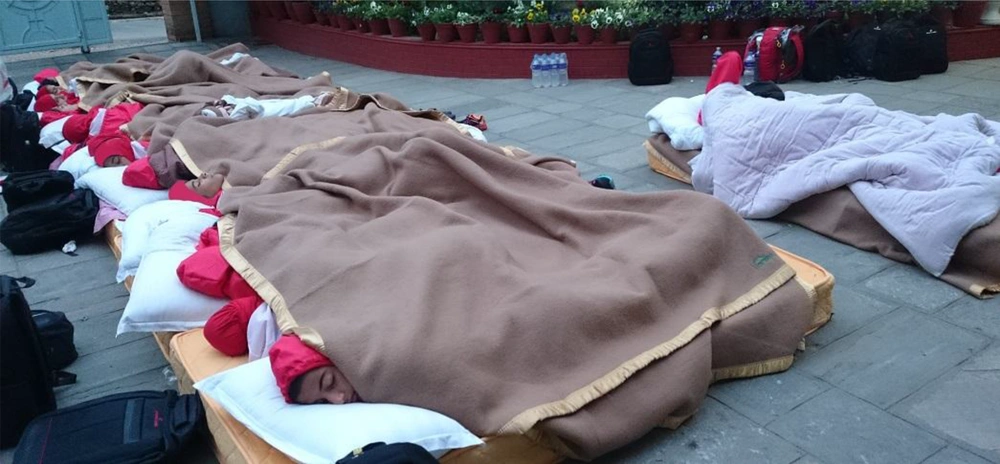
Figure 1.
The Players Spent the Whole Night Outside in the Hotel Yard
When traveling with an adolescent team, as they are minors you will have more responsibilities. Your responsibilities do differ from a volunteer physician willing to help. One of our big concerns was to plan to leave the country as soon as possible; gather all the players from time to time and inform them about the return plans. It would help them to control their anxiety.
Plan your return program based on the situation. The airport had been closed after the earthquake, but the officials informed us that the flights will take place for that day, so we went to the airport to catch our return flight on the day. You should schedule based on many delays in situation like this. We entered the airport 5 hours before our flight, as we were expecting a lot of crowd and delays. As expected, a large crowd was at the airport. It is necessary to review the strategies of not getting too far from the team and how to keep tight together in the pushing crowd. Never forget that unexpected events may show up at any moment and you should be ready to change your plans every moment. While waiting in line for passing through the last gate, the greatest after shock in magnitude rocked the airport. Due to the trainings we gave to the players, they acted wisely this time and we did not encounter any problem. This was a great experience to see how education could improve reactions and improve total health. Unfortunately, the airport went down again. As the aftershocks were starting again, we moved immediately outside to the airport runway.
We were facing a closed airport, and all the flights were cancelled. even when the power came back after 2 hours, only the military flights containing help were allowed to land in the airport. Unfortunately, we did not expect such a delay and mess and we did not have enough food and water. There was no active information center in the airport. Our only reliable center was the news from our officials in Iran whom reassured us about the return. However, we finally decided not to leave the airport for the upcoming hours. The uncertainty of the future events will make anybody anxious, especially the minor players. It is recommended to encourage them to talk about their feelings and reassure them that all of their feelings are normal. I gathered them all in a circle and started talking about the feelings which any of us could have felt. We started to sing together, we played, we shared our good memories and talked about our wishes.
While sitting on the airport runaway for more than 7 hours, one of our players called me loudly to come and help a man who had fallen down suddenly. I entered the crowd and saw a man who was fallen down with his face on the ground and was not responsive. I rolled him into supine position while checking his pulse. Facing a young unresponsive and pulseless man I started the CPR with chest compression while asking for help. In a true disaster situation cardiopulmonary resuscitation should not be performed (9). However, since we were not in a mass casualty situation I decided to start chest compression. Fortunately, because of the rapid start of CPR, the CPR and was resuscitated successfully. There was another physician in the crowd who helped me in monitoring his vital signs for the next hours. It is necessary to emphasize again; never rely only on yourself and ask for help as soon as possible.
Finally, our return flight landed and we left the airport but it was not the end. All the players and team officials will experience acute stress reaction symptoms. All the players should be followed up for the next month’s assessing any development of post-traumatic stress syndrome’s sign and symptoms. Any quick intervention can prevent such a disabling condition.
3. Conclusion
Despite the rarity of such situations, we should address preparation for such conditions when traveling with minor players. While it is impossible to be fully prepared for such a disaster, the author hopes to provide some practical points to be used as a guide to be better prepared. Young players are not trained for facing disasters and this makes the team physician’s role more important. In addition, the team physician himself may just know the basics and not be fully trained for disaster management. Dealing with a natural disaster by itself is hard and having the responsibility of adolescent players makes it more challenging. You should have the ability to avoid unnecessary risks and not to put yourself in further danger. Prepare yourself for making hard decisions while acting as a calm leader. It is suggested for all team physicians to be prepared for natural disasters and even train their players about the best responses in such situations. Keep in mind, even those who live in earthquake-prone areas do not have the necessary knowledge of the right responses during an earthquake. Communicate closely with disaster management agencies in your country for improving the whole team knowledge through educational courses. Never forget you are a human being with limited abilities and always ask for help in any situation. Be prepared to face with a lot of psychological problems and learn how to deal with them. Although it is hoped for all team physicians not to encounter a disaster, this is an unpredictable situation, which has taken place before and will take place in the future, too. So it is one of the team physicians’ duties to prepare the whole team for these conditions.