1. Background
Headache is the most common complaint in human societies (1). The exertional headache (EH) has been known for decades but since its characteristics are not precisely known, there is still no specific definition for it. In some studies, they call the headache developed during or after a continuous exercise activity “the exertional headache” and categorize the one caused by Valsalva maneuver into the benign headache after cough (1-5). These types of headaches can be so intense so that they would cause discontinuation of the physical activity and exercise.
Military conscripts do a remarkable amount of daily activity during their military service. Considering the fact that EH is more common among the youth (6), they are prone to it and its consequences. Hence, determining the prevalence and characteristics of EH would help to recognize it better and ultimately to prevent it.
2. Objectives
This study was performed to identify EH prevalence, pattern, stimulator factors, the way sufferers deal with it, and its aggravating and alleviating factors among military conscripts in Tehran, Iran.
3. Patients and Methods
Iranian military conscripts were the target population of this study. Considering the sample size of other studies in this field, and due to the random distribution of conscripts, 300 conscripts were selected randomly from all conscripts entering Afsariyeh 01 training camp, Tehran at 2014.
We used a Persian questionnaire based on the criteria of the International Headache Society (ICDH-II) which was used in a large epidemiologic study of headache in Tehran before with promising results (6).
Based on International Headache Society, primary EH is a pulsating headache, lasting from 5 minutes to 48 hours, caused by exertion, occurs only during or after exertion, and is not attributed to another disorder (7). Conscripts who experienced headaches caused by activity were asked to fill out the questionnaire regarding the details of EH, including the site of pain, laterality, quality of pain (throbbing or pressure), duration of pain, frequency of EH, aggravating and alleviating factors for pain, and other symptoms. The pain was measured using a visual analog scale (VAS).
Two trained doctors familiar with the exertional headache, filled out the questionnaires during a face to face interview with each subject. We ruled out headaches caused by sinusitis, colds, or dental problems.
We analyzed our data using IBM SPSS v22, with an acceptable P Value of < 0.05 and a confidence interval of 95%.
Each questionnaire had a code and names or addresses of the subjects were never mentioned in the process. The methods of this study was confirmed in AJA university of medical sciences ethics committee and informed consent was taken from each participant. We also provided a free medical consultation for those who suffered from headache.
4. Results
We analyzed 300 questionnaires filled by 18 - 26 year old male conscripts (Mean = 22.34 years, SD = 2.58).
Out of 300 conscripts, 64 (21.3%, CI 95%: 16.8% - 26.0%) hadn’t experienced any type headache not related to sinusitis, cold or dental problems (headache-free). Therefore prevalence of headache in conscripts of our study was 78.7% (CI 95%: 74.0% - 83.2%).
Finally, 38 cases (12.7%, CI 95%: 9.0% - 16.5%) with the mean age of 22.16 years (SD = 2.60) had suffered exertional headache (EH). Tables 1 and 2 show EH characteristics and its aggravating and alleviating factors.
Table 1.
Exertional Headache Characteristics in Conscripts
| Characteristic | No. (%) | CI 95% |
|---|---|---|
| Laterality | ||
| Unilateral | 2 (5.3) | 0.0% - 15.8% |
| Bilateral | 28 (73.7) | 60.5% - 86.8% |
| First unilateral and then bilateral | 8 (21.1) | 7.9% - 43.2% |
| Location | ||
| Frontal | 13 (34.2) | 18.4% - 50% |
| Temporal | 6 (16.8) | 5.3% - 28.9% |
| Holocephalic | 5 (13.2) | 2.6% - 26.3% |
| Occipital | 4 (10.5) | 2.6% - 21.1% |
| Vertex | 3 (7.9) | 0.0% - 15.8% |
| Can’t localize | 7 (18.4) | 6.7% - 31.6% |
| Quality | ||
| Pulsating | 18 (47.4) | 30.4% - 63.2% |
| Compressive | 17 (44.7) | 26.3% - 60.5% |
| Can’t Determine | 3 (7.9) | 0.0% - 18.4% |
| Duration | ||
| Less than 5 min | 5 (13.2) | 2.6% - 23.7% |
| 5 min to 1 h | 15 (39.5) | 26.3% - 55.3% |
| 1 h to 24 h | 16 (42.1) | 26.3% - 55.3% |
| More than 24 h | 2 (5.3) | 0.0% - 13.2% |
| Frequency (in 10 times of exercise) | ||
| < 2 | 17 (44.7) | 26.3% - 60.5% |
| 2 to 5 | 14 (36.8) | 21.1% - 52.6% |
| > 5 | 7 (18.4) | 7.9% - 31.6% |
| Time of getting EH from the onset of exercise | ||
| < 30 min | 21 (55.3) | 38.3% - 73.7% |
| 30 min to 1 h | 10 (26.3) | 13.2% - 40.7% |
| 1 hr. to 2 h | 3 (7.9) | 0.0% - 18.4% |
| > 2 h | 4 (10.5) | 0.0% - 21.1% |
| Severity | ||
| Discontinuation of exercise | 14 (36.8) | 21.1% - 53.8% |
| Total | 38 (100) |
Table 2.
Aggravating and Alleviating Factors of Exertional Headache in Conscripts
| Factors | No. (%) | CI 95% |
|---|---|---|
| Aggravating factors | ||
| Exercise in hot weather | 31 (81.6) | 68.4% - 94.7% |
| Exercise in high altitude | 3 (7.9) | 0.0% - 15.8% |
| Light | 2 (5.3) | 0.0% - 15.8% |
| Sound | 1 (2.6) | 0.0% - 7.9% |
| Coughing | 1 (2.6) | 0.0% - 7.9% |
| Alleviating factors | ||
| Exercise discontinuation | 13 (34.2) | 21.1% - 51.2% |
| Sleeping | 10 (26.3) | 10.5% - 42.1% |
| Sweat or food consumption | 9 (23.7) | 10.5% - 36.8% |
| Pain killer | 5 (13.2) | 2.6% - 26.3% |
| Liquid consumption | 1 (2.6) | 0.0% - 7.9% |
| Total | 38 (100) |
Out of 38 EH sufferers, 18 (47.4%, CI 95%: 28.9% - 63.2%) reported a regular exercise plan in the week and 21 (55.3%, CI 95%: 39.5% - 72.3%) declared their EH will occur less frequent if they exercise regularly. Table 3 shows activities which caused EH in our subjects.
Table 3.
Activities Which Caused Exertional Headache in Conscripts
| Activity | No. (%) | CI 95% |
|---|---|---|
| Aerobic exercise | 11 (28.9) | 15.8% - 44.7% |
| Body building and lifting | 8 (21.1) | 7.9% - 34.2% |
| Football and volleyball | 7 (18.4) | 7.9% - 31.6% |
| Walking | 6 (15.8) | 5.3% - 26.3% |
| Stairs or slippery slope | 4 (10.5) | 2.6% - 21.1% |
| Routine home work | 2 (5.3) | 0.0% - 15.8% |
| Total | 38 (100) |
Out of 38 EH sufferers, 16 (42.1%, CI 95%: 26.3% - 57.9%) experienced EH during exercise, 11 (28.9%, CI 95%: 14.6% - 42.1%) after exercise and 11 cases (28.9%, CI 95%: 14.6% - 42.1%) experienced it in both situations (during and after exercise).
We used a 10-score visual analog scale (VAS) to reveal the severity of exertional headache (Figure 1).
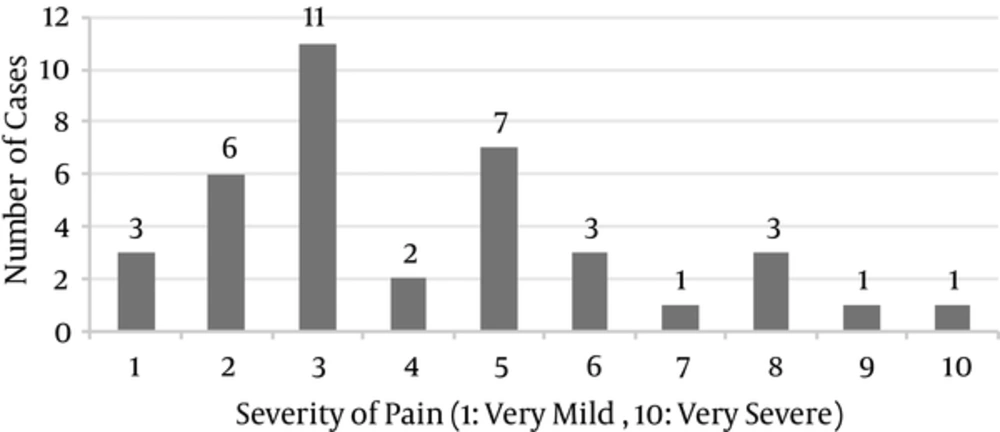
Figure 1.
Severity of Pain in an EH Episode
5. Discussion
In this cross-sectional study, we tried to reveal EH prevalence and characteristics among conscripts.
The prevalence of all types of headache in conscripts was 78.7% (CI 95%: 74.0% - 83.2%). Lifetime prevalence of headache among general population in similar studies was 96.0% in Denmark (8), 69.1% in Italy (9), 67.0% in Hungary (10), 77.2% in Norway (11), 68.0% in South Korea (12, 13), 83.6% in Oman (14), 72.5% in Qatar (14) and 77.0% in Europe (9). Differences between distribution and mean of general population’s age in those countries may affect their results.
Totally 38 (12.7%) of our subjects had experienced EH. This is slightly higher for the similar age range compared with a recent large epidemiologic study in Tehran which found prevalence of EH 7.5% and 9.1% in age groups of 12 - 19 and 20 - 39 years respectively (6). This could be due to higher activity rate of military conscripts comparing to general population. However, when comparing these results, it is worth considering that the present study was only performed on male subjects. These results are also in agreement with Sjaastad et al. who found a prevalence of 12.3% in their large sample sized study (3). Although Chen et al. found EH prevalence 30.4% in their study (4), it could not be compared to our results since their sample size age range was 13-15 years.
Among EH sufferers 73.7% reported their headache as bilateral. This finding is similar to results of other studies in this field (1-3, 6, 15).
Based on our results, the most common location of pain in EH was frontal region (34.2%) followed by temporal region (16.8%). Compressive quality was observed in about half of the EH cases and the other half reported pulsatile quality of EH. These results are similar to a recent epidemiologic EH study in Tehran general population (6).
Based on our results, 55.3% of cases EH started in the first 30 minutes of exercise and more than a third of cases discontinued their exercise due to headache. Thus, control of EH can affect these cases’ weekly exercise time and population’s health. We could also suggest short breaks during exercise to alleviate the pain before it gets severe.
The most common aggravating factor was exercise in hot weather (81.6%). This finding reveals the importance of air conditioning and temperature control.
Table 4 summarizes a comparison between this study and 3 other major studies in EH field.
Table 4.
A Comparison of Most Common Characteristics of EH Between Studies
| Studies | Sample Size | Age Range, Y | Gender Preponderance | Prevalence, % | Quality | Duration | Location | Aggravating Factors |
|---|---|---|---|---|---|---|---|---|
| Present study | 300 | 18 - 26 | Male only | 12.70 | Both pulsating and compressive | Mostly 5 min to 24 h | Bilateral (73.7%), more frequent in Frontotemporal region | Exercise in hot weather |
| Rabiee et al. (6) | 2076 | 12 - 69 | Male > Female | 7.30 | Both pulsating and compressive | Mostly 5 min to 24 h | Bilateral (68.4%), more frequent in Frontotemporal region | Exercise in hot weather and high altitude |
| Chen et al. (4) | 1963 | 13 - 15 | Female > Male | 30.40 | Pulsating (59.4%) | Short-lasting (1 h in 79%) | Bilateral (51.4%), involving frontal region | Short-lasting Valsalva-like maneuvers |
| Vaga Study (1-3) | 1838 | 18 - 65 | Female > Male | 12.30 | Pulsating | Few min to 24 h | Bilateral, global involvement with the pain maximum in anterior region | Effort and exhaustion caused by swimming and fast walking |
Only 6 out of 38 EH sufferers had visited a doctor for their condition and 3 of them were recommended to stop their exercise. This could be improved by increasing general awareness about serious risks of self-medications and benefits of professional care and treatments.
Hence there are few similar studies done in Iran and the sample sizes of studies in middle east are small, these findings can be useful for completion of database on EH and its characteristics in conscripts and designing further studies leading to prevention and better management of EH.
Cross-sectional descriptive studies have their limitations such as selection bias, information bias and recall bias. Recall bias may lead to report a lower prevalence of EH in our study. We tried to lower this bias by a face to face interview and expending plenty of time discovering the pain’s nature. On the other hand, Cross-sectional descriptive studies are less expensive than cohorts. Designing a cross-sectional descriptive study as the first step for investigations on EH seems reasonable considering limited studies done in this field.