INTRODUCTION
The travelling fellowship program is a valuable program aimed at promoting contact between countries. Previously, sports medicine travelling fellowship was not held in the world frequently. On the other hand football medicine has developed in the world in recent years. On this basis, Dato’ Dr. Gurcharan Singh, the Chairman of the AFC Medical Committee, established the idea of Football Medicine Travelling Fellowship two years ago. AFC provided high-level healthcare services to football players in Asia by signing a Memorandum of Agreement (MOA) with three Centers of Sports Medicine Excellence at AFC House on 22 November 2011.
AFC and representatives from three Sports Medicine Centers of Excellence, named the National Institute of Sports Malaysia (ISN), Aspetar-Qatar Orthopaedic and Sports Medicine Hospital and Siriraj Hospital, Faculty of Medicine, Mahidol University, Thailand signed the MoA.
AFC chose three doctors and a physiotherapist partner in Asia after reviewing their resumes that were sent via their football federations.
This period started on fifteenth of January and finished on thirteenth of February. The program was held in advanced sports medicine centers in Qatar, Thailand and Malaysia and took us a month.
The selected candidates joined each center for a week to actively participate and share knowledge in the field of football medicine. Finally they returned to their countries after attending the AFC Elite Football Medicine Seminar, in Kuala Lumpur.
Four physician or physiotherapists from Iran, Malaysia, Oman and Thailand were selected for the first batch of the AFC President's Travelling Fellowship Program.
AFC President's Travelling Fellowship Program for Football Medicine started on 15th of January, 2012.
MEDICAL FELLOWSHIP FOOTBALL COURSE REPORT
Qatar (Jan 15 - Jan 22, 2012)
After arriving in the country, it was decreed that the traveling fellowship group, visit the following sets.Aspetar: Qatar Orthopaedic and Sports Medicine HospitalAspire AcademyAL-Sadd Sports Club
1. Aspetar–Qatar Orthopaedic and Sports Medicine Hospital
Aspetar; Qatar's Orthopaedic and Sports Medicine Hospital is one of the world's leading sports medicine facilities. Aspetar provides the highest level of medical services to athletes. The hospital meets internationally accredited standards in the treatment of orthopaedic problems and athletic injuries, and uses the latest technology to guide patients through rehabilitation for complete recovery. This center is one of the best sports rehabilitation centers in the world that has acquired the criteria that is necessary for earning higher degrees from FIFA. The presence of experts in fitness, nutrition, psychology and training in the center provides the athletes with an opportunity to gain both the knowledge and the ability to maximize their training and competitive potential.
After attending this center, an introductory session with the director of the sports medicine center was held. Having meetings with the officials and staff at the Aspetar center and getting familiar with the structure of the center in form of an outline can be noted as the advantages of this part of the trip. After the session, based on a regulatory program, the various parts of the sports medicine center were introduced in brief by the representative of the center to the group in two hours. A training program that took over a week and was arranged for the group in this center is explained below in different sections:
➢ Sports and Orthopedic Sports Medicine Clinics:
At these clinics (Clinic of Sport Orthopedics and Medicine Sport Clinic) the doctors, nurses and patients were all involved in the program. The histories of the patients were taken with complete care and the information was entered in a computer. The patients were either professional Qatarian athletes or foreign athletes residing in Qatar.
The sequence of events in the sports and orthopedic sports medicine clinics: We rotated through the various sections of clinic individually along with the professors during the three days of visit. Timing for the patients who had referred for the first time was different from that of those who had referred for the follow-up session. If the patient was referred for the first time, a complete patient visit lasted 30 minutes, and 15 minutes time was considered for the patient's follow-up. The patients were introduced to the physician from the previous day.
We mostly played the role of observers, and sometimes we participated in the examination of the patients (like model 1 in Fig. 1). This method was standard because the student, the professor, and the patient are all in connection with eachother.
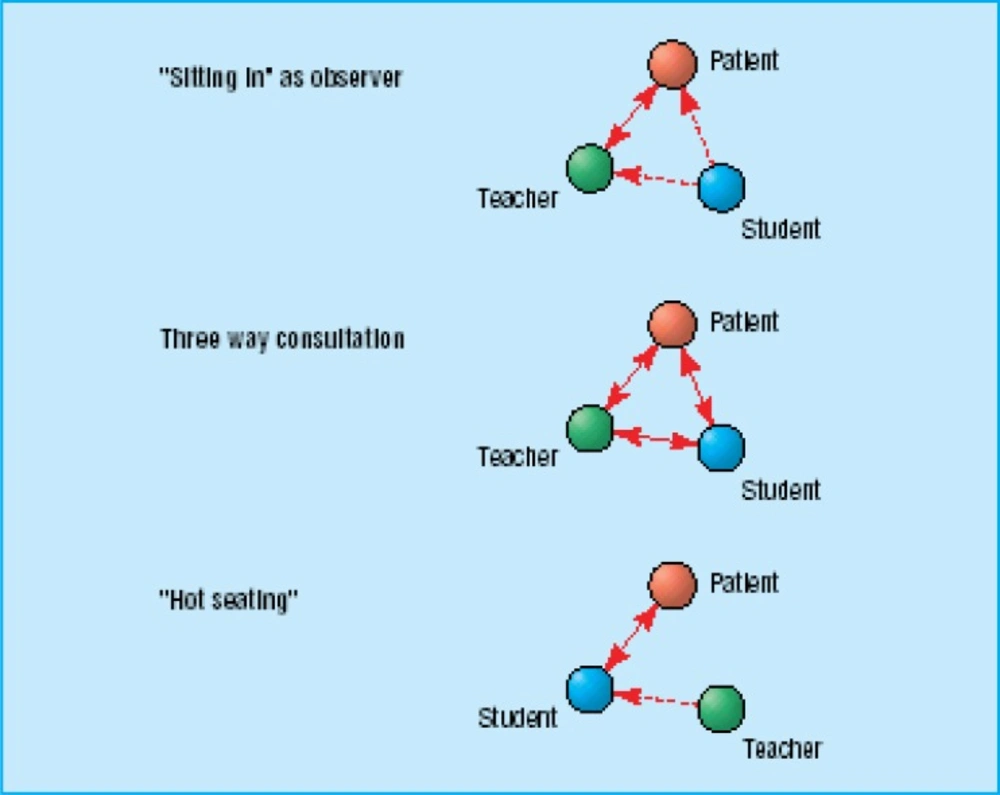
Fig. 1
Seating arrangements for teaching in clinic or surgery
It should be noted that the training in clinical centers, is one of the most important and the most effective methods of training medical students with medical education in all institutions throughout the world. In this method of teaching, students learn by a practical manner how to diagnose and treat the patient by the physician who is in role of a clinical professor, and also in some training courses, earn the chance of examination under professor supervision. Scientific resources available in the field of medical education and a variety of different models in relation to clinical training programs have been successfully developed. Successful clinical training education models, despite their diversity, have some factors in common. These factors should be considered in all education models by the planners, and the factors include:
Time and space of education: These factors in fact will determine the limitations and possibilities of the clinical learning environment.
Learner's role: The purpose of this factor is to determine the degree of learner participation in the diagnosis and treatment process that will be different according to the learners’ knowledge, clinical skills and his mastery in clinical skills and giving the relevance and the importance of diseases.
Number of Learners: This factor affects the grouping and arrangement of the learners in different parts of the learning environment, considering the teaching space and determining the ratio of teachers to students.
For example, one of the clinical educational models is the observing model or sitting in model, which I recommended it as a suitable model for future programs. The student views and practices simultaneously and this can be mentioned as one of the advantages of this model. This model has less stress than other models for learners and also provides safety to the learner's patient.
In this clinic, pre-participation examination (PPE) is performed. PPE is performed by the use of a broad range of medical investigations followed by a general medical evaluation, a cardio-vascular evaluation and a musculoskeletal screening. It helps athletes to start their activities with their best power. Unfortunately, it was in the middle of the season when we were present so PPE was not carried out at that time.
➢ Sports rehabilitation center
This center is one of the best sports rehabilitation centers in the world. The rehabilitation of various groups is one of the interesting points among all the points of this center. For example, a particular specialty for injury rehabilitation, ACL, was present. Also, the presence of research groups in the center was impressive, which were working in the studying sectors. It can be pointed to the ACL injury rehabilitation, which fully presented the useful training sessions.
Becoming familiar with the new devices of sport rehabilitation was one of the special benefits in this center. For example, there were anti-gravity treadmills (Fig. 2). These unique treadmills possess technology that allows athletes to run or walk at a fraction of their own body weight. A desirable body weight percentage can be created, via an air current that partially lifts a person off the treadmill surface thereby allowing athletes to recover faster and to train smarter. It is changing both the way athletes recover from injury and the way they train.
Fig. 2
Antigravity treadmill
Here, it can be suggested that in future programs planning be done in a way that the most common injuries in football be included in the educational programs and both the rehabilitation and the new ways of dealing with these injuries be taught.
Given the importance of rehabilitation, it seems that the increased duration of training in sports rehabilitation center gives better results.
➢ Functional testing center
These tests are done after the rehabilitation of the athlete, and before their reentrance to the competition and practice. Since these tests are so important and the doctors are not familiar enough with the tests, conducting the sessions with the focus on testing in the next periods is recommended.
➢ Hydrotherapy pools
Aspetar had two hydrotherapy pools with unique facilities for each, such as adjustable water current resistance, that will benefit injured athletes. This pool also has the capability to provide underwater photography and video analysis if required. In addition, the second hydrotherapy pool is a large 100 square meters one with the possibility of changing and adjusting the depth.
A special training program was provided for the group in this part and on these facilities, but the patients were not closely interviewed about their problems.
➢ Radiology center
MRI, CT, Ultrasound and X-Ray are all forms of digital imaging that are available in the radiology department at Aspetar. The obtained images are stored in a digital image archive and are available for instant viewing by medical staff anywhere in the hospital, at any time.
In this part, each member of the group separately visited different parts of the imaging center in 5 hours and eventually discussed with the professors. The presence of specialists in these sections was one of the important features. The center was equipped with advanced machines, CT scan, MRI and Ultrasound of muscle-bone. Also, the increasing use of musculoskeletal ultrasound in sports medicine was very impressive. For the next courses, it is better to prepare the most common forms of injuries in football, so this case would be reviewed if you have enough time.
➢ Attending the morning report
The group attended the morning report for two days and from 8 to 9 am. Every day the patients were introduced in turn and professors discussed the issues after that. One of the attractive features in these morning reports was the presence of experts in various fields of medicine, and the expression of different views in meetings.
Meeting location, good space for lectures, and video projectors were of the main attractions in this place. During the speech, images, stereotypes, radiography, and high quality figures were presented.
➢ Theoretical workshops, CPR practice, and intubation
In this workshop, after a 30-minute theory session, three practical stations were held during two hours including the transportation of the injured person to the stretcher, neck fixing, basic life support (BLS) and endotracheal intubation.
In this workshop, about 22 people participated in three different groups. This workshop was one of the most successful workshops in this period. A highlight of course in this part, was determined teachers and professors who insisted on running the process with individual participants in the workshop.
➢ Implementation of practical workshops, examining the foot
Examination and functional evaluation of the foot were fully discussed in this practical workshop. An interesting point in this session was the development of the diagnostic evaluation of foot in the world.
➢ Giving Lectures by the members of Department of Sports Medicine (sports nutrition, sports physiology and sports psychology)
Each member of the Academic Departments of Sports Medicine lectured for 30 minutes. They unfortunately lectured on the issues that were not related to football. The time limitation in the program caused the shortage of time for the lecture on psychology in sports. So, there was just a 15-minute lecture on the psychology.
➢ Speech of the trio group
The trio group of doctors who were from 3 different countries gave lecture on the related football issues and the fields relevant to football medicine in their countries and informed the Qataris in this way. In this session, each lecturer spoke for 15 minutes and the audience welcomed them. Most of the speakers spoke about the status of sports medicine and football in their countries.
➢ Talking to the center's president
In the last part they talked to the center's president and shared their views with each other. On the final day, meeting with the president of the center for sports medicine, Aspetar was held and important proposals from the group were presented. We suggested they have a journal on the center, medical tourism and more advertising in the Middle East.
2. Aspire Academy
Aspire academy was conceived to give the opportunity to young football players from developing countries to reach the heights of international football through careful training and development. Aspire has the capacity to host thirteen different sporting events simultaneously.
In this part of the program sports talent finding centers, biomechanics and biochemistry laboratories, sports physiology and performance analysis center, and research and quality assurance sections were visited in over 4 hours. I would like to suggest a larger amount of time being available for the other visitors of the next courses to have a full visit of such a large area. However, this center is an honor for Asia and I hope that sports medicine will be developed by establishing similar centers in Asia.
We visited 3D motion analysis, force plates, pressure sensors, high-speed video cameras, laser speed-guns, EMG and various instrumented machines.
3- AL-Sadd Sports Club
In this program, sports medicine clinics, rehabilitation and recovery center, testing center, sports physiology and sports nutrition center from Sadd Qatar club were visited in 4 hours. Sadd club officials cared for football and the related issues and this was an interesting point to us in this program which should be considered by the directors of the other clubs in Asia.
Thailand (Jan 23 - Jan 29, 2012)
It was planned to visit the following places in Thailand:Mahidol University College of Sports Science and TechnologyDepartment of Orthopaedic Surgery, Faculty of Medicine, Siriraj Hospital Mahidol UniversityBangkok Hospital Center and Sports MedicineNational Olympic Committee of Thailand (NOCT)The training center of the Thai national football teamThe Bangkok Glass FC and Muangthong UnitedChonburi Stadium
1. Mahidol University College of Sports Science and Technology
MU entered the THES-QS World University Rankings in 2006 as 322nd in the world and 3rd in Thailand. In 2010, the university swiftly proceeded to the 228th in the world, 28th in Asian and as Thailand's top-ranked university according to Quacquarelli Symonds 2010 Asian Ranking. MU has 17 faculties, 6 colleges, 8 research institutes and 7 centers.
Bangkok Hospital Medical Centre (BMC) and the College of Sports Science and Technology at Mahidol University have been accredited as the first FIFA Medical Centre of Excellence in Thailand and the ASEAN region since early this year.
The introductory session was held giving an introduction about the Chairman and all the officials in different sports departments. After that, as it was planned different departments in the University Center were introduced to the group briefly and by the representative of the university in 3 hours. In this academic center, meeting with various groups (sports psychologists, sports nutritionists, sports physiologists, etc) were held over a day. Meeting various groups involved in sports medicine was an important point of visiting this academic center. This scientific environment, despite its simplicity, was full of passion and vitality. In this session different groups gave speeches about the university's history, sports groups, and research and clinical works for us. The visit of the entire Mahidol University was done together with the department manager.
2. Department of Orthopaedic Surgery, Faculty of Medicine, Siriraj Hospital Mahidol University
Since the 19th Century, Siriraj hospital has been established as the first ‘western’ medical centre in the Kingdom of Thailand according to the royal legislation and graciousness of King Rama the 5th of the Chakri Dynasty. Siriraj hospital is also the first medical college of Thailand to train medical doctors and nurses for more than a century. The sports medicine division was established in the Department of Orthopaedic Surgery, Faculty of Medicine, Siriraj Hospital Mahidol University in 1969.
First, the introductory Session was held with the director of orthopedics to familiarize us with the group. Then, based on regulatory programs, an outline of the various parts of the hospital was presented by the representative of the hospital to the group during two hours. In this center a two-day training program was arranged for the group.
➢ Sports and orthopedic sports medicine clinics
Considering the clinical education facing a small working space was really shocking. Unfortunately for the three fellowship groups, assistants, patient and orthopedic physician there was not enough space.
➢ Sports rehabilitation center
In this place there was no special program planned for group.
➢ Presence in the operating room, and observing arthroscopic surgery
Presence in the operating room, and seeing the arthroscopic surgery was an interesting experience, and it was very helpful for us seeing the arthroscopic knee and shoulder surgery while listening to the professor's explanations during surgery.
3. Bangkok Hospital Center and Sports Medicine
According to schedule, the various parts of the hospital were introduced in brief within two hours, by a representative of the hospital to the group. The private hospital had high standards. In this hospital, the doctor Paizal told us about the hospital's future goals, and criteria used by FIFA for the sports medicine center.
Bangkok Hospital is located in Bangkok, Thailand and is considered as an expansive state-of-the-art medical campus providing comprehensive medical care.
4. National Olympic Committee of Thailand
The Olympic Committee of Thailand was established on June 20, 1948. After attending the center, a session focusing on the Sport Sciences was conducted. After the Session, based on the preplanned programs the various departments of the sports medicine center were introduced in brief by the director of the center to the group within three hours. Our visit included seeing the following places:Sports medical clinicsSports orthopedic clinicSports rehabilitation centerSports fitness centerCenter for anti-dopingExercise physiology lab, sports nutrition and biomechanics centers
5. The training center of the Thai national football team
In this part of the program the training centers of Thailand's national football team were introduced within three hours to the group by the help of a representative of the center.
6. The Bangkok Glass FC and Muangthong United
In addition to visiting the team facilities in these two clubs, their sports medicine centers and the doping control rooms were introduced by the representative of the club.
7. Chonburi Stadium
The group was welcomed warmly first. Then, the different issues regarding the stadium and its future were discussed. After that the group was informed of the way AFC evaluated the stadium. The other issues related to Asia Vision and CFA buildings were also discussed.
Malaysia (Jan 30th - Feb 10th)
After entering this country, the group was appointed to visit the following venues:National Sports Institute of Malaysia (Institut Sukan Negara Malaysia)Football Association of MalaysiaKuala Lumpur Sports Medicine Center (KLSMC)The headquarters of the Asian Football Confederation (AFC)
1. National Sports Institute of Malaysia (Institute Sukan Negara Malaysia)
NSI provides sports science services, centers for conducting research and development in the area of sports and helps continuing education towards achieving excellence in sports. It includes services such as biomechanics, sports medicine, nutrition, psychology, physiology, and game analysis.
After attending the center, a session with the center director was held. After the Session, based on regulatory programs, the various parts of the sports medicine center, in brief, were introduced by the representative of the center to the group within three hours. In this center, as the last part a training program was also arranged for the group that took over a week.
➢ Sports Medicine Clinic
Attendance of experts and interested professors, taking advantage of the experienced sports medicine assistants and the large number of injured athletes, was among the important features of this center.
➢ Sports rehabilitation center
The presence of capable and interested teachers and physiotherapists and the large number of patients with various problems in the center led to gaining a fruitful and productive experience in this trip.
➢ Functional test center
Functional testing specific to football was of the attractions we faced while attending in this center, although having a theoretical educational knowledge was a must for entering the center.
➢ Advanced hydrotherapy center
Different patients injured during the football could make use and benefit this center with the help of specialists.
➢ Running the practical workshops
Introducing the Stochastic Resonance Training Injuries, rehabilitation, new rehabilitation methods and rehabilitation devices together with the attendance of skilled professionals was a positive feature of this section.
➢ Lecture of Department of Sports Medicine on sports nutrition, sports fitness, sports biomechanics, exercise physiology and sports psychology:
The positive point of these lectures, was that they focused fully on medical topics in football. This lecture with such a great importance unfortunately was designed to be delivered in a day. It is better in next courses to have lectures in different days with appropriate time allocation.
2. Football Association of Malaysia
In this three-hour visit, the Malaysian national team training center was introduced by a representative of the federation to the group. Also, sufficient explanation about the Center for Sports Medicine, Rehabilitation, sports and fitness team was given to the group. It seems due to the future changes and transformations, this center could progress sufficiently in future.
3. Kuala Lumpur Sports Medicine Center
KLSMC is specifically active in sports medicine and orthopedics. It provides the players with a high level of care and a comprehensive range of medical services. The group had an introductory session with the director of the center. Then, based on the schedule, different parts of sports medicine centers were introduced to the group by the representative of the center during two hours. KLSMC is a private place. Following sections were included in our visit:Sports medical clinicsSports orthopedic clinicSports physiotherapy centerSports imaging & general radiology centers
In my opinion, visiting this center was a valuable experience for us. Sports imaging was one of the facilities in the radiology center in KLSMC. The MRI system was an extremely capable one. It provided us with a comfortable and non claustrophobic experience due to its open and quiet design. Also, sports physiotherapy was interesting. The sports physiotherapy center was a specialized center for surgical and non-surgical treatments. KLSMC provides innovative stem cell therapy for sports related injuries. In this type of treatment they use the autologous adult stem cells to regenerate and repair a damaged system in their organs.
Next, practical foot and ankle workshops were held for the group. This workshop was designed for a group of physicians and orthopedic surgeons working in Malaysia and this, despite the high value for participants, was not appropriate for the fellowship traveling group, because sports medicine topics were discussed rarely.
4. The Headquarters of the Asian Football Confederation (AFC)
This five-day seminar, entitled AFC Elite Education Seminar 2012, was held at the end of the football medicine fellowship with presence of physicians, surgeons and lecturers of FIFA, in the headquarters of the AFC. Perhaps my expectations from a football fellowship were completely fulfilled by this conference that came beside the five valuable training days. Among lectures and interesting workshops there were other activities such as CPR, discussing the medical officers’ duties and doping. There are some suggestions here that can help holding better seminars with improved quality in future.It is better to have case presentation in the next training courses.It is better to plan for presenting and discussing the new educational methods in addition to speeches that were delivered.
Issues that were raised include:
First Day:The role of AFC medical officer: The issue was raised by a speech doctor Dato’ Dr. Gurcharan Singh. He completely explained the task and responsibilities of a doping control officer in a football tournament. One important feature of this meeting that heightened its quality was discussing the training class. The part that focused on the management in a football tournament was really interesting to me. It is suggested that a fellowship course be scheduled so that a traveling fellowship group gain practical experience from a sport disaster that should be managed by a medical officer.The task of teams’ physicians: Dr Cristiano Eirale Spoke about pearls & pitfalls, role of the teams’ physicians, medical management, administrative management, Responsibilities of the physician to players, coaches and club. He, as a skillful teacher delivered his speech shortly but comprehensively and it seemed very advantageous and fruitful to us.Sudden cardiac death in football: Prof. Efraim B. Kramer, FIFA medical officer spoke about one of the most important medical problems in sports, especially football. He gave a complete speech on the incidences of cardiac arrest, famous soccer players who suffered death due to cardiac arrest, the heart study in Pre Competition Medical Assessment (PCMA), the causes, symptoms and signs of cardiac arrest, diagnosis and treatment of cardiac arrest. The lecturer's skill in speech delivery and his mastery in the subject under discussion can be mentioned as the best features of the lecture.Articular cartilage damage: Current trends about the damages to the articular cartilage, were referred to in the session by Dr. Alfred Khoury.Medical Emergency in football: In the first day's afternoon of seminar Prof. Efraim B. Kramer had a lecture about Football Medical Emergencies. He spoke about Acute Anaphylaxis, Acute Hypoglycaemia, Acute Generalised Tonic / Clonic Seizure, and acute asthma. The lecture was functionl and we can regard this feature as the best feature.Diagnosis and treatment of outer ankle instability. Professor Hu Yuelin spoke about diagnosis and treatment of antero-lateral ankle instability. The use of audio visual systems in the lecture was good.Following the meeting, Dr. Abeer Al Macki, AFC travelling fellow, based on the anticipated schedule of AFC, spoke for 5 minutes at the beginning of the lecture on the Impression of the AFC Travelling Fellowship Program. Then he spoke about Comparison of the functional outcome after ACL Reconstruction, BPTB vs. Hamstring graft.Diagnosis, treatment and prevention of groin injuryThe last speaker at the first day of the seminar was Dr. YUNG Shu-Hang Patrick who spoke about the Hip & Groin Injuries. Among attractive features of this speech was the use of CASE in training.
Second Day:The first speaker in the second day was Dr. Saw Khay Young. He spoke about application of stem cells for musculo-skeletal injuries. Then Dato’ Dr. Ramlan Abd. Aziz spoke about elite high performance athletes support for integrated support.The use of stem cells in treatment of skeletal muscle injury and increasing the athletic performance was of the other topics at this seminar.Football in hot weather: The Dato’ Dr. Gurcharan Singh spoke about Football in hot conditions. Incidence of heat exhaustion, the effect of temperature on the footballers, the role of medical officers in these conditions, and existing Guidelines were investigated. Since Asia's climate is warm, raising this issue was warmly welcomed by the participants.Dr. Paisal Chantarapitak Spoke about the Footballer's Knee. He discussed the importance of the topic, how to prevent it, how to help the footballers to return to the competitions and related issues.Women's football: The Women's Football was the last issue of the second day.Dr. Michiko DOHI at first talked about physical & physiological differences between males & females. Then she spoke about the Common injuries in female footballers. The importance of women's football in Asia and the use of research in education was an important feature of it.In the second day, practical workshops of AFCAS were held, in which software systems of AFC were completely presented. The idea of establishing a similar system in my country came to my mind as an effect of these workshops.
Third Day:The first speaker on the third day of seminar was the Prof. Efraim Kramer that spoke about mass gathering medical services inside the football stadium. In this session, he spoke about emergency medicine, definition of mass gathering, primary healthcare medicine, travel related medicine, field-side medical care, ALS and other related issues.Dr. Ameer Ibrahim spoke about the stem cell therapy.PRP in skeletal muscle damage was addressed by Cristiano Eirale, including the mechanism of action, advantages and the latest information in this field.Supplements in football were topic of the next lecture in the third day that was provided by Dr. Cristiano Eirale. He mentioned the advantages and disadvantages of various supplements and also noted to effective types of supplements in football. Finally, researches in this field were presented by him.Epidemiology of Injuries in Football Doctor Cristiano Eirale spoke about the necessity of epidemiological studies in Asia and reviewed related articles, a variety of injuries in football, and the prevention of injuries. The damages in the Qatar league were also reviewed.On third day, a workshop for the examination of the lower limb was held by Prof. Hu, Dr. Eirale, Prof. Shane, and Dr. Patrick.A practical workshop was held that was interesting to the participants.
Fourth Day:Anti-doping activities, therapeutic use exemption, and WADA code were the topics that were addressed. Dato’ Dr. Gurcharan Singh spoke on medical exemption for football players.Out-of-competition testing: Following the meeting, Dr. M. Dohi spoke about out-of-competition sampling and related issues. She first spoke about the AFC elite testing pool and pre-competition testing pool. Finally, she explained how to gather information from teams and players and also how to do the sampling.In-competition testing: In this session, Prof. Y.Y. Sul gave a lecture about sampling during the match, and the possible actions for handling the partial sampling and familiarized us with the actions in the process.On this day, I spoke about the impression of the AFC Travelling Fellowship Program. Then, he spoke about General risk factors in football injury.Tanaqon Sayanant spoke about the Impression of the AFC Travelling Fellowship Program.Emergency workshop was held by Prof Efraim Krame and attracted the attention of the participants. In this workshop issues such as Basic Life Support, using the defibrillator, transporting the injured to hospitals and other related issues were raised. The doping control workshops were run in five groups. This workshop was also acclaimed by participants.
Fifth day:Nutrition in Football was presented by Prof. Shane Brun. In this session he spoke about nutritional preparation before the competitions, in training period, and during the recovery. The referees’ diet and women's diet were also spoken about.Physician in trip was the topic addressed by Farrah-Hani Imran. He spoke about vaccination, jet lag, diet, and acclimatization.Dr. Mohd Zaidi Salleh spoke about how the physicians were impressed by the AFC Travelling Fellowship Program. Then, he spoke about the hamstring injury.At the end of this session, closing ceremony, attended by Secretary General and Director of AFC Medical Committee was held.
FINAL CONSIDERATIONS
Design and implementation of any program requires compliance with the following matters:The definition of codified missions and goalsThe participation of stakeholders and participants in setting goalsObeying the rules of writing and classification (knowledge, skills and attitudes)Good knowledge of stakeholders and participantsRevising the mission and educational goals in each period based on the received feedback
One of the important points that should be considered is that a general view of the training course must be given by the AFC to the participants, teacher and programmer, so that all people, before entering the course will know the training goals and will participate in the program with acceptable readiness. Organizers and lecturers are also expected to be aware of the program. If this happens, the participants can have both proper planning for the program and good judgment about the program and its quality, so they can help the improvement and enhancement of the program in next periods.
Finally I would like to recommend the following activities for having an improvement in the field of football:Travelling to the Asian developed countries such as Japan and Australia in order to make use of their experiences.Creating an educational network for increasing the connections between the countries that are in the same continent.Using cyberspace as an idea through which we can learn from the others in high speed. Travelling is not the only way of gaining knowledge.Preparation of an evaluation check list by AFC. The completion of the check list by the participants can be helpful for having more fruitful courses in future.