Knee Pain Following a Ski Injury

Author(s):
Morteza KhodaeeMorteza Khodaee,*, Ryan BartkusRyan Bartkus

Asian Journal of Sports Medicine:Vol. 3, issue 3; e34696
Published online:Sep 01, 2012
Article type:Discussion
Received:May 22, 2012
Accepted:Jan 12, 2012
How to Cite:Khodaee M, Bartkus R. Knee Pain Following a Ski Injury. Asian J Sports Med. 2012;3(3):e34696. doi: https://doi.org/10.5812/asjsm.34696

Abstract

Case:

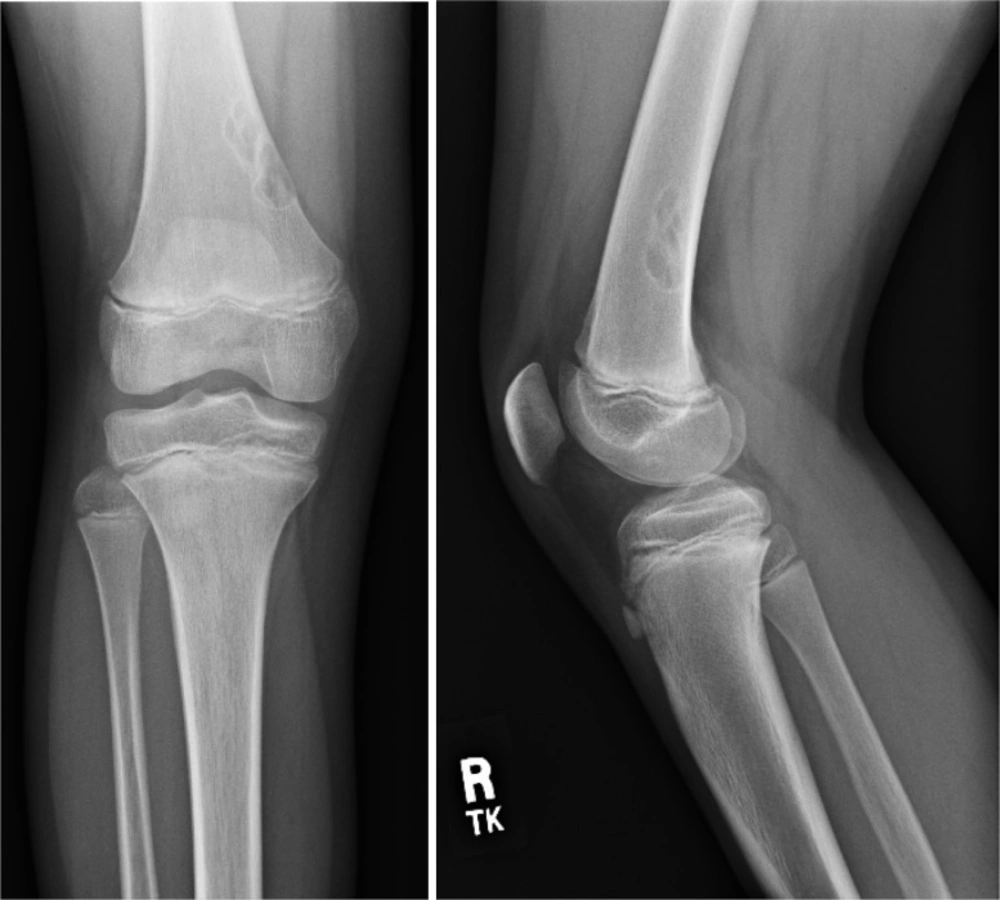
A 13-year-old boy presented to the ski clinic following a fall and a possible twisting of his right knee. He was not able to bear any weight on his right leg and was experiencing pain in the medial aspect of his right knee. His past medical and surgical histories were unremarkable and he was otherwise in good health. Physical examination revealed no ecchymosis or effusion. He had moderate tenderness over the medial femoral condyle. Stress valgus test did not reveal any laxity, but caused significant pain. Plain radiography was performed (Fig. 1).

DISCUSSION

Plain radiographs of the right knee; a) anteroposterior view; (b) Lateral view
Fig. 1

Plain radiographs of the right knee; a) anteroposterior view; (b) Lateral view

The correct answer is B. Nonossifying fibromas are common benign bone lesions seen almost exclusively in young patients under 30 years of age [1]. They are usually asymptomatic and found incidentally on radiographs [2]. They are typically located in the metaphysis or diaphysis of long bones, most commonly the femur and tibia. Furthermore, these lesions are characteristically cortically-based and eccentrically located within the medullary cavity. As seen in the radiograph above, the lesion should have well-defined borders, with no signs of periostitis, cortical breakthrough, soft tissue mass, or edema around the lesion [1].
Enchondromas are one of the most common benign bone tumors and can often be incidental findings on routine knee radiographs and MRI studies [1]. These are intramedullary lesions, typically more centrally located than eccentrically, and are usually found in the metaphysis or diaphysis of long bones. Additionally, there is no related pain, no soft tissue mass and no cortical disruption or periosteal reaction [1, 3].
Osteoid osteomas account for approximately 10% of all benign bone tumors, usually occur between 5 and 25 years of age, and are found predominantly in males (2:1 – 3:1 male to female ratio) [4]. The radiographic appearance is characteristically of a well-circumscribed, 1 to 2 cm lesion with a central osteoblastic nidus surrounded by a sclerotic border in the proximal femur or tibia[2]. They are clinically associated with pain which is worse at night and is relieved with NSAIDs [4].
Salter-Harris type II fracture refers to a physeal injury in which the fracture extends along the growth plate then out through a portion of the metaphysis, producing a triangular shaped metaphyseal fragment referred to as the “Thurston Holland sign.” This is the most common form of physeal injury and has historically been associated with a good prognosis, though recent data now suggest that this injury is associated with a greater risk of growth impairment than previously thought [5].
References

  • 1.
    Subhas N, Bui KL, Sundaram M, et al. Incidental tumor and tumor-like lesions around the knee. Semin Musculoskelet Radiol. 2009;13:353-70. [PubMed ID: 19890803].
  • 2.
    Kujawski EJ, Morgan RL. Lateral knee pain in a male college student. Am Fam Physician. 2012;85:509-10. [PubMed ID: 22534230].
  • 3.
    Gould CF, Ly JQ, Lattin GE, et al. Bone tumor mimics: avoiding misdiagnosis. Curr Probl Diagn Radiol. 2007;36:124-41. [PubMed ID: 17484955].
  • 4.
    Cerase A, Priolo F. Skeletal benign bone-forming lesions. Eur J Radiol. 1998;27:S91-7. [PubMed ID: 9652508].
  • 5.
    Caine D, DiFiori J, Maffulli N. Physeal injuries in children's and youth sports: reasons for concern? Br J Sports Med. 2006;40:749-60. [PubMed ID: 16807307].

Similar Articles

30
Nov
2008

Knee Ligament Injury in Femoral Shaft Fractures

afshin taheriazam,
Mohammadnaghi Tahmasebi

taheriazam A, Tahmasebi M. Knee Ligament Injury in Femoral Shaft Fractures. Zahedan J Res Med Sci. 2008;10(4):e94502. doi:

5
Nov
2017
Are Lower Extremity Injuries Related to Spinal form Abnormalities in Professional Football Players? A Prospective Cohort Study

Are Lower Extremity Injuries Related to Spinal form Abnormalities in Professional Football Players? A Prospective Cohort Study

Sara Lotfian,
Navid Moghadam,
Bahar Hassnamirzaie,
Salman Khalifeh Soltani

Lotfian S, Moghadam N, Hassnamirzaie B, Khalifeh Soltani S. Are Lower Extremity Injuries Related to Spinal form Abnormalities in Professional Football Players? A Prospective Cohort Study. Asian J Sports Med. 2017;8(4):e55543. doi: https://doi.org/10.5812/asjsm.55543

29
Oct
2017
Do Knee Braces Prevent Ski Knee Injuries?

Do Knee Braces Prevent Ski Knee Injuries?

Roberto Negrin,
Bastian Uribe-Echevarria,
Nicolas Reyes

Negrin R, Uribe-Echevarria B, Reyes N. Do Knee Braces Prevent Ski Knee Injuries?. Asian J Sports Med. 2017;8(4):e58678. doi: https://doi.org/10.5812/asjsm.58678

28
Dec
2016

Mechanism of Anterior Cruciate Ligament Injury in Female Soccer Players

Satoshi Kaneko,
Shogo Sasaki,
Norikazu Hirose,
Yasuharu Nagano,
Mako Fukano,
Toru Fukubayashi

Kaneko S, Sasaki S, Hirose N, Nagano Y, Fukano M, et al. Mechanism of Anterior Cruciate Ligament Injury in Female Soccer Players. Asian J Sports Med. 2017;8(1):e38205. doi: https://doi.org/10.5812/asjsm.38205

11
Sep
2014

An Unusual Knee Mass in a Soccer Player

Morteza Khodaee,
David Roy,
Karin VanBaak,
Blaine T. Bafus

Khodaee M, Roy D, VanBaak K, T. Bafus B. An Unusual Knee Mass in a Soccer Player. Asian J Sports Med. 2014;5(3):e23187. doi: https://doi.org/10.5812/asjsm.23187


Crossmark
Crossmark
Checking
Share on
Cited by
Metrics

Ordering Reprints

Articles are published under the Creative Commons license stated on each article. No permission or royalty fee is required for uses permitted by that license. CCC handles optional bulk and customized reprint orders. Any quotation covers production and delivery services only, not copyright permission. > Request Reprints from CCC