1. Background
Soccer is one of the most popular worldwide sports and performance is considered to be dependent upon many factors including technical, biomechanical, tactical, psychological and physiological aspects (1). During a 90-minute game, elite players run approximately 10 - 11 km, they change activity on average every 5 seconds and perform approximately 1,300 actions, with 200 of these being completed at high intensity (2). With reference to differences between first and second half performance and workload, computerized video analysis systems have reported that total distance and high-intensity activities are reduced in the second half compared with the first (2). Fatigue has been vindicated as a substantial contributor to this observed reduction in workload as well as decrements in passing precision toward the end of games (3, 4).
Conversely to the reported decreasing work done and a passing accuracy as game progress, preliminary investigations have identified that goal scoring increases (5-7). These observations indicate a potential causal link between match-related fatigue (as manifested in reduced distance covered, speed of sprints and passing accuracy) and goal scoring frequency. However, these data were obtained analysing major European leagues, or a single major tournament without comparing across major international tournaments. At present, there appears to be a considerable gap within the literature examining a potential country-related style of play related to goal scoring patterns across major international tournaments. Therefore, the aim of the present study was to evaluate the characteristics of goal scoring patterns between two major international tournaments, the 2016 Copa America and the 2016 European championship.
2. Methods
2.1. Subjects
Eighty-three games of 40 teams from all phases of the two tournaments were examined. The 2016 Copa America consisted of 16 teams competing in a total of 25 games and the 2016 European Championship consisted of 24 teams competing in a total of 51 games. Analysis of goal scoring frequency was performed considering all official games played in all phases of the respective tournaments. All data were collected from the official results available on each tournaments official web site (http://www.ca2016.com/ and http://www.uefa.com/uefaeuro/).
2.2. Statistical Analysis
A one-way between groups analysis of variance (ANOVA) was conducted to examine the goal scoring patterns between the European championship and Copa America. Paired Sample T-tests were conducted to compare goals scored within the first and second half within the individual European championship and Copa America. Chi square (X2) analyses were used to determine the differences in goal scoring frequency between the first and second half, as well as between the six 15-min intervals of the game (0 - 15, 15 - 30, 30 - 45, 45 - 60, 60 - 75 and 75 - 90). These differences were investigated between the 2016 Copa America and the 2016 European championships. Goals scored during in stoppage-time (i.e. 45+ and 90+) and extra-time were excluded from the analysis. Statistical significance was set at P < 0.05. All data were examined using the SPSS v 23.0.
3. Results
A total of 197 goals scored in 83 games were analysed. The goal scoring frequency during the first and second half of the Copa America and European Championship are presented in Figure 1. Paired Sample T-tests revealed a significantly higher goal scoring frequency in the second half (60.7%) compared to the first half (39.3%) in the European championship t(50) = -2.48, P = 0.02. No differences were found between the first (47.8%) and second half (52.2%) in the Copa America t(31) = -0.47, P = 0.64.
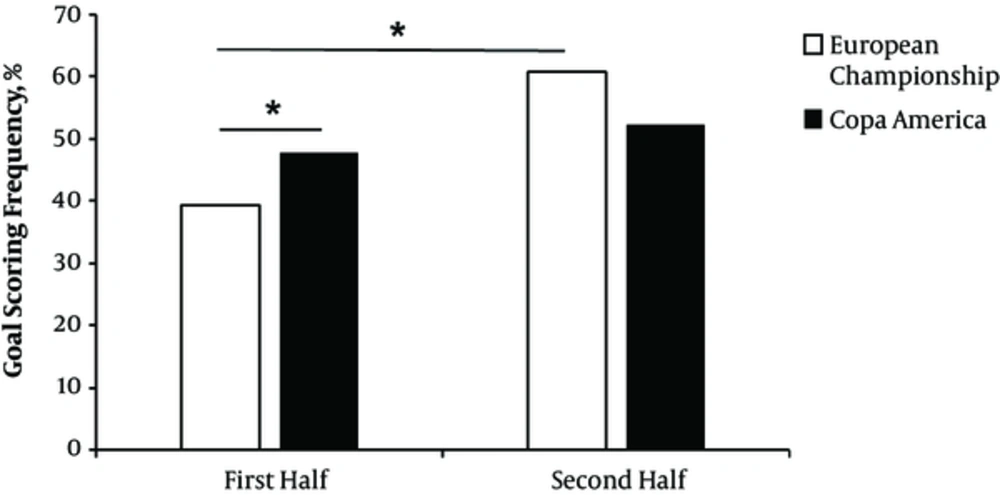
Figure 1.
*P < 0.05 significant difference.
A One-way ANOVA revealed a significantly higher amount of goals were scored in the first half of the Copa America (43 out of 32 games; 47.8%) compared to the first half of the European championship (42 out of 51 games; 39.3%), F(81,1) = 5.93, P = 0.02. No significant differences were found between the Copa America and European championship for the second half F(81,1) = 0.72, P = 0.48. The goal scoring frequency during the first and second half of the Copa America and European championship are presented in Figure 1.
There were no significant differences for the frequency of goals scored between the European championship and Copa America across the 16 - 30, 31 - 45, 46 - 60, 61 - 75, and 76 - 90 minute intervals (P > 0.05). Chi square analysis revealed a significantly (P < 0.01) higher goal scoring frequency in the first 15-minute interval for the Copa America (24%) compared to the first 15 minutes of the European championship (12%). The goal scoring frequency during each 15-minute interval between the European championship and Copa America is presented in Figure 2.
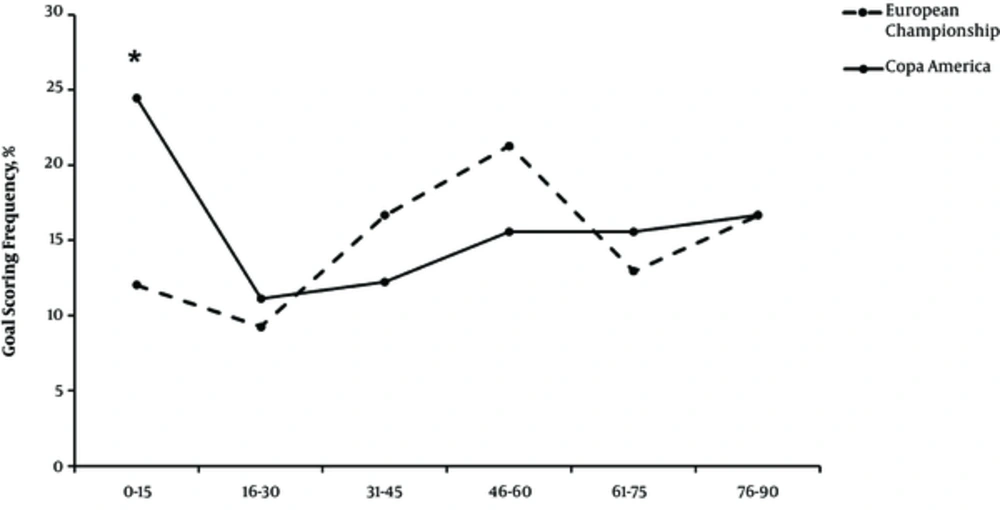
Figure 2.
*P < 0.05 significant difference.
4. Discussion
The present study examined the differences in goal scoring patterns between two major international tournaments. The main findings of the present study were that: 1) more goals were scored in the second half during the 2016 European championship but not during the 2016 Copa America; 2) more goals were scored during the first half of the 2016 Copa America compared to the 2016 European championship; and 3) more goals were scored during the opening 15 minutes of the 2016 Copa America compared to the 2016 European championship.
The amount of goals scored increased considerably in the second half compared to the first half during the European championship but not during the Copa America. There is a long standing debate about the style of play between European and South American nations with the later traditionally considered more flamboyant and offensive than European nations. Previous studies reported an increase in goal score frequency toward the end of the match (5, 6). It has been suggested that accumulated fatigue and urgency to score toward the end of game, especially if a team is drawing or a goal down (5), are two possible explanations of this phenomenon. However, this was not the case in the present study as the amount of goals did not increase toward the end of the games. One plausible explanation may be related to a difference between club and national team playing style. In many phases of international tournaments additional 30 minutes extra time play are present, as a consequence less level of urgency to score a goal may be present. However, this hypothesis should be verified in further studies.
It is acknowledged that this study may be limited as there was no data collected on the physical performance of each individual team. Thus, it is difficult to determine if there was an element of fatigue for some European teams conceding in the second half. Interestingly, the percentage of goals scored during the first half, and more specifically during the opening 15 minutes of the Copa America was double the percentage of goals scored during the opening 15 minutes of the European championship (i.e. 24% vs. 12%). Despite several discussions about the style of play between European and South American nations, no studies have examined goal scoring patterns between major European and South American tournaments. The findings of the present study suggest that European nations may have a conservative approach in the opening 15 minutes compared to South American nations. This may have important implications for both European and South American nations competing against each other during international tournaments such as the FIFA World Cup and Confederations cup. For example, European nations may be particularly cautious during the opening 15 minutes against South American nations. Similarly, South American nations may be cautious against European nations during the second half.
In conclusion, goal scoring frequency is higher in the second half for European nations but not for South American nations. Based on these data, South American nations appear to take an offensive approach in the first 15 minutes which is indicative that there may be a country-related style of play related to goal scoring patterns in major international tournaments. Future studies need to extend this research across several international tournaments to determine if there is a country-related style of play element to goal scoring patterns between European and South American international tournaments. Such research could also expand across continents to include the African Cup of Nations, the Asian Cup and Oceania nations Cup to understand goal scoring patterns between all major international tournaments.