Full Text
Full text is available in PDF
Asian Journal of Sports Medicine
Sports Medicine Research Center, TUMS
Authors
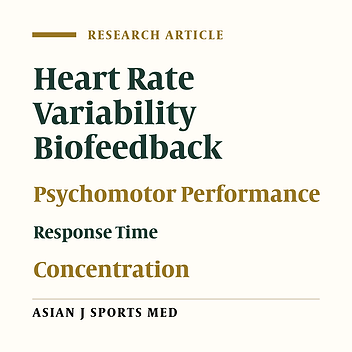
Biofeedback is an emerging tool to acquire and facilitate physiological and psychological domains of the human body like response time and concentration. Thus, the present study aims at determining the reconstitution of psychomotor and performance skills in basketball players through biofeedback training.
Basketball players (N=30) with different levels of expertise (university, state and national) aged 18-28 years (both male and female) were randomly divided into 3 equal groups - Experimental group, Placebo group and Control group. The experimental group received Heart Rate Variability Biofeedback training for 10 consecutive days for 20 minutes that included breathing at individual's resonant frequency through a pacing stimulus; Placebo group was shown motivational video clips for 10 consecutive days for 10 minutes, whereas Control group was not given any intervention. At session 1, 10 and 1month follow up, heart rate variability, respiration rate, response time (reaction and movement time), concentration and shooting performance were assessed.
Two way repeated measure ANOVA was used to simultaneously compare within and between group differences. Response time, concentration, heart rate variability, respiration rate and shooting differences were statistically significant in each group along with interaction of group and time (
The results of the study suggest that biofeedback training may help to train stressed athletes to acquire a control over their psychophysiological processes, thus helping an athlete to perform maximally.
© 2012, Author(s). This open-access article is available under the Creative Commons Attribution 4.0 (CC BY 4.0) International License (https://creativecommons.org/licenses/by/4.0/), which allows for unrestricted use, distribution, and reproduction in any medium, provided that the original work is properly cited.

Prajapat A, Ahmad I, Khan Z, Ali K, Ejaz Hussain M. Cardiac Autonomic Profile of Soccer, Field Hockey and Basketball Players: A Comparative Study. Asian J Sports Med. 2018;9(2):e62492. doi: https://doi.org/10.5812/asjsm.62492
Salimnejad Z, Zandi H, Arsham S. Effect of Bio-Neural Feedback Exercises on the Performance of Female Rugby Players. J Motor Control Learn. 2024;1(2):e146446. doi: https://doi.org/10.29252/ijmcl.1.2.10
Pashaei S, Nikbakht H, Shakeri N. Heart Rate Variability Following Eight Week Progressive Physical Training in Nonathlete Young Males. J Clin Res Paramed Sci. 2017;6(2):e81252. doi:
Bahrami A, Moradi J, Etaati Z. The Effect of Mental Fatigue on Three-Point Shot Performance in Skilled Basketball Players. J Motor Control Learn. 2024;2(4):e146525. doi: https://doi.org/10.29252/ijmcl.2.4.4
Bayat Z, Azimkhani A, Vaez Mousavi SMK. Investigating Physical and Psychological Interventions on the Performance and Bold Behavior of Elite Kung Fu Fighters. J Motor Control Learn. 2023;5(1):e144155. doi: https://doi.org/10.52547/ijmcl.5.1.45
Last Update: 2 weeks ago
Last Update: 2 weeks ago
Last Update: 2 weeks ago
Last Update: 1 hour ago
Last Update: 9 hours ago
Last Update: 5 days ago