
1. Background
Body composition and anthropometric indices in athletes are essential parameters in characterizing their success rate in sports career (1). Previous studies have shown that body composition could indicate athletic performance in soccer players (2). Some constant factors such as inheritance, sex, age or ethnicity have a fundamental impact on body composition, but the result is highly dependent on nutritional status, eating pattern and exercise training (1, 2).
Dietary pattern of young soccer players especially the type of macronutrients they consume is essential for their developmental goals and to support them during strenuous training loads (3). Studies have shown that the intake of nutrients in young athletes is lower than recommended (4). Many studies have hypothesized that meal frequency has some effects on adiposity and body composition (5).
Athletic performance is affected by body composition, which is typically divided into fat and lean body mass (6). Percentage of body fat in athletes is lower than general (1) and in soccer players, the amount of body fat mass and fat-free mass differed between players in various studies (2, 7, 8). On the other hand, nutritional intake has an undeniable effect on the performance of athletes and it is recommended that players should follow a healthy eating pattern with most favourable nutrients intake, in order to optimize energy supplies and prevent sports injuries (9-11).
Few studies have investigated the body composition and food frequency of young soccer players and those who have some reports of total energy intake and macronutrient use often concluded that young soccer players don’t meet the recommended values (3).
2. Objectives
Because of the lack of studies on body composition and eating patterns in elite young soccer players, the aims of the present study were (1) to assess the body composition and body fat percent of elite young Iranian soccer players in Tehran province, (2) to analyze their food frequency questionnaire and (3) to determine the relationship between dietary supplements and food intake with body composition as secondary goal.
3. Methods
The present study was a cross-sectional study on 3839, 10 - 34 year-old male soccer players. The participants were recruited from all leagues in Tehran province. The total soccer league players in the Tehran province were called for the assessments and all those who attended were evaluated. The participants were referred to the Football Association of Tehran province before seasonal league games, during the months of June to December 2016. All of the participants completed the informed consent. Body composition variables including weight, skeletal muscle mass (SMM), fat-free mass (FFM), the percentage of body fat (PBF) and other indices of body composition were measured by body impedance analyzer (InBody 370, Biospace America, Inc.), and height was measured using a standard tape. Participants were requested not to perform high-intensity physical activity, not to drink coffee throughout the last day before the measurement and to eat a light meal 2 hours before body composition analysis.
The participants were divided into 5 age groups according to National Iranian Football Federation categorization: U14: 10 - 13.9; U16: 14 - 15.9; U19: 16 - 18.9; U21: 19 - 20.9; adult: ≥ 21 years old. The summarized food frequency questionnaire was used for dietary intake indices assessment, including grains group (breads, rice, rice noodles, pasta, potato and others such as wheat and barley); meats and beans group (beef, lamb, chicken, turkey, fish, eggs, beans and other beef products such as hot dogs, sausages); dairy products group (cheese, milk, yogurt and ice cream); fruits and vegetables groups, fats group (cream, butter, solid fat or liquid fat like olive oil, nuts such as almonds, walnuts and peanuts); and beverages (tea, coffee and soft drinks) was completed by each participant.
The intake frequency of the mentioned items was evaluated by 5 categories: never, 1 - 2 times/month, 1 time/week, 2 - 3 times/week and 4 - 7 times/week.
Supplement use was reported by each participant in the following categories: Carbohydrate supplements, protein supplements, caffeine-containing supplements, fat burner supplements, antioxidant and vitamin supplements, energy drinks, and others. The questions in this page were open-ended with a description of the name and brand of the supplements for best categorization and data analysis. Unnamed questionnaires were adjusted to reduce the error report.
3.1. Statistical Analysis
Quantitative and categorical data are presented as mean ± SD and number (percentage), respectively. The normality of the distribution of quantitative data was tested by the Shapiro-Wilk test and they are presented as mean ± SD. Logistic Regression model, adjusted by weight was used in order to evaluate the relationship between skeletal muscle mass and frequency of protein consumption and usage of protein sports supplements in the present study. The significance level of this study was considered as P < 0.05 and SPSS (version 21) was used for data analysis in the study.
4. Results
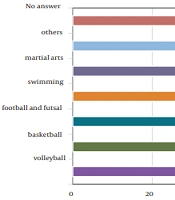
In total, 3839 soccer players from Tehran leagues participated in this study. The mean ± SD height, age, weight and body mass index (BMI) of the participants were 170.7 ± 10.6 cm, 17.8 ± 4.2 years, 61.9 ± 12.9 kg and 21.0 ± 2.8 Kg/m2, respectively. Characteristics of body composition of the participants according to age groups are presented in Table 1. Details of food frequency questionnaire analysis are shown in Table 2. Based on regression linear model adjusted for weight, skeletal muscle mass has a significant relationship with frequency of high protein containing foods consumption (P: 0.007) (CI: 0.004 - 0.02) based on food frequency questionnaire and also, usage of protein sports supplements (P < 0.001) (CI: 0.463 - 1.258) (Figure 1). The increment of frequency in high protein-containing foods (meat, beans and dairy groups) in FFQ could increase the mean of skeletal muscle mass by 0.02 (kg).
| Age Groups (No.) | Variable | ||||||||
|---|---|---|---|---|---|---|---|---|---|
| Height, cm | Weight, kg | BMI, kg/m2 | BFM | FFM | SMM | ||||
| kg | % | kg | % | kg | % | ||||
| U14 (313) | 152.0 ± 8.4 | 42.5 ± 8.6 | 18.2 ± 2.4 | 8.0 ± 4.1 | 18.8 | 34.5 ± 6.4 | 81.2 | 18.5 ± 3.9 | 43.5 |
| U16 (1076) | 164.9 ± 8.7 | 53.5 ± 9.9 | 19.5 ± 2.4 | 8.7 ± 4.3 | 16.3 | 44.8 ± 7.9 | 83.7 | 24.6 ± 4.8 | 46.0 |
| U19 (1106) | 174.6 ± 7.4 | 64.8 ± 8.6 | 21.2 ± 2.2 | 9.6 ± 4.3 | 14.8 | 55.2 ± 7.7 | 85.2 | 31.0 ± 4.7 | 47.8 |
| U21 (762) | 176.6 ± 6.6 | 69.0 ± 8.2 | 22.1 ± 2.1 | 9.9 ± 3.7 | 14.3 | 59.1 ± 6.9 | 85.7 | 33.5 ± 4.2 | 48.5 |
| Adult (581) | 176.4 ± 6.0 | 73.7( 9.3 | 23.6 ± 2.5 | 12.6 ± 4.9 | 17.1 | 61.1 ± 6.6 | 82.9 | 34.7 ± 4.2 | 47.1 |
Abbreviations: BFM, body fat mass; BMI, body mass index; FFM, lean body mass; SMM, skeletal muscle mass.
aAge groups (year): U14: 10 - 13.9; U16: 14 - 15.9; U19: 16 - 18.9; U21:19 - 20.9; adult: ≥ 21 years old
bValues are expressed as mean ± SD.
Table 2.
Food Frequency Characteristics of Participants
| Variable | Percent | ||||
|---|---|---|---|---|---|
| Never | 1 - 2, times/mo | 1, time/wk | 2 - 3, times/wk | 4 - 7, times/wk | |
| Grains | |||||
| Breads | 0.2 | 0.2 | 0.6 | 7.1 | 82.1 |
| Rice, rice noodles | 0.5 | 1.5 | 10.8 | 37.4 | 39.9 |
| Pasta | 0.6 | 1.8 | 11.5 | 37.7 | 38.5 |
| Potato | 0.7 | 2.8 | 16.3 | 43.0 | 27.6 |
| Others (including wheat and barley) | 9.2 | 16.1 | 28.3 | 25.9 | 9.6 |
| Meats, egg and beans | |||||
| Beef, lamb | 5.3 | 7.1 | 19.8 | 42.8 | 15.4 |
| Chicken, Turkey | 1.0 | 2.7 | 16.7 | 46.7 | 23.3 |
| Fish not including shellfish | 12.9 | 30.8 | 27.9 | 13.9 | 4.5 |
| Shellfish | 54.4 | 21.9 | 7.5 | 3.5 | 1.4 |
| Eggs | 5.2 | 5.3 | 16.5 | 35.3 | 27.4 |
| Egg white | 8.6 | 6.8 | 16.8 | 29.7 | 27.3 |
| Other beef products (hot dogs, sausages, …) | 28.3 | 29.6 | 17.7 | 9.7 | 4.1 |
| Beans (chickpeas, kidney beans, lentils, ...) | 2.7 | 9.5 | 25.2 | 35.9 | 15.8 |
| Dairy products | |||||
| Cheese | 3.6 | 2.4 | 6.3 | 22.4 | 55.6 |
| Milk | 1.9 | 2.2 | 8.4 | 22.2 | 55.5 |
| Yogurt and yogurt drink | 1.4 | 1.7 | 7.0 | 26.1 | 54.0 |
| Ice cream | 2.5 | 6.0 | 18.1 | 29.4 | 34.4 |
| Fruit and vegetables | |||||
| Fruit | 0.3 | 0.2 | 3.6 | 15.4 | 70.7 |
| Fruit juice | 1.1 | 3.9 | 15.5 | 33.5 | 35.9 |
| Vegetables | 2.4 | 4.8 | 16.1 | 35.1 | 31.4 |
| Fat products | |||||
| Cream | 11.8 | 14.5 | 25.1 | 24.4 | 13.9 |
| Butter | 11.5 | 10.0 | 19.3 | 27.3 | 21.5 |
| Liquid fat (like olive oil) | 4.8 | 6.9 | 14.4 | 29.9 | 32.8 |
| Nuts (including almonds, walnuts, peanuts) | 7.2 | 17.4 | 25.1 | 27.0 | 12.9 |
| Beverages | |||||
| Common beverage (including tea and coffee) | 8.5 | 9.5 | 11.8 | 23.2 | 36.8 |
| Soft drinks (like Cola) | 27.2 | 17.6 | 17.1 | 18.5 | 9.8 |
| Others | |||||
| Cake, biscuits, and pancakes | 4.2 | 12.5 | 25.1 | 31.7 | 15.5 |
| Chocolate | 7.2 | 12.6 | 24.9 | 28.2 | 16.4 |
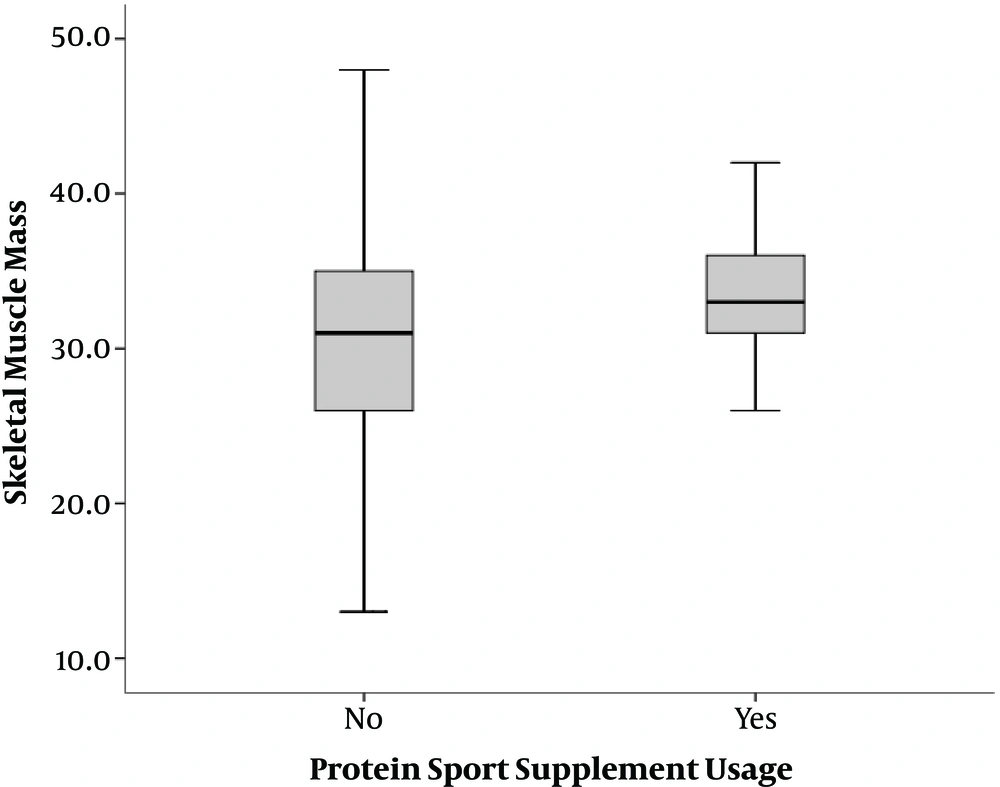
Figure 1.
Association between supplement use and increased skeletal muscle mass (kg) in soccer players
In the field of supplements, 17.4% (n = 668) of participants did not report their supplement use. At least 7 major groups of supplements were consumed by soccer players and Table 3 presents the percent of usage and most prevalent consumed supplements in each group.
Table 3.
Sports Supplements Usage by Participating Athletesa
| Sports Supplements | Number of Reports | The Most Prevalent Supplement Type | |
|---|---|---|---|
| Yes | No | ||
| Carbohydrate supplements | 243 (6.3) | 2890 (75.3) | Gainer, carbohydrate |
| Protein supplements | 219 (5.7) | 2911 (75.8) | Whey protein |
| Caffeine supplements | 73 (1.9) | 3041 (79.2) | Caffeine tablet |
| Fat burner supplements | 79 (2.1) | 3028 (78.9) | L-carnitine |
| Antioxidant and vitamins supplements | 245 (6.4) | 2885 (75.1) | Multivitamin, vitamin C |
| Energy drinks | 439 (11.4) | 2684 (69.9) | Hype, Red Bull |
| Others | 231 (6.0) | 2879 (75.0) | Glutamine, Pharmaton, creatine |
aValues are expressed as No. (%).
5. Discussion
The present study was a descriptive study of 3839 Iranian male soccer players in domestic leagues.
As can be seen in Table 1, the mean BMI was 21.0 ± 2.8 kg/m2 and the mean PBF was 15.6 ± 5.6 in the participants. In soccer players especially in adolescence age group, limited studies with small sample size are available in this field. Nikolaidis and Vassilios Karydis in 2011, evaluated 297 adolescent soccer players in nine age-groups within the 12.01 - 20.98 years age range. It seems that in similar age groups, the reported data in PBF are in line with our results, for example in 14 - 15 year-old groups the mean PBF was reported 16.11% vs. 16.3% in our study. Weight and BMI in the mentioned age groups were 58.9 (0.26) kg and 20.75 (2.34) kg/m2 respectively. It seems that their participants had higher BMI and weight but not percentage body fat in comparison to our athletes (2). However, due to the differences in weight categorization, accurate comparison is not possible. Hidalgo y Teran Elizondo et al. evaluated elite Mexican teenage soccer players of different ages (12). In the 17.3 (0.04) year-old group (n: 18), BMI (kg/m2), weight (kg), body fat (kg) and muscle mass (kg) were 22.2 (0.38), 67.1 (1.26), 15.9 (0.53) and 32.1 (0.65) respectively (12). So the participants had higher BMI, weight, PBF and skeletal muscle mass in comparison to the mean of our study’s participants. It seems that the existing differences in available studies are related to race and other environmental variances such as training program. These differences between races in body composition have been reported earlier. Some evidence suggests that Asians have lower BMI but higher PBF than do whites (13).
In the present study, nutritional habits were evaluated by FFQ that food frequency characteristics in the participants were reported as the frequency used, per week or month. The biggest frequency used in grain group was breads (82%, 4 - 7 times/week) and the second rank was related to rice, pasta and potato. These are good options for athletes because of their high glycemic index nature (14).
In the protein group, the most frequently used were red meat, chicken and turkey, egg (whole egg or egg white) and beans. Poultry use was more frequent than red meat. Protein use in athletes is usually higher than recommended intake (15, 16). We should therefore be focused on high-quality protein selection by athletes (15). In the present study, consuming fish was less than other types of red and white meats (beef, lamb, chicken and turkey). It seems that it is necessary to educate athletes to increase fish consumption for their health benefits and omega 3 content (17).
In the relationship assessments, we found a significant effect of protein consumption frequency in foods (meats, egg, beans and dairy products) (P: 0.007) or as a supplement (P < 0.001) on the muscle mass. The Deane et al. study was in line with our results (18). Muscle mass/protein intake ratio had a direct relationship, especially when the protein was eaten with an appropriate combination of other supplements such as hydroxyl β-methyl butyrate and creatine (18). However, our study found that each consumption of protein food groups could increase mean of skeletal muscle mass by 0.02 kg.
In the dairy group, more than 50 percent of participants reported consumption of cheese, milk and yogurt products most of the days per week. As we know, 3 servings of dairy products per day is recommended for adults (19). However, when the calorie requirement is greater than 2000 kcal/day, the dairy requirement also grows (19). However, the athletes need to be educated about greater intake of this type of foods. The low intake of calcium in young athletes has been reported in previous studies (20, 21).
Regarding fruit and vegetable groups, as we see in Table 2, the vegetable use was lower than that in the fruit group. Only 31.4% of participants consumed vegetables 4 - 7 times/week. The natural antioxidants existing in natural fruit and especially vegetable groups, are important in athletes (22). The education of athletes for regular intake of these types of food groups is important for best sports performance.
As fat products use show in Table 2, fortunately, the liquid fat was the most frequent fat used that was reported by the participants, but probably the athletes need further education about the use of other types of suitable options in fat groups such as nuts.
In the field of nutritional habit in soccer players, the food group based research in adolescents and young athletes is limited. For example, In the Iglesias-Gutierrez et al. study, the carbohydrate consumption from different main food groups was below and fat consumption was above the healthy recommendations, respectively (23). Unfortunately, no well-designed educational program in the field of nutrition has been implemented (15, 23); especially in younger soccer players which have poorer dietary intake (24).
In summary, it seems that the soccer players should be re-educated about healthy diet and correct food selection especially about the best meat type selection. In addition, further use of dairy products, vegetables and food containing polyunsaturated and monounsaturated fatty acids.
Regardingsports supplements, it seems that the participants underreported the supplements use (Table 3). However, the higher reported supplements use was related to carbohydrate, protein and antioxidant and vitamin supplements. In the FIFA Futsal World Cup’s study, the vitamins and minerals were in the first rank in the four periods (2000, 2004, 2008 and 2012) (25). As we discussed before, the natural vitamins and antioxidants have a better effect than vitamin supplements on the endogenous antioxidant system (22). Therefore, further supervision is needed about using such supplements in athletes.
On the other hand, the most used supplements were energy drinks. Soccer is an aerobic exercise type and a low dose of coffee existing in these types of drinks helps athletes for longer running with lower central and peripheral fatigue (26). However, the athletes should be educated about having enough intake of carbohydrate and sodium, during training and competition as well as caffeine use (27). Energy drinks do not contain enough carbohydrate and sodium. The physician and nutritionists who work with soccer players should prescribe enough fluid, carbohydrate, sodium and if necessary, caffeine during training.
5.1. Limitation and Strength
The present study is the first study on the body composition and dietary pattern of Iranian male soccer players with a large sample size. The dietary pattern of participants was evaluated by non-quantitative food frequency questionnaire. So some errors were expected. For example, recall bias due to memory reliance. In addition, we could not assess a number for serving size of eaten foods. These forms of bias could affect the results interpretation, for example consumption of a large serving size of meat twice per week in comparison to a small portion, four times per week is equal in the protein content, but is different in frequency of intake. We recommended a quantitative study for more accurate evaluation of the relationship between dietary pattern and body composition. We could not generalize the results to different sports fields. For example, strength trainers need different body composition style and different macronutrients intake. In addition, we could not generalize the results to the other countries due to different intake habits; for example, western high protein and high fat diet. However, the presented pattern of dietary intake of participants could effectively guide the health care professionals in the field of sports to educate athletes about correction of their food intake habits.
5.2. Conclusions
The present study showed that body composition of Iranian young male soccer players had a little differences related to that in the other countries. The most frequent use in grain group was bread and in the meat group was red and white meat except fish and other sea foods. The vegetable use was lower than fruit. The liquid fat use was more frequent that solid fat. A significant relationship was seen between the frequency of use of high protein containing food groups and increasing skeletal muscle mass. According to the results, the authors suggest that the soccer players should be educated in the field of healthy nutrition and best food groups and supplement selection.