
1. Background
At the beginning of the third millennium, tourism was among the most lucrative industries in the world. Tourism accounts for a significant portion of a country's foreign exchange earnings. International trade in tourism ranks third among all industries in 2000 (1). Health tourism is a form of tourism. A health tourism trip involves an organized journey from one's environment to another to maintain, improve, and regain physical and mental health (2). Medical tourism as a branch of health tourism includes travel aimed at treating physical illness and undergoing surgery under the supervision of doctors in medical centers and hospitals.
Generally, nature cure tourism and tourism are intended to alleviate a disease by allowing patients to undergo a period of recovery under medical supervision and intervention. This is done using natural resources, including hot mineral water, medical sludge, radioactive grasslands, or treatment in specific climates. Tourism for health, well-being, welfare, or prevention is a trip to villages and areas with mineral water spas. This is to escape the stresses of daily life and rejuvenate without recourse to medical intervention or supervision (3).
Global competition is emerging in the healthcare industry. Increasingly, patients are traveling from developed countries to third-world countries for medical reasons (4). According to statistics, around 12 billion euros are spent annually on treatment abroad by 10% of patients in EU countries (5). Health tourism is one of the fastest-growing sectors of the tourism industry today. Investment in the medical industry can lead to significant increases in GDP, improved foreign exchange earnings, and improved trade and tourism balances. Many nations have recognized the potential of the medical field, especially since it has been integrated with the tourism industry (6). Moreover, given the advantages of medical tourism in this respect, such as the low cost of appropriate equipment services and qualified doctors with a wealth of historical attractions and high medical capability, the opportunities available in the health services market can also be exploited (7). Although, we still face significant challenges in utilizing our capabilities in this area, namely the compliance of medical facilities with international standards (8).
According to Lifeski and Myers 2008, attracting tourists to the health sector and the international market depends entirely upon quality assurance (9). In addition, Keshtkaran et al. note that if health tourism is considered a priority, Iran can prevent the outflow of currency and workforce to foreign countries (10). The development of health tourism can be attributed to many factors, including changes in consumer values, changes in construction, the aging population, and the requirements of the health care system (7). Because of these factors, health tourism has become one of the fastest-growing types of tourism today (11).
Several studies indicate that Arab countries represent a significant source of medical tourists. As a result of the large population of 245 million people in 17 Arab countries and a shortage of specialized services, patients have been transferred every year. Approximately 6 000 patients are referred to international hospitals each year from the United Arab Emirates alone. The security situation in Iraq has resulted in a relatively low number of healthcare investors within the country (12).
Hospitals in Abadan are well suited to attracting people to use medical services. In addition to its distinguished faculty, a large number of hospitals, a wide range of clinical services, and a well-recognized name, Abadan University of Medical Sciences enjoys a special place in the province and country because of its proximity to the Arab countries and its cultural similarities with most of them. To reap the benefits of this lucrative market, Abadan needs to increase its attention and investment in the tourism industry and improve its health care infrastructure.
2. Objectives
This study aims to identifying the most important strategies for development health tourism in affiliated regions of Abadan University of Medical Sciences.
3. Methods
This was a qualitative study that was performed in the 2022. Participants in this study included all (22 person) experts and thinkers in health tourism from the Abadan University of Medical Sciences and other leading medical universities in Iran. To increase the quality of the research, the inclusion criteria were people with at least 10 years of experience and sufficient knowledge and experience of various levels of health tourism.
In the interview sessions two general questions were asked: (1) what are the challenges of health tourism development at Abadan University of Medical Sciences?; (2) What are the health tourism development strategies of Abadan University of Medical Sciences? In the present study, textual data were reported and analyzed by the content analysis method. The interviews were recorded using a voice recorder and were transcribed afterward.
In the current research, a semi-structured interview was used, and to confirm the form and questions, the opinions of professors and consultants and the review of related texts were used.
The interview was conducted in a group of experts and experts in a face-to-face manner. In this type of interview, the interviewee was given enough time and freedom of action to present his opinions in a particular way, and any comments about the rightness or wrongness of the answers were avoided during the interview. With the consent of the people, a voice recorder was used, and in addition, notes were taken during the interviews.
The interview process was as follows:
Before conducting the interview: Coordinating with the organizations and people under study and explaining the objectives and determining the interview schedule
Time and place of the interview: The time and place of the interviews were determined according to the participants' opinions and previous arrangements with them. After the initial coordination, the notification form was made available to the participants by visiting in person or sending it through Outlook or e-mail. Before conducting the interview, the objectives of the study were given to the people and informed consent was obtained from the people to participate in the interview. The time of the interviews lasted between 30 and 90 minutes.
While conducting the interviews: Before the interview, all things were recorded by the device with the consent and permission.
After the interview: After the completion of each interview, the interviews were implemented and a copy of it was sent to the interviewee and its approval was obtained.
The interview process continued until the stage of data saturation. We used the content analysis method for data analysis. Researchers (5 person) read the entire text several times before coding the concepts to ensure that they were fully familiar with the data. The initial codes were extracted from transcriptions. Classes were created based on the initial codes, and similar codes were placed within them. Research group members coded several interviews independently, and they were examined for similarity, and where there was disagreement, a consensus was reached. The results were classified and analyzed using MAXQDA version 2021 software.
The purpose of the interview was explained to the interviewees, and their written consent was obtained before the interview. The interviewees had the right to withdraw at any stage of the interview.
4. Results
After extracting codes from interview transcriptions and eliminating duplicates and merging similar cases, 15 codes were identified in five main categories (administrative and executive, economic, law and regulation reform, marketing, and information) and 46 subcategories. Table 1 presents the administrative-executive strategies for tourism development at Abadan University of Medical Sciences.
Table 1
. Administrative-Executive Strategies of Tourism Development in Abadan Province
| Administrative-Executive Strategies | Frequency |
|---|---|
| Service providers should be required to obtain international certifications such as JCI (interviewees 1 and 11) | 2 |
| Provide ranking for service centers (interviewees 5 and 11) | 2 |
| Continual monitoring of the quality and quantity of services (interviewees 2, 4, and 6) | 3 |
| Determining the medical service charges for foreign patients (interviewees 3, 4, 7, and 8) | 4 |
| Continuous monitoring of the quality and quantity of services (interviewees 2, 4, and 7) | 3 |
| Determining the responsibilities of each organization involved in health tourism to (interviewees 3 and 5) | 2 |
| Government committees formed to organize health tourism must include representatives of the relevant private sectors (interviewees 2 and 8) | 2 |
| Providing incentives and rewards for travel agencies and tour operators active in health tourism (interviewees 1, 9, 10, and 11) | 4 |
| Providing infrastructure for foreign patients’ stay in Abadan during their recovery time (interviewees 2 and 11) | 2 |
Abbreviations: JCI, Joint Commission International.
As illustrated in Table 1, administrative-executive tourism development strategies include ranking health service centers, requiring health service centers to obtain a license from international organizations such as Joint Commission International (JCI), and specifying the medical service charges for foreign patients. Following are the economic strategies for tourism development in Abadan (Table 2).
Table 2.
The Economic Strategies for Tourism Development at Abadan University of Medical Sciences
| The Economic Strategies | Frequency |
|---|---|
| Reducing the customs tariff on medical equipment for those centers and hospitals that serve foreign patients (interviewees 9, 11, 13, and 14) | 4 |
| Financial institutions, such as banks, should prioritize medical tourism plans for granting financial aid (interviewees 5 and 9) | 2 |
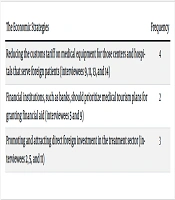
| Promoting and attracting direct foreign investment in the treatment sector (interviewees 2, 5, and 11) | 3 |
Table 2 presents the most significant economic strategies for the development of tourism at Abadan University of Medical Sciences, including reducing the customs tariff on medical equipment for treatment centers and hospitals that serve foreign patients as well as encouraging and attracting direct foreign investment in the treatment sector. Accordingly, the following strategies are proposed for revising and reforming the rules and regulations of health tourism development at Abadan University of Medical Sciences (Table 3).
Table 3.
The Strategies for Revising and Reforming the Rules and Regulations of Health Tourism Development at Abadan University of Medical Sciences
| Strategies for Revising and Reforming the Rules and Regulations | Frequency |
|---|---|
| Removing barriers to the transferability of foreign insurance (interviewees 4, 6, and 7) | 3 |
| Facilitating the issuance of visas to medical tourists (interviewees 4, 7, 10 and 15) | 4 |
| Issuing long-term visas to medical tourists (interviewees 2 and 3) | 2 |
| Guidelines for facilitating the entry and departure of medical tourists (interviewees 1 and 6) | 2 |
| Developing standards and rules for all medical tourism authorities (customs organizations, law enforcement agencies, hospitals and welfare centers) (interviewees 11 and 12) | 2 |
| Maintaining the security and rights of tourists (interviewees 5, 9 and 13) | 3 |
| Developing medical and insurance regulations suitable for the target countries (interviewees 4 and 5) | 2 |
| Assisting with the licensing of clinics and hospitals and assisting with the issuance of construction permits (interviewees 2, 4, 6, 11, 13 and 14) | 2 |
Table 3 illustrates the most important initiatives for reforming and revising the rules and regulations for tourism development at Abadan University of Medirespondents' processes, including issuing visas to medical tourists and removing transferability barriers for foreign health tourists' rights and safety. The respondents proposed the following marketing strategies for tourism development at Abadan University of Medical Sciences (Table 4).
Table 4.
The Marketing Strategies of Health Tourism Development at Abadan University of Medical Sciences
| Marketing Strategies | Frequency |
|---|---|
| Providing foreign tourists with free medical examinations at their residence (interviewees 5 and 9) | 2 |
| An assessment of Abadan's advantages in medical tourism in various medical fields (interviewees 7 and 11) | 2 |
| Setting up relevant government agencies within target countries (interviewees 1, 8 and 10) | 3 |
| Identifying target markets that are culturally, religiously, linguistically, and geographically similar in the region (interviewees 2, 5, 11, 13 And 14) | 5 |
| Development of a health town and the transfer of hospitals to the city in the long run (interviewees 1 and 2) | 2 |
| Contracts with hospitals in other countries for referrals of patients after treatment (interviewees 5, 9, 12 and 14) | 4 |
| Recruiting marketing specialists with experience in hospital services (interviewees 3 and 8) | 2 |
| Utilizing staff who are able to speak international languages in order to treat foreign patients (interviewees 3, 4, 9 and 10) | 4 |
Table 4 summarizes the most important marketing strategies to develop tourism at Abadan University of Medical Sciences, including identification of target markets in the region with common culture, religion, language, and geographical proximity, as well as signing contracts with other countries for patient referral to these hospitals after treatment, and establishing relevant government agencies in target markets countries. Based on the respondents' responses, there are several methods of informing, advertising, and promoting internal services for health tourism development at Abadan University of Medical Sciences (Table 5).
Table 5.
Informing, Advertising, and Promoting Strategies for The Development of Health Tourism at the Abadan University of Medical Sciences
| The Strategies of Informing, Advertising and Promoting Internal Services | Frequency |
|---|---|
| Developing a tourism information portal for Abadan (interviewees 5, 6, 7 and 11) | 4 |
| Engaging in relevant regional and international exhibitions (interviewees 3, 5, 9, 11 and 14) | 5 |
| Making use of the current tourism advertising capacity to present Abadan's capacity for medical tourism (interviewees 6 and 9) | 2 |
| Presenting Abadan's human resources and technological capabilities to the international medical tourism community through electronic and non-electronic means (including international exhibitions on medical tourism and embassies) (interviewees 11 and 14) | 2 |
| Attaining international licenses and accreditations to demonstrate the quality of our services. (interviewees 6 and 11) | 2 |
| Allocating internal resources to the provision of health services (interviewees 10 and 12) | 2 |
| Organizing meetings with medical schools in target countries (interviewees 8, 9, 12 and 14) | 4 |
| Keeping statistics and information on health tourists up to date (interviewees 5 and 6) | 2 |
| The establishment of a large network of people familiar with hospital services to inform the public and attract patients (interviewees 4, 7 and 9) | 3 |
Table 5 shows the most effective strategies for marketing, advertising, and promoting Abadan University of Medical Sciences' internal health tourism development services. These include directing the demand for medical services towards internal resources, establishing a health tourism information portal at Abadan University of Medical Sciences, strengthening trust in the quality of medical services by obtaining licensures and accreditations from international agencies, and completing and recording health tourism statistics.
5. Discussion
This study found that the most important strategies for health tourism development at Abadan University of Medical Sciences covered five main themes (administrative-executive, economic, reforming and revising rules and regulations, marketing, and informing). Several factors are believed to be influential in the development of medical tourism in Hamadan city, notably general conditions, personnel, medical equipment, and website standards, according to Khalajian et al. (13). Based on the findings of the study, the most influential administrative-executive strategies for tourism development at Abadan University of Medical Sciences include ranking health service centers, requiring health service centers to acquire licenses from international organizations such as JCI, and establishing medical service tariffs in exchange for foreign patients.
Results from a study by Ghanbari and Sharifi (14) are consistent with those obtained in the present study. Based on their findings, standardization of medical services according to international standards was identified as a top priority in their executive-administrative indicator for the development of medical tourism. By adhering to standards and obtaining international licenses such as JCI, the healthcare centers become part of the global list of standardized healthcare facilities, which is a powerful marketing tool. This is accomplished through the communication of these centers with other hospitals and centers.
According to the findings of the study, the most important economic strategies for tourism development are the reduction of customs tariffs on medical equipment for medical centers and hospitals that provide services to foreign patients as well as encouraging foreign direct investment in the health care sector. People tend to seek treatment in less developed countries due to the high cost of health care in developed nations. The cost of treatment in these countries differs greatly from those in developed nations, causing many individuals to travel there for treatment. This has resulted in the availability of cheap medical equipment in other countries (15). As a result, it is recommended that customs tariffs on medical equipment be reduced and middlemen be eliminated.
Based on the findings of the present study, the most important strategies for reforming and revising tourism development rules and regulations include the visa-issuance process for medical tourists, removing barriers to foreign insurance transfers, and protecting the rights and welfare of tourists. According to Gonzales et al. (16), strengthening legal frameworks to guarantee consumer protection and high-quality care is a critical factor influencing medical tourism's development. According to Porter et al. (17), the establishment of an insurance system for medical tourists is also essential in developing Philippine medical tourism.
According to Smith and Forgione (18), medical tourism is on the rise, and they examined the various factors that influence patients' decisions regarding health care internationally. Furthermore, they have identified four factors that influence the selection of a hospital by patients, including cost, hospital credit, quality of medical care, and training of medical staff. So, it is essential to facilitate the licensing of private clinics and hospitals and to monitor their activities.
At Abadan University of Medical Sciences, some of the most important marketing strategies have consisted of identifying target markets in the region with shared culture, religion, language, and geographical proximity, as well as signing contracts with hospitals of in other countries for patients to be referred to their hospitals after treatment and setting up government representatives in the countries of the target markets. As a result of a study conducted by Heung et al. (6), similar results were obtained and two factors, culture and government, were found to be significant in attracting health tourists and determining tourism destinations in the Philippines. According to a study performed by Zarei et al. (19) to assess the social marketing in medical tourism, enhancing some components, such as transportation status, advertising, expertise, communication, security, cost and attractiveness, can positively impact the design of an effective social marketing. Considering social marketing strategies are believed to have a positive impact on social marketing, it is reasonable to expect that formulating marketing strategies based on the analysis of the market, landscape, internal environment, and target markets will influence the integrated implementation of the marketing. Medical tourism can benefit from social marketing if it helps to create a positive image in people's minds. Therefore, senior managers should pay attention to the vital role that social marketing plays in their organizations. Our research results suggest that the most important strategies for informing, advertising and promoting internal services of tourism development at Abadan University of Medical Sciences include directing health care needs toward internal resources, creating a tourism information site in Abadan, building trust by obtaining international licenses and accreditations, and maintaining accurate statistics regarding health tourism.
Among the variables affecting informing mechanisms, only mass advertising has a significant effect on attracting medical tourists, according to Ayoubian et al. (20). Therefore, advertising the country's capabilities in foreign countries' media in relation to health care, physicians, and topology can result in greater numbers of medical tourists visiting the country (21). According to Ghalami (22), the dissemination of information about the health services and capabilities of medical centers in international media, the distribution of brochures and pamphlets to foreign tourists, the participation of the medical centers in international exhibitions, the establishment of an information portal, and preparing medical centers and placing posters in the international airports of the country all contribute to the promotion of the export of health services.
Among the limitations of this research was the non-cooperation of some managers in the implementation of the research.
5.1. Conclusions
Our study indicated that the most important strategies for the development of medical tourism are included: (1) High-ranking health service centers; (2) requiring centers to obtain licenses from international organizations, such as JCI; (3) expediting the issuance of visas in the medical tourism industry; (4) identifying target markets in the region with common cultural, religious, and linguistic characteristics; (5) negotiating contracts with other hospitals for the purpose of referring patients to them after treatment; (6) focusing on internal resources for health care; (7) launching an information portal on medical tourism. In order to enhance and promote medical tourism, it is recommended that policymakers and stakeholders take action to address the identified priorities.