


1. Background
Globalization has significantly increased the cross-border movement of individuals seeking healthcare, creating both challenges and opportunities for the governance of patient care. One notable outcome of this global interaction is the emergence and rapid expansion of the medical tourism market (1). Medical tourism, a subset of the broader health tourism industry, involves patients explicitly traveling abroad to receive medical treatments, often combining these with leisure and wellness activities (2). While health tourism encompasses a wide array of services aimed at enhancing physical and mental well-being, including preventive and wellness treatments (3, 4), medical tourism is primarily focused on obtaining necessary medical procedures in foreign countries (5). The intention of medical tourists usually includes access to better quality, faster treatment, and less expensive care (6). However, the primary motivation behind medical tourism is to save money on healthcare expenses by seeking more affordable dental, medical, and surgical treatments in foreign countries (7).
In recent decades, the surge in medical tourism has not only transformed it into a significant economic force but has also established it as an essential segment of the global tourism industry (8). Factors such as reduced treatment costs, shorter waiting times, and the ability to combine medical care with leisure activities have contributed to its growing popularity (9-11).
Therefore, medical tourism offers a unique opportunity for countries to diversify and enhance their tourism markets by leveraging their healthcare capabilities. Unlike traditional tourism, which relies heavily on environmental and cultural attractions, medical tourism thrives on the quality and affordability of healthcare services (12). However, historical monuments and diverse tourism goals in some developing countries can also be leveraged to support the development of medical tourism. Countries pursuing the development of medical tourism, regardless of the capabilities and quality level of healthcare services, can be divided into two categories: (1) Those with an active tourism market and (2) those without one. Therefore, countries that already serve as destinations for other types of tourism can expand their market dimensions by developing medical tourism.
Iran is a prime example of a developing country that can capitalize on its dual strengths as both a traditional and medical tourism destination (13). With its rich historical heritage, cultural diversity, varied climate, and natural beauty, Iran already attracts tourists from around the world. The recent growth in medical expertise, coupled with the expansion of hospitals and healthcare facilities, provides Iran with a significant opportunity to develop its medical tourism sector alongside its existing tourism industry (14).
2. Objectives
This study aims to explore the current status and potential of Iran's medical tourism market, examining the factors that influence its development and identifying the strengths and limitations of its existing programs. By understanding these dynamics, Iran can better position itself to harness the benefits of medical tourism, contributing to its economic growth and global tourism appeal.
3. Methods
In this study, the target group includes Iranian hospitals. The methods employed are “data collection and analysis”. This study was conducted based on collecting official data on the status of medical tourism in Iran and analyzing it based on the review of effective criteria in this market. First, data were gathered from official health and tourism sources through interviews. Second, relevant factors were identified and analyzed qualitatively through a systematic review of related literature.
To achieve the above purpose, studies conducted in health tourism in developing countries were listed as registered experiences. A particular process was followed in selecting related articles that aligned with the study objectives. The review study follows a “structured plan” outlining how the review will be carried out, including the research questions to be explored and the analytical methods employed. Therefore, a search protocol was defined based on the keywords "health tourism" and "medical tourism". The search was performed based on the presence of at least one of these keywords in the article's title, abstract, or keywords. Databases such as Scopus, Google Scholar, and PubMed were used. Since Iran is a developing country, the phrase "developing countries" was considered one of the keywords. The search was conducted in 2023 to answer the question: "How can medical tourism be promoted in developing countries?" In this study, it was also crucial to seek solutions for the following additional questions:
(1) What are the requirements for developing medical tourism in developing countries?
(2) What factors affect the rise of the medical tourism market?
(3) What are the reasons for the lack of development of medical tourism, and how can they be solved?
After completing the database search, the authors performed three screening stages to select relevant articles. In the first stage, by studying the titles of the found articles, those in the field of health tourism or medical tourism were included. In the second stage, by examining the abstracts of the articles selected from the first screening stage, those that mentioned the status or factors affecting health tourism or medical tourism in developing countries were included. In the third stage, by studying the content of the articles selected in the second stage, the articles that had appropriate answers to the questions of this study were included.
4. Results
This study aimed to explore the requirements for the development of medical tourism in Iran and other developing countries, as well as the limitations faced in achieving this goal. The results are presented in the following sections.
4.1. Requirements for Medical Tourism Development
4.1.1. National and International Factors Affecting Tourism Development in Iran
Considering that health tourism is one of the important categories of tourism, the factors that affect tourism will influence the types of health tourism, such as medical tourism (15). In a general sense, the factors affecting tourism can be classified into two groups: (1) National factors and (2) international factors: (1) National factors include government initiatives, infrastructure (e.g., hotels, transportation networks such as airports and railways), cultural aspects, and the role of the private sector; (2) international factors include global economic conditions, technology, political relations, and other aspects affecting relations between countries (16).
Table 1 summarizes these national and international factors, which are essential in shaping the medical tourism landscape in Iran.
Table 1.National and International Influential Factors in Health Tourism
| Categories and Factors | Effects |
|---|---|
| National | |
| Development plan | Paying attention to tourism as one of the economic development tools in government programs can lead to the development of this market. |
| Tourism requirements | Temporary residences like hotels in tourism destinations will grow this market. |
| Economy | A robust national economy will contribute to the development of medical tourism by providing technology, manpower, and medical equipment. Also, the development of transportation networks and tourism requirements is directly dependent on the national economy. |
| Transportation | The existence of a broad and up-to-date transportation network, such as railways, airports, and roads, is a necessity and priority for choosing tourist destinations. |
| Culture | The cultural similarity between visitors and residents is one of the relative advantages of choosing a tourist destination, which substantially impacts this market, especially in types such as health tourism. |
| Private investment | The increase in investment in the development of the transportation network and tourism requirements is directly related to the development of this market. |
| International | |
| Economy | Favorable economic conditions will increase the number of trips to tourist destinations, while unfavorable economic conditions caused by various factors, the recent experience of which was the consequences of the COVID-19 pandemic, have a negative impact on this market. |
| Technology | The development of technology and its use in transportation and the use of the Internet in the introduction of tourist destinations have a positive effect on all types of tourism. |
| Politics | Friendly political relations between governments, as well as the development of economic cooperation based on favorable political ties, will have a positive effect on the tourism market. |
4.1.2. Theoretical Framework for Tourism Development
Based on these factors, theories of tourism development have been formed, which include four theories: Natural potential, relative cost, absolute privilege, and demand conditions (2, 4). These theories are foundational to understanding medical tourism and its development. Considering the goals of health tourism, which include the provision of healthcare services, absolute privilege should be considered the foundational theory for creating and expanding this type of tourism (17). Other theories of tourism development are categorized as related to the requirements of medical tourism.
4.1.3. Potential of Natural Resources in Developing Countries
As illustrated in Figure 1, the factors affecting medical tourism, based on the review of related articles, include (1) tourism requirements such as economic, political, and infrastructure services, and travel facilities; (2) medical factors, which encompass manpower, institutional capacity, and the quality of healthcare services; and (3) natural resources such as history, culture, and environment, which serve as relative advantages for attracting health tourists. The potential of natural resources, including history, culture, and nature, can be of interest to tourists and serve as a relative advantage in choosing a health tourism destination (13). However, the existence of healthcare services as the goal of health tourism and medical tourism is an absolute privilege in the tourism market (1). This type of tourism is supported by other absolute privilege factors, such as modern banking services, technology, and unique tourist areas (18).
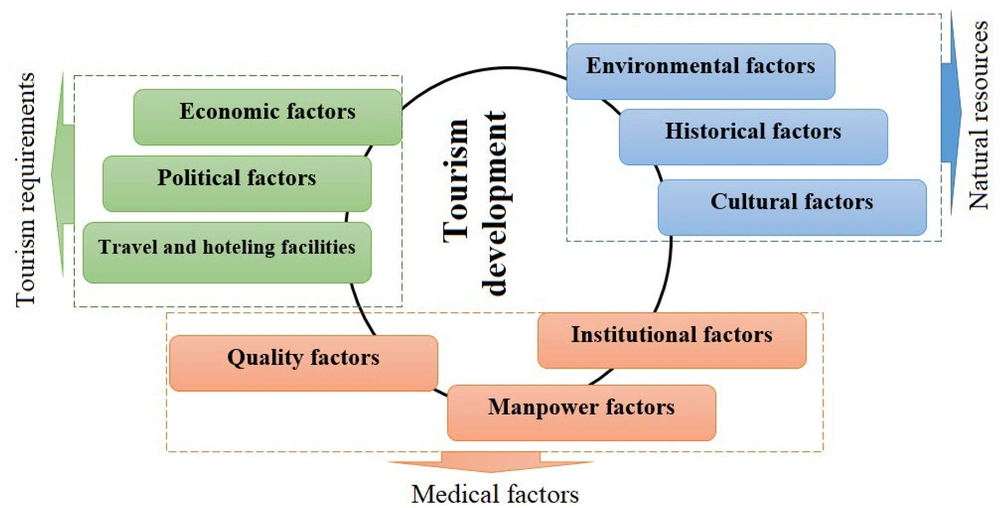
Figure 1.
Effective factors in medical tourism
Although in some developing countries, the requirements for transportation and technology related to health tourism are limited, natural, historical, and cultural resources have the potential to support this type of tourism (13, 14). For example, Iran, as a developing country, has diverse climates and natural beauties, including deserts, mountains, forests, and various touristic beaches (14). This characteristic, along with historical monuments from the country’s civilization, has created significant natural potential in tourism, which can be recognized as a strength in the development of Iran's tourism sector (19). However, international evaluations show that Iran constitutes only a small portion of the global tourism market, which may be caused by limitations in other influential factors (13).
According to the world travel and Tourism Council’s report in 2011 (among 182 countries), Iran's rank in terms of the share of tourism in GDP was 127; in terms of employment related to tourism, it was 135, and in terms of investment in tourism, it was 138. Meanwhile, Iran's tourism sector compares unfavorably to developing countries such as Singapore, UAE, Turkey, and Jordan. For example, in 2021, it was reported that Iran's rank in tourism and travel competitiveness was 41, while the ranks of Costa Rica, Singapore, UAE, Turkey, and Jordan were 15, 17, 22, 27, and 35, respectively (20). Additionally, only about 0.4% of the global tourism market's income was generated in Iran, reflecting the unfavorable situation of the tourism market in this developing country (1). In this context, health tourism, which is affected by the generally unfavorable tourism conditions in developing countries, can be recognized as a strength in improving the tourism market in these regions (14, 19).
4.2. Factors Affecting Medical Tourism
4.2.1. General Factors
Health tourism is one of the most important types of tourism, encompassing medical tourism, preventive and health-conductive tourism, and wellness tourism (21). Surgery or treatment of a disease is one of the primary goals of medical tourism, while controlling stress levels and promoting a healthy lifestyle are the goals of wellness tourism (22). Health tourism and its various forms, including medical tourism, are influenced by general factors and face other challenges. The most important factors affecting medical tourism include (i) the demand for healthcare services and (ii) the quality and variety of healthcare services (23, 24).
4.2.2. Specific Factors in Developing Countries
In a situation where the demand for healthcare services in society is increasing, this is considered a positive factor for the health tourism market (23). Although access to healthcare services is directly dependent on economic factors and overall well-being, in developing countries, health indicators have shown a positive trend, and healthcare demand is growing (25). Therefore, there is significant potential for the development of all types of health tourism, including medical tourism, in developing regions due to the improvement of health indicators and increased demand for healthcare services.
The review of articles related to the questions of this study indicated that the factors influencing the choice of a medical tourism destination can be divided into two general categories, as shown in Figure 2. One important factor that significantly impacts medical tourism is the level of medical knowledge and the quality of healthcare service centers (26). Typically, in developing regions, the quality of healthcare services is lower than in developed countries. Therefore, the improvement of medical knowledge and the development of healthcare centers, such as hospitals in developing countries, represent suitable capacities for the growth of medical tourism (13). For example, in Iran, a developing country, the expansion of universities in recent decades has led to a significant increase in the number of scientific professionals in the health field, such as doctors.
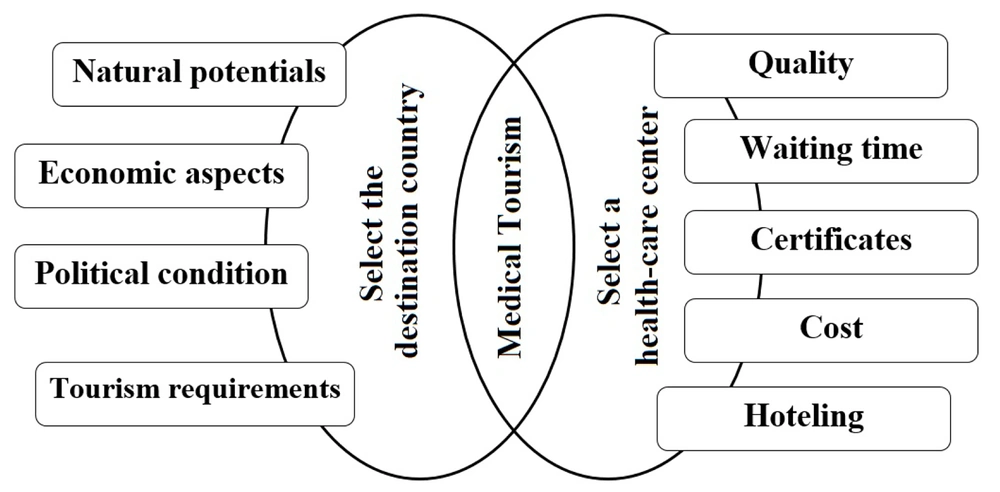
Figure 2.
Effective factors in choosing a medical tourism destination
As a result, Iran has strong potential for medical development due to the increasing demand for healthcare services from neighboring countries (14). The third factor affecting the development of medical tourism is creating an advantage for tourists by reducing waiting times (27). One of the main reasons for medical trips and the creation of medical tourism is the long waiting times for treatment caused by a lack of doctors or medical equipment (5). Therefore, the development of healthcare centers and the reduction of waiting times are relative advantages for medical tourists in choosing their destinations. Additionally, lower treatment costs are another factor that affects the development of medical tourism and serves as a relative advantage in choosing a medical tourism destination (28). In developing countries, the income levels and overall well-being of citizens are typically lower than in developed countries. Therefore, the affordability of treatment relative to citizens' income is a critical factor in choosing healthcare centers (4).
4.3. Classification of Countries in Terms of Medical Tourism Potential
According to the factors that influence the development of health tourism, including medical tourism—such as technology, economy, government programs, scientific manpower, infrastructure requirements (e.g., hotels and airports), and relative advantages (29)—countries can be classified into several categories based on their medical tourism potential. Figure 3 illustrates that developed countries typically have scientific manpower and favorable medical equipment, which places them into two categories: (1) Developed countries with an absolute or relative advantage in medical tourism, along with requirements such as natural resources and affordable treatment costs; (2) developed countries with an absolute advantage in healthcare and treatment services but lacking a relative advantage in medical tourism requirements like natural resources and cost.
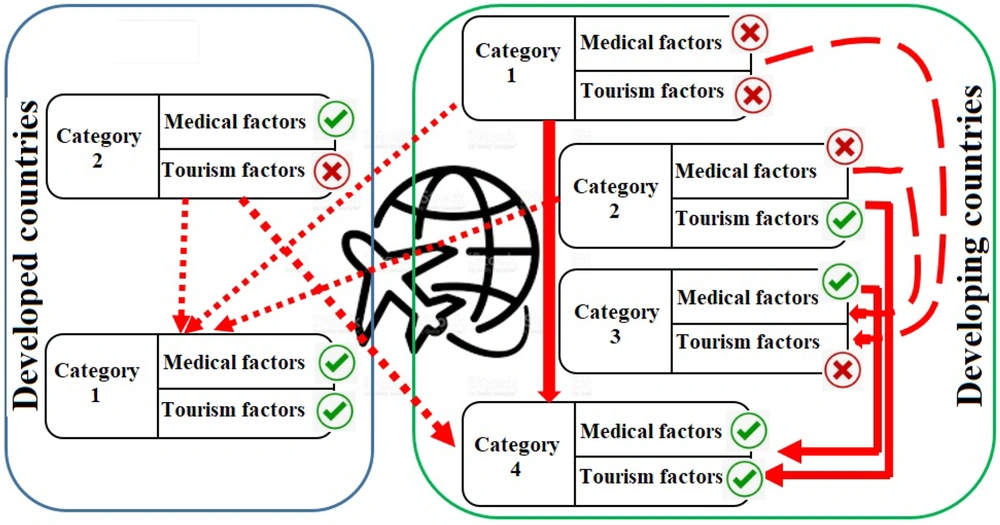
Figure 3.
The cycle of medical tourism in the world based on the medical and tourism potential of the countries
In contrast, developing countries can be divided into four groups: (1) Countries that are poor in terms of medical equipment, scientific manpower, and medical tourism requirements; (2) countries with historical, cultural, and natural potential but lacking in medical equipment and scientific manpower; (3) countries with a relative advantage in scientific manpower and medical equipment but lacking essential medical tourism requirements such as hotels, airports, and cultural and historical resources; (4) countries with natural potential that have become a relative advantage in medical tourism by developing the necessary infrastructure and advancing medical sciences.
For developing countries to enter the medical tourism market and progress to the fourth group, where they can fully capitalize on their potential, government planning is essential (30). The development stages of medical tourism in categories one, two, and three vary, but in general, they include several basic stages. A key principle is the advancement of medical sciences and the development of healthcare centers, such as hospitals and medical laboratories (31).
4.4. The Case of Iran
The development of medical sciences universities and the increase in graduates to train scientific manpower is essential, and this has been significantly achieved in Iran in recent decades (2). Iran is currently classified in the third group, with a strong medical infrastructure but lacking key tourism services, such as transportation and accommodations. To transition into the fourth group, Iran requires strategic government planning and investment in tourism infrastructure. Prioritizing the development of medical sciences, healthcare centers, and scientific manpower is crucial to realizing its full potential in medical tourism.
5. Discussion
In addition to scientific manpower and well-equipped healthcare centers, several other factors must be considered for developing countries like Iran to capture a significant share of the medical tourism market. For example, economic stability has been shown to have a positive impact by reducing the direct costs of treatment and increasing investment in the healthcare sector, which in turn reduces the indirect costs of treatment (32). Indirect costs, such as travel, accommodation, and non-medical services, decrease with economic stability and increased investment, creating a comparative advantage for the country (1, 4). Given that the high cost of treatment in developed countries is a primary reason for medical trips to developing countries, reducing both direct and indirect costs for medical tourists through methods like tax reductions can also help develop this market.
As shown in Table 2, in addition to the economy and costs, other factors can be introduced as strategies for developing medical tourism, including time, policy, medical services, quality, leisure, and information (33). One of the main reasons for medical tourism is the long waiting times in developed countries and the lower costs of medical treatments in developing countries (34, 35). For example, American medical tourists often seek treatments at one-fourth, or sometimes one-tenth, of the cost they would pay in their home country. In Canada and the UK, long waiting times mean that many people cannot afford private healthcare (36). Therefore, reducing waiting times by expanding healthcare centers and increasing scientific manpower is both a solution and a necessity for the development of medical tourism.
Table 2.Basic Actions in the Development of Medical Tourism
| Parameters | Description |
|---|---|
| Investment | Government and private investment in tourism requirements such as transportation and hoteling will reduce travel costs. Also, increasing the number of healthcare centers and equipping them, which is one of the requirements for the development of medical tourism, can be achieved with investment. |
| Reduce waiting time | Quick access to medical services and health care is one of the main motivations of health tourists. Therefore, increasing the number of healthcare centers and the number of specialists will reduce the waiting time and create a relative advantage for the development of medical tourism. |
| Political conditions and laws of foreign nationals | Developing political relations with countries and facilitating the conditions of travel to the country through visa waiver agreements for health tourists can make travel easier for them and be a relative advantage for choosing a medical tourism destination. |
| Hospital hotels | Establishing temporary residence centers for patients' companions in the nearest hospital or hospital building is an advantage in choosing the hospital as the goal of medical tourism because it will eliminate the time lost in city traffic and help the patient and companion relax. |
The provision of temporary residence for patients' companions before and after treatment is essential in medical tourism (1). For developing countries with a relative advantage in treatment costs and waiting times, offering accommodation for patients' companions at healthcare centers or nearby locations is an effective solution to meet the requirements of medical tourism and create a relative advantage for selecting a tourist destination (37). For example, in countries like Hong Kong and Singapore, residences are established on one of the hospital floors or in close proximity to the hospital. Additionally, developing infrastructure related to medical tourism requirements in developing countries is another way to foster this type of tourism (14).
Suitable transportation and accommodation infrastructure—such as airports, ports, highways, urban transportation, hotels, catering services, telecommunications, and easy access to information—are prerequisites for developing health tourism in any region (38). These factors make travel more accessible, leading to higher satisfaction among health tourists, who benefit from both the medical facilities and the overall experience in the destination country. Furthermore, addressing challenges related to the treatment of foreign patients is another solution for promoting medical tourism. These challenges can be alleviated by establishing necessary laws and legal protections. Key issues in treating foreign patients include a lack of insurance coverage abroad, the absence of international certification by healthcare centers, delays in patient return and lack of follow-up care, insufficient laws protecting foreign patients against medical errors, and inadequate alignment of medical and nursing education with international protocols.
In addition to the solutions mentioned above, addressing the cultural needs of health tourists through the education of citizens and healthcare personnel plays a vital role in attracting medical tourists. Culture, which encompasses the similarities and differences between tourists and locals regarding religion, language, customs, food preferences, and more, can significantly influence tourists' attitudes toward a destination (39). Therefore, the host country's ability to accommodate tourists from diverse cultural backgrounds and provide services tailored to their religion, language, habits, and interests requires the creation of a suitable cultural platform and the presence of well-trained personnel across various service sectors. This is crucial because foreign patients are more likely to choose destinations where they feel comfortable with the local population and where their cultural needs are respected.
5.1. Conclusions
This study explored the current state of medical tourism and development strategies in developing countries, with a particular focus on Iran. Despite its considerable natural potential and relative advantages in specialized medical services, Iran's share of the global medical tourism market remains low. To improve its position, the development of medical tourism in Iran—like in other developing countries—requires comprehensive government planning. This planning should aim to create competitive advantages in key areas and expand the provision of specialized medical and healthcare services. Developing a skilled workforce is essential. Iran must prioritize training scientific manpower across all healthcare and treatment fields. Additionally, by equipping healthcare facilities with state-of-the-art medical equipment, Iran can enhance its appeal to medical tourists seeking advanced and effective treatments.
Furthermore, efforts should be made to reduce both direct and indirect healthcare costs through strategic investments and efficient resource management in the healthcare sector. Establishing adequate medical tourism infrastructure, such as hotels and accommodations for patients and their companions, is also crucial. Increasing trust and security for medical tourists by implementing safeguards against medical malpractice and ensuring the ability to transfer insurance coverage to Iranian healthcare providers is essential.
Finally, it can be concluded that, given Iran's potential to become a leading destination for medical tourism, focusing on integrating economic, legal, cultural, and service quality considerations can significantly boost its share in the global medical tourism market.



