Fulltext
The full text of this article is available on PDF.
Image Credit:Educ Res Med Sci
Authors
Introduction: Critical thinking skills as thinking and judging self-regulation are purposeful and result in solving problems and making appropriate decisions. Therefore, the importance of this subject and its role in the nursing profession and the clinical decision, this study was done to compare critical thinking skills of nursing students in continuous licentiate and bachelor- licentiate admissions.
Methods: This study was the analytical method that all continuous and discontinuous nursing students(70) were assessed using a standard questionnaire form Watson and Glaser. Data were analyzed using statistical software SPSS.13.00.
Results: The results showed that the difference between the scores of critical thinking skills among continuous licentiate (42.29) and bachelor- licentiate (49) nursing students were statistically significant (P-value < 0.001). With an increase in semesters, there was increase in students critical thinking skills score consistently, but not statistically significant (P-value = 0.6). Between the average and marital status with critical thinking skills, no statistically significant relationship was found.
Conclusion: Poor scores in critical thinking of nursing students in this study and other studies represent the need to review teacher’s clinical teaching methods, evaluation and how to delegate tasks to the student. According to study results, the need to review how to spend course and select of clinical educators for these courses seem evident.
© 2012, Educational Research in Medical Sciences. This open-access article is available under the Creative Commons Attribution-NonCommercial 4.0 (CC BY-NC 4.0) International License (https://creativecommons.org/licenses/by-nc/4.0/), which allows for the copying and redistribution of the material only for noncommercial purposes, provided that the original work is properly cited.
Babamohamdi H, Khalili H. Comparison Of Critical Thinking Skills In Students Of Nursing In Continuous And Interrupted Bs Sections Of Semnan University Of Medical Sciences. J Med Edu. 2005;6(2):e105162. doi: https://doi.org/10.22037/jme.v6i2.770
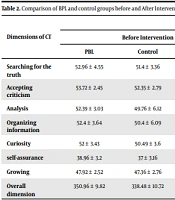
Kazemi N, Beigmoradi S, Farmitani Z, Ghorbani F, Jamalinasab A, et al. The Effect of Problem-Solving-Based Learning on Critical Thinking Skills of Nursing Students. J Health Rep Technol. 2022;8(4):e133327. doi: https://doi.org/10.5812/jhrt-133327
Khalili H, Baba Mohammadi H, Hadji Aghadjani S, Qods A. The Effects Of Two Educational Methods, Classic And Critical Thinking Strategies (CTS), On The Stable Learning Of Nursing Students. J Med Edu. 2003;3(2):e105022. doi: https://doi.org/10.22037/jme.v3i2.861
Khalili H, BabaMohammadi H, HajiAghajani S. The effects of two educational methods, classic and critical thinking strategies, on the stable learning of nursing students. koomesh. 2004;5(2):e152008. doi:
Kalantari Meibodi M, Lakdizaji S, Abdollahzadeh F, Hassankhanih H, Rahmani A, et al. Impact of Guided Reciprocal Peer Questioning on the Disposition of Critical Thinking among Nursing Students. Thrita J Neu. 2013;2(3):10-14. doi: https://doi.org/10.5812/thrita.8716
Last Update: 2 weeks ago
Last Update: 2 weeks ago
Last Update: 2 weeks ago
Last Update: 7 hours ago
Last Update: 1 day ago
Last Update: 5 days ago