
1. Background
Obesity is a major public health problem throughout the world. It is a chronic imbalance between energy intake and energy expenditure. Obesity can result from complex interactions between genetic and environmental factors. Several genes are known to contribute to obesity.
The genetic factors that regulate appetite and energy homeostasis are important factors in controlling weight gain and obesity (1). Polymorphisms and mutations in those genetic factors could cause obesity and disruption of energy homeostasis (2). One of the most important factors in the hormonal regulation of energy intake and consumption is leptin, which is responsible for transferring information related to controlling energy intake, food, metabolism, and energy expenditure (3).
Leptin (LEP) is a polypeptide hormone with some structural similarities to long-chain helical cytokines. It is an adipocytokine secreted from adipose tissue and in small amounts from other tissues. LEP is associated with body mass and fat composition by regulating appetite and energy balance and co-regulating some other biological functions.
LEP by its membrane-localized receptors (LEPR) acts on target tissues. LEPR displays a structural similarity with the class I cytokine receptor family (2). LEPRs are primarily expressed in the brain and hypothalamus, but they are also widely distributed in peripheral tissues including the adipose tissue, liver, kidneys, pancreas, and gonads. LEPR gene is located at chromosome 1p31. Mutations in this gene could be associated with obesity and pituitary dysfunction (4). The results of alternative mRNA splicing and posttranslational processing have shown several receptor isoforms (LRa, LRb, LRc, LRe, and LRf) that the long isoform, LRb, was more involved in signal transduction (5).
Leptin acts through connecting through its own receptors with the target tissues. One of the most important targets of leptin is the central nervous system (CNS) (6). Leptin regulates energy consumption and energy intake by central nervous system (CNS) companion via its long receptor (Ob-Rb) located in the hypothalamus.
The hypothalamus containing two types of neurons detects leptin. One type expresses appetite suppressing peptides derived from pro-opiomelanocortin (POMC) precursors and the other type produces appetite stimulating peptides such as neuropeptide Y (NPY) and agouti-related peptide (AgRP) (7, 8). There can be different causes for disorders in leptin physiological function. Study of mutations and polymorphisms of leptin and leptin receptor genes in the humane and animal models proved the relationship of this protein with obesity (9).
In many cases, the cause of obesity is not due to defects in leptin, but the problem is leptin resistance. Leptin resistance may be created under the influence of various factors, such as defects in the signaling by leptin, lipotoxicity, and endoplasmic reticulum stresses as well as inflammatory reactions that can disrupt intracellular transport of messages (5). If leptin cannot effectively bond to its own receptors in the brain (hypothalamus), there will create disruptions in the transmission of messages through NPY, AgRP, and reduction of POMC expression simultaneously. This might be associated with severe obesity and different physiological disorders such as Type 2 diabetes (T2D), high blood pressure, insulin resistance, cardiovascular disease, and asthma (7).
Efficient interaction of leptin and leptin receptors is critical for effective leptin signaling (10). LRb is the longest isoform of leptin receptor with a length of 1165 amino acids while its intracellular domain is composed of 304 amino acids. The LRb is expressed in the hypothalamus in high levels and its presence is essential for leptin signaling (11).
LEPR mutation is a very rare condition that is not observed in many obese individuals as homozygote genotype (12, 13). Lys 109 Arg (K109R) (rs1137100) Polymorphism of lepR gene in exon 4 by displacement of adenine with guanine in codon 109, and case displacement of lysine amino acid with arginine in extracellular part of receptor might be a reason for leptin ability to bind to the receptor (14).
Gnl223grA (rs1137101) polymorphism may result from displacement of adenine with guanine in nucleotide 668 of codon 223 in exon 6. This causes the replacement of positively charged arginine by negatively charged glutamine amino acid. This amino acid change in extracellular domain of receptor might cause defects in leptin binding and signaling (15).
2. Objectives
In this study, we investigated the association of LepR gene Lys 109Arg and Gnl223Arg leptin polymorphisms with obesity and overweight in a young student population of Zanjan Islamic Azad University.
3. Methods
3.1. Human Subjects
This study was approved by the ethics committee (ZUM.REC.1395.135) of Zanjan University of Medical Sciences. EDTA anticoagulated whole peripheral blood samples were collected from 240 students of Zanjan Islamic Azad University in 4 groups of low weight, normal weight, overweight, and obese (Table 1). Sampling was performed during 2 months. Clinical evaluation consisted of weight (kg) and height (m) measurements to determine body mass index (BMI) expressed as kg/m2.
Table 1.
Descriptive Data of all Volunteersa
| Variables | Normal (N) | Low Weight (LW) | Overweight (OW) | Obese (Ob) | P Value, Mean Defference (Lower Limit-Upper Limit) | ||
|---|---|---|---|---|---|---|---|
| LW vs. N | OW vs. N | Ob vs. N | |||||
| N. | 60 | 60 | 60 | 60 | |||
| Age | 23.1 ± 3.2 | 22.5 ± 3.1 | 23.3 ± 2.2 | 22.3 ± 2.2 | 0.29, 0.6 (-0.53 - 1.7) | 0.69, -0.2 (-1.2 - -0.79) | 0.11, 0.8 (-0.19 - 1.79) |
| BMI | 23 ± 2.8 | 16 ± 1.3 | 27 ± 2.4 | 30 ± 7.1 | 0.00, 7 (6.21 - 7.79) | 0.00, -4 (-4.94 - -3.05) | 0.00 -7 (-8.9 - -5.1) |
Abbreviations: BMI; Body mass index; N; No. of subjects.
aSignificant (P < 0.05). Values are expressed as mean ± standard deviation (SD), and were compared by t-test.
Table 2.
The Specific Primers and Restriction Enzymes for Polymorphisms Gln223Arg and Polymorphism Lys109Arg
| Polymorphism | Sequence | Annealing Temperature, °C | Restriction Enzyme | PCR Product Size, bp | Parts of Cutting, bp |
|---|---|---|---|---|---|
| Gln223Arg | |||||
| CAG / CGG | 5 - ACCCTTTAAGCTGGGTGTCCCAAATAG-3 | 57 | MspI (HpaII) | 330 | A allele 330 |
| 5 - CAATATTTATGGGCTGAACTGACATT-3 | G allele 293, 37 | ||||
| Lys 109 Arg | |||||
| AAG / AGG | 5 - CTTTTGCCTGCTGGACTCTC-3 | 57 | BsuRI (HaeIII) | 217 | A allele 217 |
| 5 - AAACTAAAGAATTTACTGTTGAAACAAATGTC-3 | G allele 186, 31 |
3.2. Genetic Analysis
Genomic DNA was extracted from whole blood, which stored in EDTA coated tubes by using Cinna Pure DNA Kit (Cat. No.: PR881612 ).
Genomic DNA concentration was determined by Optical Density (OD) measurement. The purity was determined by calculating the ratio of absorbance at 260 nm to absorbance at 280 nm (A260/A280). Pure DNA should have an A260/A280 ratio of 1.7 - 1.9.
Genotyping of the Gln223Arg and Lys109Arg Ob-R polymorphisms was carried out using the polymerase chain reaction restriction fragment length polymorphism (PCR-RFLP) assay by specific primers and restriction enzymes. For analyzing Gln223Arg Polymorphism forward 5’-ACCCTTTAAGCTGGGTGTCCCAAATAG-3’ and revers 5’-CAATATTTATGGGCTGAACTGACATT-3’ primers (13) and for Lys109Arg polymorphism forward 5’-CTTTTGCCTGCTGGACTCTC-3’ and revers 5’-AAACTAAAGAATTTACTGTTGAAACAAATGTC-3’ primers (2,15) were used.
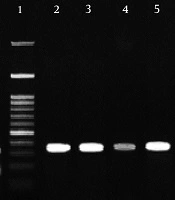
PCR was performed at 95°C for 5 minutes as a hot start and 95°C for 60 second, 57°C for 60 second, and 72°C for 60 second, in 35 cycles, with a final extension step at 72°C for 8 minutes in the presence of Taq DNA polymerase master mix (Ampliqon). PCR products size was confirmed through 2% agarose gel electrophoresis and ethidium bromide staining.
PCR products (0.5 µg DNA) were then treated with 1 U restriction enzyme (thermo scientific) for 16 h at 37°C. Restriction products were resolved by 2% agarose gel electrophoresis and visualized by ethidium bromide staining. 330bp PCR product of Gln223Arg polymorphism was digested with MspI (HepaII) restriction enzyme. G allele was digested and in AA (Arg/Arg) homozygotes, there were 293, 37 bp restriction fragments. AG (Arg/Gln) heterozygotes had 330, 293, and 37 bp fragments and AA homozygotes showed 330 bp uncut fragment. 217bp PCR product of Lys109Arg polymorphism was digested with BsuRI(HaeIII) restriction enzyme. G allele was digested and GG (Arg/Arg) homozygotes produced 186 and 31 bp restriction fragments. AG (Lys/Arg) heterozygotes had 217, 186, 31 bp fragments, and AA (Lys/Lys) homozygotes 217 bp uncut fragment.
All statistical analyses were performed using the statistical package for social sciences (SPSS) version 18.0 (SPSS Inc., Chicago, IL, USA). Descriptive data were given as mean ± standard deviation (SD). The associations of BMI and other parameters with genotypes were incestigated using independent samples t- test. A case-control study was designed to compare patients (who were low-weight, overweight, or obese) with controls (who had normal weight). Statistical significance was defined as the probability of P < 0.05.
4. Results
240 students (65 women and 175 men) were recruited from Zanjan Islamic Azad University and invited to participate in the study. There was no significant difference in age of subjects. There were significant differences in BMI between the normal group and low-weight, overweight, and obese groups (P < 0.05).
In the study of Lys109Arg polymorphism, there were no significant differences in allele frequencies between overweight, low weight, obese, and normal groups (P > 0.05). When comparing AA, AG, and GG genotypes in the study groups, we did not observe any significant difference (P > 0.05) (Table 3).
Table 3.
Genotypic and Allelic Distribution of Leptin Receptor Polymorphism of Lys 109 Arg in the Study Groupsa
| Genotypes | Study groups | |||||||||
|---|---|---|---|---|---|---|---|---|---|---|
| Normal (Co) | Obese (Ob) | P value | OR (CI95%) | Over weight (Ow), weight | P value | CR (CI95%) | Low weight (Lw), Weight | P value | OR (CI 95%) | |
| AA | 53 (88.3) | 54 (90) | Reffb | 47 (78.3) | Reffc | 51 (85) | Reffd | |||
| AG | 5 (8.3) | 4 (6.7) | 0.728 | 0.78 (0.19 - 1.08) | 9 (15) | 0.226 | 2.03 (0.64 - 1.48) | 6 (10) | 0.729 | 1.25 (0.36 - 0.34) |
| GG | 2 (3.4) | 2 (3.3) | 0.98 | 0.98 (0.13 - 0.22) | 4 (6.7) | 0.34 | 2.25 (0.39 - 0.88) | 3 (5) | 0.63 | 1.56 (0.25 - 0.71) |
| Allele | ||||||||||
| A | 0.91 | 0.89 | Reff | 0.85 | Reff | 0.87 | ||||
| G | 0.09 | 0.11 | 0.978 | 0.85 (0.01 - 0.68) | 0.15 | 0.737 | 4.43 (0.04 - 0.44) | 0.13 | 0.944 | 1.42 (0.05 - 0.34) |
aValues are expressed as No. (%).
bP value = 0.769, OR (CI95%) = 0.84 (0.26 - 2.66).
cP value = 0.141, OR (CI95%) =2.09 (0.77 - 5.68).
dP value = 0.591, OR (CI95%) = 1.33 (0.46 - 3.85).
In the study of Gln223Arg polymorphism, frequency of AA genotype (Gln/Gln) was significantly higher in the obese (86.6%, P = 0.003) and overweight (65%, P = 0.043) than normal (46.6%) groups; but, there were no significant differences between low-weight (43.3%, P = 0.713) and normal groups.
While there was an increased frequency of AG genotype (Gln/Arg) in the normal group (51.7%) compared to the obese (8.4%, P = 0.003) and overweight (33.4%, P = 0.040) groups, there was no significant deference compared to the low weight group (51.6%, P = 0.84). There was an increased frequency of AA genotype in the obese and overweight groups, and an increased frequency of AG genotype in the normal group. Comparison of the obese, overweight, low-weight, and normal groups showed no significant difference in the frequency of homozygous GG (P > 0.05) (Table 4). A allele in Gln223Arg polymorphism was more frequent than G allele in our study population although we observed no significant difference between the groups (Table 4).
Table 4.
Genotypic and Allelic Distribution of Leptin Receptor Polymorphism of Gln223Arg in the Study Groupsa
| Genotypes | Study Groups | |||||||||
|---|---|---|---|---|---|---|---|---|---|---|
| Normal (Co) | Obese (Ob) | P value | OR (CI95%) | Over weight (Ow), weight | P value | CR (CI95%) | Low weight (Lw), Weight | P value | OR (CI95%) | |
| AA | 28 (46.6) | 52 (86.6) | Reffb | Reffc | 26 (43.3) | Reffd | ||||
| AG | 31 (51.7) | 5 (8.4) | 0.003 | 0.08 (0.03 - 0.24) | 20 (33.4) | 0.040 | 0.46 (0.22 - 0.97) | 31 (51.6) | 0.84 | 1.07 (0.52 - 2.23) |
| GG | 1 (1.7) | 3 (5) | 0.68 | 1.61 (0.16 - 0.26) | 1 (1.6) | 0.816 | 0.71 (0.04 - 0.97) | 3 (5.1) | 0.302 | 3.23 (0.32 - 33.04) |
| Allele | ||||||||||
| A | 0.73 | 0.90 | Reff | 0.82 | Reff | 0.69 | ||||
| G | 0.27 | 0.11 | 0.740 | 0.26 (0.07 - 0.928 | 0.18 | 0.878 | 0.59 (0.06 - 0.5) | 0.31 | 0.962 | 1.15 (0.02 - 0.54) |
aValues are expressed as No. (%).
bP value = 0.003 OR (CI95%) = 0.13 (0.05 - 0.33).
cP value = 0.043, OR (CI95%) = 0.47 (0.22 - 0.98).
dP value = 0.713, OR (CI95%) = 1.14 (0.55 - 2.35).
5. Discussion
The obesity and overweight occur severely under the environmental factors and life circumstances, but the role of genetic factors is undeniable as determining factors. Any factor that impresses weight, by regulating metabolism and appetite, could be effective for study of obesity results.
In fasting and weight loss process after a long time diet, leptin level drops to regulate energy intake and expenditure and energy homeostasis (16).
Leptin regulates the energy and food consumption through interaction with its own receptors in the target tissues, and one of the most important target tissues is central nervous system (CNS), which regulates the appetite and energy consumption through the Ob - Rb receptor located in the hypothalamus (6). The lack of proper leptin interaction with its own receptor in the hypothalamus may disrupt the leptin signaling, and the obesity can occur due to the disruption of intake and consumption balance of energy, which may lead to blood pressure, type 2 diabetes, and cardiovascular disorders, as well (7).
In many cases, the cause of obesity is not due to defects in leptin, but the problem is the leptin resistance. Leptin resistance may occur due to various factors, such as disruption in leptin signaling, lipotoxicity, and endoplasmic reticulum stress as well as inflammatory reactions that can disrupt the transmission of intracellular messages (5).
In this research, we studied leptin receptor Lys109Arg and Gln223Arg polymorphic alleles’ distributions in obese, overweight, and low weight subjects in comparison with those obtained from normal subjects. Considering the importance of leptin receptor extracellular domain in connection with leptin for leptin signaling transmission, two polymorphisms Lys109Arg and Gln223Arg in exon 4 and exon 6, leptin receptor gene (LepR), were examined.
Lys109Arg polymorphism with substitution of nucleotide A by nucleotide G in the second position of codon 109 (AAG > AGG) causes replacement of lysine amino acid by arginine which may be effective in the connection of leptin with its own receptor (2).
This might alter leptin binding and therefore, receptor dimerization and signaling capacity of the leptin receptor. In our study population, the frequency of A allele was higher than the frequency of G allele and it might be the reason that we observed no significant correlation between G allele and obesity or overweight. However, such mutations are extremely rare and data in literature concerning the association between Lys109Arg polymorphism and obesity are controversial among different ethnic populations (15, 17, 18). If we could study more samples from different ethnic groups of Iranian population, G allele or GG genotype would have a significant correlation with obesity or overweight.
Mutation in codon 223 causes the substitution of A by G in the second nucleotide of codon (CAG > CGG) and Glutamine conversion to Arginine. In the study of this polymorphism, we found that the frequency of AA genotype in the obese group (86%) was significantly higher than the frequency of the normal group (46.6%). Nevertheless, AG genotype was more frequent in the normal group (51.7%) than the obese (8.4%) (P = 0.003) and overweight (33.4%) (P = 0.040) groups. There was no significant difference between GG genotype frequencies in the study groups and allelic frequency was not significantly different in the study groups, as well. AG genotype and presence of Gln and Arg might have protective effects against obesity and overweight. Due to the low frequency of G allele in our study group, we could not investigate the exact correlation of G allele or GG genotypes with obesity. In some other ethnic groups, researchers reported Gln223Arg polymorphism could have a critical role in obesity and overweight (17-19).
Our study had limitations due to the small sample size that did not allow including gender as a grouping criterion. Our study subjects were students of Zanjan Islamic Azad University from different ethnics of Iranian population. If we could study different ethnic groups, the results would change.
5.1. Conclusion
Polymorphisms rs1137100 (K109R) were not correlated with obesity phenotype in our study population although rs1137101 (Q223R) in LEPR gene was correlated with the phenotype of obesity. Therefore, it can be concluded from this research that
these polymorphisms could be the risk factors for obesity in Iranian population