
1. Background
The concept of social citizenship is of great importance in the course of social sciences. It is attributed to the social nature of human beings, who throughout history have always needed to satisfy their minimal needs for living. In fact, it can be introduced as the most important reason for human beings to gather around each other and form a society. Some of the common needs are security, survival, and continuity of life against the violence of nature (famine, flood, fire, and disease), as well as physiological and social needs (1). Therefore, it can be said that the main goal of many economic and social policies is to improve the quality of life of citizens in every community (2).
Experts such as Marshall introduced social citizenship as the provision of economic security and prosperity, the right to participate in social processes, and the enjoyment of civilized living standards in a community (3). In addition, meeting the diverse needs of citizens and social groups is not possible without their participation in determining and implementing supportive policies. Moreover, the presence of citizens in support mechanisms to meet their needs is, in fact, the main approach of social citizenship (4). In general, social citizenship is not specifically the goal of development, but it is development itself, that is, a community is considered to be developed only when it provides the minimum or proportionate standards of living in terms of housing, education, nutrition, employment, health, and social security for every citizen (1, 5).
This study is an attempt that was made to measure social citizenship as an emerging concept and approach in welfare planning and as a criterion for countries to achieve comprehensive development. It is an indicator that should be considered as a serious scale in countries (6). Therefore, in this research, an attempt was made to construct a social citizenship index to measure social citizenship and its components and dimensions in different countries (7).
Social citizenship covers a wide range of different dimensions beyond rights and duties, and there are several theories in this field that can be classified into four groups:
- The first group: Experts such as Doyal and Gough (1991) believe that to enjoy social citizenship, it is not necessary to meet conditions such as having a job and responsibility at all times. This right is based on social interactions and is a responsibility of every community that must be fulfilled for every individual. Thus, the community must provide the resources for human development (8). In the 20th century, there were some problems related to inequality and social justice that are being addressed or reduced through the institutionalization of social welfare systems. At the end of the 20th century, no reduction was observed in social and economic inequalities, and social welfare mechanisms were criticized seriously (9). In the social citizenship approach, in addition to the social rights of citizens, social and political participation is also emphasized (10).
For the first time, Thomas Marshall formally addressed the relationship between social citizenship and social inequality in industrial communities (11). He points out that the welfare state, through the redistribution of material resources, is an integral part and prerequisite of social rights. Social citizenship is the guarantor and custodian of civil, political, and social rights, which plays an effective role in reducing the class inequality created by the market. In general, it can be said that social citizenship plays the main role in de-commodification and social inclusion in every community. It allows everyone, regardless of market value, to have access to social security (12). It can be said that social citizenship is the last bastion of countries to get out of the economic and livelihood crisis and reduce social inequalities.
- The second group: From the perspective of egalitarian liberalism, the development of individual freedom and individual rights is the core of creating social policies through the realization of social citizenship. It aims to reach free and equal citizens (13). The liberalist approach seeks equality by providing minimum welfare services and seeks to reduce costs with the most welfare coverage; that is, low welfare services with higher public coverage (14). People with such a perspective also argue that social citizenship resembles social rights that are legally established by modern welfare states (15). In general, social citizenship, in their view, is very closely related to the modern welfare state.
- The third group: In the Anglo-Saxon liberal tradition, property rights are essentially the basis of other rights and are used to translate other types of property claims. They are conceptualized in the form and pattern of property rights in the context of equal transactions. In this context, social citizenship cannot be used as a real right. From this perspective, all non-private and non-property relationships should be in the form of charity and philanthropy (16). Since the recipients of welfare benefits have nothing to pay for what they receive, it is a violation of market principles that is inappropriate and inconsistent with their principles. They believe that to purposefully enjoy the advantages of social citizenship (such as job training for unemployed people), it is necessary to adhere to market-based principles and perform individual duties (17).
- The fourth group: This group considers social citizenship as a consequence of the free market or a method to repair the negative consequences of free-market such as occupational diseases, disability, aging, unemployment, and lack of income (18). It seems that in the 21st century, leading governments in the field of welfare services, to varying degrees and forms, have sought to reform and improve their social policies. In this regard, they seek to reconfigure the basic structure of social citizenship (19).
From the perspective of the new communitarians, duties must precede social rights because social rights are acquired after carrying out duties by citizens. In other words, "duties before rights" are a precondition for securing the virtues and privileges of social citizenship. They have a strong focus on active citizenship and use political tools to strengthen the duties and responsibilities of active citizens (20).
2. Objectives
The present study aimed to construct and validate the social citizenship index and rank countries based on the social citizenship index. The outline of the study is presented in Table 1.
Table 1.
Study Outline
| Systematic Review | Qualitative (Semi-structured Interviews) | Quantitative | Validation | Ranking of Countries |
|---|---|---|---|---|
| Data search strategy | 16 interviews with experts | (125 countries) data collection | (125) countries | All countries with accessible information (125) |
| 46 articles related to social citizenship | Limits: Having a book, article, or research in the field of social citizenship | Limited: international sites, reliability, availability of data | EFA (26 variables) | Social citizenship index |
| From 2010 | 45 minute interviews on average | Z score | Main dimensions | |
| Manual coding | Elongation and skewness | The categories were extracted based on the opinion of the research group and the cutting point of statistical quartiles | ||
| Extraction of the main and sub-components | Cronbach’s Alpha | |||
| Selection of variables (68) and the main dimensions of social citizenship index | Correlation; Revised by 5 experts outside the interviewee and research team |
3. Methods
In this study, a mixed-methods approach was used (with quantitative and qualitative data), particularly the IDCV meta-framework, to develop and validate the social citizenship index. The IDCV method included 10 sequential phases that started with the conceptualization of social citizenship and its dimensions using a directed content analysis approach). Then, the revised index was applied by five experts outside the interviewee and research teams to measure the construct validity and convergent validity of the index. Finally, the dimensions and correlates of social citizenship among countries were explored. In this process, directed content analysis and manual coding were used for qualitative data analysis, while for quantitative data analysis, statistical techniques such as explanatory data analysis, canonical correlation, and normal distribution were applied in SPSS software. Internal consistency was assessed by calculating Cronbach’s alpha to examine internal reliability. The test-retest method was used for external validity.
To develop and apply this index, the following steps were performed:
1. Search strategy: The term "social citizenship" was searched in the ProQuest, EBSCO, Jstor, Pubmed, and Scopus databases. In addition to the five major databases, we searched other search engines, such as google scholar, and read as many articles as possible from 2010 according to similar criteria. Search paths were used in each database, and the phrase "social citizenship" was used in the search title; if possible, "or" was used to search for two words simultaneously for example, in the Ebsco database, "social or citizenship” was searched. The criteria for including the articles in the present study were as follows: The word “social citizenship” should be included in the title, the words “model, definition, theory, structure, dimension, or perception” should be included in the abstract; the articles should be in English and published in the full text, and other terms such as citizenship, political citizenship, or economic citizenship should not be included in the study to avoid overlapping concepts.
2. Development of a theoretical framework: It was carried out through reviewing scientific resources related to social citizenship and conducting semi-structured interviews as mentioned earlier in the theoretical framework.
3. Selection of variables: At first, to analyze social citizenship and its various dimensions, we systematically reviewed the studies conducted in the field of social citizenship, and social citizenship indicators were extracted from 46 articles. Figure 1 shows how to select the articles.
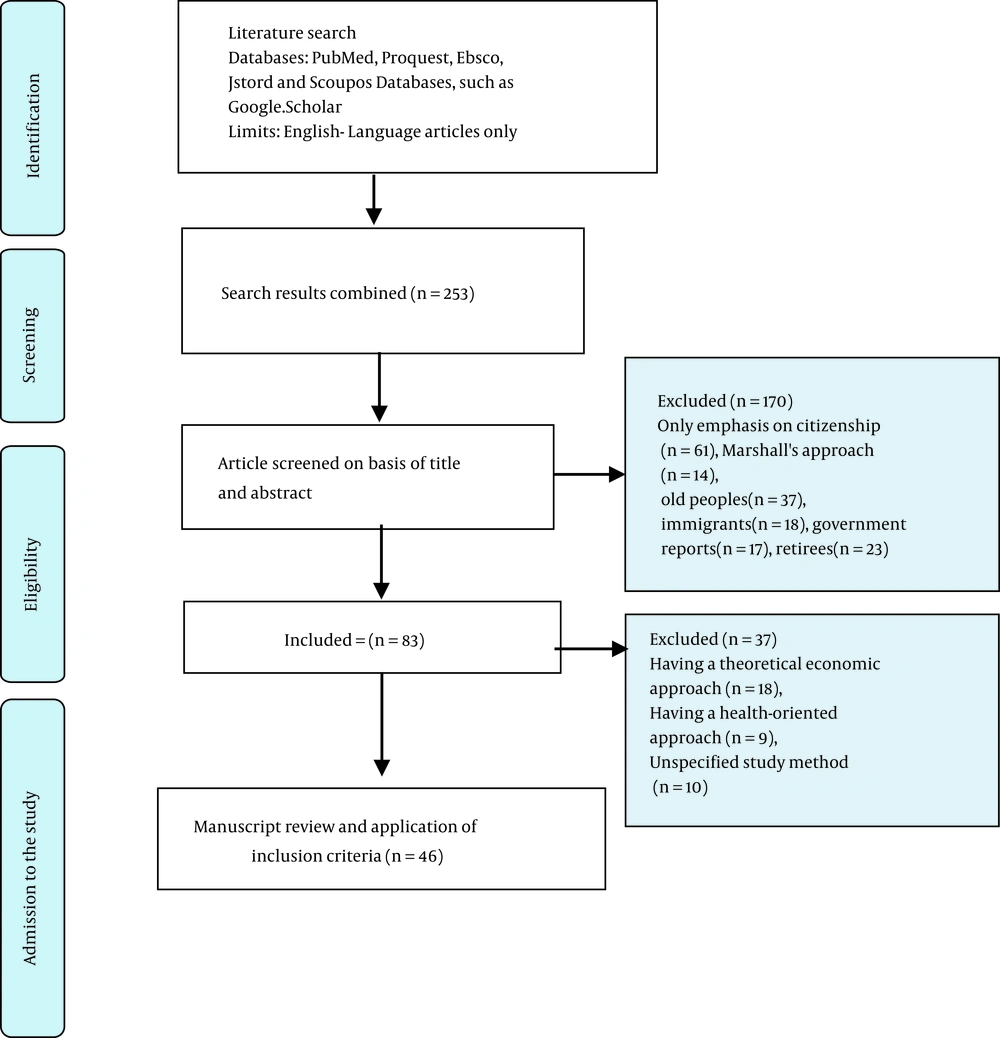
Figure 1.
PRISMA flow diagram of literature search and selection process
4. Extracting dimensions of social citizenship: The dimensions of social citizenship were extracted based on the results of 16 interviews with experts in the field of social citizenship. Each interview lasted an average of 45 minutes. After the interviews, the texts were sorted and coded, and the main and secondary components of social citizenship were categorized. After the coding, the main components and sub-components were extracted. After analyzing the results obtained from reviewing resources and interviewing experts, 26 indicators in four dimensions were chosen as the selected indicators, as follows: health and education component (16 indicators). This dimension is very important so that all the interviewees emphasized its importance, “. . . Health and education are the main basic needs of every human being without which life is not possible . . .” (interview 7); Open community component (six indicators), “. . . Individual, political, and press freedom improves the quality of life and enhances societies. . .” (interview 2); political-economic prosperity component (two indicators), “. . . The rate of economic growth in any country is a sign of economic development and the purchasing power of citizens, of course, along with the distributive justice of wealth. . .” (interview 5); and livelihood component (two indicators), “. . . Supporting people in difficult situations helps reduce life crises and leads to a normal life. . .” (interview 15).
5. Conducting exploratory and confirmatory factor analysis: The research team assessed and analyzed the results obtained from exploratory and confirmatory factor analysis and made final decisions on variables based on internal homogeneity and internal correlation in each factor.
6. Standardization based on Z score: Due to the fact that different variables usually have various units of measurements, before the aggregation process, they must become specified and be assessed using an identical unit. In this study, among the various normalization methods, we selected the standardization method using the Z score.
7. Performing normal distribution tests (elongation and skewness), correlation tests of social citizenship index dimensions, and reliability by Cronbach's alpha.
8. Aggregation: Since the standardization of expressions had been performed in the previous stages, in the present stage, the method of linear aggregation was used.
9. Performing correlation tests between social citizenship components and other related statistical tests.
10. Introducing a new index and ranking 125 selected countries (125 countries were selected because their data were accessible).
4. Results
In the present study, out of 47 variables selected in the systematic review of scientific resources and interviews, 26 variables were selected based on the results of principal component analysis. It should be noted that when selecting variables with significant factor loads, the signs of some of them (correlation) are probably negative. Therefore, the negative signs of these variables indicate the opposite direction of the relationship between the variables. Thus, for the variables including death due to household gas poisoning, infant mortality, maternal mortality, death due to infectious diseases, premature marriage, mortality due to road accidents, inequality in education, lack of press freedom, discrimination and violence against minorities, lack of adequate income, and lack of legal protection for employees, we used the reverse technique. Therefore, they were re-encoded, and new inverse variables were created.
As observed in the scree plot (Figure 2), the evaluated indicators had the highest variability on four factors, and the decreasing trend at this point became almost smooth.
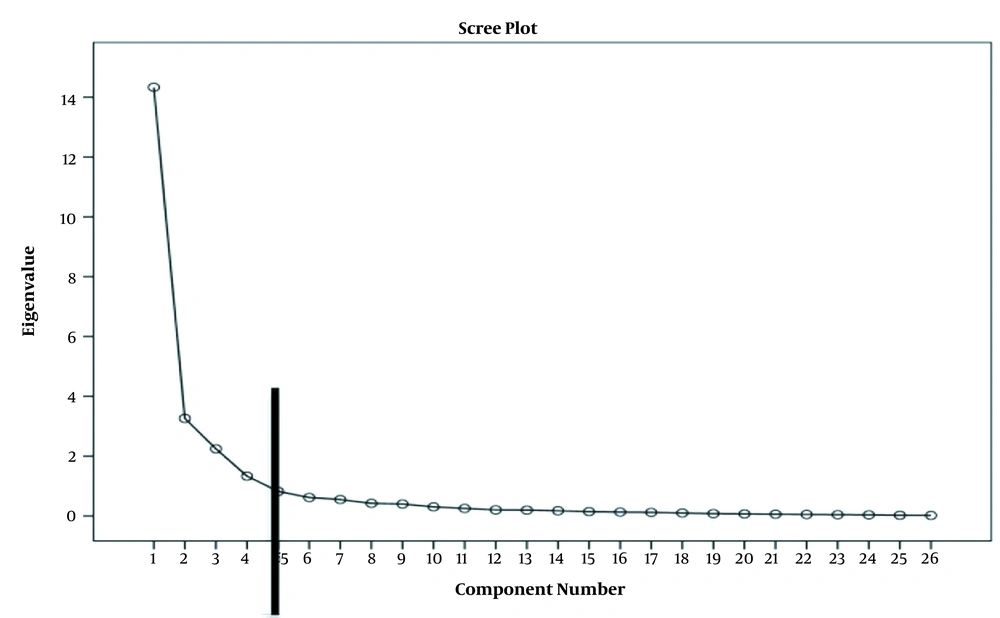
Figure 2.
Scree plot of social citizenship index factor analysis
First stage. Evaluating the possibility of factor analysis on factors: Based on the Kaiser-Meyer-Olkin (KMO) measure of sampling adequacy, which was equal to 0.91, research data could be reduced to a number of underlying and fundamental factors. In addition, based on the results of Bartlett's test of sphericity (4441, 856), which was significant at the error level of less than 0.00, the correlation matrix between the variables was the matrix of similarity. On the one hand, there was a high correlation between the variables within each factor, and on the other hand, there was not much correlation between the variables of one factor and the variables of another factor.
Second stage. Assessing the contribution of each factor to explaining the total distribution of all variables: As the next issue, it was necessary to determine the percentage of the distribution of a set of variables explained by each factor. This problem can be understood in Table 2, which shows the total distribution. This table presents the eigenvalues and the percentage of dispersion, and the percentage of cumulative dispersion obtained from the data set for each factor.
Table 2.
Total Variance Explained by Components of Social Citizenship a
| Component | Initial Eigenvalues | Extraction Sums of Squared Loadings | Rotation Sums of Squared Loadings b | ||||
|---|---|---|---|---|---|---|---|
| Total | % of Variance | Cumulative % | Total | % of Variance | Cumulative % | Total | |
| 1 | 14.333 | 55.127 | 55.127 | 14.333 | 55.127 | 55.127 | 13.618 |
| 2 | 3.261 | 12.542 | 67.669 | 3.261 | 12.542 | 67.669 | 7.573 |
| 3 | 2.246 | 8.638 | 76.306 | 2.246 | 8.638 | 76.306 | 2.361 |
| 4 | 1.332 | 5.123 | 81.430 | 1.332 | 5.123 | 81.430 | 3.099 |
| 5 | 0.823 | 3.165 | 84.595 | ||||
| 6 | 0.618 | 2.377 | 86.972 | ||||
| 7 | 0.550 | 2.115 | 89.087 | ||||
| 8 | 0.423 | 1.625 | 90.712 | ||||
| 9 | 0.400 | 1.537 | 92.249 | ||||
| 10 | 0.304 | 1.169 | 93.419 | ||||
| 11 | 0.253 | 0.974 | 94.393 | ||||
| 12 | 0.206 | 0.792 | 95.184 | ||||
| 13 | 0.197 | 0.759 | 95.943 | ||||
| 14 | 0.173 | 0.667 | 96.610 | ||||
| 15 | 0.147 | 0.564 | 97.175 | ||||
| 16 | 0.132 | 0.508 | 97.682 | ||||
| 17 | 0.121 | 0.466 | 98.148 | ||||
| 18 | 0.100 | 0.386 | 98.534 | ||||
| 19 | 0.080 | 0.306 | 98.840 | ||||
| 20 | 0.068 | 0.260 | 99.101 | ||||
| 21 | 0.060 | 0.230 | 99.330 | ||||
| 22 | 0.051 | 0.195 | 99.525 | ||||
| 23 | 0.043 | 0.165 | 99.691 | ||||
| 24 | 0.038 | 0.145 | 99.835 | ||||
| 25 | 0.024 | 0.091 | 99.926 | ||||
| 26 | 0.019 | 0.074 | 100.000 | ||||
a Extraction Method: Principal Component Analysis.
b When components are correlated, the sums of squared loadings cannot be added to obtain a total variance.
According to Table 2, the four extracted factors (81.430%) explained the percentage of the total dispersion of the indicators. The first factor alone explained 55.1% of the total dispersion. The second factor explained 12.5%, the third factor explained 8.6%, and the fourth factor explained 5.1% of the total dispersion.
Third stage. Understanding the matrix of correlation between variables and factors and classifying variables in each factor: To classify variables among factors based on their factor loads, we used the results of a rotated factor matrix (Table 3). This table shows the correlation matrix between variables and factors after rotation, in which the correlation value fluctuates between -1 and +1 and is categorized based on the largest factor load of the variables.
Table 3.
Structure Matrix
| Indicator | Factor | |||
|---|---|---|---|---|
| 1 | 2 | 3 | 4 | |
| Healthy life expectancy | 0.946 | 0.493 | 0.092 | -0.310 |
| Access to improved sanitation facilities | 0.945 | 0.297 | 0.080 | -0.239 |
| Household air pollution attributable deaths | -0.942 | -0.332 | -0.054 | 0.310 |
| Child mortality rate | -0.925 | -0.367 | -0.144 | 0.336 |
| Women's average years in school | 0.910 | 0.474 | 0.147 | -0.195 |
| Secondary school enrollment | 0.905 | 0.502 | 0.134 | -0.220 |
| Maternal mortality rate | -0.902 | -0.259 | -0.056 | 0.357 |
| Internet users | 0.895 | 0.569 | 0.152 | -0.139 |
| Access to piped water | 0.894 | 0.455 | 0.141 | -0.206 |
| Deaths from infectious diseases | -0.861 | -0.191 | -0.008 | 0.339 |
| Adult literacy rate | 0.853 | 0.196 | 0.122 | -0.243 |
| Early marriage | -0.822 | -0.376 | -0.154 | 0.189 |
| Life expectancy at 60 | 0.815 | 0.626 | 0.110 | -0.242 |
| Traffic deaths | -0.787 | -0.576 | -0.119 | 0.140 |
| Inequality in the attainment of education | -0.745 | -0.405 | -0.165 | 0.083 |
| Community safety net | 0.736 | 0.445 | 0.055 | -0.260 |
| Political rights | 0.448 | 0.921 | 0.178 | -0.135 |
| Freedom of expression | 0.357 | 0.912 | 0.177 | -0.112 |
| Press Freedom Index | -0.254 | -0.901 | -0.188 | 0.020 |
| Corruption | 0.629 | 0.841 | 0.168 | -0.087 |
| Private property rights | 0.599 | 0.837 | 0.171 | -0.122 |
| Discrimination and violence against minorities | -0.380 | -0.803 | -0.121 | 0.062 |
| GDP | 0.092 | 0.149 | 0.962 | -0.211 |
| Trust in government | 0.139 | 0.153 | 0.955 | -0.261 |
| Adequate income | 0.305 | 0.125 | 0.263 | -0.984 |
| Social protection expenditure, excluding health | 0.295 | 0.123 | 0.258 | -0.980 |
| Eigenvalue | 14.33 | 3.26 | 2.24 | 1.33 |
| % of Variance | 55.12 | 12.54 | 8.63 | 5.12 |
| 81.430 | ||||
| Significance | KMO = 0.91; Bartlett's test Sig = 0.000; α = 0.93 | |||
At this stage, the titles were selected for each of the factors, as follows: (1) the first factor, health and education; (2) the second factor, open society; (3) the third factor, political-economic prosperity; and the fourth factor: livelihood. There were 16 indicators in the health and education component, six indicators in the open society component, two indicators in the political-economic prosperity component, and two indicators in the livelihood component.
4.1. Test of Normality of Social Citizenship Index
Using graphic indicators (elongation and skewness), the normality of the distribution of education and health, open society, political-economic prosperity, and livelihood components and the social citizenship index in the society was studied.
4.2. Calculation of Elongation and Skewness Indices
Values close to zero for these two indices indicates the normality of the distribution of a variable, and usually, values between +1 and -1 indicate acceptable elongation and skewness. In other words, if the two calculated indices have values between these two cutting points, the distribution of the studied variable is normal.
As shown in Figure 3, the score of the health and education component in the studied countries was almost normal. Based on the elongation and skewness indices, the distribution of data tended to the left. Based on the elongation and skewness indices of data distribution, the open society component also had an almost normal distribution and was inclined to the right. As observed, the score of the livelihood component in the studied countries was almost normal. However, based on the elongation and skewness index, the data distribution tended to the left. The score of the political-economic prosperity component was also almost normal and was slightly inclined to the right based on the skewness index and slightly inclined to the left based on the elongation score. Social citizenship scores were almost normal in the studied countries. However, based on the elongation and skewness indices, the data distribution tended to the left.
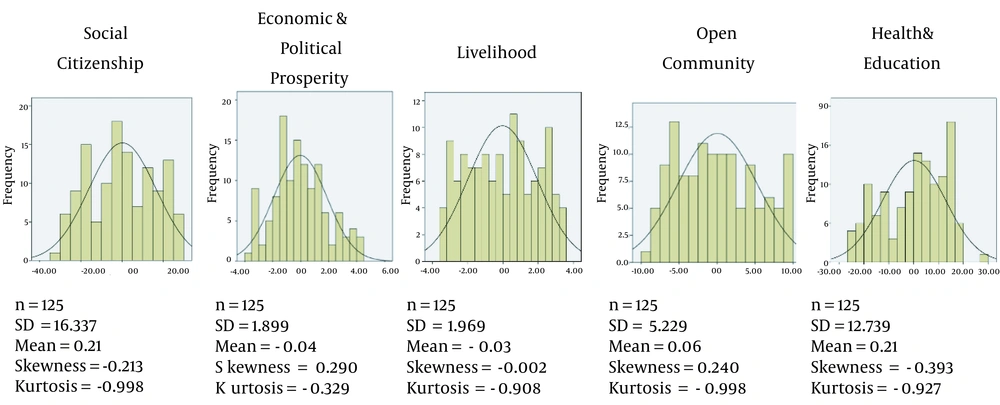
Figure 3.
Normal distribution of components and Social Citizenship Index
Cronbach's alpha is used to examine the internal correlation, which is one of the important indicators for measuring reliability. A higher value (close to 1) indicates greater internal consistency and coherence. For scales that had subscales, Cronbach's alpha was calculated separately for each of them. Cronbach's alpha value for all of the social citizenship indicators was 0.91. As shown in Table 4, Cronbach's alpha value for all the dimensions of social citizenship was above 0.70.
Table 4.
Reliability Statistics (n = 125, α = 0.91)
| Items | Cronbach's Alpha | Std. Deviation | Cronbach's Alpha if Item Deleted |
|---|---|---|---|
| Health and Education (n = 125) | 0.93 | 307.9676 | |
| Healthy life expectancy | 0.932 | ||
| Access to improved sanitation facilities | 0.943 | ||
| Household air pollution attributable deaths | 0.941 | ||
| Child mortality rate | 0.933 | ||
| Women's average years in school | 0.933 | ||
| Secondary school enrollment | 0.942 | ||
| Maternal mortality rate | 0.915 | ||
| Internet users | 0.927 | ||
| Access to piped water | 0.913 | ||
| Deaths from infectious diseases | 0.932 | ||
| Adult literacy rate | 0.922 | ||
| Early marriage | 0.939 | ||
| Life expectancy at 60 | 0.944 | ||
| Traffic deaths | 0.921 | ||
| Inequality in the attainment of education | 0.938 | ||
| Community safety net | 0.954 | ||
| Open Community (n = 125) | 0.87 | 100.3497 | |
| Political rights | 0.851 | ||
| Freedom of expression | 0.824 | ||
| Press Freedom Index | 0.886 | ||
| Corruption | 0.847 | ||
| Private property rights | 0.825 | ||
| Discrimination and violence against minorities | 0.865 | ||
| Economic and Political Prosperity (n = 125) | 0.85 | 23.8471 | |
| GDP | 0.847 | ||
| Trust in government | 0.867 | ||
| Livelihood (n = 125) | 0.91 | 71.0634 | |
| Adequate income | 0.913 | ||
| Social protection expenditure, excluding health | 0.912 |
Table 5 presents the relationship and correlation between the components. As presented, a significant relationship was observed between health & education and open society, livelihood and political-economic prosperity, open society and political-economic prosperity, and political-economic prosperity and livelihood.
Table 5.
Correlation Between the Components
| Correlation | Health and Education | Open Society | Political-Economic Prosperity | Livelihood | Social Citizenship |
|---|---|---|---|---|---|
| Health and education | 1 | 0.597 a | 0.203 b | -0.255 a | 0.958 a |
| Open society | 1 | 0.213 b | -0.153 | 0.767 a | |
| Political-economic prosperity | 1 | -0.368 a | 0.190 b | ||
| Livelihood | 1 | -0.165 | |||
| Social citizenship | 1 |
a Correlation is significant at the 0.01 level.
b Correlation is significant at the 0.05 level.
a Sources: WHO, ILO, OECD, World Bank, World Happiness Report, Social Progress Index, Institute for Economics and Peace Global Peace Index, FAO, UN, ITU, RSF, Freedom House, World Justice Project Rule of Law Index, Heritage Foundation, Pew Research Center Government Restrictions Index, UNESCO, Fund for Peace Fragile States Index, Reporters Without Borders.
Finally, the social citizenship index with dimensions and indicators is seen in Figure 4 after factor analysis and normality tests.
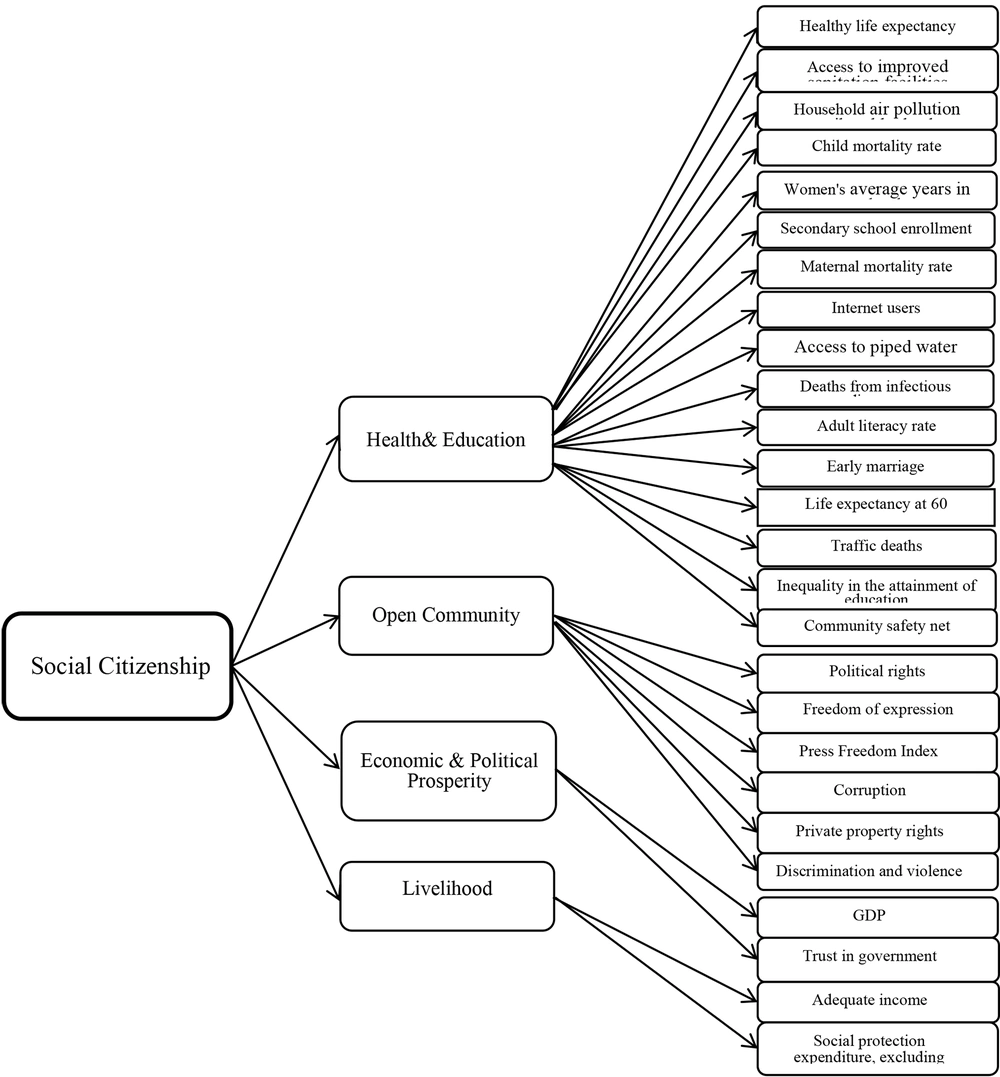
Figure 4.
Index of social citizenship
4.3. The Status of Social Citizenship and Its Dimensions in the Studied Countries
In this part of the study, we assessed the status of the studied countries in terms of social citizenship dimensions and related indicators.
As shown in Table 6, the position of the countries was determined according to the final index of social citizenship and its main dimensions, including health and education, livelihood, economic-political prosperity, and open society. Finally, the results showed that in the social citizenship index, 32 countries were in the upper position, 62 countries were in the middle position, and 31 countries were in the lower position.
Table 6.
Rank of Countries in Components and Social Citizenship Index (n = 125) a
| Country | Social Citizenship Index | Economic and Political Prosperity | Livelihood | Open Community | Health and Education |
|---|---|---|---|---|---|
| Finland | 1 | 2 | 5 | 1 | 4 |
| Sweden | 2 | 4 | 7 | 3 | 2 |
| Switzerland | 3 | 6 | 1 | 6 | 9 |
| Netherlands | 4 | 8 | 3 | 7 | 7 |
| Norway | 5 | 10 | 4 | 5 | 8 |
| Australia | 6 | 7 | 10 | 11 | 3 |
| Germany | 7 | 3 | 6 | 13 | 15 |
| United K | 8 | 15 | 17 | 18 | 12 |
| Denmark | 9 | 9 | 14 | 4 | 11 |
| Iceland | 10 | 1 | 12 | 10 | 5 |
| Ireland | 11 | 13 | 8 | 9 | 16 |
| Austria | 12 | 14 | 2 | 12 | 10 |
| Belgium | 13 | 20 | 20 | 14 | 14 |
| Japan | 14 | 12 | 13 | 19 | 17 |
| Spain | 15 | 16 | 15 | 26 | 6 |
| Estonia | 16 | 21 | 29 | 20 | 22 |
| Israel | 17 | 24 | 18 | 50 | 1 |
| Portugal | 18 | 5 | 21 | 17 | 25 |
| United S | 19 | 17 | 27 | 21 | 28 |
| Italy | 20 | 23 | 24 | 37 | 13 |
| Greece | 21 | 19 | 23 | 44 | 24 |
| Hungary | 22 | 18 | 33 | 43 | 29 |
| Slovenia | 23 | 28 | 31 | 25 | 20 |
| Canada | 24 | 25 | 16 | 8 | 21 |
| Lithuania | 25 | 27 | 19 | 23 | 35 |
| Slovakia | 26 | 22 | 36 | 34 | 30 |
| Poland | 27 | 34 | 22 | 27 | 26 |
| Latvia | 28 | 30 | 49 | 36 | 34 |
| France | 29 | 31 | 28 | 29 | 23 |
| New Zealand | 30 | 29 | 34 | 2 | 31 |
| Czech Re | 31 | 56 | 86 | 24 | 19 |
| Korea, R | 32 | 26 | 9 | 31 | 27 |
| Chile | 33 | 32 | 52 | 16 | 36 |
| Croatia | 34 | 57 | 35 | 41 | 32 |
| Cyprus | 35 | 59 | 37 | 30 | 18 |
| Uruguay | 36 | 55 | 48 | 15 | 42 |
| Costa Ri | 37 | 61 | 38 | 22 | 39 |
| Mauritius | 38 | 58 | 39 | 28 | 54 |
| Montenegro | 39 | 46 | 44 | 65 | 38 |
| Serbia | 40 | 63 | 26 | 53 | 37 |
| Romania | 41 | 35 | 40 | 45 | 48 |
| Bulgaria | 42 | 36 | 41 | 56 | 40 |
| Kuwait | 43 | 11 | 25 | 76 | 44 |
| Albania | 44 | 39 | 42 | 51 | 47 |
| Jamaica | 45 | 62 | 89 | 32 | 58 |
| Argentina | 46 | 37 | 45 | 48 | 45 |
| Panama | 47 | 47 | 43 | 49 | 64 |
| Macedonia | 48 | 53 | 71 | 81 | 41 |
| Ukraine | 49 | 33 | 65 | 78 | 49 |
| Belarus | 50 | 43 | 46 | 111 | 33 |
| Armenia | 51 | 48 | 47 | 77 | 46 |
| Turkey | 52 | 40 | 11 | 101 | 43 |
| Mexico | 53 | 42 | 51 | 70 | 56 |
| Colombia | 54 | 52 | 56 | 66 | 65 |
| Tunisia | 55 | 65 | 98 | 61 | 69 |
| Brazil | 56 | 44 | 32 | 40 | 63 |
| Malaysia | 57 | 49 | 54 | 79 | 66 |
| Lebanon | 58 | 54 | 70 | 94 | 51 |
| Moldova | 59 | 64 | 69 | 63 | 60 |
| Georgia | 60 | 67 | 66 | 58 | 53 |
| Peru | 61 | 50 | 55 | 60 | 72 |
| Ecuador | 62 | 66 | 68 | 83 | 67 |
| Kazakhstan | 63 | 51 | 58 | 112 | 52 |
| Jordan | 64 | 60 | 60 | 82 | 57 |
| El Salvador | 65 | 75 | 57 | 54 | 80 |
| Saudi Ar | 66 | 38 | 53 | 107 | 61 |
| Azerbaijan | 67 | 72 | 59 | 117 | 55 |
| Kyrgyzstan | 68 | 69 | 62 | 95 | 71 |
| Mongolia | 69 | 73 | 82 | 39 | 79 |
| Botswana | 70 | 71 | 76 | 35 | 89 |
| South Af | 71 | 76 | 63 | 38 | 83 |
| Honduras | 72 | 74 | 72 | 86 | 82 |
| Namibia | 73 | 87 | 75 | 98 | 91 |
| Bolivia | 74 | 79 | 61 | 67 | 84 |
| Sri Lanka | 75 | 68 | 74 | 90 | 68 |
| Thailand | 76 | 82 | 64 | 104 | 70 |
| Philippines | 77 | 70 | 79 | 80 | 78 |
| Russia | 78 | 77 | 73 | 121 | 50 |
| Paraguay | 79 | 85 | 77 | 69 | 73 |
| Indonesia | 80 | 84 | 78 | 75 | 87 |
| Dominica | 81 | 86 | 83 | 59 | 81 |
| Morocco | 82 | 78 | 80 | 91 | 86 |
| Egypt | 83 | 81 | 84 | 116 | 75 |
| China | 84 | 45 | 30 | 120 | 62 |
| Iran | 85 | 41 | 50 | 123 | 74 |
| Algeria | 86 | 83 | 102 | 100 | 76 |
| Nicaragua | 87 | 80 | 101 | 85 | 85 |
| Ghana | 88 | 95 | 93 | 33 | 101 |
| Senegal | 89 | 91 | 92 | 46 | 104 |
| Uzbekistan | 90 | 88 | 81 | 125 | 59 |
| Lesotho | 91 | 93 | 85 | 52 | 105 |
| Myanmar | 92 | 120 | 95 | 114 | 90 |
| Tajikistan | 93 | 90 | 94 | 122 | 77 |
| Guatemala | 94 | 100 | 110 | 89 | 88 |
| Cambodia | 95 | 110 | 106 | 99 | 92 |
| India | 96 | 97 | 67 | 62 | 95 |
| Malawi | 97 | 104 | 103 | 55 | 112 |
| Kenya | 98 | 106 | 96 | 88 | 94 |
| Laos | 99 | 92 | 117 | 119 | 93 |
| Nepal | 100 | 102 | 91 | 92 | 97 |
| Madagascar | 101 | 111 | 88 | 57 | 114 |
| Bangladesh | 102 | 89 | 118 | 105 | 98 |
| Benin | 103 | 115 | 90 | 42 | 117 |
| Congo, R | 104 | 105 | 113 | 108 | 103 |
| Togo | 105 | 94 | 87 | 73 | 116 |
| Nigeria | 106 | 96 | 105 | 93 | 111 |
| Mauritania | 107 | 98 | 121 | 84 | 109 |
| Tanzania | 108 | 103 | 119 | 68 | 106 |
| Uganda | 109 | 107 | 114 | 97 | 108 |
| Liberia | 110 | 108 | 99 | 64 | 118 |
| Rwanda | 111 | 114 | 98 | 109 | 99 |
| Cameroon | 112 | 113 | 104 | 106 | 107 |
| Burkina | 113 | 99 | 100 | 47 | 120 |
| Pakistan | 114 | 101 | 112 | 103 | 96 |
| Yemen | 115 | 123 | 125 | 124 | 100 |
| Zimbabwe | 116 | 119 | 123 | 102 | 102 |
| Afghanis | 117 | 117 | 107 | 110 | 115 |
| Mozambique | 118 | 112 | 124 | 74 | 119 |
| Angola | 119 | 109 | 109 | 113 | 113 |
| Sierra L | 120 | 118 | 116 | 71 | 123 |
| Niger | 121 | 116 | 122 | 72 | 124 |
| Central | 122 | 125 | 115 | 118 | 110 |
| Ethiopia | 123 | 124 | 108 | 87 | 121 |
| Mali | 124 | 122 | 120 | 96 | 122 |
| Guinea | 125 | 121 | 111 | 115 | 125 |
a Sources: WHO, ILO, OECD, World Bank, World Happiness Report, Social Progress Index, Institute for Economics and Peace Global Peace Index, FAO, UN, ITU, RSF, Freedom House, World Justice Project Rule of Law Index, Heritage Foundation, Pew Research Center Government Restrictions Index, UNESCO, Fund for Peace Fragile States Index, Reporters Without Borders.
5. Discussion
Social citizenship is a kind of realization of social rights, and participation means the expansion and increase of social rights in society. That is, with the participation of community members in the political and legal spheres, the scope of social rights increases, and social awareness is achieved. In the meantime, governments should promote the quality of life and social welfare by providing health services that are the basis of the fundamental rights (21), as well as other social services such as education and social support to their citizens.
The four main components of social citizenship included "health and education", "open society", "livelihood", and "political-economic prosperity". Based on the scores obtained in the four components, the selected countries were grouped in the upper, middle, and lower groups, so that 32 countries were at the highest level, 62 countries were at the medium level, and 31 countries were at the lowest level. The results showed that Finland, Sweden, Switzerland, the Netherlands, Norway, Australia, Germany, the United Kingdom, Denmark, and Iceland were the top 10 countries, in sequence, and Zimbabwe, Afghanistan, Mozambique, Angola, Sierra Leone, Niger, Ethiopia, Mali, Guinea, and Chad ranked last among the 125 countries studied. Meanwhile, Iran, along with Egypt, China, Algeria, and Nicaragua, ranked 85th in the social citizenship index. Concerning the main components, it ranked 75th in health and education, 123rd in open society, 50th in livelihood, and 41st in economic-political prosperity. It can be concluded that the success of the first-level countries in the social citizenship index can be a model in providing welfare services to citizens in other countries.
Significant progress has been made in measuring and comparing the development of different societies at the international level by various indicators. Meanwhile, the study of different countries based on different social, economic, political factors with scientific indicators helps planners and policymakers to create promotional programs (22). One of the important international indicators for measuring and comparing countries is the Legatum welfare index. This index measures the social welfare situation in different countries. The Legatum Research Institute has published this index since 2007. This index is a combination of variables in eight areas, which are common to the social citizenship index in four areas of the economy, education, health, and individual freedoms, and differ in the areas of business opportunities, governance, social capital, security, and safety.
Also, in 2006, the EU Lifelong Learning Research Center developed the concept of active citizenship in four dimensions and assessed it in 19 European countries: citizens’ political life (nine factors), citizens' civic activities in society (18 factors), activities Citizens 'social status (25 factors), and citizens' values (11 factors). The results showed that Norway and Sweden had the highest rank, and Hungary and Poland had the lowest rank in terms of civic activities of citizens in society. Our findings also showed similar results.
The Quality of Life Index was used for the first time in 2005 to rank countries in the world based on nine factors: income status, job security, health, political freedom, gender equality (common to the social citizenship index), political stability, and security, family life, social life, climate, and geography. The Human Development Index (HDI) was also presented in three dimensions: life expectancy, education, and income to compare and measure the countries; our study also obtained education and economics. Other studies by constructing a composite index of economic well-being and measuring it in Kurdish countries showed that, on average, Morocco had the highest value of the IEWB index and Bangladesh had the lowest (23). In terms of growth rate, Turkey had the highest growth rate, and Bangladesh had the lowest growth rate. Iran did not have a good position and was ranked eighth. The economic and revenue factors of this index are similar to our results. The Combined Social Welfare Index was used to compare the provinces of Iran. The index includes information in various fields such as health, education, economy, employment, social security, and housing. The factors of health, economy and education were also obtained in the social citizenship index (24). The Social Welfare and Social Citizenship Index, which measures health and livelihood, is based on our findings (25).
The social citizenship index, a new index in this study, showed the changes in social citizenship better due to having more diverse dimensions and expressions. According to the approach of social expressions, it can be said that any policy that increases or decreases social expressions will play an effective role in changing social citizenship.
What seems certain is that social citizenship, like other indicators of assessing the state of societies, has its own characteristics, and tries to achieve a more accurate measurement. Gather valid data is important to measure social citizenship.
It seems that in international organizations such as Legatum, UN, etc., a special section should be created to provide statistics and information needed to measure social citizenship, which always monitors changes in social citizenship of countries, to provide policies and suggestions for its improvement in countries and the world, and to help improve the quality of life of all communities by providing proposed policies at the international level.
In general, it can be said that the index of social citizenship, due to the coverage of various dimensions affecting life, helps with the possibility of partial-general analysis and realistic measurements, as well as examining the effects of social policies on various aspects of society's life, and making appropriate decisions by transnational organizations and governments.
The results of this study showed that Iran had not a good position. But, it can improve its position by applying appropriate social policies in line with the international community. Also, in the field of building the Indigenous Index of Social Citizenship of Iran, it will be possible to evaluate and continuously monitor welfare policies and programs.
5.1. Limitations of the Study
In this study, the lack of statistics and information of all countries in the world was the main limitation. Also, this research topic was new, and it was difficult to find reliable sources.
5.2. Conclusion
It can be concluded that the social citizenship index, due to the coverage of various effective dimensions and the possibility to be used for detailed and general analysis, helps to more accurately measure the quality of life and social welfare more accurately. In addition, by assessing the effects of social policies on various aspects of society, it helps the government to make appropriate decisions. The results of this study, regarding the construction of an indigenous index of social citizenship, are expected to facilitate the continuous evaluation and monitoring of welfare and development policies and programs.