
1. Background
A workplace has a significant role in maintaining staff health. Thus, if the required conditions and facilities are provided to deal with health and self-care issues in the workplace, it is likely that wrong habits leading to the occurrence of non-communicable diseases will reduce, thereby boosting efficiency of the whole organization (1). Over half of early deaths result from factors associated with an unhealthy lifestyle. Thus, it is essential to provide, preserve, and promote staff health that affects their lifestyle (2). A healthy workplace is not merely defined in terms of the lack of potential conditions associated with diseases or disabilities. In contrast, the main feature of a healthy workplace is the existence of health promotion and welfare signs and components (3, 4). Based on the estimates made by the International Labor Organization, as many as 2.34 million people lose their lives annually as a result of accidents or labor-associated diseases, with 314 million people suffering from occupational injuries (4). In addition to their direct costs, accidents lead to indirect costs four times more than direct ones, including reduced credit (5). These figures indicate the significance effect of the issue on health promotion among the staff. These facts necessitate conducting preventive interventions in terms of staff health promotion (6). In addition to increasing staff efficiency, interventions conducted for staff health promotion in the workplace can reduce healthcare costs of the staff, being of high significance in countries where health insurance premiums are directly paid by employers. Moreover, most of the employers assert that deteriorated health conditions are directly associated with reduced efficiency, safety, and spirit among the staff (7). Most of the studies have focused on the strategies of physical activity and healthy nutrition among individuals in the workplace. In fact, any changes in an individual's behavior directly affect the change desired for the policies of an organization and its social environment. These interventions have reduced overweight, obesity, and medical costs in the workplace (8). The results of a cost-effectiveness meta-analysis of physical activity and nutrition interventions indicated that they were effective in reducing the cholesterol levels and risks of cardiovascular diseases (9, 10). The present job diversity and staff involvement in health problems necessitate systematic health planning and health need assessments for the purpose of promoting self-care health and safety in the organizational environment by increasing awareness, attitude, and performance among the staff. Besides, research indicates that the cost-effectiveness of health interventions is by far more than the costs of medicine, cessation of work, disabilities, and workflows of the staff. Against this background, the present study aims to investigate health programs in the workplace and their effects on the staff of both Zahedan University of Medical Sciences and University of Sistan and Baluchestan, Zahedan.
2. Methods
The present quasi-experimental was conducted in the time period of 2020 to 2021 in Zahedan, southeastern Iran. The control and intervention groups included a random selection of 110 and 144 non-academic staff members of Zahedan University of Medical Sciences (ZAUMS) as well as Sistan and Baluchestan University (SBU), respectively. In each of the mentioned universities, based on random blocks and the participants' consent to participation in the study, the subjects were included in the study. Accordingly, the number of the people working in each unit of Sistan and Baluchestan University, who entered the study, was equivalent to that of the people working in the same unit of Zahedan University of Medical Sciences, with the same range of work experience. A researcher-made questionnaire was created, which included the two variables of nutrition and physical activity. Each variable included three constituents of knowledge (10 questions), attitude (10 questions), and performance (10 questions). The questionnaire validity was evaluated by a panel of experts, with a CVI of 90% and a CVR of 92% obtained. Based on the data from a sample of 20 staff members, the Cronbach's alpha was determined at 85%. However, this sample was excluded from the results of the study. This study was approved by the Ethics Committee of Zahedan University of Medical Sciences (IR.ZAUMS.REC.1397.489 – 9067). All the participants signed a consent form for participating in the study after they were briefed on the study, its duration, and educational interventions.The questionnaire was designed on an online Iranian platform (Porsline, https://survey.porsline.ir) and sent at the participants' address using WhatsApp and Soroush messengers. After receiving the completed questionnaires, two educational booklets and two virtual educational videos that were recorded in Camtasia were uploaded on the website of Sistan and Baluchestan University. Besides, the educational booklets were provided to the intervention group via WhatsApp and Soroush messengers, where the participants were allowed to ask their questions after every session. One month from conducting the educational intervention, the questionnaires were re-uploaded on Porsline as a posttest. The data were described by frequency, percentage, as well as mean ± SD. Besides, analysis of covariance was performed to compare the mean of outcome variables in the posttest between the intervention and control groups after adjusting for pretest scores. In addition, data were analyzed in SPSS V21.0.
3. Results
There were 144 and 110 participants in the intervention and control groups, respectively. The frequency of permanent public employment was 31.2 and 27.3% in the intervention and control groups, respectively. Besides, 25% of the participants were male in the intervention group, 82.6% were married, and 90.3% had a work experience of at least 10 years. In the control group, 33.9% of the participants were male, 78.2% were married, and 45.5% had a work experience of less than 10 years. The results indicated no significant difference (P > 0.05) between the two intervention and control groups in terms of demographic variables (Table 1).
Table 1.
Demographic Characteristics of the Participants in the Intervention and Control Groups a
| Variables | Intervention; N = 144 | Control; N = 110 | P-Value* |
|---|---|---|---|
| Employment status | 0.08 | ||
| Permanent public employment | 45 (31.2) | 30 (27.3) | |
| Permanent contractual employment | 71 (49.3) | 3 (2.7) | |
| Temporary contractual employment | 28 (19.4) | 77 (70.0) | |
| Gender | 0.524 | ||
| Male | 36 (25.0) | 37 (33.9) | |
| Female | 108 (75.0) | 72 (66.1) | |
| Marital status | 0.146 | ||
| Single | 22 (15.3) | 21 (19.1) | |
| Married | 119 (82.6) | 86 (78.2) | |
| Divorced/widowed | 3 (2.1) | 3 (2.7) | |
| Working experience (y) | 0.07 | ||
| Less than 5 | 4 (2.8) | 21 (19.1) | |
| 5 - 10 | 10 (6.9) | 39 (35.5) | |
| 10 - 15 | 43 (29.9) | 19 (17.3) | |
| 15 - 20 | 42 (29.2) | 9 (8.2) | |
| More than 20 | 45 (31.2) | 22 (20.0) |
a Values are expressed as No. (%).
After adjusting for pretest scores, the mean posttest knowledge of nutrition was not significantly different between the intervention and control groups (P = 0.418). However, nutrition attitude (P < 0.001) and performance (P < 0.001) were significantly different between the two groups so that the posttest mean score was greater in the intervention group (Table 2).
Table 2.
Mean Scores of Knowledge, Attitude, and Performance for Nutrition and Physical Activity Before and After the Intervention
| Variables | Pre-intervention (Mean ± SD) | Post-intervention (Mean ± SD) | P-Value a |
|---|---|---|---|
| Nutrition knowledge | < 0.001 | ||
| Intervention | 13.03 ± 1.87 | 13.36 ± 1.68 | |
| Control | 12.53 ± 4.137 | 12.78 ± 4.14 | |
| Nutrition attitude | < 0.001 | ||
| Intervention | 26.82 ± 2.78 | 28.01 ± 2.269 | |
| Control | 23.81 ± 4.68 | 24.17 ± 4.2 | |
| Nutrition performance | < 0.001 | ||
| Intervention | 22.67 ± 2.45 | 24.81 ± 2.89 | |
| Control | 21.79 ± 4.07 | 22.13 ± 3.71 | |
| Physical activity knowledge | < 0.001 | ||
| Intervention | 16.66 ± 1.71 | 17.48 ± 1.35 | |
| Control | 15.46 ± 2.89 | 15.56 ± 3.09 | |
| Physical activity attitude | < 0.001 | ||
| Intervention | 26.66 ± 2.60 | 27.49 ± 2.44 | |
| Control | 26.06 ± 3.05 | 25.93 ± 3.31 | |
| Physical activity performance | < 0.001 | ||
| Intervention | 20.76 ± 4.49 | 24.31 ± 4.028 | |
| Control | 18.75 ± 4.93 | 19.71 ± 4.24 |
a P-value for comparing the mean of post-test scores between the intervention and control groups after adjusting for pretest scores using analysis of covariance.
After adjusting for pretest scores of physical activity, the mean posttest knowledge (P < 0.001), attitude (P < 0.001), and performance (P < 0.001) were significantly different between the intervention and control groups, with greater mean values having been observed in the intervention group (Table 2).
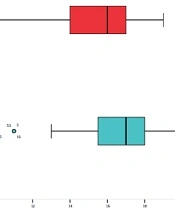
According to the results, physical activity performance was significantly affected by not only the intervention (P < 0.001) but also by work experience (P < 0.001). Although the intervention had a greater impact on physical activity performance in the staffs with a work experience of at least 5 years, there was no significant correlation between work experience and physical activity performance (P = 0.08) (Figure 1).
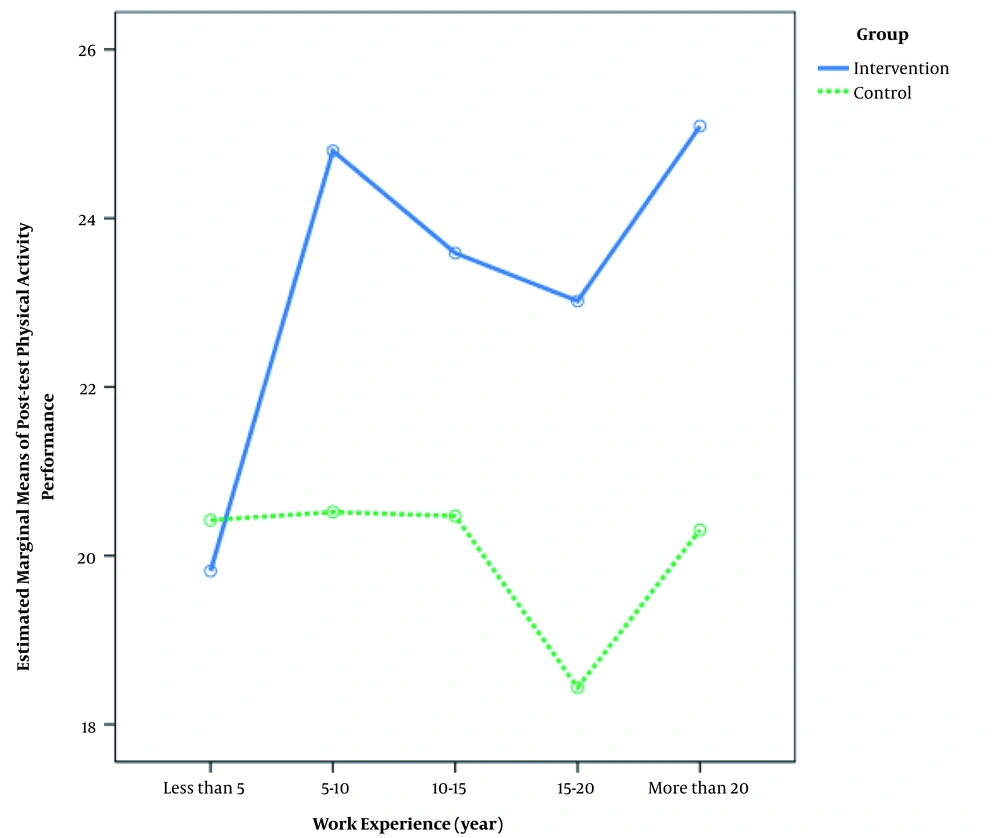
Figure 1.
Correlation between the physical activity and work experience with intervention performance
According to the results, nutrition behavior was significantly better in the female staff than in the male ones (P = 0.048), yet there was no correlation between gender and the intervention (P = 0.266) (Figure 2).
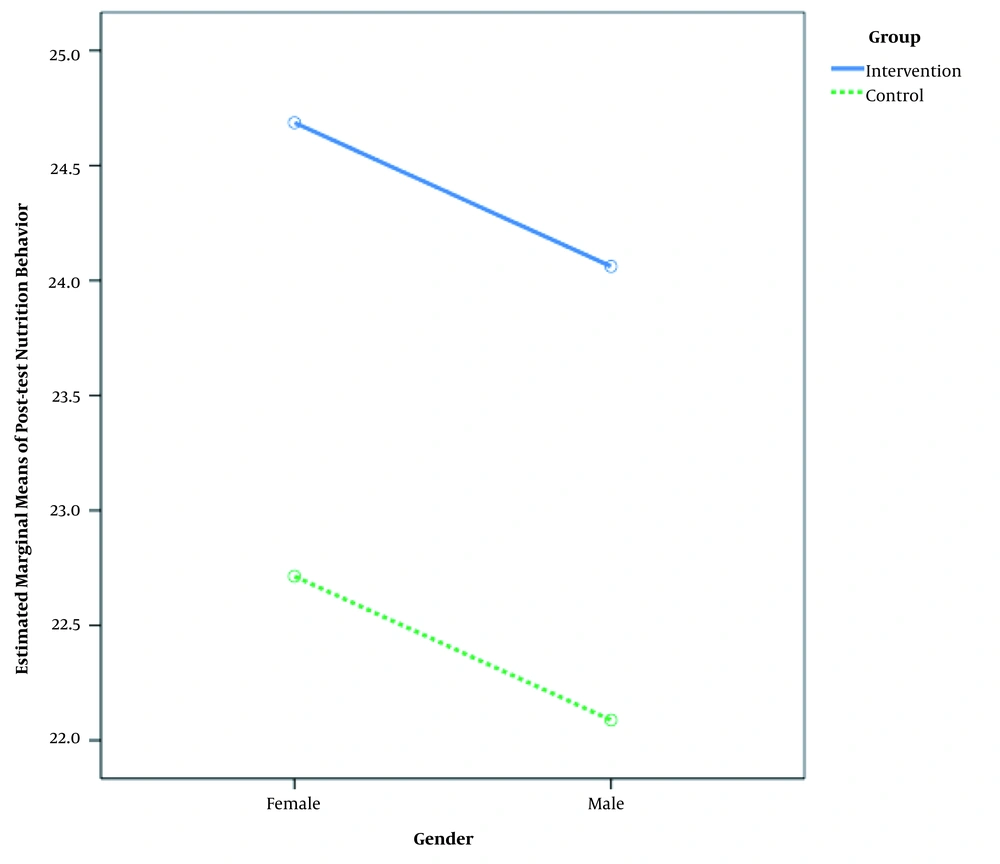
Figure 2.
Correlation between nutrition behavior and gender with intervention performance
4. Discussion
The results obtained from the present study indicate that self-care behaviors among the staff, including nutrition awareness, attitude, and performance, as well as physical activity increased after the educational intervention, with the post-intervention scores having been significantly different from the pre-intervention ones. This indicates that the health promotion educational intervention resulted in the increased levels of nutrition awareness, attitude, and performance, as well as physical activity among the staff. Concerning nutrition awareness in the intervention group, the mean pre-intervention score increased. Thus, given the increased level of awareness, it can be concluded that the virtual educational intervention was effective in promoting awareness of the right nutrition pattern among the staff. This finding was in line with the findings of other studies on nutrition (11, 12). It is worth noting that when reviewing previous studies on the issue, it was found that few studies had been conducted on staff. Increased awareness resulted in following a healthy diet among the staff, with this having had a strong effect on the staff’s ability to perform their jobs more effectively. Improved ability and concentration while doing tasks are among the benefits of using healthy nutrition among the staff. Educational programs of healthy nutrition provide the required instructions for selecting healthy foods, utilizing different ways of cooking healthy foods, and selecting healthy drinks. By executing health promotion programs, organizations can both help their staff select healthy foods and ensure their access to healthy foods in their rooms and office meetings. Accordingly, the staff will have an easier access to fresh fruits and healthy snacks in the organization. As regards the level of the nutrition attitude, the pre-intervention score increased. Thus, given the increased score of the post-intervention nutrition attitude, it can be concluded that the virtual educational intervention was effective in promoting a positive attitude among the studied staff. This was in line with the findings of the previous study on nutrition (13). To make changes in the nutrition behavior of the staff, it is required to change their attitude. In other words, the staff can be assisted with following a healthy diet through teaching them and changing their attitude so as to prevent nutrition-associated diseases. As to the level of nutrition performance, the mean pre-intervention score increased. Thus, given the increased level of nutrition performance, one can conclude that the virtual educational intervention was effective in promoting self-care behaviors among the staff. This finding was consistent with those of another study (14). Self-care behaviors of healthy nutrition among the staff would result in fewer physical and mental problems. Thus, proper education is likely to reduce costs and disabilities associated with diseases, thereby promoting staff health in organizations. As for the level of physical activity awareness, the pre-intervention mean score increased. Thus, given the increased level of physical activity awareness, one can conclude that the virtual educational intervention was effective in promoting physical activity awareness among the staff. This was in line with the findings of other studies (15, 16). The pre-intervention awareness of physical activity was less than the post-intervention awareness of physical activity among the staff. This was possibly owing to the lack of sufficient information and sources on physical activities. Thus, it is recommended to develop and assess educational programs for promoting physical activities among the staff. Accordingly, following educational instructions on physical activities will result in exhibiting healthy self-care behaviors by the staff. As for level of physical activity attitude, the mean pre-intervention score increased. Thus, given the increased score of the post-intervention physical activity attitude, one can conclude that the virtual educational intervention was effective in promoting a positive attitude towards physical activity among the studied staff. This was in line with the findings of the previous studies (17, 18). The staff’s attitude towards physical activity was highly effective in their performance and participation in physical activities. Based on previous studies, when the staff’s personal attitude towards physical activity, their social effects, and self-efficacy improved, their participation in physical activities increased as well. However, the findings of the present study were not in line with those of a previous one (10). The possible reason for this inconsistency could be the difference in the measurement tool, the method of the study, the duration of the intervention, and the time of taking the test after conducting the educational intervention. The presence of numerous obstacles, the lack of a proper environment for performing physical activities and leisure time exercises, and the habit of having an inactive lifestyle from childhood could be the main reasons for this problem. As for the level of physical activity performance, the mean pre-intervention score increased. Thus, given the increased score of the post-intervention physical activity performance, one can conclude that the virtual educational intervention was effective in promoting physical activity performance among the studied staff. This was in line with the findings of a previous study (19). Educational programs are highly effective in increasing physical activities. However, the effects are short-term and limited. Some of the results of the present study were not consistent with those of other studies (20, 21). This inconsistency could be due to the fact that changing continuous unhealthy behaviors is hard, and that a longer educational intervention might be required to change such behaviors. Moreover, due to long working hours and long presence at the workplace, and despite having awareness and an attitude towards physical activities, the staff might not be able to exhibit health behaviors. In the present study, given the use of the environment required for exhibiting physical activities in the workplace, the behaviors were monitored during working hours, with healthy behaviors observed and assessed during that time.
A limitation of the present study was the short time of the meetings due to the attendance impossibility of the staff for their working time. Due to the high engagement of employees in work activities, using online intervention sessions and training packages could help them change their behaviors to healthy behaviors.
4.1. Conclusions
The results of the present study showed that the virtual education intervention as well as the designed educational package were effective in promoting awareness, attitude, and performance scores in terms of self-care behaviors of nutrition and physical activity among the staff of Sistan and Baluchestan University. Besides, it is recommended that the present educational intervention be conducted in other organizations and offices.