
1. Context
In recent decades, human activities have caused air pollution, which has brought serious concerns for citizens and local governments around the world. Toxic air pollutants are the most dangerous risk factors for respiratory disorders, cardiovascular diseases (CVD), asthma, and death (1). Urbanization, industrialization, and air pollution have become issues of concern due to their impact on health, attracting the attention of government officials (2). Approximately 87% of the world’s current population lives in areas where particulate pollutants (an aerodynamic diameter less than 2.5 microns (PM2.5) exceed the WHO’s limits. Also, 90% of people in low- and middle-income countries are exposed to high levels of toxic compounds (2-4). Air pollution-related mortality has increased from one million per year to 3.1 million per year from 2000 to 2012 (2-5). Since humans need an average of 10 cubic meters of air per day, controlling pollutant emission is very important due to their impact on air quality and human health (6). Around the world, vegetation and animal ecosystems around industrial areas are being destroyed. If the proper distance between industries and residential areas is not respected, the amount of suspended particles and gaseous pollutants will exceed the standard, which will cause health problems for nearby residents, as well as pollution of water, soil, and environment (7). In general, if the amount of toxic pollutants produced and released in water, soil, and air is very high, it can affect the health of all living organisms (humans, animals, and plants) (7-9). In many countries, a sensible approach relying on the inherent capabilities of nature is used to reduce air pollution (10), such as creating green spaces and using trees in public places of the city, offering many ecological, social, cultural, and economic benefits, as well as aesthetic values (11). Of course, it should also be kept in mind that a period of 15 to 40 years is required to reap the benefits of tree planting (8).
Urban green spaces can reduce ambient air temperature, mitigate storms and hurricanes caused by atmospheric turbulence, absorb carbon dioxide (CO2) and greenhouse gases, and release oxygen (O2), increase and maintain biodiversity, and improve human health communities. In addition, expanding green spaces in cities contributes to the achievement of the United Nations’ Sustainable Development Goals (12). It is necessary to explain that the creation of urban green spaces requires integrated management and continuous maintenance, in order to maintain and increase per capita green space and reduce the level of pollutants (13, 14).
This study aimed to compare the air pollution tolerance of different plant species found in vegetation traffic barriers and to investigate the effect of air pollution on the resistance of these plant species in urban areas.
2. Evidence Acquisition
2.1. Eligibility Criteria and Search Strategy
Table 1 shows the results of search in various databases, including Web of Science, PubMed, Google Scholar, Springer, and Science Direct. The search was conducted to gather English language epidemiological articles. All relevant studies published from 1993 to 2021 were identified. Five hundred and fifteen articles were retrieved from these databases.
Table 1.
Search Terms and Literature Search Results
| Term | PubMed | Science Direct | Springer | Web of Science | Google Scholar | Unique Results |
|---|---|---|---|---|---|---|
| Plant | 14 | 37 | 21 | 14 | 70 | 156 |
| Air pollutants | 9 | 31 | 10 | 4 | 31 | 85 |
| Species resistant | 16 | 24 | 14 | 6 | 28 | 88 |
| Long-term exposure | 23 | 17 | 7 | 12 | 40 | 99 |
| Urban area | 18 | 11 | 22 | 24 | 47 | 122 |
| Total | 80 | 120 | 74 | 60 | 216 | 550 |
2.2. Eligibility Criteria
Medical subject headings (MeSH) were used in this study, including "plant", "air pollutant", "resistant species", "long-term exposure" and "urban area". The search strategy was compiled in a way to obtain all articles related to our topic between 1993 and 2021. Studies conducted on plant species resistant to air pollution in urban areas published in journals indexed in Science Direct, Scopus, Google scholar, Springer, and PubMed were included.
2.3. Study Selection
According to the criteria mentioned above, after the initial screening of 550 titles, 71 duplicated studies were excluded. Then 65 and 10 articles found based on records identified through database searching, and additional records were identified through other sources. In the next stage, 38 studies were screened, and 18 full-text articles entered into the analysis process. Finally, 12 articles were selected in this study. Figure 1 shows the steps of literature search, study selection, and qualification based on the PRISMA guideline
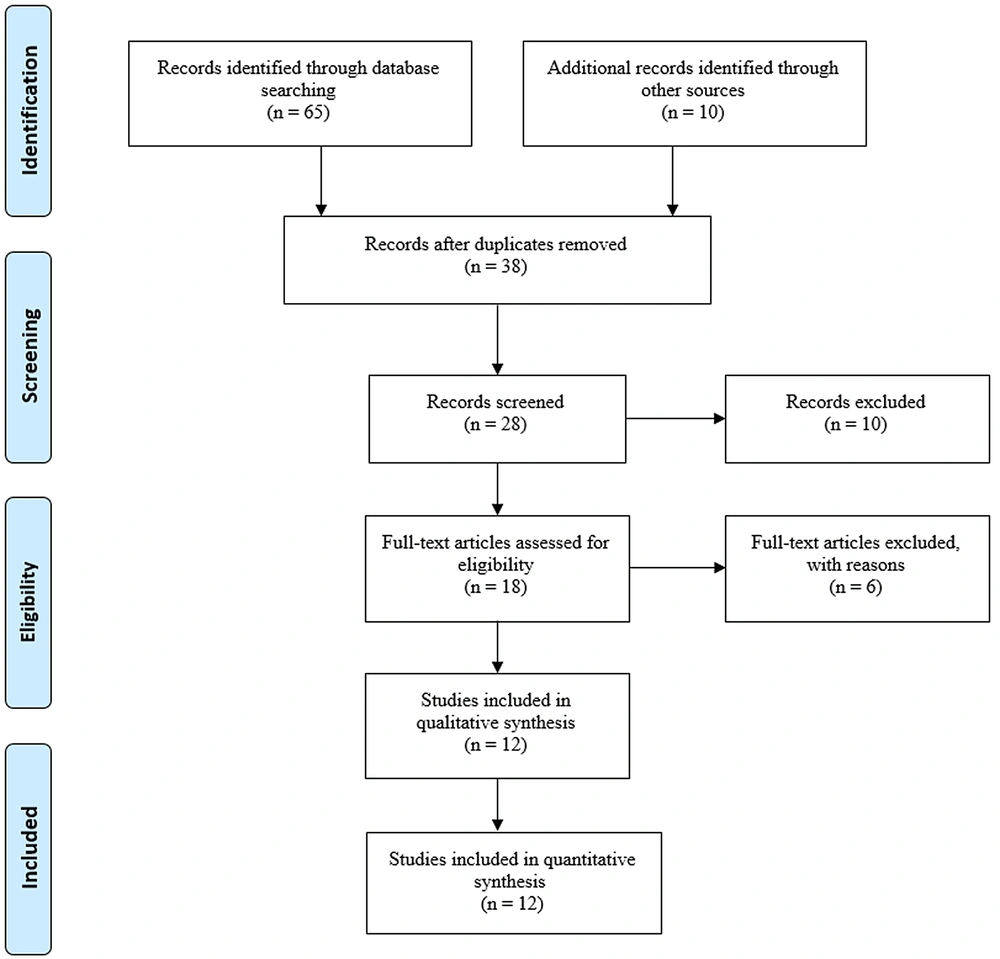
Figure 1.
The search strategy based on the PRISMA guideline
2.4. Data Extraction
Data from selected publications were extracted and transferred into a Microsoft Excel spreadsheet.
2.5. Ethical Approval
According to national guidelines, review studies do not require obtaining consent
3. Results
3.1. Plant Species
Due to the rapid expansion of urbanization and industrialization of societies, the most critical part of environmental pollution is an increase in the concentration of pollutants caused by the urban transportation system, industries, and factories. Air pollution endangers the health of people and other living organisms and accelerates climate change (8). Significant amounts of pollutants [such as nitrogen dioxide (NO2), sulfur dioxide (SO2), polycyclic aromatic hydrocarbons (PAHs), PM, and ozone (O3)] are produced on highways, freeways, streets, and roads in cities, inflicting destructive effects on human health. In order to reduce air pollution, planting trees and creating green spaces in urban areas are among the desirable and least expensive ways. Therefore, in order to improve the quality of life of citizens and reduce the risk of various diseases, planting trees that have the ability to trap and neutralize dangerous air pollutants should be considered (8-15).
The type of species planted, their growth rate throughout the year, the density of vegetation, and post-planting care (including timely pruning of trees) should be considered to create sufficient vegetation in urban areas (16-19). Based on available evidence, there is a positive correlation between vegetation density and the level of PM and gaseous pollutants produced from natural and man-made resources (8, 20-23).
Previous studies have reported that trees have a direct effect on reducing air pollution by absorbing pollutant particles through stomata (holes in leaves barks) and canopies (the highest part of tree canopy) (16, 24). Their indirect effects are mediated through the process of transpiration (a biological process for reaching the right temperature and improving respiratory function), which in turn reduces atmospheric temperature and the rate of the reactions that produce secondary pollutants (16, 25).
The value of PM2.5 deposition differs significantly from PM10 among different trees (26), but in general, the leaves of each tree species with unique structures can retain suspended particles, dust, and ambient air pollutants (27). Trees with prominent and irregular circular cells on the surface of their leaves are able to absorb large amounts of toxic air pollutants through pores with different sizes. In the same way, other species of trees with parallel veins and grooves on the surface of their leaves, as well as trees with scaly leaves can absorb large amounts of primary and secondary pollutants and improve air quality. Among other trees are those whose upper and lower leaf surfaces are different. The upper surface with mesh projections can absorb a large amount of pollutants released in the environment, but at lower levels, due to the smoothness of the leaves, they can absorb a small amount of pollutants as well. The fine pores on the surface of the leaf or the pores that play a key role in the exchange of air in the physiological activities of the plant also have important roles in the absorption of airborne particles (27). Fluffy living cells also emerge from the leaf surface of plants and are able to absorb contaminants with a small aerodynamic diameter (27); however, fluffs are not very important compared to stomata (26). In general, the most desirable characteristics of trees that enable them to reduce air pollution is a combination of large and coarse leaves with complex and various shapes and a large number of surface pores (26).
In addition, a comparison between conifers (evergreen) and broadleaf (deciduous) trees has shown that the aerodynamic diameter of PM absorbed by conifers is larger than the diameter of the particles absorbed by broadleaf trees. Among the factors affecting the diameter of the particles absorbed, one can mention the microscopic structure of leaf surfaces and the duration of dust remaining in the environment, which are factors that have a great influence on the diameter of the particles absorbed on the leaf surface (27).
3.2. Air Pollution
Air pollution occurs when one or more pollutants remain in the atmosphere in sufficient amounts and for a period that can endanger human health and the life or biological functions of animals and plants life or unreasonably interfere with the pleasantness of life (28). Today, air pollution is considered a serious threat to the health of living organisms and the environment, and sometimes, it has bad socio-economic consequences. Therefore, air pollution is considered as a global problem, and in addition, the WHO has also announced air pollution as the cause of millions of premature deaths around the world (29-31). One of the most dangerous and deadly atmospheric pollutants are PMs, which are a complex mixture of tiny solid particles and liquid droplets (except pure water) dispersed in the atmosphere. After being produced due to various activities, they can travel long distances (via wind) and cause short-term and long-term harmful effects (29, 32-34). Various reasons such as industrial activities, the growing of human populations, and the consumption of fossil fuels, especially during urban rush hours, can significantly increase the concentration of PMs, especially PM10 particles, which then enter the human body mainly through the respiratory system, causing diseases in vulnerable groups of society (i.e., children, the elderly, people with heart and lung diseases, and pregnant women) (29, 35). In recent years, by passing laws and monitoring the strict implementation of national and international regulations, the emission of PMs to the atmosphere has somewhat reduced and become under control, but it is not possible to completely eliminate these substances because the process will be technically very difficult and financially very expensive (29).
Ozone (O3) is a secondary pollutant whose toxic effects are mainly due to its oxidation ability. Exposure to this compound will result in numerous adverse health consequences, including damage to the respiratory system, bronchitis, asthma, reduced lung function, other types of pulmonary diseases, and increased risk of mortality (36-40). The harmful effects of this toxic pollutant on plants include significant damage to leaves, reduced growth, and reduced fruiting. Another important pollutant produced by various natural and human activities is NO2 with reddish brown color and a very nasty odor that reduces the quality of indoor and outdoor air. This compound is a culprit of global warming and a physiological stimulant of the lower respiratory tract (36). Sulfur dioxide (SO2) is another contaminant responsible for air pollution that enters the atmosphere through human activities in significant amounts and substantially reduces visibility. Since almost all fossil fuels contain sulfur, it enters the air mainly through the combustion of coal and petroleum fuels, causing negative impacts on the environment and the health of living organisms (1, 41). Whenever SO2 combines with suspended solids and moisture droplets, it aggravates air pollution via synergistic effects, increasing the risk of respiratory diseases in at-risk populations (1, 42).
As a group of organic air pollutants, PAHs are often released into the air due to the use and incomplete combustion of fossil fuels in cars. They have destructive effects on humans and the environment, which in addition to preventing the growth of plants, can also promote mutagenesis and cause cancer in humans (43-45). Other harmful contaminants that are toxic in low concentrations include heavy metals (HM), mainly lead, mercury, and cadmium, which have relatively high density and tendency to accumulate in the human body, causing problems such as CVDs, nervous system diseases, eye irritation, asthma, and lung dysfunction and increasing the risk of cancer over lifetime, as well as other significant negative effects (7, 46). Finally, we should mention acid rain (with a pH less than 5), the constituents of which are pollutants (such as SO2 and NOX) produced by various industries. Acid rain has significant adverse effects on the environment, including the acidification of natural water sources and damage to aquatic life, leaching of soil nutrients that reduces the production of crops and expansion of forests, changes in natural vegetation, as well as the destruction of old buildings and historical sculptures (1). Figure 2 shows the sources of air pollutants.
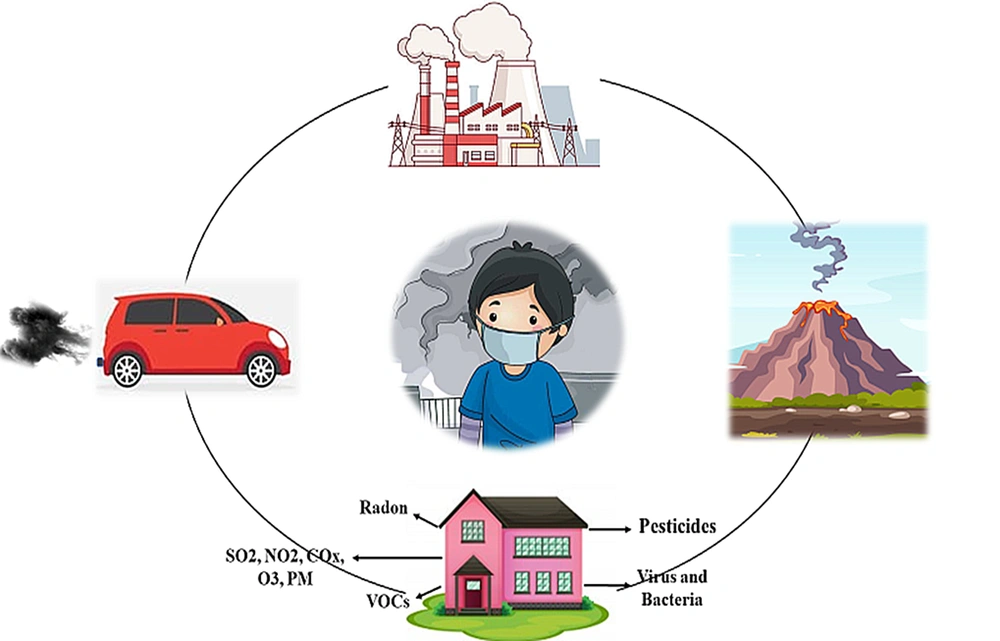
Figure 2.
Sources of air pollutants
3.3. Impact of Various Pollutants on Plant Species
In recent years, air pollution has turned into a general health problem, and one of the solutions to reduce the problems caused by this phenomenon is to plant trees widely in different places so that they can absorb pollution from the environment, resulting in cleaned and refined air (43). Among various environmental challenges; however, air pollution is not a new phenomenon, yet it has serious effects on public health. It is one of the most detrimental factors and worrying threats disrupting life in large cities. Therefore, the first step to reduce air pollution is to accurately identify the pollutants released in the atmosphere and their sources. The next step should be to quickly plan to reduce the release of these particles and gases (43, 47, 48). Different plant species play a key role in reducing environmental pollutants (including NO2 and O3), depending on the spatial pattern and type of planted trees, climatic conditions, and the distance between vegetation and pollutant sources (43). Plant species can reduce the load of environmental air pollution, but this may come at the cost of destructive effects on plants. The impacts of air pollutants on the structure of plant species vary according to their biological traits, but in general, these pollutants disrupt the function of plants and lead to their death at high concentrations. Different types of pollutants have their own unique properties and have diverse effects on trees (7, 49, 50).
The effectiveness of urban green infrastructure strategy in controlling air pollution and improving air quality depends on various factors, including climatic conditions of the region, density and coverage of plant species, and the ability of trees to absorb environmental pollutants (43, 51-53). With the deposition of suspended particles and gaseous pollutants on different parts of trees, these pollutants absorbed through pores on the leaves and leading to different biological reactions (43, 54, 55). In plant ecosystems where pollutants accumulate on the leaves of trees, if air is not exchanged for plant respiration, the life of plants is threatened due to ensuing negative effects (43, 56, 57). Also, some studies have reported that in areas with no vegetation and trees compared to forest areas, open air flow moderates air pollution by increasing the energy kinetic of particles and creating unstable atmospheric conditions secondary to the rapid transference of pollutants (43). Figure 3 shows the effects of pollutants on the plant environment.
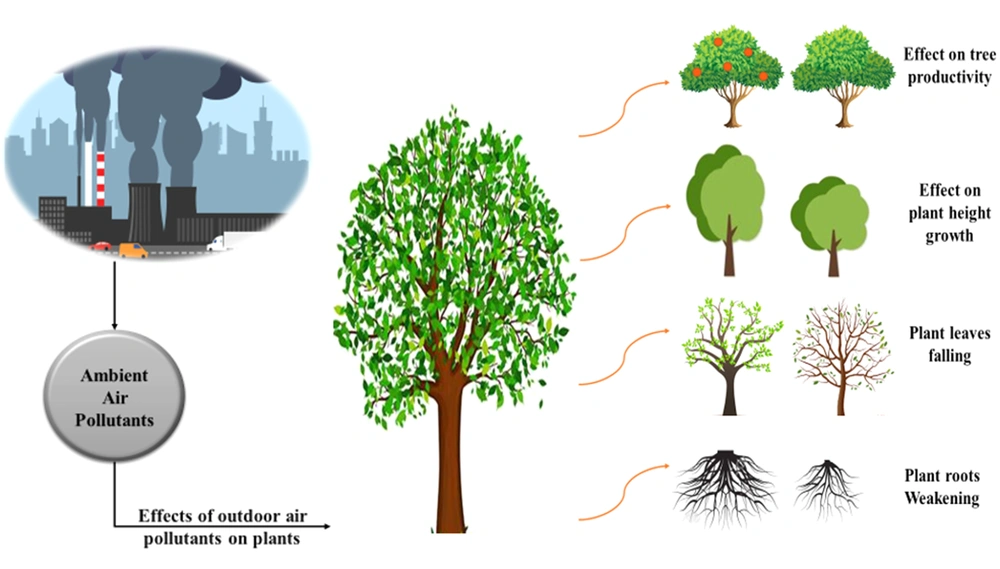
Figure 3.
Effects of pollutants on the plant environment
3.4. Purification or Removal of Pollutants
Unfortunately, with the expansion of societies (urbanization) and industrialization, the environment is being severely destroyed. Therefore, tree planting infrastructure has acquired the attention of planners to control the environmental challenges caused by industrialization and to reduce air pollution at a low cost (17, 58-60). Green spaces and artificial forests created by city officials in different areas include a collection of trees and shrubs to suit the climate, soil, and water of the region, helping control the hazards of pollutant emissions and improving air quality (13, 61). Urban green spaces should be designed according to the technical characteristics of trees (i.e., height, crown shape, type of roots and leaves, resistance to heat and cold, ecological conditions, applications, etc.), and it should be noted that all these features depend on the weather condition of different seasons during the year where trees also change, including leafing, with the change of seasons (13). One way to use trees for air purification is to plant evergreen trees (i.e., trees that have leaves for several years) instead of deciduous trees (i.e., those that lose their leaves during a part of the year) (13).
Although PM10 and PM2.5 are trapped by large leaf stomata, leading to a reduction in their concentration in the atmosphere, the continuous absorption of these particles causes substantial damage to plants (20, 58, 62). For more than a century, lichens have been used to measure air pollution based on the coexistence of algae and fungi and their ability to ascertain the concentration of pollutants. Lichens absorb pollutants through air, providing a desirable criterion for determining air quality index (10, 63, 64).
Research has shown that while urban green spaces and trees planted in order to purify urban polluted air can remove primary and secondary pollutants, but for various reasons, city officials do not employ this strategy as a routine procedure (43). For example, air entrapment among the trees planted, especially under tree canopies, in highly polluted areas may increase the local concentration of PAHs compared to the surrounding environment. On the other hand, lower levels of O3 have been detected in urban forests compared to areas without tree coverage, indicating the deposition and uptake of O3 by trees, reducing the negative impacts of this pollutant on public health (43). Finally, it should be noted that quantifying the capacity of trees planted in urban green spaces for the uptake of pollutants is difficult, requiring developing evaluation models (56, 58, 65). Figure 4 shows the benefits of planted areas in reducing pollutants.
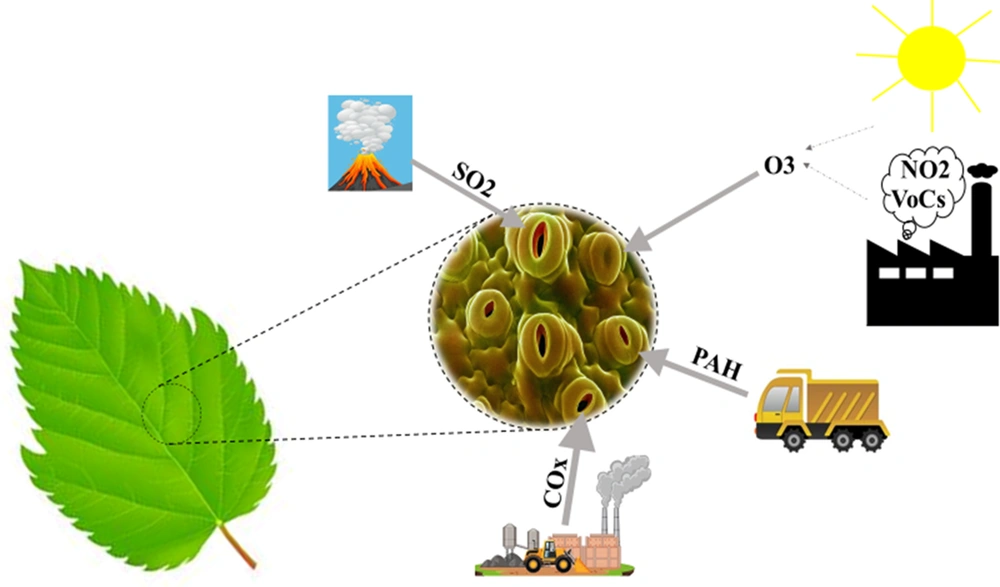
Figure 4.
Benefits of plant areas in the reduction of pollutants
The factors affecting the growth or deterioration of trees and shrubs in urban green spaces depend on the concentration and type of air pollutants, the condition and type of soil, possible mechanical damages of trees (such as broken branches and damaged skin), the ambient temperature, and the growth space of trees (66-69). Evergreen plants have attracted the attention of officials due to their adaptability to tropical climates and resistance to drought, environmental stress (such as salty and dry soil with poor drainage), and air pollution (70, 71). Table 2 shows outdoor air pollutants and their effects on human health.
Table 2.
Outdoor Air Pollutants and Their Effects on Human Health
| Effects | Pollutants | References |
|---|---|---|
| Cardiopulmonary diseases; cardiac arrhythmia; decreased lung function | PM | (29, 35) |
| Bronchitis; asthma | O3 | (38) |
| Airway inflammation; eye irritation | NO2 | (36) |
| Respiratory diseases | SO2 | (42) |
| Carcinogenicity; mutagenicity | PAH | (43) |
| Cardiovascular diseases; nervous system diseases; Pulmonary dysfunction; increased risk of cancer | HMs | (46) |
4. Conclusions
As mentioned, one of the benefits of trees in cities is the absorption of pollutants. However, one should consider environmental conditions to plant suitable tree species. One of the social and environmental benefits of forests is air pollution reduction. Therefore, if trees are planted near pollutant sources, they will be more capable of absorbing pollutants. Due to growing human populations in urban areas, the rate of premature deaths due to air pollution is expected to rise, imposing significant social and economic costs. Therefore, nature-based solutions are necessary to reduce the effects of pollution in urban areas. Our purpose here was to explore the benefits of plant remediation in neutralizing gaseous pollutants and particles produced by industries, machines, and other man-made polluting activities. In addition to reducing air pollution, the use of plants and trees can beautify the environment and improve the air temperature.