
1. Background
Road traffic accidents and the resulting injuries and fatalities remain a major global public health challenge. These incidents threaten human life and impose substantial economic and social burdens on communities and health care systems. Road traffic accidents are currently considered among the leading causes of death worldwide and rank as the ninth cause of mortality (1, 2). The occurrence of road traffic accidents is influenced by multiple factors, including driver-related characteristics, vehicle conditions, and environmental circumstances such as weather and road quality. Various epidemiological determinants, including poorly maintained or outdated vehicles, reckless or high-speed driving, driving under the influence of alcohol, hazardous road conditions, adverse weather, and inadequate lighting, contribute to accidents. Identifying and analyzing these factors can help elucidate the underlying causes of traffic accidents and inform the development of effective preventive strategies (3).
Road traffic injuries are also a major contributor to hospital admissions and place considerable pressure on health care resources (4). Studies conducted in several countries, including the United States, have examined the role of three main components in traffic accidents: human factors, road and environmental conditions, and vehicle-related issues. The findings indicate that human error is involved in approximately 93% of accidents, whereas road-related factors and vehicle defects contribute to about 34% and 20% of cases, respectively (5). Similarly, other studies have reported that driver-related factors account for nearly 90% of road traffic accidents.
Despite improvements in road safety measures, Iran continues to experience a high rate of traffic accidents. In many cases, inadequate adherence to safety regulations and risky driving behaviors contribute to the increasing number of accidents. According to the Iranian Forensic Medicine Organization, 16,947 individuals lost their lives in traffic accidents in 2019 (6). Global statistics also indicate that road traffic accidents cause approximately 3000 deaths each day worldwide and that a considerable proportion of injured individuals eventually die from their injuries (7, 8). Analyses of traffic accidents in Iran consistently identify human factors as the most important contributor to these incidents. In many cases, improper or unsafe driving behavior is considered the primary cause of vehicle crashes. Driving involves a complex and dynamic set of actions that require constant control, decision-making, and interaction with the surrounding environment (9, 10).
Driving behavior refers to the patterns and actions drivers adopt while operating a vehicle, including speed selection, level of concentration, and maintaining a safe distance from other vehicles (11). Individual behavioral tendencies are often shaped by personality traits, which influence how people respond in different situations. Research has shown that personality characteristics can affect driving behavior and may increase the likelihood of violating traffic regulations. In some cases, such behaviors satisfy personal psychological needs, even though they conflict with traffic laws and safety standards (12).
Several external and situational factors may also influence driving behavior, including traffic density, driving skills, vehicle control in relation to other road users, and driving time, whether during the day or at night. These factors can lead to differences in driving patterns between private and professional drivers (13, 14). Numerous studies conducted both internationally and in Iran have examined behavioral determinants of traffic accidents. For example, a study conducted in Azarshahr in 2019 reported that vehicle skidding was one of the most significant contributors to traffic accidents. In addition, demographic variables such as gender, age, education level, and driving time were found to play important roles in accident occurrence. The authors emphasized the importance of educational programs aimed at improving drivers' attitudes and behaviors.
Similarly, a study conducted in Hamedan in 2020 found significant associations between the severity of traffic injuries and age, gender, educational level, driving experience, and daily driving duration. The findings suggested that sociodemographic characteristics are closely related to driving behavior and may influence the likelihood of traffic accidents and the severity of the resulting injuries. Based on these results, the researchers highlighted the need for targeted interventions aimed at improving driving behavior among drivers (15).
2. Objectives
Given the increasing burden of traffic accidents and their consequences, as well as the paucity of comparable studies in our region, this study was designed to investigate the frequency of high-risk behaviors among accident-involved drivers hospitalized at Imam Khomeini Hospital in Urmia during 2021 - 2022.
3. Methods
3.1. Study Design and Setting
This descriptive-analytical study was conducted among drivers involved in road traffic accidents who were admitted to Imam Khomeini Hospital in Urmia during 2021 - 2022. A census sampling strategy was used; therefore, all eligible drivers hospitalized during the study period were included.
3.2. Participants
The inclusion and exclusion criteria were defined before data collection. The primary inclusion criterion was hospitalization after a traffic accident while driving. Cases with incomplete or insufficient medical records were excluded.
3.3. Data Collection and Variables
Data were collected using a structured checklist developed for this study. The checklist included demographic variables, including age, sex, marital status, educational level, and occupation. In addition, several driving-related behaviors were assessed, including seat belt use, mobile phone use while driving, listening to music while driving, and consumption of alcohol or drugs before driving. Information on the severity of injuries resulting from the accident was also recorded.
Based on the Road Traffic Injury classification, accident severity was categorized into three groups: drivers involved in accidents without physical injury, drivers with moderate injuries requiring hospitalization for more than 24 hours, and drivers with severe or fatal injuries (16).
3.4. Statistical Analysis
After data collection was completed, all data were entered into SPSS version 18 for statistical analysis. Descriptive statistics, including the mean and standard deviation for quantitative variables and the frequency and percentage for categorical variables, were used to summarize the data. Analytical tests, including the chi-square test and the independent t-test, were used to evaluate associations between variables.
4. Results
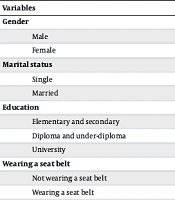
In this study, the mean age of the drivers was 42.07 ± 14.83 years. Most participants were male (556, 76.8%) and married (487, 67.3%). Regarding educational level, 312 participants (43.1%) had a diploma or a lower level of education. Regarding driving behaviors, 502 drivers (69.3%) reported wearing seat belts, 470 (64.9%) did not use mobile phones while driving, and 418 (57.7%) did not listen to music while driving. Furthermore, 592 participants (81.8%) reported no alcohol consumption, and 611 (84.4%) reported no drug use. In addition, 390 cases (53.9%) involved accidents without injuries (Table 1).
Table 1.
Demographic Characteristics of the Study Participants
| Variables | Frequency | Percentage |
|---|---|---|
| Gender | ||
| Male | 556 | 76.8 |
| Female | 168 | 23.2 |
| Marital status | ||
| Single | 237 | 32.7 |
| Married | 487 | 67.3 |
| Education | ||
| Elementary and secondary | 188 | 26 |
| Diploma and under-diploma | 312 | 43.1 |
| University | 224 | 30.9 |
| Wearing a seat belt | ||
| Not wearing a seat belt | 222 | 30.7 |
| Wearing a seat belt | 502 | 69.3 |
| Using a mobile phone | ||
| Used a mobile phone | 254 | 35.1 |
| Did not use a mobile phone | 470 | 64.9 |
| Listening to music | ||
| Listened to music | 306 | 42.3 |
| Did not listen to music | 418 | 57.7 |
| Consuming alcohol | ||
| Drank alcohol before driving | 132 | 18.2 |
| Did not drink alcohol before driving | 592 | 81.8 |
| Consuming drugs | ||
| Used drugs before driving | 113 | 15.6 |
| Did not use drugs before driving | 611 | 84.4 |
| Accident severity | ||
| Accident without injury | 390 | 53.9 |
| Moderate accident | 210 | 29 |
| Severe collision | 124 | 17.1 |
The results indicated a significant association between injury severity and age (P = 0.001), with the mean age being lower among drivers involved in severe accidents (Table 2).
Table 2.
Relationship Between Accident Severity and Age of Drivers Hospitalized at Imam Khomeini Hospital, Urmia
| Injury severity | Mean Age ± SD | Minimum | Maximum | P-Value |
|---|---|---|---|---|
| Non-injury accident | 45.18 ± 14.74 | 18 | 78 | 0.001 |
| Moderate accident | 41.12 ± 15.14 | 18 | 73 | 0.001 |
| Severe accident | 34.02 ± 10.89 | 18 | 63 | 0.001 |
| Total patients | 42.07 ± 14.83 | 18 | 78 | 0.001 |
Accident severity was significantly associated with gender, with male drivers experiencing severe accidents more frequently (P = 0.018) (Table 3).
Table 3.
Relationship Between Accident Severity and Gender of Drivers Hospitalized at Imam Khomeini Hospital, Urmia a
| Variables | Accident without Injury | Moderate Accident | Severe Accident | P-Value |
|---|---|---|---|---|
| Male | 282 (50.7) | 158 (28.4) | 116 (20.9) | 0.018 |
| Female | 107 (63.7) | 52 (31) | 9 (5.4) | 0.018 |
| Total drivers | 389 (53.7) | 210 (29) | 125 (17.3) | - |
a Values are expressed as No. (%).
Accident severity was significantly associated with marital status, with single drivers being more likely to experience severe accidents (P = 0.024) (Table 4).
Table 4.
Relationship Between Accident Severity and Marital Status of Drivers Hospitalized at Imam Khomeini Hospital a
| Variables | Accident without Injury | Moderate Accident | Severe Accident | P-Value |
|---|---|---|---|---|
| Single | 118 (49.8) | 43 (18.1) | 76 (32.1) | 0.024 |
| Married | 271 (55.6) | 167 (34.3) | 49 (10.1) | 0.024 |
| Total drivers | 389 (53.7) | 210 (29) | 125 (17.3) | - |
a Values are expressed as No. (%).
Accident severity was significantly associated with educational level, with drivers with lower levels of education being more likely to experience severe accidents (P = 0.035) (Table 5).
Table 5.
Relationship Between Accident Severity and Educational Level of Drivers Admitted to Imam Khomeini Hospital a
| Variables | Accident without Injury | Moderate Accident | Severe Accident | P-Value |
|---|---|---|---|---|
| Elementary | 65 (34.6) | 64 (34) | 59 (31.4) | 0.035 |
| Diploma and sub-diploma | 166 (53.2) | 97 (31.1) | 49 (15.7) | 0.035 |
| University | 158 (70.5) | 49 (21.9) | 17 (7.6) | 0.035 |
| Total drivers | 389 (53.7) | 210 (29) | 125 (17.3) | - |
a Values are expressed as No. (%).
5. Discussion
Road traffic accidents and the associated injuries and fatalities remain a major global public health challenge. These incidents threaten human health and impose substantial economic burdens on societies and health care systems. Road traffic accidents are recognized as one of the leading causes of death worldwide and rank as the ninth leading cause of mortality (17, 18).
In the present study, the mean age of drivers was 42.07 ± 14.83 years. Most participants were male (556, 76.8%) and married (487, 67.3%), and 312 individuals (43.1%) had a diploma or lower level of education. Regarding driving behaviors, 502 drivers (69.3%) reported wearing seat belts, 470 (64.9%) reported not using mobile phones while driving, and 418 (57.7%) reported not listening to music while driving. In addition, 592 drivers (81.8%) reported no alcohol consumption and 611 (84.4%) reported no drug use. More than half of the accidents (390 cases, 53.9%) occurred without physical injuries. Furthermore, a significant relationship was observed between injury severity and demographic variables, including age, gender, marital status, and educational level.
In a study conducted in 2019 in Azarshahr, the occurrence of traffic accidents among drivers showed significant associations with gender, age, education, type of vehicle, driving time, and place of residence. The findings indicated that demographic factors such as gender, age, education, and driving time play an important role in accident occurrence, highlighting the importance of educational interventions and training programs aimed at improving drivers' attitudes and behaviors. Consistent with these findings, the present study also demonstrated a significant relationship between accident severity and drivers' age, gender, and educational level.
Similarly, another study in Hamedan and reported that the highest and lowest mean percentages of abnormal driving behaviors were related to unintentional violations (19.13%) and errors (16.44%), respectively. Behaviors such as listening to music while driving, overtaking slow drivers, and unintentional speeding were identified as factors associated with road traffic injuries. The study also found significant relationships between the severity of traffic injuries and age, gender, education level, driving experience, and daily driving hours. The authors concluded that sociodemographic characteristics are closely related to driving behavior and that behavioral factors contribute significantly to traffic accidents and resulting injuries. Therefore, these findings may help in designing effective interventions aimed at improving driving behaviors among drivers (15). In line with these results, our study also found that listening to music while driving was one of the risky behaviors, with 42.3% of drivers reporting this behavior, and that accident severity was significantly associated with age, gender, and education.
In another study by Azad et al. in 2015, a significant association was observed between intentional traffic violations and age group. The study also showed that intentional violations were more common among private bus drivers, while slips and errors were more frequently observed among government bus drivers, indicating a significant relationship between behavioral factors and vehicle ownership type. In addition, individuals with a history of two accidents in the past 3 years demonstrated higher levels of intentional and unintentional violations as well as slips (P = 0.004). The authors concluded that behavioral factors such as age, vehicle ownership type, and accident history play a substantial role in the occurrence of traffic accidents (19). Consistent with this finding, the present study also identified a significant relationship between accident severity and drivers' age (P = 0.001).
A study conducted by Youssef et al. in 2023 in Lebanon found that older age and female gender were negatively associated with aggressive driving offenses. In contrast, being a professional driver and having higher annual driving mileage were positively associated with aggressive driving behavior (10). Higher levels of education were associated with a lower likelihood of committing traffic violations, while increased driving experience was related to a greater tendency toward aggressive offenses. In addition, driver anger triggered by factors such as hostile gestures, rudeness, police presence, and slow driving was positively associated with aggressive driving behaviors. Traffic congestion and emotional reactions were also linked to increased driving errors. The authors emphasized the importance of driver education and coping strategies to reduce aggressive and deviant driving behaviors (19). Similar to the findings of that study, the present research also demonstrated that risky behaviors and accident severity were more common among males (P = 0.018), younger drivers (P = 0.001), and drivers with lower educational levels (P = 0.035).
In a 2022 study by Alhomoud et al. in Saudi Arabia, traffic accidents were reported by 26.4% of young male drivers and 19.3% of young female drivers. Male drivers exhibited more aggressive driving patterns and higher rates of speeding compared with female drivers. In addition, driving experience, vehicle type, traffic violations, mobile phone use while driving, and distraction-related factors were identified as predictors of traffic crashes (20). In line with these findings, the present study also identified mobile phone use while driving as one of the risky behaviors, with 35.1% of drivers reporting this behavior, and higher accident severity was observed among young male drivers.
A 2022 study conducted in Hong Kong by Zhang et al. found that age, gender, lighting conditions, and weather did not independently affect the likelihood of driver-fault crashes or severe crash outcomes among drivers from Hong Kong and Macau traveling in mainland China. However, when combined with factors such as vehicle type, road characteristics, and environmental conditions, these variables could influence crash risk. The authors suggested that improving driver education, road infrastructure, safety campaigns, and traffic management policies could help reduce risky driving behaviors and traffic-related injuries (17). In contrast to those findings, the present study demonstrated that driver age and gender were significantly associated with accident severity and fatal outcomes.
Finally, a 2016 study by Mekonnen et al. in Ethiopia reported that monthly income, driving experience, annual mileage, and previous crash history were significantly related to risky driving behaviors among professional drivers. The authors suggested that risky driving behavior is relatively common among professional drivers and recommended that policymakers consider factors such as working conditions, driving experience, and workload when designing strategies to reduce traffic accidents. They also emphasized the importance of learning from previous accident experiences and reducing excessive driving mileage to minimize risk (18).
5.1. Conclusions
According to the findings of this study, most accident-involved drivers were male and had lower levels of education. Therefore, implementing educational and cultural programs aimed at promoting the use of safety measures, such as seat belts for car occupants and helmets for motorcyclists, along with increasing public awareness through mass media, may contribute to reducing the incidence of traffic accidents.