
Entrepreneurial Intention, Awareness, Facilitators, and Barriers Among Healthcare Providers in Saudi Arabia: A Cross-sectional Study

Author(s):
Mohammed AlnuhaitMohammed AlnuhaitMohammed Alnuhait ORCID1,*, Tariq AlqahtaniTariq Alqahtani2, Refal FagiehaRefal Fagieha3, Rahaf Yousef AliRahaf Yousef Ali3, Naif AljehaniNaif Aljehani3, Nada AlsuhebanyNada Alsuhebany4, 5, 6, Mohammed Abdulelah AlotaibiMohammed Abdulelah Alotaibi3, Abdulmalik AlotaibiAbdulmalik Alotaibi3, Abdulfattah AlhazmiAbdulfattah Alhazmi3
1Department of Clinical Pharmacy, College of Pharmacy, Shaqra University, Al-Dawadmi Campus, Al-Dawadmi, Saudi Arabia
2Department of Preclinical Studies, Benefit and Risk Assessment Executive Directorate Drug Sector - Saudi Food and Drug Authority, Riyadh, Saudi Arabia
3Department of Pharmaceutical Practices, College of Pharmacy, Umm Al-Qura University, Makkah, Saudi Arabia
4King Abdullah International Medical Research Center, Riyadh, Saudi Arabia
5Department of Pharmacy Practice, College of Pharmacy, King Saud bin Abdulaziz University for Health Sciences, Riyadh, Saudi Arabia
6Department of Pharmaceutical Care Services, King Abdulaziz Medical City, Ministry of National Guard Health Affairs, Riyadh, Saudi Arabia
*Corresponding Author: Department of Clinical Pharmacy, College of Pharmacy, Shaqra University, Al-Dawadmi Campus, Al-Dawadmi, Saudi Arabia. Email: [email protected]

Health Scope:Vol. 15, issue 3; e172444
Published online:Jul 18, 2026
Article type:Research Article
Received:May 31, 2026
Accepted:Jul 13, 2026
How to Cite:Alnuhait M, Alqahtani T, Fagieha R, Yousef Ali R, Aljehani N, et al. Entrepreneurial Intention, Awareness, Facilitators, and Barriers Among Healthcare Providers in Saudi Arabia: A Cross-sectional Study. Health Scope. 2026;15(3):e172444. doi: https://doi.org/10.5812/healthscope-172444

Abstract

Background:

Healthcare entrepreneurship is increasingly relevant to the transformation of the Saudi healthcare system, private-sector participation, digital health, and innovation. However, evidence regarding healthcare providers’ entrepreneurial intentions, awareness, and perceived facilitators and barriers in Saudi Arabia remains limited.

Objectives:

This study assessed entrepreneurial intention, awareness, perceived facilitators, motivators, and barriers among healthcare providers in Saudi Arabia and examined factors associated with entrepreneurial readiness and willingness.

Methods:

A cross-sectional online survey was conducted in November 2023 among 435 healthcare providers working in Saudi Arabia. Participants were recruited through convenience sampling, and the bilingual questionnaire was distributed electronically via professional networks and social media platforms, including LinkedIn and X/Twitter. Descriptive statistics were used to summarize the findings, and Mann-Whitney U and Kruskal–Wallis tests were used to examine factors associated with entrepreneurial readiness and willingness scores.

Results:

Among 435 participants, 82.8% reported interest in entrepreneurship, 76.3% believed that healthcare providers could become entrepreneurs, and 72.2% had considered starting a healthcare-related business. However, only 32.9% were familiar with entrepreneurship concepts, 35.6% had completed entrepreneurship courses, and 6.2% had started a healthcare-related business. The mean entrepreneurial readiness and willingness score was 3.94 ± 0.72 out of 5. Entrepreneurial readiness and willingness scores were significantly higher among female participants than among male participants (4.05 ± 0.64 vs. 3.85 ± 0.77; P = 0.004) and differed significantly across professional groups (P < 0.001). Higher scores were also associated with interest in entrepreneurship, prior entrepreneurship education, institutional support, and previous healthcare-related business experience (all P < 0.001).

Conclusions:

Among surveyed healthcare providers in Saudi Arabia, entrepreneurial interest was high; however, the establishment of healthcare-related businesses remained uncommon. This intention–implementation gap underscores the need for structured entrepreneurship education, institutional support for innovation, mentorship, regulatory guidance, and access to funding or incubation pathways within the Saudi healthcare system.

Highlights

1. Background

Entrepreneurship has become a key driver of innovation, job creation, and service development across diverse sectors. In healthcare, entrepreneurship can support new care models, digital health solutions, patient-centered services, and more efficient systems of care. Healthcare providers are well positioned to identify unmet clinical needs because of their direct contact with patients, workflows, and system-level challenges. However, translating clinical ideas into sustainable healthcare ventures requires business knowledge, institutional support, regulatory awareness, mentorship, and access to funding (1-4). In Saudi Arabia, healthcare entrepreneurship is particularly relevant because of the ongoing transformation of the healthcare system under Vision 2030 and the Health Sector Transformation Program (5). These reforms emphasize service efficiency, private-sector participation, digital health, preventive care, and improved patient experience. The expansion of public-private partnerships and the increasing focus on innovation create opportunities for healthcare providers to contribute beyond traditional clinical roles (6, 7). However, healthcare entrepreneurship in Saudi Arabia may also be affected by regulatory complexity, limited entrepreneurial training among health professionals, uncertainty regarding funding pathways, and limited institutional mechanisms for converting clinical ideas into scalable services.
Despite increasing attention to entrepreneurship in Saudi Arabia, evidence regarding entrepreneurial readiness among practicing healthcare providers remains limited. In particular, it is unclear whether healthcare providers are familiar with entrepreneurship concepts, whether they are willing to engage in entrepreneurial activities, what facilitators and barriers they perceive, and which educational or institutional factors are associated with greater entrepreneurial willingness. Existing evidence has often focused on students or single professional groups, whereas multi-professional data from practicing healthcare providers remain limited (8-11). Addressing this gap is important because healthcare providers may play a direct role in identifying and implementing innovative solutions within the Saudi healthcare system.

2. Objectives

Therefore, this study aimed to assess entrepreneurial intention, awareness, perceived facilitators, motivators, and barriers among healthcare providers in Saudi Arabia. It also aimed to examine demographic, professional, educational, and institutional factors associated with entrepreneurial readiness and willingness.

3. Methods

3.1. Study Design and Recruitment

This cross-sectional online survey was conducted among healthcare providers in Saudi Arabia in November 2023. A convenience sampling approach was used. The survey link was distributed electronically through professional networks and social media platforms, including LinkedIn and X/Twitter. Participation was voluntary, and no personal identifiers were collected. Because the survey was distributed via an open online link, the total number of individuals who received or viewed the invitation could not be determined; therefore, a response rate could not be calculated.
The questionnaire was developed and administered using Google Forms. The survey was available in Arabic and English and targeted healthcare providers and healthcare interns or trainees working in, or undertaking formal professional training in, various healthcare settings across Saudi Arabia. Ethical approval was obtained from the Institutional Review Board of Umm Al-Qura University (approval number: HAPO-02-K-012 - 2023 - 11 - 1847).

3.2. Eligibility Criteria

Eligible participants included physicians, pharmacists, dentists, nurses, allied healthcare professionals, and healthcare interns or trainees. Participants were required to be working or undertaking formal professional healthcare training in Saudi Arabia during the study period, be able to complete the questionnaire in Arabic or English, and provide electronic informed consent. Individuals were excluded if they were not healthcare providers or healthcare interns/trainees, were not working or undertaking formal healthcare training in Saudi Arabia during the study period, declined to provide informed consent, or submitted an incomplete questionnaire.

3.3. Questionnaire Development and Validation

The questionnaire was developed by the research team based on a review of the relevant literature and input from experts in healthcare and entrepreneurship-related fields (8, 9, 12). It was not adapted from a single previously validated instrument. The initial item pool was designed to capture demographic characteristics, professional background, entrepreneurship awareness, previous entrepreneurial exposure, perceived motivators, perceived facilitators, barriers, and willingness to become an entrepreneur. The questionnaire comprised 30 items. The entrepreneurial readiness and willingness section consisted of 13 statements assessed using a five-point Likert scale ranging from 1 = strongly disagree to 5 = strongly agree. Face validity was assessed by the research team to ensure clarity, relevance, and appropriateness of the survey items for healthcare providers in Saudi Arabia. The Arabic and English versions were reviewed for consistency and clarity before distribution. A pilot test was conducted among 10 healthcare providers, and their feedback was used to refine the wording and improve item clarity. Internal consistency of the 13-item entrepreneurial readiness and willingness scale was assessed using Cronbach’s alpha. The scale demonstrated good internal consistency, with a Cronbach’s alpha of 0.85.

3.4. Sample Size Calculation

The required sample size was calculated using the single-proportion formula: n = Z2 × p × (1 − p) / d2, where Z = 1.96 for a 95% confidence level, P = 0.50 because the expected level of entrepreneurship awareness among healthcare providers was unknown, and d = 0.05 for a 5% margin of error. This calculation yielded a minimum required sample size of 384 participants. Although the minimum required sample size was 384, the survey remained open until the end of the planned recruitment period, and 435 complete responses were received and included in the final analysis. All complete responses received during the planned recruitment period were included to improve the precision of the estimates.

3.5. Statistical Analysis

Data were extracted into Microsoft Excel and analyzed using IBM SPSS Statistics version 25.0. Categorical variables were summarized using frequencies and percentages. Continuous variables were summarized using the mean ± standard deviation or the median and interquartile range, as appropriate. The entrepreneurial readiness and willingness score was calculated as the mean of the 13 Likert-scale items among participants who completed all items, with higher scores indicating greater entrepreneurial readiness and willingness. The possible score ranged from 1 to 5. Because the score was derived from Likert-scale items and the distribution was not assumed to be normal, nonparametric tests were used. Mann-Whitney U tests were used for comparisons between two groups, and Kruskal–Wallis tests were used for comparisons among more than two groups. Because only complete questionnaires were included, there were no missing data in the analyzed dataset. A P value < 0.05 was considered statistically significant.

4. Results

A total of 435 complete responses were included in the final analysis. Because the questionnaire was distributed via an open online link, the number of individuals who received or viewed the invitation could not be determined; therefore, the response rate could not be calculated. Incomplete responses were excluded from the analysis. The mean age was 35.25 ± 8.53 years, and 55.4% of participants were male. Most participants were Saudi nationals (80.2%). Physicians represented the largest professional group (46.7%), followed by pharmacists (25.7%) and dentists (24.1%). Nurses accounted for only 0.5% of the sample. Most participants worked in the government sector (63.0%), and the median years of experience was 7 years. Participant characteristics are shown in Table 1.
Table 1.Sociodemographic and Professional Characteristics of Participants (N = 435) a
CharacteristicValue
Age (y)
Mean ± SD35.25 ± 8.53
Median (IQR)34 (30 - 40)
Gender
Male241 (55.4)
Female194 (44.6)
Nationality
Saudi349 (80.2)
Non-Saudi86 (19.8)
Highest qualification/professional training status
Bachelor’s degree283 (65.1)
Master’s degree77 (17.7)
MBA10 (2.3)
PhD57 (13.1)
Healthcare intern/trainee8 (1.8)
Work region
Central94 (21.6)
Eastern54 (12.4)
Northern67 (15.4)
Southern65 (14.9)
Western155 (35.6)
Profession
Physician203 (46.7)
Pharmacist112 (25.7)
Dentist105 (24.1)
Allied healthcare professional/specialist13 (3.0)
Nurse2 (0.5)
Type of institution
Government sector274 (63.0)
Private sector161 (37.0)
Healthcare experience (y)
Mean ± SD7.94 ± 6.63
Median (IQR)7 (3 - 11)

a Values are expressed as No. (%) unless otherwise indicated. Abbreviations: SD, standard deviation; IQR, interquartile range.

4.1. Attitudes and Awareness of Entrepreneurship in Saudi Arabia

Most participants were interested in entrepreneurship (82.8%) and believed that healthcare providers could become entrepreneurs (76.3%). However, only 32.9% were familiar with entrepreneurship terms and concepts, 35.6% had taken entrepreneurship courses, and 6.2% had started a healthcare-related business. In addition, 74.3% reported a willingness to join an entrepreneurship-support program, and 76.6% believed that entrepreneurship education could broaden career choices in healthcare (Table 2).
Table 2.Entrepreneurship Awareness, Exposure, and Attitudes Among Participants a
ItemsNo. (%)
Have you ever participated in entrepreneurial activities within the healthcare sector?
No289 (66.4)
Yes146 (33.6)
Are you interested in entrepreneurship?
No75 (17.2)
Yes360 (82.8)
Do you think a healthcare provider can become an entrepreneur?
I do not know48 (11.0)
No55 (12.6)
Yes332 (76.3)
Are you familiar with entrepreneurship terms and concepts?
I do not know85 (19.5)
No207 (47.6)
Yes143 (32.9)
Have you ever taken courses in entrepreneurship?
I do not know47 (10.8)
No233 (53.6)
Yes155 (35.6)
If an entrepreneurship-support program were available, would you consider joining it or pursuing it as an additional qualification, such as a master’s degree?
I do not know44 (10.1)
No68 (15.6)
Yes323 (74.3)
Does your institution support entrepreneurs?
I do not know171 (39.3)
No81 (18.6)
Yes183 (42.1)
Would you think about starting a business in the healthcare field?
I do not know53 (12.2)
No68 (15.6)
Yes314 (72.2)
Would you think about starting a business in another field?
I do not know77 (17.7)
No74 (17.0)
Yes284 (65.3)
Have you ever started a healthcare-related business?
No408 (93.8)
Yes27 (6.2)
Do you think entrepreneurship education can broaden career choices in the healthcare field?
I do not know61 (14.0)
No41 (9.4)
Yes333 (76.6)
Which of the following factors could improve the awareness of healthcare entrepreneurship in Saudi Arabia?
Social media345 (79.3)
Online courses350 (80.5)
Offer entrepreneurship education as a stand-alone course in higher education302 (69.4)
Add entrepreneurship education as a topic to existing higher-education courses268 (61.6)

a Participants could select more than one response for the item assessing factors that could improve awareness; therefore, percentages for that item do not total 100%.

4.2. Characteristics, Skills, Facilitators, and Barriers of Healthcare Entrepreneurship

The most frequently selected characteristics of healthcare entrepreneurs were willingness to take risks (72.2%), creativity and unconventional thinking (68.5%), project management ability (65.7%), and the ability to open new markets or sources of resources (65.5%). The most commonly selected skills were business management skills (71.3%), financial skills (71.0%), communication skills (68.7%), critical thinking skills (66.9%), and analytical/problem-solving skills (66.2%). The most frequently reported facilitators were a supportive healthcare ecosystem and networks (64.6%), mentorship and guidance (63.2%), and access to funding and investment opportunities (57.7%) (Table 3). The most commonly reported barriers were inadequate entrepreneurship education and training, resistance to change within the healthcare system, financial management challenges, lack of awareness of entrepreneurial opportunities, and lack of funding or investment (Figure 1).
Table 3.Perceived Characteristics, Required Skills, and Facilitators of Healthcare Entrepreneurship a
ItemsNo. (%)
In your opinion, what are the characteristics of an entrepreneur in the healthcare field? (Select all that apply)
Willingness to take risks314 (72.2)
Creativity and unconventional thinking298 (68.5)
Outstanding ability in project management286 (65.7)
Leadership ability269 (61.8)
The ability to open new markets or sources of resources285 (65.5)
Ability to learn from mistakes and experience192 (44.1)
In your opinion, what skills should an entrepreneur acquire? (Select all that apply)
Communication skills299 (68.7)
Business management skills310 (71.3)
Analytical and problem-solving skills288 (66.2)
Critical thinking skills291 (66.9)
Financial skills309 (71.0)
Teamwork and leadership skills261 (60.0)
Customer service skills184 (42.3)
What factors or facilitators encourage healthcare providers to explore entrepreneurship in healthcare? (Select all that apply)
Availability of mentorship and guidance275 (63.2)
Access to funding and investment opportunities251 (57.7)
Supportive healthcare ecosystem and networks281 (64.6)
Personal passion and drive for entrepreneurship243 (55.9)
Recognition and incentives for innovation242 (55.6)
Flexibility within healthcare organizations to explore entrepreneurial initiatives201 (46.2)

a Participants could select more than one response; therefore, percentages do not total 100%.
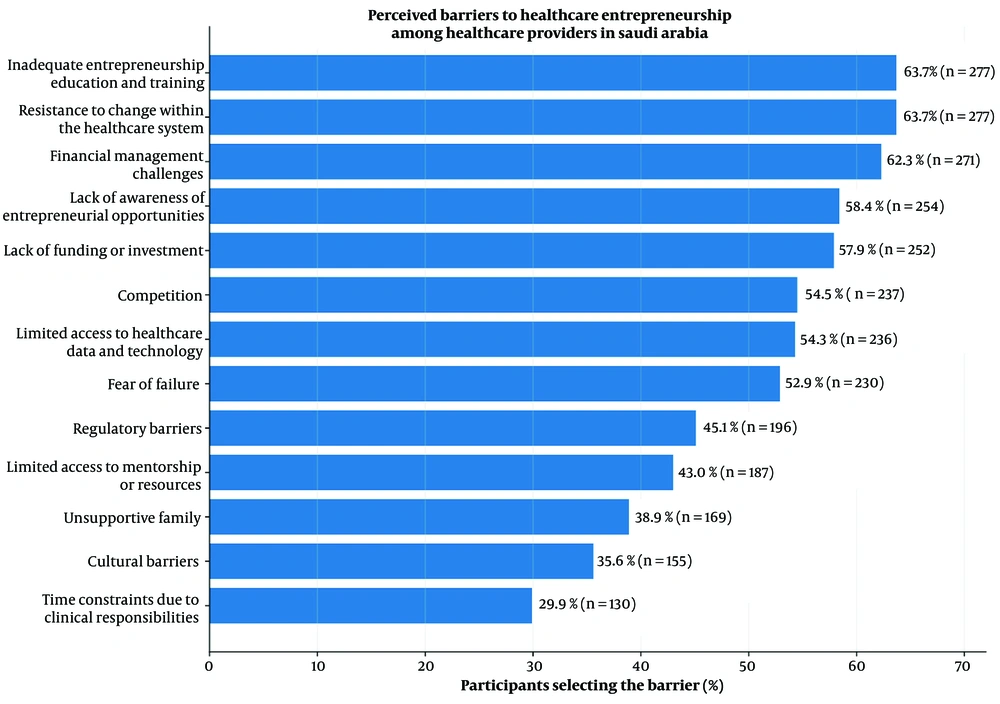
Perceived barriers to healthcare entrepreneurship among healthcare providers.
Figure 1.

Perceived barriers to healthcare entrepreneurship among healthcare providers.

4.3. Entrepreneurial Readiness and Willingness

Improving patient care was identified as a motivation for healthcare entrepreneurship by 73.3% of participants, while 74.5% identified passion for innovation, 72.2% identified professional autonomy, and 63.0% identified financial opportunities. The overall entrepreneurial readiness and willingness score was 3.94 ± 0.72 out of 5. The highest-rated items concerned employer-provided entrepreneurship training, autonomy in work-related decision-making, being the first or best in one’s area of expertise, and prioritizing healthcare entrepreneurship education in Saudi Arabia. The lowest-rated items concerned understanding healthcare entrepreneurship requirements and assessing calculated risks in a healthcare business environment. Participants’ responses to the individual scale items are presented in Tables 4 and 5.
Table 4.Responses to the Entrepreneurial Readiness and Willingness Scale a
ItemsDisagree/Strongly DisagreeNeutralAgree/Strongly AgreeValues
Item 1. I understand the requirements of healthcare entrepreneurship.133 (30.6)130 (29.9)172 (39.5)3.31 ± 1.24
Item 2. I understand how to assess and take calculated risks in a healthcare business environment.146 (33.6)116 (26.7)173 (39.8)3.26 ± 1.22
Item 3. Healthcare entrepreneurship education should be a high priority in Saudi Arabia.53 (12.2)63 (14.5)319 (73.3)4.12 ± 1.13
Item 4. Employers should offer staff training in entrepreneurship.47 (10.8)63 (14.5)325 (74.7)4.17 ± 1.07
Item 5. I have new ideas that I would like to apply in the healthcare field.51 (11.7)78 (17.9)306 (70.3)4.01 ± 1.10
Item 6. I can implement innovative healthcare business solutions to enhance the patient experience and strengthen the business.49 (11.3)81 (18.6)305 (70.1)3.98 ± 1.06
Item 7. I understand that starting and running a business involves facing problems and addressing them when they arise.61 (14.0)111 (25.5)263 (60.5)3.86 ± 1.12
Item 8. When necessary, I am willing to take financial and professional risks.57 (13.1)68 (15.6)310 (71.3)4.01 ± 1.09
Item 9. I believe I would be more financially successful if I ran my own business.49 (11.3)72 (16.6)314 (72.2)4.10 ± 1.07
Item 10. As a healthcare provider, I can see myself starting and running a business.55 (12.6)77 (17.7)303 (69.7)4.03 ± 1.12
Item 11. I know how to improve patient outcomes by creating unique and timely solutions.48 (11.0)77 (17.7)310 (71.3)4.05 ± 1.08
Item 12. I try to be the first or the best in my field of expertise.46 (10.6)67 (15.4)322 (74.0)4.13 ± 1.05
Item 13. I prefer making my own work-related decisions and managing my work tasks.46 (10.6)65 (14.9)324 (74.5)4.15 ± 1.07
Overall entrepreneurial readiness and willingness score3.94 ± 0.72

a Values are expressed as No. (%) or mean ± SD. Responses were measured using a five-point Likert scale ranging from 1 = strongly disagree to 5 = strongly agree. For presentation, strongly disagree and disagree were combined, while agree and strongly agree were combined. Item means and the overall score were calculated using the original five response categories. N = 435.

Table 5.Association Between Participant Characteristics and Entrepreneurial Readiness and Willingness Scores a
VariablesNo.Mean ± SDMedianP Value
Nationality0.096
Non-Saudi863.70 ± 0.984.00
Saudi3494.00 ± 0.634.08
Gender0.004
Female1944.05 ± 0.644.15
Male2413.85 ± 0.774.00
Work region0.441
Central944.05 ± 0.584.15
Eastern543.97 ± 0.894.15
Northern673.85 ± 0.804.08
Southern653.93 ± 0.764.08
Western1553.90 ± 0.684.00
Highest qualification/professional training status0.427
Bachelor’s degree2833.96 ± 0.734.15
Master’s degree773.84 ± 0.774.00
MBA104.17 ± 0.754.04
PhD573.91 ± 0.583.92
Healthcare intern/trainee83.89 ± 0.784.12
Profession< 0.001
Allied healthcare professional/specialist133.86 ± 0.553.77
Dentist1053.42 ± 0.993.62
Nurse24.27 ± 1.034.27
Pharmacist1124.08 ± 0.634.00
Physician2034.13 ± 0.434.23
Type of institution0.980
Government sector2743.98 ± 0.614.08
Private sector1613.87 ± 0.884.08
Previous participation in entrepreneurial activities within healthcare0.490
No2893.88 ± 0.784.15
Yes1464.05 ± 0.594.00
Interest in entrepreneurship< 0.001
No752.93 ± 0.793.00
Yes3604.15 ± 0.504.15
Belief that a healthcare provider can become an entrepreneur< 0.001
I do not know483.14 ± 0.703.31
No553.23 ± 0.923.38
Yes3324.17 ± 0.504.23
Familiarity with entrepreneurship terms and concepts< 0.001
I do not know853.41 ± 0.823.62
No2074.02 ± 0.664.15
Yes1434.14 ± 0.594.15
Previous entrepreneurship courses< 0.001
I do not know473.04 ± 0.803.15
No2333.96 ± 0.664.15
Yes1554.18 ± 0.564.15
Willingness to join an entrepreneurship-support program< 0.001
I do not know442.89 ± 0.782.92
No683.54 ± 0.853.66
Yes3234.17 ± 0.494.23
Institutional support for entrepreneurs< 0.001
I do not know1713.79 ± 0.804.08
No813.74 ± 0.753.85
Yes1834.17 ± 0.544.23
Considering starting a business in healthcare< 0.001
I do not know532.94 ± 0.743.00
No683.55 ± 0.813.62
Yes3144.19 ± 0.484.23
Considering starting a business in another field< 0.001
I do not know773.18 ± 0.783.23
No743.64 ± 0.773.69
Yes2844.22 ± 0.474.23
Previous healthcare-related business experience< 0.001
No4083.90 ± 0.714.08
Yes274.50 ± 0.634.62
Belief that entrepreneurship education broadens career choices in healthcare< 0.001
I do not know613.15 ± 0.783.23
No413.09 ± 0.833.23
Yes3334.19 ± 0.474.23

a Scores were calculated as the mean of the 13 items, with higher scores indicating greater entrepreneurial readiness and willingness. Mann-Whitney U tests were used for variables with two categories, and Kruskal-Wallis tests were used for variables with three or more categories. A P value < 0.05 was considered statistically significant. The analyses were unadjusted, and statistically significant findings should be interpreted cautiously because multiple comparisons were performed. Profession-specific comparisons should be interpreted cautiously because some categories, particularly nurses, included very small numbers of participants.
In unadjusted analyses, entrepreneurial readiness and willingness scores were significantly higher among female participants than among male participants (4.05 ± 0.64 vs. 3.85 ± 0.77; P = 0.004). Scores also differed significantly across professional groups (P < 0.001), although profession-specific comparisons should be interpreted cautiously because some groups, particularly nurses, had very small sample sizes. Higher entrepreneurial readiness and willingness scores were also observed among participants who were interested in entrepreneurship, believed that healthcare providers could become entrepreneurs, were familiar with entrepreneurship concepts, had taken entrepreneurship courses, were willing to join entrepreneurship-support programs, reported institutional support, considered starting a healthcare-related business, had previous healthcare-related business experience, and believed that entrepreneurship education could broaden career choices in healthcare (all P < 0.001). Nationality, work region, highest qualification/professional training status, type of institution, and previous participation in entrepreneurial activities within healthcare were not significantly associated with entrepreneurial readiness and willingness scores.

5. Discussion

The main finding of this study was a clear gap between entrepreneurial interest and actual entrepreneurial engagement among surveyed healthcare providers in Saudi Arabia. Although 82.8% of participants were interested in entrepreneurship and 76.3% believed that healthcare providers could become entrepreneurs, only 6.2% had started a healthcare-related business. This intention–implementation gap indicates that interest alone may be insufficient to translate clinical ideas into sustainable healthcare ventures. This finding can be interpreted using the Theory of Planned Behavior, which proposes that intention is influenced by attitudes, subjective norms, and perceived behavioral control (13). The high level of entrepreneurial interest observed in this study suggests generally positive attitudes toward entrepreneurship. However, the low level of actual business creation may reflect limited perceived behavioral control, particularly regarding funding, navigating regulations, financial management, mentorship, and practical business skills. Previous studies have similarly linked entrepreneurship education, entrepreneurial self-efficacy, personal values, perceived feasibility, and organizational barriers with entrepreneurial intention or engagement in healthcare and other professional populations (14-17). The observed associations between higher entrepreneurial readiness and willingness scores and previous entrepreneurship education, familiarity with entrepreneurship concepts, institutional support, and previous healthcare-related business experience further support this interpretation. In the context of Saudi healthcare transformation, digital health expansion, and increasing private-sector participation, these findings suggest that healthcare providers may be interested in entrepreneurship but still lack clear institutional and practical pathways to convert ideas into regulated and scalable healthcare services. Exposure, training, mentorship, and supportive institutional environments may therefore represent relevant targets for future interventions, although causal effects cannot be established from this cross-sectional study. Beyond these education- and support-related factors, entrepreneurial readiness and willingness also differed according to selected participant characteristics.
Female participants had significantly higher entrepreneurial readiness and willingness scores than male participants. Previous research has shown that gender differences in entrepreneurial intention may be influenced by entrepreneurial self-efficacy, perceived feasibility, career expectations, personal values, and the surrounding social environment (15, 17). The higher scores observed among female participants in the present study may reflect a greater perceived value of entrepreneurship as a pathway to professional autonomy, career flexibility, or professional growth. However, this interpretation should be considered tentative because the study did not directly examine gender-specific motivations, social expectations, or employment circumstances. Qualitative and longitudinal studies are needed to clarify the factors underlying this difference.
Entrepreneurial readiness and willingness scores also differed significantly across professional groups. Profession-related differences may reflect variation in professional education, clinical autonomy, exposure to private practice, opportunities to identify unmet healthcare needs, and previous access to entrepreneurship training. Studies involving dentists, pharmacists, and nursing populations have similarly indicated that entrepreneurial attitudes and intentions may vary according to professional context, educational exposure, and perceived opportunities (8-11). However, the profession-specific findings in the present study should be interpreted cautiously because the sample was not professionally balanced. Physicians, pharmacists, and dentists represented most participants, whereas only two nurses were included. This distribution likely reflects the convenience sampling approach and the professional networks used to distribute the questionnaire rather than the actual composition of the Saudi healthcare workforce. Future studies should use profession-stratified or quota-based sampling to ensure adequate representation of nurses and allied healthcare professionals.
The entrepreneurial characteristics and skills identified by participants included risk-taking, creativity, project management, business management, financial skills, communication, and problem-solving. These findings are consistent with previous healthcare entrepreneurship literature emphasizing that clinical knowledge alone is insufficient to develop a sustainable healthcare venture and must be combined with opportunity recognition, financial competence, resource mobilization, leadership, and the ability to navigate complex healthcare systems (1-4). The most frequently reported barriers in the present study were inadequate entrepreneurship education and training, resistance to change within the healthcare system, financial management challenges, lack of awareness of entrepreneurial opportunities, and lack of funding or investment. Similar barriers, including limited business knowledge, inadequate mentorship, funding constraints, organizational resistance, and regulatory complexity, have been reported in previous healthcare entrepreneurship studies (1, 2, 4, 16). Collectively, these findings indicate that the barriers are not limited to individual motivation; rather, they arise from a combination of individual capability, organizational culture, financial accessibility, and regulatory requirements. Therefore, interventions focused solely on increasing entrepreneurship awareness may have limited impact unless accompanied by mentorship, regulatory guidance, institutional innovation pathways, and access to funding or incubation programs.
In view of these individual, organizational, financial, and regulatory barriers, the findings have practical implications for healthcare organizations, universities, and professional development bodies in Saudi Arabia, particularly in light of ongoing health-sector transformation and public-private partnership initiatives (5, 6). Entrepreneurship support for healthcare providers should not be limited to general business awareness; it should include healthcare-specific regulatory literacy, business-model development, financial management, intellectual property awareness, digital health innovation, clinical governance, patient safety, privacy considerations, and pathways for public-private partnerships. Healthcare institutions could establish innovation units, mentorship programs, protected time for innovation activities, and formal links with incubators, investors, and funding bodies. Academic institutions could integrate entrepreneurship education into health professional curricula and continuing professional development programs, with applied components such as business-plan development, problem validation, and healthcare innovation projects.
The observed association between previous entrepreneurship education and higher entrepreneurial readiness and willingness scores supports previous research suggesting that structured entrepreneurship education may improve entrepreneurial self-efficacy, knowledge, and intention among healthcare-related graduates (14, 15). Entrepreneurship education may increase perceived behavioral control by helping healthcare professionals understand opportunity recognition, business-model development, risk assessment, financing, and the practical steps required to establish a healthcare venture. However, completing an entrepreneurship course alone may not be sufficient. The present findings also showed higher scores among participants reporting institutional support and previous healthcare-related business experience, suggesting that formal education may be more effective when combined with mentorship, experiential learning, organizational support, and opportunities for practical implementation. This interpretation is consistent with studies in pharmacy and nursing showing that healthcare professionals may recognize entrepreneurial opportunities but still require targeted training and supportive organizational environments to act on them (3, 10, 11, 16).
Recent evidence further supports the relevance of educational and organizational factors in promoting entrepreneurship and healthcare development. Among faculty members of a medical university, entrepreneurial behavior and social capital were associated with job performance, and entrepreneurial behavior influenced the relationship between social capital and performance (18). A scoping review identified public-private partnerships as a potential approach for mobilizing private-sector capacity, addressing resource limitations, and supporting the delivery of primary healthcare services (19). Furthermore, a quasi-experimental study among midwifery graduates found that entrepreneurship education improved self-efficacy beliefs and entrepreneurial intention (20). Together, these findings support the present study’s emphasis on structured entrepreneurship education, supportive professional networks, institutional collaboration, and practical pathways that enable healthcare professionals to translate entrepreneurial interest into action.

5.1. Limitations

This study has several limitations. First, the use of convenience sampling limits the generalizability of the findings, and the results should be interpreted as reflecting the surveyed healthcare providers rather than the entire healthcare workforce in Saudi Arabia. Second, because the survey was distributed through an open online link, the response rate could not be calculated. Third, the sample was not proportionally representative of the Saudi healthcare workforce; physicians, pharmacists, and dentists were overrepresented, whereas nurses were severely underrepresented. This limits profession-specific interpretation and may have influenced comparisons across professional groups. Fourth, the online survey design may have introduced selection bias, as healthcare providers with an interest in entrepreneurship may have been more likely to participate. Fifth, data were collected in November 2023; therefore, participants’ awareness and perceptions may have evolved with ongoing healthcare transformation and increasing attention to innovation and entrepreneurship in Saudi Arabia. Sixth, the cross-sectional design prevents causal interpretation of the associations observed. Seventh, multiple bivariate comparisons were conducted without adjustment for multiplicity; therefore, statistically significant findings should be interpreted cautiously. Because the analyses were unadjusted, residual confounding cannot be excluded, and the observed associations should not be interpreted as independent effects. In addition, the 13-item scale included items assessing knowledge, attitudes, perceived capability, autonomy, educational support, and willingness; therefore, the composite score should be interpreted as a broad measure of entrepreneurial readiness and willingness rather than a pure measure of behavioral intention. Finally, although the questionnaire was literature-informed, expert-reviewed, pilot-tested, and showed good internal consistency, it was researcher-developed and requires further psychometric validation in future studies.

5.2. Conclusions

This study identified high entrepreneurial interest but limited actual healthcare-related business engagement among surveyed healthcare providers in Saudi Arabia. The findings demonstrate an intention–implementation gap, as most participants expressed interest in entrepreneurship, whereas only a small proportion had established a healthcare-related business. Addressing this gap requires more than increasing general awareness. Healthcare professional education and continuing professional development programs should incorporate structured entrepreneurship education, healthcare business planning, regulatory literacy, financial management, intellectual property awareness, and innovation implementation skills. Healthcare institutions should also develop mentorship pathways, innovation units, and formal links with incubators, investors, and public-private partnership programs. Given the use of convenience sampling and the underrepresentation of nurses, larger studies using profession-stratified sampling are needed to confirm these findings and to inform targeted entrepreneurship-support programs in Saudi Arabia.

Footnotes

  • AI Use Disclosure:The authors declare that no generative AI tools were used in the creation of this article.

  • Authors' Contribution:Study concept and design: Mohammed Alnuhait and Tariq Alqahtani. Acquisition of data: Mohammed Abdulelah Alotaibi, Naif Aljehani, and Rahaf Yousef Ali. Analysis and interpretation of data: Mohammed Alnuhait and Tariq Alqahtani. Drafting of the manuscript: Mohammed Alnuhait, Tariq Alqahtani, Refal Fagieha, Rahaf Yousef Ali, Nada Alsuhebany, Abdulmalik Alotaibi, and Abdulfattah Alhazmi. Critical revision of the manuscript for important intellectual content: All authors. Statistical analysis: Mohammed Alnuhait. Administrative, technical, and material support: Naif Aljehani and Tariq Alqahtani. Study supervision: Mohammed Alnuhait. All authors read and approved the final manuscript.

  • Conflict of Interests Statement:The authors declare no conflicts of interest.

  • Data Availability:The data supporting the findings of this study are available from the corresponding author upon reasonable request.

  • Ethical Approval:The study received ethical approval from the Institutional Review Board at Umm Al Qura University, under the approval number HAPO-02-K-012 - 2023 - 11 - 1847. Participants were informed about the study's aims, emphasizing that their involvement was entirely voluntary. Prior to participation, all participants provided electronic informed consent, ensuring their awareness and agreement. Participant confidentiality and anonymity were maintained throughout data collection. The research adhered to ethical guidelines outlined in the Declaration of Helsinki, ensuring compliance with its established ethical standards.

  • Funding/Support:This research received no external funding.

  • Informed Consent:Electronic informed consent was obtained from all participants before completing the online questionnaire. Participants were informed about the study objectives, the voluntary nature of participation, confidentiality, anonymity, and their right to withdraw before submitting their responses.

References

  • 1.
    Mishra A, Pandey N. Global entrepreneurship in healthcare: A systematic literature review and bibliometric analysis. Glob Bus Organ Excell. 2023;42(5):9-21. https://doi.org/10.1002/joe.22193.
  • 2.
    Kulkov I, Ivanova-Gongne M, Bertello A, Makkonen H, Kulkova J, Rohrbeck R, et al. Technology entrepreneurship in healthcare: Challenges and opportunities for value creation. J Innov Knowl. 2023;8(2). 100365. https://doi.org/10.1016/j.jik.2023.100365.
  • 3.
    Mattingly TJ, Mullins CD, Melendez DR, Boyden K, Eddington ND. A systematic review of entrepreneurship in pharmacy practice and education. Am J Pharm Educ. 2019;83(3). 7233. [PubMed ID: 31065169]. [PubMed Central ID: PMC6498207]. https://doi.org/10.5688/ajpe7233.
  • 4.
    Amini Z, Arasti Z, Bagheri A. Identifying social entrepreneurship competencies of managers in social entrepreneurship organizations in the healthcare sector. J Glob Entrep Res. 2018;8(1). 19. https://doi.org/10.1186/s40497-018-0102-x.
  • 5.
    Saudi Vision 2030. Saudi Vision 2030. 2030, [cited 2026 Jun 29]. Health Sector Transformation Program. Available from: https://www.vision2030.gov.sa/en/explore/programs/health-sector-transformation-program.
  • 6.
    Joudyian N, Doshmangir L, Mahdavi M, Tabrizi JS, Gordeev VS. Public-private partnerships in primary health care: A scoping review. BMC Health Serv Res. 2021;21(1). 4. [PubMed ID: 33397388]. [PubMed Central ID: PMC7780612]. https://doi.org/10.1186/s12913-020-05979-9.
  • 7.
    Ahmad A, Albarrak MS, Akhtar S, Akram HW. Sustainable development and Saudi Vision 2030: Entrepreneurial orientation of students toward e-businesses and proposed model of "Virtual Business Incubator" for SEU. Educ Res Int. 2023;2023:6106580-16. https://doi.org/10.1155/2023/6106580.
  • 8.
    Wang J, Peng B, Zhou H, Zhang JH. Dentists' entrepreneurial intention and associated factors in public hospitals in major cities in Guangdong, South China: A cross-sectional study. BMC Oral Health. 2020;20(1). 334. [PubMed ID: 33228603]. [PubMed Central ID: PMC7685661]. https://doi.org/10.1186/s12903-020-01331-z.
  • 9.
    Alnuhait M, Alqurashi N, Abdullatif G, Maash M, Fagieha R, Alshareef H, et al. Exploring entrepreneurship in pharmacy: Attitudes and perceptions among Saudi pharmacists and students. Integr Pharm Res Pract. 2024;13:1-8. [PubMed ID: 38264491]. [PubMed Central ID: PMC10802168]. https://doi.org/10.2147/IPRP.S441142.
  • 10.
    Soder RM, Cechet CEC, Higashi GDC, Silva LAAD, Amaral TMO, Menegaz JDC, et al. Entrepreneurship among undergraduate nursing students at a public university. Rev Bras Enferm. 2021;75(1). e20201388. [PubMed ID: 34614079]. https://doi.org/10.1590/0034-7167-2020-1388.
  • 11.
    Boore J, Porter S. Education for entrepreneurship in nursing. Nurse Educ Today. 2011;31(2):184-191. [PubMed ID: 20594624]. https://doi.org/10.1016/j.nedt.2010.05.016.
  • 12.
    Wang Z, Ortiz GGR. Assessing the management student's entrepreneurial intentions: Role of entrepreneurship education and technology transfer. Front Psychol. 2022;13. 953324. [PubMed ID: 36003108]. [PubMed Central ID: PMC9393513]. https://doi.org/10.3389/fpsyg.2022.953324.
  • 13.
    Ajzen I. The theory of planned behavior. Organ Behav Hum Decis Process. 1991;50(2):179-211. https://doi.org/10.1016/0749-5978(91)90020-T.
  • 14.
    Jahani S, Babazadeh M, Haghighi S, Cheraghian B. The effect of entrepreneurship education on self-efficacy beliefs and entrepreneurial intention of nurses. J Clin Diagn Res. 2018;12(6):LC18-LC21. https://doi.org/10.7860/JCDR/2018/31525.11654.
  • 15.
    Wilson F, Kickul J, Marlino D. Gender, entrepreneurial self-efficacy, and entrepreneurial career intentions: Implications for entrepreneurship education. Entrep Theory Pract. 2007;31(3):387-406. https://doi.org/10.1111/j.1540-6520.2007.00179.x.
  • 16.
    Elango B, Hunter GL, Winchell M. Barriers to nurse entrepreneurship: A study of the process model of entrepreneurship. J Am Acad Nurse Pract. 2007;19(4):198-204. [PubMed ID: 17430540]. https://doi.org/10.1111/j.1745-7599.2007.00215.x.
  • 17.
    Gorgievski MJ, Stephan U, Laguna M, Moriano JA. Predicting entrepreneurial career intentions: Values and the theory of planned behavior. J Career Assess. 2018;26(3):457-475. [PubMed ID: 30443149]. [PubMed Central ID: PMC6196350]. https://doi.org/10.1177/1069072717714541.
  • 18.
    Kalhor R, Hashemi F, Neysari N, Shahsavari S, Rafiei S. The mediating role of entrepreneurship behavior in the relationship between social capital and job performance: A study among faculty members of a medical university. Health Scope. 2020;9(4). e102691. https://doi.org/10.5812/jhealthscope.102691.
  • 19.
    Ghasemi M, Amini-Rarani M, Shaarbafchi Zadeh N, Karimi S. Role of public-private partnerships in primary healthcare services worldwide: A scoping review. Health Scope. 2022;11(3). e129176. https://doi.org/10.5812/jhealthscope-129176.
  • 20.
    Kaabnezhadian N, Jahani S, Cheraghian B, Tadayon Najafabadi M. The effect of entrepreneurship education on self-efficacy belief and entrepreneurial intention of midwifery graduates. J Health Rep Technol. 2025;11(2). e159230. https://doi.org/10.5812/jhrt-159230.

Copyright

Copyright © 2026, Alnuhait et al. This is an open-access article distributed under the terms of the Creative Commons Attribution 4.0 International License (CC BY 4.0) (https://creativecommons.org/licenses/by/4.0/) which permits unrestricted use, distribution, and reproduction in any medium, provided the original work is properly cited.

Similar Articles

18
May
2020
International Journal of Health and Life Sciences

The Barriers Against the Entrepreneurship Development of Medical and Healthcare Tourism Industry: Evidence From Kermanshah, Iran

Omidali Kahrizi,
Nader Naderi,
Bijan Rezaei,
Hossein Olya

Kahrizi O, Naderi N, Rezaei B, Olya H. The Barriers Against the Entrepreneurship Development of Medical and Healthcare Tourism Industry: Evidence From Kermanshah, Iran. J Health Rep Technol. 2020;6(2):e102036. doi: https://doi.org/10.5812/ijhls.102036

11
Jan
2022

The Impact of Business Attitude on Entrepreneurial Behavior in Postgraduate Students: A Cross-sectional Study During the COVID-19 Pandemic

Sima Rafiei,
Ahad Alizadeh,
Leyla Aziziani,
Faeze Homaei Borojeni,
Fateme Vahdati,
Zahra Nejatifar

Rafiei S, Alizadeh A, Aziziani L, Homaei Borojeni F, Vahdati F, et al. The Impact of Business Attitude on Entrepreneurial Behavior in Postgraduate Students: A Cross-sectional Study During the COVID-19 Pandemic. J Health Rep Technol. 2022;8(1):e119118. doi: https://doi.org/10.5812/jhrt.119118

6
Nov
2022

Attention-Deficit Hyperactivity Disorder Symptoms and Entrepreneurial Behavior: A Mediation Analysis

Farzaneh Fani Isfahani,
Elaheh Sadeghi,
Fereshteh Shakibaei,
Mohammad Reza Maracy

Fani Isfahani F, Sadeghi E, Shakibaei F, Maracy MR. Attention-Deficit Hyperactivity Disorder Symptoms and Entrepreneurial Behavior: A Mediation Analysis. Iran J Psychiatry Behav Sci. 2022;16(4):e126423. doi: https://doi.org/10.5812/ijpbs-126423

24
Feb
2025
J Health Rep Technol

The Effect of Entrepreneurship Education on Self-efficacy Belief and Entrepreneurial Intention of Midwifery Graduates

Nahal Kaabnezhadian,
Simin Jahani,
Bahman Cheraghian,
Mitra Tadayon Najafabadi

Kaabnezhadian N, Jahani S, Cheraghian B, Tadayon Najafabadi M. The Effect of Entrepreneurship Education on Self-efficacy Belief and Entrepreneurial Intention of Midwifery Graduates. J Health Rep Technol. 2025;11(2):e159230. doi: https://doi.org/10.5812/jhrt-159230

14
Oct
2016

The Role of meta-cognition believe in prediction of entrepreneurial traits Students in Medical and Paramedical school of Kermanshah University of Medical Sciences

Seyyed Mohsen Azizi,
Somaye Negahdari,
Mostafa Bagherian Jelodar,
Arash Ziapour

Azizi SM, Negahdari S, Bagherian Jelodar M, Ziapour A. The Role of meta-cognition believe in prediction of entrepreneurial traits Students in Medical and Paramedical school of Kermanshah University of Medical Sciences. J Clin Res Paramed Sci. 2016;5(3):e81515. doi:

Download PDF370.57 KB

Crossmark

Crossmark

Checking

Share on
Cited by
Metrics

Ordering Reprints

Articles are published under the Creative Commons license stated on each article. No permission or royalty fee is required for uses permitted by that license. CCC handles optional bulk and customized reprint orders. Any quotation covers production and delivery services only, not copyright permission. > Request Reprints from CCC 

Search Relations

Author(s):

Related Articles
