Cover image of the article: Hajj Pilgrimage and the New Emerging Cases of Middle East Respiratory Syndrome Outside the Middle East

Image Credit:Health Scope

Hajj Pilgrimage and the New Emerging Cases of Middle East Respiratory Syndrome Outside the Middle East

Authors

Viroj Wiwanitkit1,*
1Graduate School Public Health Curriculum, Surin Rajabhat University, Surin, Thailand
*Corresponding Author: Corresponding author: Viroj Wiwanitkit, Graduate School Public Health Curriculum, Surin Rajabhat University, Surin, Thailand. Tel: +66-24132436, Fax: +66-24132436, E-mail: Email: wviroj@yahoo.com

Health Scope:Vol. 5, issue 1; e32370
Published online:Feb 15, 2016
Article type:Letter
Received:Aug 13, 2015
Accepted:Sep 28, 2015
How to Cite:Wiwanitkit V. Hajj Pilgrimage and the New Emerging Cases of Middle East Respiratory Syndrome Outside the Middle East. Health Scope. 2016;5(1):e32370. doi: https://doi.org/10.5812/jhealthscope.20155

Dear Editor,
Emerging infectious disease is an important issue in health scope and problematic in public health. Within the past few years, many new and problematic infections have emerged in the world. Middle East Respiratory Syndrome (MERS) is a new emerging infection that was firstly detected in the Middle East and since then several epidemics have been reported in other areas (1). The occurrence of MERS outside the Middle East has become a global public health issue.
For any new emerging infection, the mode of transmission is usually the significant issue in medicine. There is also a common concern on the transmission of disease in the situations with crowded population. The gathering of a large group of people during the annual pilgrimage period (such as in India and Saudi Arabia) is usually accused as a starting point for disease outbreak (2). This is also the case for the MERS. Since the original site of MERS was the Middle East, the Hajj pilgrimage is usually mentioned for the possible spread of the disease to other areas. However, this accusation seems to be wrong. Regarding the 2015 outbreak of MERS in Korea, China, and Thailand, there was no evidence of imported cases of MERS from Hajj or other Islamic pilgrimage visit to the Middle East (3, 4) (Figure 1). In addition, many cases of MERS have been reported in non Middle East areas, and there was only one case reported in Malaysia that had an evidence of relationship to Hajj (5) (Table 1). Hence, it should be noted that Hajj pilgrimage is not the common detected problem in new emerging cases outside the Middle East. Good preparation and strict sanitation practice during pilgrimage visit can guarantee the safety of this practice (6).
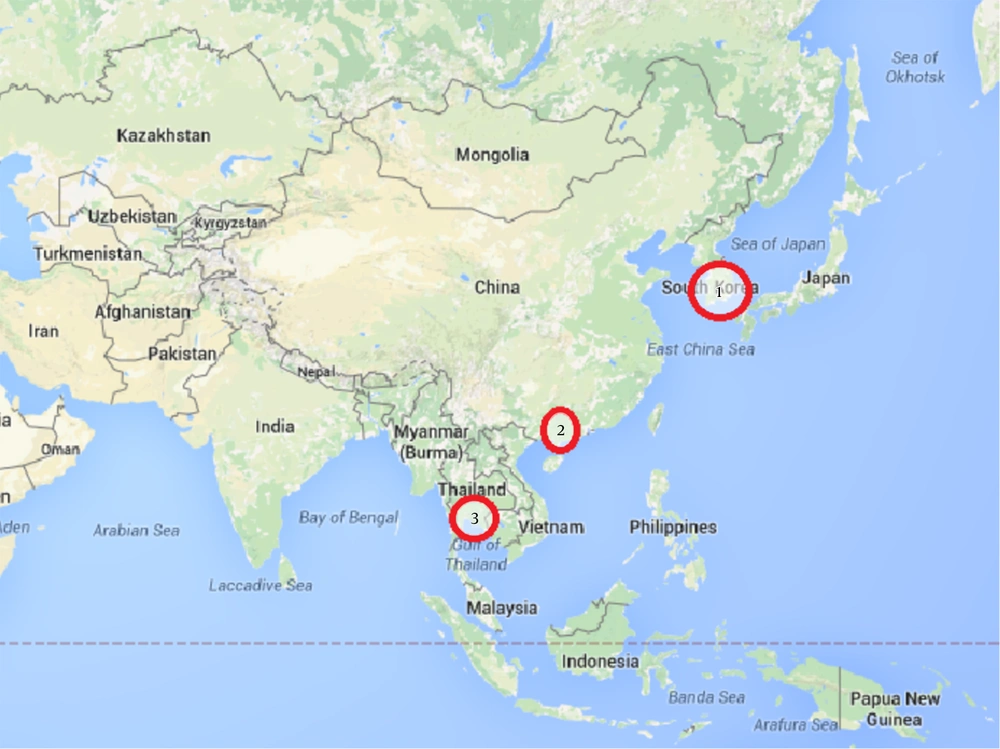
1, Seoul, South Korea, the first case was a Korean contracted disease after returning from a business trip in the Middle East (May 2015); 2, Guangdong, China, the first case was a Chinese contracted disease after visiting his friend in South Korea (May 2015); 3, Bangkok, Thailand, the first case and only one case was a foreigner from Oman who carried the disease from the Middle East (June 2015).
Figure 1.
1, Seoul, South Korea, the first case was a Korean contracted disease after returning from a business trip in the Middle East (May 2015); 2, Guangdong, China, the first case was a Chinese contracted disease after visiting his friend in South Korea (May 2015); 3, Bangkok, Thailand, the first case and only one case was a foreigner from Oman who carried the disease from the Middle East (June 2015).
Table 1.
Pattern of the MERS in the First Year of Its Detection Along With the Trend of Disease in the Following Years
YearTrend
2012The first case was reported in Saudi Arabia along with some sporadic cases in the Middle East.
2013A large outbreak was seen in Saudi Arabia and there was a new emerging disease in Europe. WHO called for attention of the global threat of MERS.
2014The first case was seen in the USA.
2015New emerging disease occurred in South Korea and there was a large epidemic in South Korea. Also, sporadic emerging infections are seen in China and Southeast Asia (Thailand and the Philippines)

References

  • 1.
    Zumla A, Hui DS, Perlman S. Middle East respiratory syndrome. Lancet. 2015;386(9997):995-1007. [PubMed ID: 26049252]. https://doi.org/10.1016/S0140-6736(15)60454-8.
  • 2.
    Landry P, Slama S. Pilgimage and other mass gatherings: epidemiology and prevention [in French]. Rev Med Suisse. 2008;4(157):1192-5. [PubMed ID: 18561823].
  • 3.
    Khan A, Farooqui A, Guan Y, Kelvin DJ. Lessons to learn from MERS-CoV outbreak in South Korea. J Infect Dev Ctries. 2015;9(6):543-6. [PubMed ID: 26142661]. https://doi.org/10.3855/jidc.7278.
  • 4.
    Ling Y, Qu R, Luo Y. Clinical analysis of the first patient with imported Middle East respiratory syndrome in China [in Chinese]. Zhonghua Wei Zhong Bing Ji Jiu Yi Xue. 2015;27(8):630-4. [PubMed ID: 26255008]. https://doi.org/10.3760/cma.j.issn.2095-4352.2015.08.002.
  • 5.
    Memish ZA, Zumla A, Alhakeem RF, Assiri A, Turkestani A, Al Harby KD, et al. Hajj: infectious disease surveillance and control. Lancet. 2014;383(9934):2073-82. [PubMed ID: 24857703]. https://doi.org/10.1016/S0140-6736(14)60381-0.
  • 6.
    Premila Devi J, Noraini W, Norhayati R, Chee Kheong C, Badrul AS, Zainah S, et al. Laboratory-confirmed case of Middle East respiratory syndrome coronavirus (MERS-CoV) infection in Malaysia: preparedness and response, April 2014. Euro Surveill. 2014;19(18). [PubMed ID: 24832116].

Copyright

Copyright © 2016, Health Promotion Research Center. This is an open-access article distributed under the terms of the Creative Commons Attribution-NonCommercial 4.0 International License (http://creativecommons.org/licenses/by-nc/4.0/) which permits copy and redistribute the material just in noncommercial usages, provided the original work is properly cited.

Similar Articles

25
Jul
2015
Resurgence of Middle East Respiratory Syndrome Coronavirus Outbreak in Saudi Arabia

Resurgence of Middle East Respiratory Syndrome Coronavirus Outbreak in Saudi Arabia

Masoud Mardani

Mardani M. Resurgence of Middle East Respiratory Syndrome Coronavirus Outbreak in Saudi Arabia. Arch Clin Infect Dis. 2015;10(3):e31466. doi: https://doi.org/10.5812/archcid.31466

25
Apr
2014
Middle East Respiratory Syndrome Outbreak Threat Becomes More Urgent

Middle East Respiratory Syndrome Outbreak Threat Becomes More Urgent

Masoud Mardani

Mardani M. Middle East Respiratory Syndrome Outbreak Threat Becomes More Urgent. Arch Clin Infect Dis. 2014;9(2):e20693. doi: https://doi.org/10.5812/archcid.20693

30
Nov
2003
Hepatitis in Middle East

Hepatitis in Middle East

Said RA,
Hamzeh YY,
Mehyar NS,
Rababah MS

RA S, YY H, NS M, MS R. Hepatitis in Middle East. Hepat Mon. 2003;1(1):e92756. doi:

29
Sep
2015
Dermatological Disorders Caused by Middle East Respiratory Syndrome

Dermatological Disorders Caused by Middle East Respiratory Syndrome

Hai Err,
Viroj Wiwanitkit

Err H, Wiwanitkit V. Dermatological Disorders Caused by Middle East Respiratory Syndrome. J Skin Stem Cell. 2015;2(3):e30817. doi: https://doi.org/10.17795/jssc30817

30
Apr
2007
Surveying respiratory infections among Iranian Hajj pilgrims

Surveying respiratory infections among Iranian Hajj pilgrims

Seyed Mansour Razavi,
Hossein Ziaee,
Talaat Mokhtari Azad,
Rasoul Hamkar,
Taher Doroodi,
Aliakbar Mirsalehian
,et al.

Razavi SM, Ziaee H, Mokhtari Azad T, Hamkar R, Doroodi T, et al. Surveying respiratory infections among Iranian Hajj pilgrims. Arch Clin Infect Dis. 2007;2(2):. doi:

More by these authors

Viroj WiwanitkitPubMedScholar
Share
Cited by
Metrics