


1. Background
Noise-induced hearing loss (NIHL) is one of the most prevalent risks in the workplaces. A progressive increase in population combined with the development of industry and technology has led to many considerable problems, among which is the noise pollution (1). NIHL is usually caused by the destruction of the organ of Corti and specifically outer and inner hair cells (2, 3). Loud noise is also partly responsible for metabolic disturbance in the cochlea (4). Such disturbance may contribute to the excessive formation of free radicals such as ROS (OH•) and RNS (ONOO-) in the mitochondria (3). The formation of these free radicals in the cochlea has been frequently reported to have the main role in the development of NIHL (5).
In many industries, workers are simultaneously exposed to noise and air pollutants such as gases, vapors, fumes, and aerosols (6). Carbon monoxide (CO) is among ototoxic gases present in mane workplaces all over the world. In some areas such as indoor environments, car parks, road tunnels, and underground, the mean concentration of CO can rise above 100 ppm (7). CO poisoning is one of the most common types of fatal poisoning in many occupational and household settings and simultaneous exposure to noise and carbon monoxide potentiates NIHL at high frequencies (8). Exposure to CO has shown to be able to potentiate the formation of free radicals induced by noise in the cochlea (9, 10). Many studies have examined the effect of CO on the development of NIHL. Their results have revealed that the level of free radicals within the cochlea of the animals exposed to noise and CO was significantly higher than the free radicals level in the cochlea of animals that were only exposed to noise (11). It is evident that due to the excessive risks of simultaneous exposure to noise and CO, preventive measures and treatments are essential.
Previous studies have established the significant role of antioxidants (e.g., N-acetylcysteine and α-Tocopherol) in the prevention and treatment of NIHL caused by the combined exposure to noise and CO (12-14).
Hydrogen gas (H2) has shown to have healing effects in the treatment of several disorders (15). It is believed that H2 exerts such effects mainly through destroying hydroxyl radicals and proxy nitrite selectively but it does not necessarily affect the biologic free radicals such as superoxide anion, peroxide hydrogen, and nitric oxide. The remarkable point about H2 is that because of its physical characteristics, it can quickly diffuse into and permeate the biologic membranes and cytoplasm (16). Hydrogen decreases the level of H2 radical in the nucleus (16) and crosses the blood-brain barrier and exerts its protective effects against the free radicals (17).
2. Objectives
In this study, we examined the protective effect of inhaled H2 on hearing after exposure to noise and carbon monoxide using auditory brainstem responses (ABR).
3. Methods
3.1. Animals
Twelve male albino Guinea pigs of two-months-old (250 - 350 g) were purchased from the Pasteur Institute (Tehran, Iran). The animals were housed in cages with free access to water and food in a temperature-controlled room (20 ± 25°C) with a 12 h light/dark cycle. In the present study, a checklist of working with laboratory animals approved by the Ministry of Health was used. Before exposure, the animals were kept at an animal laboratory at the school of rehabilitation science of Iran University of Medical Sciences for three days for adapting with the new living environment. The Guinea pigs were randomly divided into two groups: (1) Exposed to noise plus carbon monoxide and (2) exposed to noise plus carbon monoxide and inhaled hydrogen.
3.2. Noise Plus Carbon Monoxide Exposure
Guinea pigs in group 1 were simultaneously exposed to 500 ppm carbon monoxide and one-octave band noise centered at 4 kHz at 105 dB SPL for six hours a day over five consecutive days. The animals were kept inside individual cages inside the noise chamber with a reverberant field at a time in order to prevent them from gathering and creating a defense against the noise. The level of noise was calibrated with SLM (Band K, model 2243). The chamber was designed in 60 × 80 × 100 cm of glass and galvanized iron. The noise was presented with a noise generator (Benaphone Electronic Company). The noise emanated from two speakers supported with a power amplifier. The distance of the speakers from the ears was 10 cm. The noise was measured in almost every 10 minutes through the holes on the sidewalls of the chamber. CO gas was introduced into the chamber using a microvalve and mixed with air using a compressor (HAILEA, model Aco-208). The air ventilation rate in this chamber was 60 - 80 L/min. The concentration of CO was set at 500 ppm and monitored continuously using an electrochemical sensor (Stack Sampler, MRU model).
3.3. Inhaled Hydrogen Gas
Immediately after the exposure to one octave band noise centered at 4 kHz at 105 dB SPL with 500 ppm carbon monoxide for six hours a day over five consecutive days, Guinea pigs in group 2, unlike in the noise chamber, were collectively and not separately kept inside the inhalation chamber due to the lack of enough space for five hours a day over five consecutive days. In order to expose the subjects to 2% inhaled H2, a gas cylinder containing a mixture of 48% oxygen, 50% nitrogen, and 2% H2 was prepared and the Guinea pigs inhaled this mixture of gas during the time they were inside the chamber. The inlet/outlet gas flow was adjusted in a way that the atmosphere within the chamber contained 2% H2. The chamber was designed in 35 × 40 × 50 cm. The chamber for H2 inhalation was made of Plexiglas and as it was necessary to maintain the H2 concentration constant dynamically, it was designed to be smaller than the noise chamber.
3.4. Auditory Brainstem Response Measurement
In group 1, ABR was measured before and immediately after the exposure to noise plus carbon monoxide using Biologic Navigator pro system (Natus, USA), and then ABR was measured five days after the noise and carbon monoxide exposure. During the five days, the animals were exposed to free air without inhalation of hydrogen in their cages. In group 2, ABR was measured before and immediately after the exposure to noise plus carbon monoxide and immediately after five days of hydrogen gas inhalation in their chamber. ABRs were measured at frequencies of 2, 4, 8, and 16 kHz. For recording the ABR, the animals were anesthetized with a mixture of xylazine (4 mg kg-1 body weight) and ketamine (40 mg kg-1 body weight) by i.p. injection. An active needle electrode was positioned subcutaneously below the test ear, a reference electrode at the vertex, and a ground electrode below the other ear. The responses from the recording electrodes were amplified (× 100000) and filtered (100 - 3000 Hz). 1024 tone presentations delivered at a rate of 11.1 in a time window of 10.66 milliseconds were averaged to obtain a waveform at each level. Tone bursts were used and the sound intensity decreased in 10 and then 5 dB steps near the hearing threshold. The hearing threshold was recorded at the lowest level at which a clear peak III could be detected.
3.5. Statistical Analyses
The Kolmogorov-Smirnov test was used to assess the normality of data in each group.
For testing the hypothesis about the difference of thresholds (mean ± SD) between the two groups, variables were compared using the Independent-Samples t test and within the groups using the Paired-Samples t test.
P values of < 0.05 were considered statistically significant for the analysis. The IBM SPSS 22 statistical software package was used for the statistical analysis.
4. Results
The ABR thresholds before exposure to noise and carbon monoxide were not significantly different between the two groups at all frequencies.
The results showed a considerable temporary threshold shift immediately after the exposure to noise and carbon monoxide at all frequencies in group 1 and the most increased ABR threshold was seen at 16 kHz (P value = 0.001) (Table 1).
Table 1.Auditory Brainstem Response (ABR) Thresholds Before (Baseline) and After Simultaneous Exposure to Noise and Carbon Monoxide in Group 1 (N = 6)
a P values < 0.05.
The results showed the ABR thresholds immediately after the exposure to noise and carbon monoxide increased compare to the baseline values at all frequencies in group 2. On the other hand, the ABR thresholds immediately after the inhalation of H2 reduced compared to before inhalation at all frequencies and the threshold shift was statistically significant between immediately after and before exposure to H2 at 4, 8, and 16 frequencies and the highest effect of hydrogen was seen at 8 kHz in group 2 (P value = 0.01) (Table 2).
Table 2.Auditory Brainstem Response (ABR) Thresholds Before and After Exposure to Noise + Carbon Monoxide and Then to H2 in Group 2 (N = 6)
a P values < 0.05.
The ABR was recorded immediately after the exposure to noise and carbon monoxide in the two groups and then compared between the groups. The results showed no significant differences between ABR thresholds at all frequencies (P value > 0.05) (Figure 1).
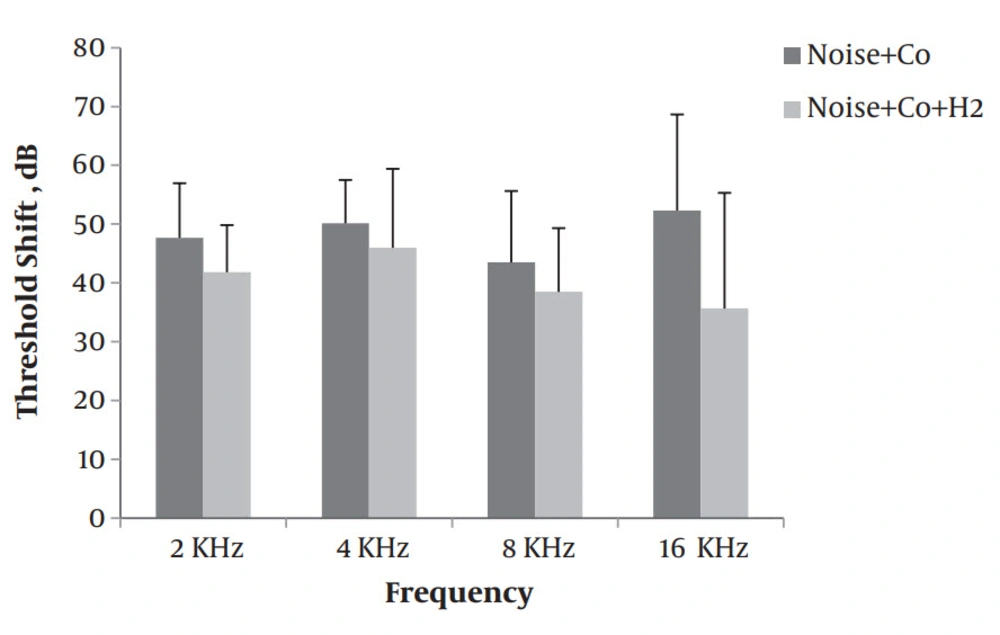
Figure 1.
Comparison of ABR threshold immediately after exposure to noise and carbon monoxide in two groups at all frequencies
The ABR thresholds immediately after the inhalation H2 in group 2 reduced compared to the ABR thresholds five days after the exposure to one octave band noise centered at 4 kHz at 105 dB SPL with 500 ppm carbon monoxide for six hours a day over five consecutive days in group 1 at all frequencies and this difference was significant at 16 kHz (P value = 0.04) (Table 3).
Table 3.Comparison of Auditory Brainstem Response (ABR) Thresholds Five Days After Exposure to Noise Plus Carbon Monoxide in Group 1 and Immediately After Five Days of 2% Hydrogen Inhalation in Group 2 at All Frequencies (N = 6, Each)
| Frequency, Hz | Threshold (Mean ± SD) | F | P Value | |
|---|---|---|---|---|
| Group 1 | Group 2 | |||
| 2 | 43.5 ± 10.36 | 37.66 ± 9.83 | - 0.58 | 0.58 |
| 4 | 31.83 ± 9.7 | 28.50 ± 6.89 | - 1.21 | 0.24 |
| 8 | 22.66 ± 7.52 | 16 ± 10.48 | - 2.44 | 0.16 |
| 16 | 27.33 ± 12.51 | 14 ± 7.07 | - 2.03 | 0.04a |
a P values < 0.05.
The results showed that when Guinea pigs inhaled 2% hydrogen following simultaneous exposure to one-octave band noise centered at 4 kHz at 105 dB SPL with 500-ppm carbon monoxide for six hours a day over five consecutive days, an adequate protection was provided against the combined exposure-induced hearing loss in the animals. There were significant differences between the ABR thresholds five days after the exposure to noise plus carbon monoxide in group 1 and the ABR thresholds immediately after five days of 2% hydrogen inhalation in group 2 (simultaneous exposure to noise and carbon monoxide and then hydrogen inhalation) at 16 KHz (P value = 0.04) (Figure 2).
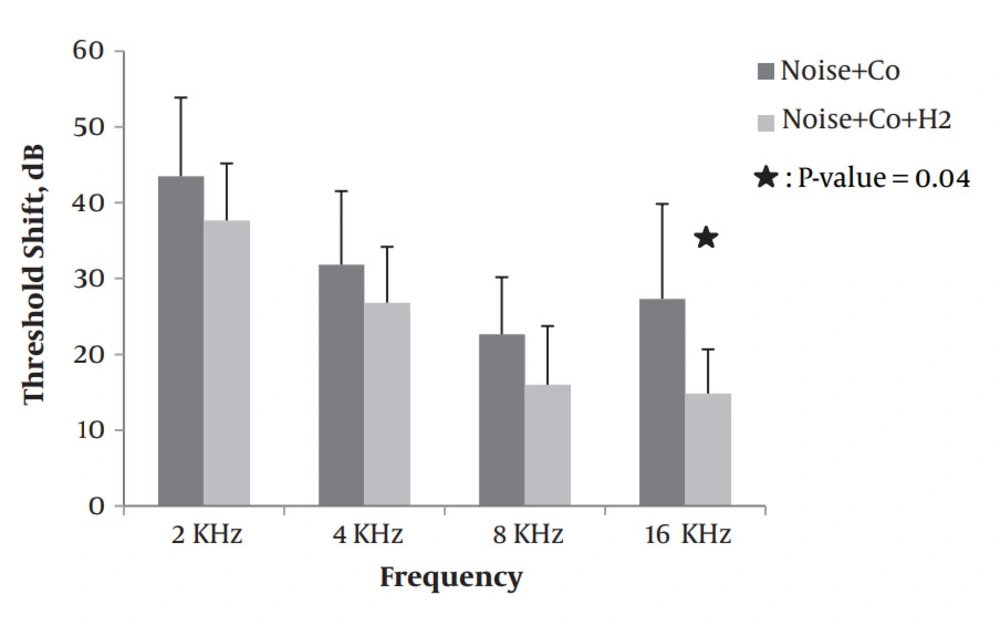
Figure 2.
The ABR thresholds five days after exposure to noise plus carbon monoxide in group 1 and immediately after five days of 2% hydrogen inhalation in group 2 at all frequencies
5. Discussion
In this study, the results showed the simultaneous exposure to 105 dB SPL octave band noise centered at 4 kHz, six hours per day for 5 consecutive days, and 500 ppm carbon monoxide-induced hearing loss at all frequencies in Guinea pigs. Carbon monoxide gas is colorless and odorless, but it is toxic for human and is one of the main air pollutants (18). Recent studies showed that the level of free radicals was higher in the cochlea of animals that were simultaneously exposed to noise and carbon monoxide than in animals exposed to noise only (1, 11). Thus, the effect of carbon monoxide on induced hearing loss in the current study was attributed to the role of this gas in the increase of oxidative stress in the cochlea. The results showed (Table 1) a considerable TTS immediately after the exposure to noise plus carbon monoxide at 16 kHz. It can be explained by the highest effect of carbon monoxide on NIHL, which occurs at high frequencies. This result was reported in several previous studies (8, 9, 19).
Due to the increase of free radicals following simultaneous exposure to noise and carbon monoxide, the theory of using antioxidants is proposed. Hydrogen is a unique antioxidant because it is in a gas form and is able to diffuse rapidly into the tissues. As a natural chemical element, it is so small that can easily penetrate the cellular and intracellular membranes to react selectively with hydroxyl radicals and proxy nitrites, owing to its fast diffusion into the biologic membranes.
The current work was the first study to investigate the effects of inhaled hydrogen on hearing protection following exposure to noise plus carbon monoxide. Kurioka et al. exposed Guinea pigs to one octave band noise centered at 4 kHz at 121 dB SPL for five hours and immediately with inhaled H2 (0.5%, 1.0%, and 1.5%) for five hours a day over five consecutive days; their results showed that there was a more improvement in the threshold shift in the 1.0% and 1.5% H2 treated groups than in the non-treated group and this effect was highest at 16 and 20 kHz (20). In the current study, the ABR thresholds of animals exposed to noise plus CO and inhaled hydrogen gas (group 2) at all frequencies were significantly smaller than those of animals that were exposed to noise plus CO and no inhaled hydrogen gas (group 1) on day 5, and hydrogen attenuated the ABR threshold shifts more significantly at 16 kHz. This indicates that treatment with hydrogen gas could reduce the temporary ABR threshold shift at all frequencies with the highest effect at the highest frequency in subjects exposed to noise and CO simultaneously.
Several studies have shown that free radicals increased after the exposure to noise and carbon monoxide. Therefore, the effects of hydrogen gas in this study were attributed to its ability to neutralize free radicals after simultaneous exposure to noise and carbon monoxide.
5.1. Conclusion
This study showed the protective effects of 2% H2 inhalation on the temporary threshold shift after simultaneous exposure to noise and carbon monoxide.

