
1. Background
Daily developing industries, increasingly expanding cities, increasing population, and human activities lead to an increase in resource and energy consumption. Highly human activities deteriorate environments including heavy-metal pollution. Recently, urban soil contaminated with heavy metals has been focused upon in order to avoid environment deterioration. Some correction experiments have been done on these fields. Heavy elements are potent traces of human activities (1-4). According to the fact that heavy metals are among the most significant and well-known pollutants, their penetration into the environment leads to various damages and diseases. The mentioned elements are toxic and harmful to some creatures, including humans. However, their consumption and also production in some industries are inevitable (5). The heavy metals originated from resources penetrating the environment, such as soil, water, sedimentation, and ecosystem. The main resources for production, distribution, and propagation of heavy metals include household activities, agriculture wastes, industrial emissions (such as power plants, fossil fuel burning, metallurgy industry, and chemical factories), and traffic emission (particles emitted due to asphalt corrosion, route equipment’s, route maintenance equipment’s, vehicle tire, as well as gas emitted from motor vehicles and other machineries) (6-11). In conclusion, combustion process leads to distribution of VOC, NOx, CO, and particulate matter. Toxic particulate matters emitted from vehicles are of the high concern in terms of human health (4). Therefore, motor vehicle emissions are among the most important heavy metal resources in urban environments. Traffic leads to serious problems, especially in highly populated cities (12). Studies have shown that an increase in dust, as an air pollution index in urban regions and heavy metals embedded in atmosphere sedimentations (due to accumulation of solid particles on the ground), are used to provide useful information on pollution levels of urban regions, which can be an average measure for urban environment quality (13-15). Additionally, sediments on the streets can be carried over by wastewater, which is one of the most important contamination resources (16). Therefore, it is necessary to explore the origin of production and distribution of heavy metals propagated in urban environments (17).
2. Objectives
This study is aimed at evaluating the pollution level of heavy metals (arsenic (As), cadmium (Cd), copper (Cu), lead (Pb), and zinc (Zn)) as well as identifying the natural and human-made pollution resources affecting the pollutants concentration distributed around Tehran. To evaluate the pollution level of samples, geo-accumulation index (Igeo) and enrichment factor (EF) are calculated.
3. Methods
3.1. Study Area Description
Tehran is of 51 to 53 east longitude and of 35 to 36 north latitude. From the south, Tehran is surrounded by west-north boundary of central and it goes to the south part of Alborz Mountain from the north. The east part of Tehran is surrounded by Jajrood and the west part of it attaches to Karaj (18). Tehran has an area of 750 km, including 22 districts (19), and its population is 8293140 based on statistics published in 2011 (20).
3.2. Sampling and Analysis
A total of 35 street dust samples randomly defined in geographic information systems (GIS) were collected in June 2016, in Tehran (Figure 1). To collect the samples, a plastic brush and a scoop were used. By applying the global positioning system (GPS), the longitude and latitude of the sampling site has been determined.
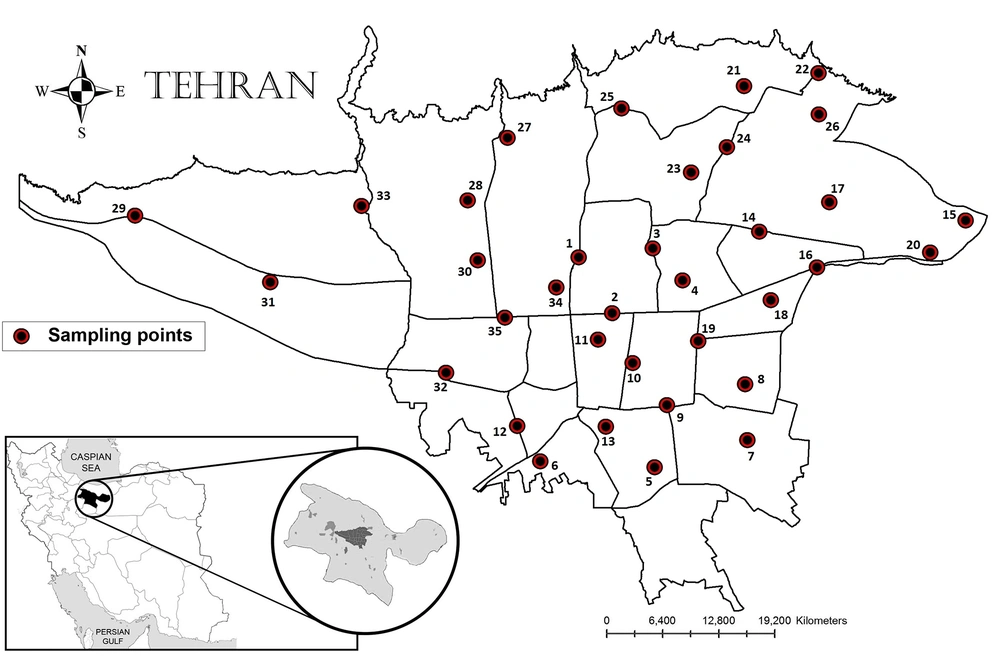
Figure 1.
The study area and location of dust sample points, Tehran, Iran
At each sample site, approximately 500 g of dust sample was collected by sweeping. Next, they were dried in an oven at 60˚C for 24 hours in order to prevent the loss of possible volatile metallic compounds. After drying, samples were passed through a stainless steel sieve of 0.149 mm (100 mesh) to remove sands, coarse particles, and other fragments. A total of 1 g of each sample was transferred into a glass Pyrex beaker (21). Samples were digested with HNO3, HCL, and H2O2 (purchased from Merck Company, Germany) using the USEPA 3050B method (22); then, digested solutions were filtered through a 0.2 µ filter. Metal concentrations of As, Cd, Cu, Pb, and Zn, in the digestion solution, were determined using inductively coupled plasma optical emission spectrometry (ICP-OES) (Spectro Arcos Model, Cleve, Germany). Blank, standard, and duplicated samples were simultaneously performed in two analyses as quality control. Statistical analysis issued in the current study includes descriptive statistics and evaluation of data normality using SPSS 21. Additionally, Origin Lab 9.2 is used to draw box figures of metal pollution indices.
3.3. Quantification of Dust Pollution
The pollution levels of heavy metals were found applying EF and Igeo, which are commonly used to assess the pollution levels of metals in soil (23-25) sediment (26-28) and dust (17, 29, 30). Igeo and EF can be employed to study the pollution status (23). When using EF and Igeo, choosing proper background levels is an essential effect. In literature, the background values can be assessed based on average values or the average crustal abundance data. However, these data are likely to be overall and might be misinformed in a specific study area; the local background values could be more suitable (31) (Table 1).
Table 1.
Statistical Summary of Metal Concentrations in and Background Soils (mg kg-1)
| Heavy Metal | As | Cd | Cu | Pb | Zn |
|---|---|---|---|---|---|
| Mean | 5.63 | 0.92 | 182.89 | 110.27 | 370.97 |
| Min | 1.29 | 0.05 | 48.97 | 24.99 | 79.51 |
| Max | 9.87 | 8.85 | 518.84 | 249.57 | 615.02 |
| Standard deviation | 1.37 | 1.65 | 75.4 | 52.64 | 156.05 |
| Skewness | -0.31 | 4.11 | 2.54 | 0.88 | 0.03 |
| Coefficients variation | 0.24 | 1.79 | 0.41 | 0.48 | 0.42 |
| Background value | 4.52 | 0.13 | 27.40 | 27.92 | 70.38 |
The pollution assessment levels for a single heavy metal in street dusts have been conducted using the Igeo introduced by Müller (32). Mathematically, Igeo is given as Equation 1:
where Cn is the content of measured metal, n the specified sample, Bn is the geochemical background content of the metal n (33-35) (natural value of the metal in the nearby soil without human affect is used to compensate possible variations of data because of lactogenic effects) (36). The coefficient 1.5 is introduced to minimize the fluctuations in the background values (37, 38).
The geo-accumulation index includes seven classes (39) (Table 2). Class six is an open class and consists of all values higher than grade five. The elemental pollution in grade six may be hundred folds greater than the background value (40).
Table 2.
Classes of Igeo and EF in Relation to Pollution Levels and Enrichment, Respectively
| Class | Igeo | EF | ||
|---|---|---|---|---|
| Value | Designation of Street Dust Quality | Value | Designation of Street Dust Quality | |
| 0 | Igeo ≤ 0 | No polluted | EF ≤ 1 | No enrichment |
| 1 | 0 < Igeo ≤ 1 | No to moderate polluted | 1 < EF ≤ 3 | Minor enrichment |
| 2 | 1 < Igeo ≤ 2 | Moderately polluted | 3 < EF ≤ 5 | Moderate enrichment |
| 3 | 2 < Igeo ≤ 3 | Moderately to heavily polluted | 5 < EF ≤ 10 | Moderately severe enrichment |
| 4 | 3 < Igeo ≤ 4 | Heavily polluted | 10 < EF ≤ 25 | Severe enrichment |
| 5 | 4 < Igeo ≤ 5 | Heavily to extremely polluted | 25 < EF ≤ 50 | Very severe enrichment |
| 6 | Igeo > 5 | Extremely polluted | EF > 50 | Extremely severe enrichment |
In order to quantify the degree of heavy metal pollution, the EF was determined on the standardization of a measured metal. A reference metal is usually characterized by low existence variability, such as elements: aluminum, iron, titanium, silicon, strontium, potassium, etc. (17, 29, 41-43).
To minimize the effect of particle size influencing on heavy metal pollution, data should be regularized by a conventional element (44). Al has been recognized as the background level due to its geo-chemical characteristic, low conversion, and transfer through environment (45). Al is inert in the immigration process and results from natural anthropogenic sources, therefore, Al, as a standardized element, has gained general credit (44). The EF calculation is expressed as Equation 2:
4. Results
Statistical features of metal concentrations of dusts dispersed in the under-study area and background values are given in Table 1. Heavy metal concentrations are 1.92 to 9.78 mg/kg dust for As (with the mean of 5.63), 0.05 to 8.85 for Cd (with the mean of 0.92), 48.97 to 518.84 for Cu (with the mean of 182.59), 24.99 to 249.57 for Pb (with the mean of 110.27), and 79.51 to 615.02 for Zn (with the mean of 370.97). Additionally, coefficient of variation (C.V = standard deviation/mean) follows the following order: CVAs (0.24), CVCu (0.41), CVZn (0.42), CVPb (0.48), and CVCd (1.79). The results of Kolmogorov-Smirnov test shows that the concentration of arsenic, copper, lead, and zinc follows the normal distribution function while cadmium does not follow the mentioned function, which normalized using data natural logarithm.
The calculated results of Igeo of heavy metals in dust collected from street dust of Tehran and are presented in Table 4. The Igeo ranges from, -2.40 to 0.54 (average of -0.45) for As, -1.88 to 5.52 (average of 1.49) for Cd, 0.25 to 3.66 (average of 2.05) for Cu, -0.754 to 2.58 (average of 1.24) for Pb, and -0.41 to 2.54 (average of 1.74) for Zn, respectively. The average degrees of Igeo (Figure 2) decreases in the order of CAs < CPb < CCd < CZn < CCu.
Table 3.
Heavy Metal Contents in Road/Street Dust of Different Cities (mg kg-1)
| Area | As | Cd | Cu | Pb | Zn | Reference |
|---|---|---|---|---|---|---|
| Beijing (China) | - | 0.72 | 69.90 | 105.00 | 223.00 | (32) |
| Newcastle (UK) | 6.40 | 1.00 | 132.00 | 992.00 | 421.00 | (48) |
| Sivas (Turkey) | - | 2.60 | 82.00 | 197.00 | 206.00 | (49) |
| Aviles (Spain) | 17.50 | 22.30 | 183.00 | 514.00 | 4829.0 | (50) |
| Ottawa (Canada) | 1.40 | 0.30 | 29.54 | 16.60 | 98.70 | (51) |
| Shiraz (Iran) | 6.58 | 0.50 | 136.34 | 115.71 | 403.46 | (15) |
| Zahedan (Iran) | - | 0.10 | 29.70 | 28.40 | 184.30 | (47) |
| Tehran (Iran) | 5.63 | 0.92 | 182.89 | 110.27 | 370.97 | This work |
Table 4.
Igeo and the Samples Percentage of Different Igeo Degrees
| Element | As | Cd | Cu | Pb | Zn |
|---|---|---|---|---|---|
| Igeo | |||||
| Mean | -0.45 | 1.49 | 2.05 | 1.24 | 1.74 |
| Min | -2.4 | -1.88 | 0.25 | -0.74 | -0.41 |
| Max | 0.54 | 5.52 | 3.66 | 2.58 | 2.54 |
| Samples value Igeo, % | |||||
| Igeo ≤ 0 | 40 | 3 | 0 | 3 | 3 |
| 0 < Igeo ≤ 1 | 60 | 34 | 6 | 43 | 3 |
| 1 < Igeo ≤ 2 | 0 | 43 | 28 | 37 | 48 |
| 2 < Igeo ≤ 3 | 0 | 11 | 63 | 17 | 46 |
| 3 < Igeo ≤ 4 | 0 | 3 | 3 | 0 | 0 |
| 4 < Igeo ≤ 5 | 0 | 3 | 0 | 0 | 0 |
| Igeo > 5 | 0 | 3 | 0 | 0 | 0 |
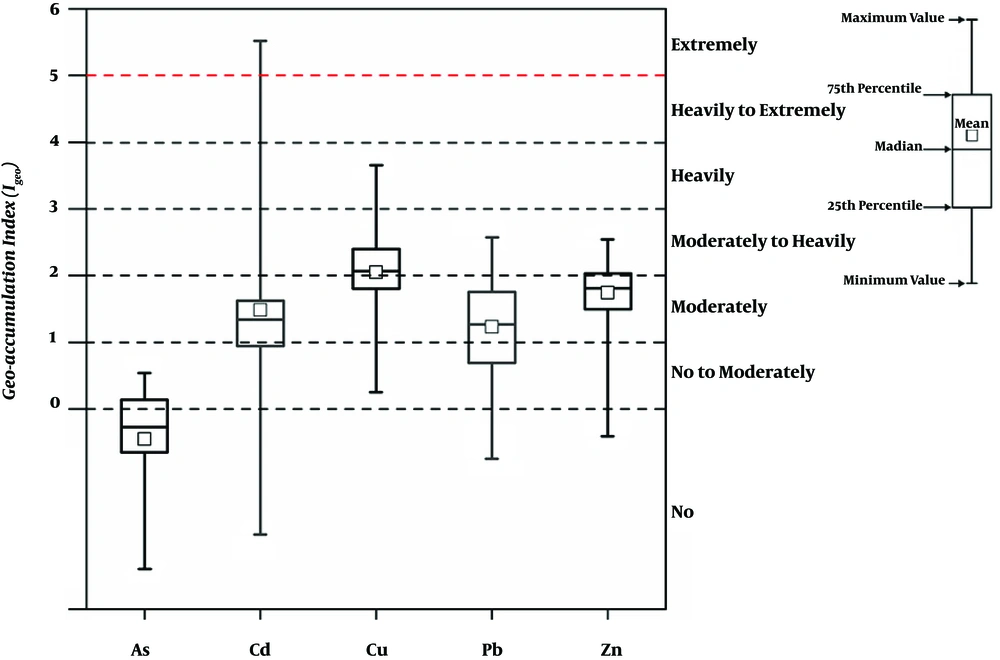
Figure 2.
Boxplot of geo-accumulation index for heavy metals in street dust from Tehran. No pollution (Igeo ≤ 0); no to moderate polluted (0 < Igeo ≤ 1); moderately pollution (1 < Igeo ≤ 2), moderately to heavily polluted (2 < Igeo ≤ 3), heavily polluted (3 < Igeo ≤ 4), heavily to extremely polluted (4 < Igeo ≤ 5), and extremely polluted (Igeo > 5)
The results of EF of heavy metals in the study are showed in Table 5. The EF ranges from 0.23 to 1.80 (average of 1.01) for As, 0.36 to 60.00 (average of 6.24) for Cd, 1.56 to 16.54 (average of 5.82) for Cu, 0.78 to 7.81 (average of 3.45) for Pb, and 0.99 to 7.75 (average of 4.83) for Zn, respectively.
Table 5.
EF and the Samples Percentage of Different EF Degrees
| Element | As | Cd | Cu | Pb | Zn |
|---|---|---|---|---|---|
| EF | |||||
| Mean | 1.01 | 6.24 | 5.82 | 3.45 | 4.84 |
| Min | 0.23 | 0.36 | 1.56 | 0.78 | 0.99 |
| Max | 1.80 | 60.00 | 16.54 | 7.81 | 7.75 |
| Samples value EF, % | |||||
| EF ≤ 1 | 66 | 3 | 0 | 3 | 3 |
| 1 < EF ≤ 3 | 34 | 26 | 3 | 37 | 0 |
| 3 < EF ≤ 5 | 0 | 54 | 37 | 48 | 65 |
| 5 < EF ≤ 10 | 0 | 8 | 57 | 12 | 32 |
| 10 < EF ≤ 25 | 0 | 3 | 3 | 0 | 0 |
| 25 < EF ≤ 50 | 0 | 3 | 0 | 0 | 0 |
| EF > 50 | 0 | 3 | 0 | 0 | 0 |
5. Discussion
According to Table 1, the minimum concentration of Cu is 48.97 mg/kg related to sediments (sample 1) of Chamran highway and the Gisha Bridge; the maximum value is 518.84 mg/kg, which is founded at Shariati Street (sample 4). It can be said that significant reduction in Cu concentration is due to the construction of multilevel junction and lack of traffic on Chamran Highway. Due to heavy traffic and frequent use of brakes, Cu concentration increases (30). The minimum concentration of Pb is 24.99 mg/kg, which is related to the Chamran Highway for specific times and days of the weak due to light traffics. The maximum concentration of Pb is 285.89 mg/kg, which is related to Enghelab Street crossing Vesal Street (sample 2) showing serious problems comparing to mean concentration of mantle elements. Enghelab is one of the main streets of Tehran loaded with a high amount of Pb due to heavy traffic and high speed of motor vehicles. The minimum concentration of Zn is 79.51 mg/kg, which is related to the Chamran Highway and the maximum value is 647.41 mg/kg, which is related to Fisrt Sadeghie, Kashani Street (sample 30). According to the fact that tire friction produces high amounts of zinc, the mentioned street is heavily loaded with Zn, which is due to heavy traffic, traffic light, and frequent use of brakes.
In comparison with heavy metal concentration calculated in other cities (Table 3), cadmium, copper, zinc, and lead are of the highest concentrations leading to serious problems. In comparison between metal concentration and background value concentrations (Table 1), it is shown that the under-study area is heavily polluted. The high amount of these pollutants originates from other resources than natural ones. One possible resource can be fossil fuels used for motor vehicles in Tehran, which leads to more serious problems in Tehran due to low quality. Vehicle corrosion, metal equipment’s around the city and particles emitted from tires and brakes are among other unnatural resources. In comparison to other cities, especially developed ones, Tehran suffers from higher amounts of cadmium, copper, lead, and zinc. Copper and zinc are of the highest concentration. In worldwide comparison, cadmium and lead, as the primary pollutants, are of high concentration except in some parts. Although Iran is not considered as an industrial country compared to such countries as Spain, Canada, and England, high amounts of pollutants cause serious problems. Compared to studies conducted in Shiraz, cadmium, copper, and lead are of significantly high concentration.
The Igeo values of 40% in As dust samples are less than zero, which shows that the mean Igeo As in the dust of Tehran streets is not polluted. The Igeo values 34% Igeo of Cd, 43% Igeo of Pb, and 60 % Igeo of As; between zero and one none to moderate pollution is revealed. The mean values of Igeo for Pb, Cd, and Zn, and 37% Igeo of Pb, 43% Igeo of Cd, and 48% Igeo of Zn, which were between one and two revealing moderately polluted, while 11% Igeo of Cd, 17% Igeo of Pb, and 46% Igeo of Zn, between two and three reveals moderately severe pollution. The mean Igeo was obtained for Cu points to moderately severe polluted. Percentage Igeo of Cu mainly falls into class three (1 < Igeo ≤ 2, 28 %) and class four (2 < Igeo ≤ 3, 63 %) showing that Cu is moderately polluted and moderately severe polluted in dust. Table 4 shows Zn, Pb, Cu, and Cd pollution in different levels of dust samples collected from Tehran streets. Results of geo-accumulation index, which were based on the average value for qualifying the heavy metal pollution, showed a minor pollution. Only a small amount of contamination related to Cd and Cu as well as Pb and Zn were found. Arsenic showed no trace in samples.
The EF values of As in 66% dust samples is < 1 in dust street of Tehran are no enrichment. The mean values of EF for As, and 26% EF of Cd, 34% EF of As, and 37% EF of Pb were between one and three, which reveals minor enrichment. The mean values of EF for Pb and Zn were between three and five, while the EF values 37% EF of Cu, 48% EF of Pb, 54% EF of Cd, and 65% EF of Zn revealing moderate enrichment. The mean EF for Cu and Cd, and 8% EF of Cd, 12% EF of Pb, and 32% EF of Zn, and 57% EF of Cu were between five and ten, showing moderately severe enrichment. The contamination results assessment of EF is consistent with those of Igeo. According to EF, it is possible to compare the amount of an element and its natural concentration (52). EF discriminates natural and human resources (46). According to studies on EF, if EF is < 1 the element has the natural origin and if EF is > 1 the human origin is proved (53, 54). Based on Figure 3, we have 1 ≤ EF for arsenic, 3 ≤ EF for zinc and copper, and 5 ≤ EF for cadmium and copper. Cadmium, copper, lead, and zinc are really harmful to the human health in contact with sediments of the studied area. Geomorphological features of the area are of high effect.
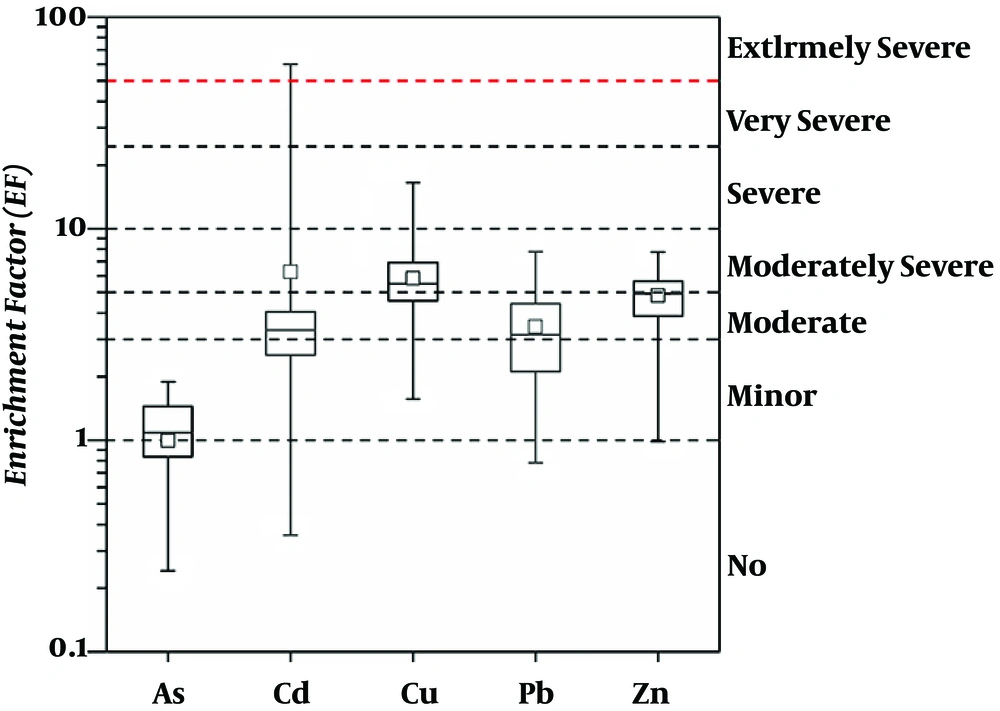
Figure 3.
Boxplot of enrichment factor for heavy metals in street dust from Tehran. No enrichment (EF ≤ 1); minor enrichment (1 < EF ≤ 3); moderate enrichment (3 < EF ≤ 5), moderately severe enrichment (5 < EF ≤ 10), severe enrichment (10 < EF ≤ 25), very severe enrichment (25 < EF ≤ 50), and extremely severe enrichment (EF > 50).
According to wild nick classification, soil parameters with the CV of more than 35% are categorized as highly changing variables (55). The comparison of metal CVs indicates that cadmium is the highest changing metal and arsenic is the lowest changing one. To identify the origin of metals, Guo et al., concluded that metal under the effect of human activities are of higher CV (56). They showed that elements with CV < 0.4 are of the natural origin and elements with CV > 0.4 are human-based (57). Based on EF results, it is concluded that cadmium, copper, lead, and zinc are of the human-based resources (vehicle components and building ingredients) and arsenic is of the natural origin.
According to the fact that street sediments easily spread and enter the breathing system, heavy metals has to be focused on. Results have indicated that high amounts of lead are included in dust and street sediments. According to EF and Igeo, cadmium and copper concentrations are seriously threatening in Tehran. Results also show that heavy pollution of central parts of Tehran is due to human activities. Studies have shown that there is direct relationship between human activities and heavy metal pollution due to metal accumulation.