
1. Background
Historically, process industries have been known for being the most hazardous places, in which accidents’ risk, damages, fatal and non-fatal injuries might occur. Process industries, such as petrochemical, oil and gas refineries and chemical industries have lots of difficulties for their occupational safety and health (S and H) performance. This fact is mainly because of detrimental factors in these industries and complexity of the processes. Moreover, several studies have shown that there is a high rate of severe accidents, such as explosion, fire, release of toxic materials, and other minor and severe injuries in these industries (1, 2).
Lost working days (LWD) as an accidents’ size index has become a fundamental quantitative index for occupational accidents’ analysis (3). Several indicator variables and latent factors in process industries can cause LWD; therefore, discovery of LWD-related factors is an effective way to reduce and prevent occupational accidents in process industries. In most cases, various factors, as well as their combinations can cause severe consequences and damages. Variables of S and H risk management system (e.g. S and H training, risk assessment indicator variables, and control measures) are good cases in point (4-6).
Generally, studies have indicated that consideration of indicator variables of risk management and the practical application of risk management factors led to good management and reduction of risks and size of accidents (5, 7, 8).
Consequently, analysis of S and H risk management indicator variables and their roles and functions in process industries is essential for reducing the accidents’ rate and size; furthermore, it could be considered as a self-monitoring approach for safety risk management system. In that case, as shown in several studies, failure in risk management systems plays an important part in industrial accidents (9).
2. Objectives
The present study was planned and carried out with the purpose of modeling and analyzing the accidents’ size based on S and H risk management factors and variables in 10-process industries, using the feature selection method and structural equation models.
3. Methods
In this retrospective cross-sectional study, 1020 human injuring accidents, which had occurred in construction, installation, and start-up phases at 10-process industries (including four petrochemical, two gas refineries, and four chemical industry) within eight years (2008 to 2014) were analyzed. Analyzed data included risk management indicator variables as exogenous and LWD as an endogenous variable.
3.1. Implementation Steps
The present study was implemented in four steps as follows; I, collection and verification of data related to accidents, II, data gathering about risk management factors and variables, III, feature selection, IV, analysis and modeling of variables and factors affecting LWD by means of SEM (Figure 1).
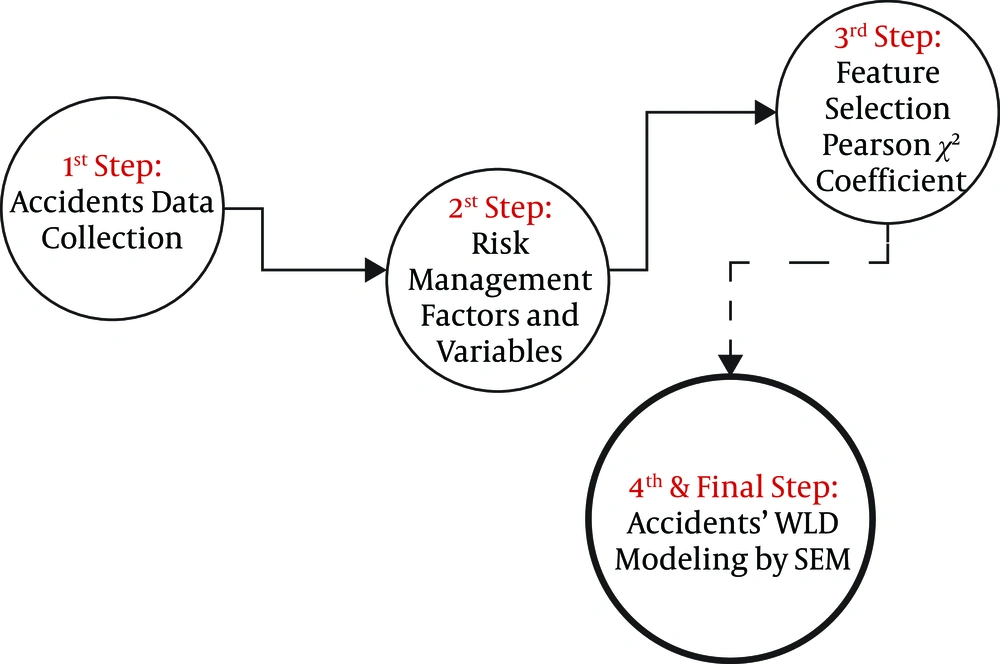
Figure 1.
Algorithm of the lost working days analytical modeling
3.1.1. First Step
In the first step, occupational accidents’ data had been collected by investigating accident report forms. It should be noted that the accident report form is just one tool for collecting descriptive data related to the accident, which is commonly used in all industries. Overall, 1038 occupational accident were collected by census sampling. Then gathered data were revised and those, which had missing information were excluded. Each accident had an accident report form that was included in the study. Also, accidents with incomplete and ambiguous information (including risk management indicator variables) were excluded from the study. Finally, 1020 human injuring accidents were chosen to be studied; as mentioned, analyzed data included working lost days of occupational accidents (LWD).
3.1.2. Second Step
In the second step, information on the latent factors of established risk management systems in the studied process industries and related indicator variables were collected. According to findings of some studies, as well as the designed algorithm for this study, the risk management systems in process industries were analyzed in a three-factor framework including S and H training factor (TF), S and H risk assessment factor (RAF), and S and H Risk control factor (RCF). Furthermore, each of these three factors is known as an exogenous latent factor and the related variables were introduced as the indicator variables of risk management system (4, 5).
3.1.2.1. S and H Training Factor (TF)
According to several studies, dangerous actions and different kinds of human errors were results of inappropriate and inadequate S and H training, which can induce severe accidents. It was also mentioned that hazard identification and risk perception could be improved by S and H training. Therefore, considering indicator variables of S and H training will be useful in improvement of risk management systems and accident prevention and reduction (10-12). Underlying indicator variables of latent TF included trainings of pre-employment, periodic, past accident, Personal Protective Equipment (PPE), housekeeping, duration and contents of training.
3.1.2.2. S and H Risk Assessment Factor (RAF)
Process industries deal with high risks of severe and catastrophic occupational accidents. In order to alleviate the accidents’ number and size, it is necessary to confirm S and H risk management system and risk assessment indicator variables. As shown in some studies, poor performance of RMS, such as hazard identification’s failure, inadequate S and H risk assessment and its inappropriate methods, affect accidents’ size (6, 13, 14). The latent risk assessment factor is attributed to indicator variables, such as hazard identification (HAZID), periodic risk assessment, implementing report system of incidents, accident investigation, S and H checklist, and audit and inspection.
3.1.2.3. S and H Risk Control Factor (RCF)
Risk control measures are very important to accidents’ size, for example insufficient or lack of risk control, such as housekeeping and PPE, causes severe accidents and damages (5, 6, 15). In the present study, the latent risk control factor was divided to PPE, housekeeping, and tool box meetings (TBM).
3.1.3. Third Step
The third step was to determine and estimate the importance of each indicator variable of the risk management systems in LWD. Typically, real-world problems, such as occupational accidents, involve a large number of inputs and one or more output. Analysis of such large volume of data takes time and much effort (16) and may lead to difficulties, such as curse of dimensionality (17). Therefore, in order to overcome such problems, algorithms of feature selection are used in the analysis to identify effective variables and factors. To feature selection, the IBM SPSS Modeler 14.2, one of the most powerful data mining software, was used. Since the entry included a wide variety of data types, such as continuous, nominal, flag and ordinal data, the Pearson χ2 coefficient was used. Importance cut off point for feature selection was considered as 0.95 (16, 17).
3.1.4. Fourth Step
In the fourth step all important variables extracted from feature selection were interred in the statistical software of IBM SPSS AMOS v22.0 and then analysis and modeling of the data, with the purpose of investigating the relation between latent factors and indicator variables of risk management systems and lost working days, was done by means of the SEM approach. Structural equation modeling, as a causal modeling, is a strong analysis technique of multivariable regressions and a comprehensive statistical approach used for testing hypotheses about interrelations of latent and observes variables. It is able to involve latent variables in the model, and discovers interrelations between exogenous and endogenous variables. This method is one of the main ways of structural analysis of complex phenomenon; therefore, it is essential to use it to find and model the impact of different factors (e.g. risk management system’s factors) on dependent variables (e.g. accident size and LWD) (5, 7, 18). Accordingly, the designed conceptual model was verified and approved by using confirmatory factor analysis (CFA), and then analysis and modeling the preferred model was done by means of SEM. The maximum likelihood method, using the covariance matrix, was used to estimate the parameters of the model. Moreover, the goodness of fit of this model was evaluated using several indices, including χ2/df, root mean square error of approximation (RMSEA), comparative fit index (CFI), normed-fit index (NFI), and non-normed fit index (NNFI) or tucker-lewis index (TLI). For acceptable fit, the range for the ratio χ2/df, RMSEA, CFI, AGFI and TLI are 2 to 3, 0.05 to 0.08, 0.95 to 1.00 and 0.95 to 1.00 respectively (18).
4. Results
The results showed that the average number LWD was 197.42 ± 111.06 days. It also indicated that 10% of accidents caused over one year of working lost, further, more than 70% of them led to three to twelve months of working lost (Table 1).
Table 1.
Working Lost Days due to Occupational Accidents
| Accidents Index | Value and Frequency |
|---|---|
| LWD, mean ± SD | 197.42 ± 111.06 |
| LWD, mo, No. (%) | |
| ≤ 3 | 173 (17.0) |
| 3 - 6 | 365 (35.8) |
| 6 - 9 | 301 (29.5) |
| 9 - 12 | 80 (7.8) |
| > 12 | 101 (9.9) |
Findings of analyzing S and H risk management system’s factors are shown in Table 2. According to the Table, high and very high desirability of pre-employment, periodic and past accident trainings were 18.9%, 35.5%, and 9.4%, respectively. The results showed that in 7.4% and 13.5 of the investigated occupational accidents the duration and content of S and H trainings was low, respectively. Furthermore, medium desirability of PPE and housekeeping trainings was 61.2% and 42.4%, respectively. The results related to RAF showed that high and very high desirability implementation of some risk assessment indicator variables, such as HAZID, reporting, and accident investigation, was lower than 20% (14.5%, 8.2%, and 11.4%, respectively). High desirability of risk assessment indicators was dedicated to implementation of S and H checklists (80.6%) and periodic risk assessment (42.6%). Additionally, the findings of RCF showed that high levels of design and implementation of PPE, TBM, and housekeeping were estimated as 23.7%, 10.8%, and 17.5%, respectively.
Table 2.
Findings of Indicator Variables of risk management Factorsa
| Safety and Health Risk Management Indicator Variables | Low | Medium | High | Very High |
|---|---|---|---|---|
| Safety and Health training factor (TF) | ||||
| Pre-employment training | 289 (28.3) | 538 (52.7) | 160 (15.7) | 33 (3.2) |
| Periodic training | 4 (0.4) | 655 (64.2) | 297 (29.1) | 64 (6.3) |
| Past-accident training | 607 (59.5) | 317 (31.1) | 81 (7.9) | 15 (1.5) |
| PPE training | 190 (18.6) | 624 (61.2) | 154 (15.1) | 52 (5.1) |
| Housekeeping training | 489 (47.9) | 432 (42.4) | 67 (6.6) | 32 (3.1) |
| Training’s duration | 75 (7.4) | 729 (71.5) | 200 (19.6) | 16 (1.6) |
| Training’s content | 138 (13.5) | 686 (67.3) | 174 (17.1) | 22 (2.2) |
| Safety and health risk assessment factor (RAF) | ||||
| HAZID | 354 (34.7) | 518 (50.8) | 146 (14.3) | 2 (0.2) |
| Periodic risk assessment | 57 (5.6) | 529 (51.9) | 362 (35.5) | 72 (7.1) |
| Accident investigation | 436 (42.7) | 468 (45.9) | 76 (7.5) | 40 (3.9) |
| Reporting | 592 (58.0) | 344 (33.7) | 84 (8.2) | 0 (0.0) |
| Checklist | 17 (1.7) | 181 (17.7) | 635 (62.3) | 187 (18.3) |
| Audit and inspection | 325 (31.9) | 545 (53.4) | 136 (13.3) | 14 (1.4) |
| Safety and health risk control factor (RCF) | ||||
| PPE | 113 (11.1) | 667 (65.4) | 141 (13.8) | 99 (9.7) |
| TBM | 697 (68.3) | 213 (20.9) | 110 (10.8) | 0 (0.0) |
| Housekeeping | 230 (22.5) | 611 (59.9) | 98 (9.6) | 81 (7.9) |
aValues are expressed as No. (%).
As shown in Table 3, the results of the feature selection using Pearson χ2 analysis showed that indicator variables of TF (periodic, past accident, PPE, duration, and content of provided trainings) and RAF indicator variables (HAZID, periodic risk assessment, accident investigation, and checklist), and also indicator variables related to RCF (PPE, TBM, and housekeeping) were most important (importance rate ≥ 0.95). Therefore, these factors were qualified to enter the SEM to analyze the factors affecting LWD.
Table 3.
Determining the Important Affecting Factors on Lost Working Days
| Selected Factors | Value and Importance Rate |
|---|---|
| Periodic training | 0.998 |
| Past-accident training | 0.996 |
| PPE training | 0.995 |
| Training’s duration | 0.987 |
| Training’s content | 1.0 |
| HAZID | 0.966 |
| Periodic risk assessment | 1.0 |
| Accident investigation | 0.963 |
| Checklist | 0.975 |
| PPE | 0.987 |
| TBM | 0.969 |
| Housekeeping | 0.987 |
Analysis of accidents’ LWD in the process industries were done using SEM; based on the results of feature selection. The findings are illustrated in Figure 2. As shown, these results, include the relationship between risk management indictor variables and TF, RAF, and RCF, the three risk management factors and risk management system, and also the relationship between RMS and LWD. The result of this modeling represents positive and negative effects of each variable/factor on LWD. Moreover, the presented values included parameter S.E (P value).
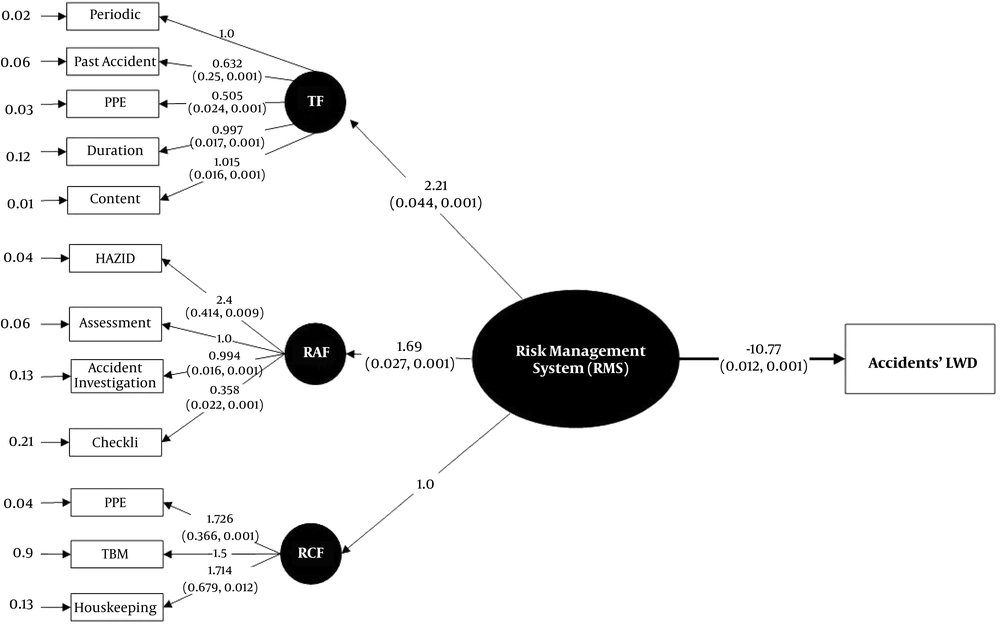
Figure 2.
Structural equation model of accidents’ lost working days
The SEM results showed that the most impact on S and H training factor (TF) was, respectively, related to indicator variables of content of S and H trainings (parameter = 1.015), periodic training (1.0), duration’s trainings (0.997), past accident training (0.632), and finally PPE training (0.505). Indicator variables included HAZID (2.4), periodic risk assessment (1.0), and accident investigation (0.0994), mostly affected by the risk assessment factor (RAF). Moreover, the influencing of PPE (1.726) and housekeeping (1.714) was more than TBM (1.0) on RCF.
Based on the findings of the structural equation model, effect of S and H training factor and risk assessment factor on risk management system was reported as 2.21 and 1.69, respectively. In other words, increasing these factors, the risk management system will be improved.
The significant result of this model was the relation of risk management system with accidents’ LWD index. The impact of RMS on LWD was estimated as 10.77%. Hence, according to other results of the SEM, an increase in factors like training, risk assessment, and risk control and their indicator variables will result in less accidents’ LWD.
The results of goodness of fit indices of the conceptual model are presented in Table 4. The value of indices, such as χ2/df, RMSEA, CFI, AGFI and NNFI, was 2.76, 0.058, 0.991, 0.981 and 0.974, respectively. Therefore, this model is acceptable according to the results of goodness of fit. This model explained 36% of the variance for the accident outcome.
Table 4.
Goodness of Fit Indices of the Lost Working Days Conceptual Model
| Indices | Value |
|---|---|
| χ2 | 35.99 |
| χ2/df | 2.76 |
| RMSEA | 0.058 |
| CFI | 0.991 |
| NNFI (TLI) | 0.974 |
| AGFI | 0.981 |
5. Discussion
Accident analyses in big and process industries have indicated the important role of risk management system and its factors in accident investigation (1, 2, 8). Accordingly, analyzing and modeling of accidents’ size in process industries was done on the basis of risk management system’s factors, including S and H training, risk assessment, and risk control factors.
Based on the SEM findings, latent S and H training factor was recognized as the most effective factor on risk management system and strongly affected accidents LWD. In accordance with these results, several researches revealed that training programs can improve workers’ knowledge of recognizing workplace hazards and dangers. In addition, a training, which simulates real situations, helps workers perform their best with hazard identification and accident black spots in the industries (19). Briefly, it can be said that S and H trainings, which are performed due to job needs and the training indicator variables that are at a desirable degree, can be useful and effective in accident prevention and mitigation (6, 19).
Despite the weakness of the risk assessment indicator variables in this study, it is apparent that indicator variables, such as development and implementation of a comprehensive and systemic framework for the identification of risks in the process industries (HAZID), using a variety of risk assessment processes, risk assessment methods and techniques, designing a practical system or structure to investigate occupational accidents, and using various S and H checklists to better identify and assess the workplaces hazards and risks can mostly reduce accidents’ size in process industries (5, 8, 11).
According to the SEM results, indicator variables, such as using PPE, implementation of housekeeping, and TBM have the most effect on S and H risk control latent factor. Furthermore, consistent with the findings, several studies revealed that using PPE and implementing housekeeping as well as TBM are basic ways in reducing unsafe conditions and accident prevention in installation and construction phases (4, 12, 15).
In interpreting this preferred structural model interpretation, it can be said that not having established appropriate quantitative and qualitative risk management systems and poor performance in implementation of indices of RMS (e.g. indicator variables of S and H training, RAF and RCF) had influenced accidents’ size, directly or indirectly. For example, SEM findings indicated that implementation of housekeeping, as an indicator variable, affected the risk control factor; also, RCF (as an exogenous latent factor) influenced RMS and then accidents’ size. In summary, inappropriate and poor housekeeping make unsafe conditions, which can cause accidents and severe consequences (20).
The findings have proved that the investigated and modeled important variables and factors in construction, installation, and start-up phases of process industries for various reasons had been ignored. Some of these reasons are unstable working conditions, using contract workforces, financial and budget limitations, time pressure for completing projects, insufficient organizing safety issues, financial problems for implementing S and H measures, caused by unsystematic risk management, incomplete and insufficient data and information about dangers and accidents, lack of HAZID and accident investigation system in risk management systems, and not having involved workers in safety problems (4, 5, 12, 21).
However, the indicator variables and latent factors of the risk management system and their effects on the size of accidents were analyzed and modeled in three important phases before the operation in the process industries; it is notable that occupational accidents, especially in more complicated process workplaces and unstable phases, such as construction, installation, and start up arisen from faults or failures in the interactions between workers, workplaces, material and equipment. Thus, more important steps should be taken to achieve a better causal analysis and reduction of such accidents, and improving safety in the future.
Based on the benchmark values of the goodness of the fit, in the confirmatory factor analysis, and as the results of Table 4 indicate, the goodness of fit in the conceptual model was high and acceptable. Therefore, it can be admitted that the risk management factors and their indicator variables are important as indicators for reducing incidence and severity of accidents in different industries. Therefore, these results can be used to design an integrated and effective risk management system in any industry.
Finally, the findings of this study indicated that this method is very practical and useful for analyzing complex phenomena, such as occupational accidents. Therefore, based on the findings of this study, this technique can be used as an effective technique in the analysis and modeling of accidents and their consequences, and analysis of the effects of latent factors and indicator variables on occupational accidents.
It is necessary to mention that no individual data in this study has been assessed, and the publication of the data was without mentioning the industries studied. Therefore, there was no ethical issue in this study.
5.1. Conclusion
Based on the findings of the structural equation model, indicator variables and factors of risk management systems have a strong correlation with the accidents’ LWD index in process industries, thus, to reduce and mitigate the size of accidents in the industries, a comprehensive risk management system should be designed and implemented, according to all and most important indicator variables and factors. In addition, this type of structural equation modeling can be used for a comprehensive analysis of accidents in process industries and other industries.