
1. Background
Welding is the most efficient way for connecting metals. The use of welding has been increasing daily. American welding association (AWS) has defined welding as the process of connecting two metal pieces to each other by the melting of a metal called the electrode (1). Welding has different types. In the process of shielded metal arc welding (SMAW), the protected melt basin is done by the shielded electrode. In the processes of gas metal arc welding (GMAW) and gas tungsten arc welding (GTAW), the gas is used as a shield around the arc to prevent contamination of the welding with air. In the welding process of submerged arc welding (SAW), gas protection from the molten pit and hot welding metal is done by the welding powder. In the process of plasma arc welding (PAW), the gas is directed towards the workpiece via a conductor and is converted to plasma due to the heat generated by the electric current, which provides the required temperature for welding the desired area (2).
According to the 2014 - 2015 Jobseeker’s guide published by the US department of labor and the US bureau of labor statistics, there are approximately 500,000 full-time welders in the United States (3). In the world, this figure is more than 2,000,000 workers. In Europe, there are approximately 730,000 full-time welders and there are 5.5 million weld-related jobs (4). Welding is a common industrial process. On the other hand, welding is a very harmful job that jeopardizes welders’ health. One of the main factors that a welder is exposed to is fume and gas from welding operations. About 90% of the pollutant compounds are in the welding materials and about 10% are the base metal (5). New laws have been passed in the EU and the United States in the field of occupational safety and health, which require the study of new welding processes and the selection of effective methods that reduce the emission of fumes and gases from welding (6).
Various studies have been conducted on the hazards of welding, but very few have been conducted on the risk of gases emitted during welding. The gases emitted during the welding process are suspended for some time in the atmosphere, and then they enter the welders’ lungs through inhalation and can cause serious dangers for the health of the welders. The origins of gases as major respiratory pollutants in welding are fuel gases, protective gases, and gases in the process of welding (7).
Different gases are produced and emitted during welding operations, such as ozone (O3), nitrogen oxides (NOx), carbon monoxide (CO), and carbon dioxide (CO2) (8). In welding processes, the reaction of heat and weld flux compounds, and carbon monoxide and carbon dioxide are produced (5). In many welding processes, nitrogen oxides (NOx) are formed from the reaction of nitrogen and oxygen in the air during the arc formation (9).
Ozone is a strong oxidizing agent and it is produced during electric arc formation due to the effect of ultraviolet radiation on the surrounding area of welding arc (10). Ozone is produced within 30 seconds during welding. However, the time that ozone floats in the air remains unknown (11). Both carbon monoxide and carbon dioxide are suffocating. Carbon dioxide gas is a greenhouse gas that plays a major role in global warming, climate change and human activities (12). Carbon monoxide is a colorless, odorless and tasteless gas (13). Carbon monoxide is more dangerous because it can be fatal, as it reduces the capacity of blood for carrying oxygen; however, at low concentrations, it causes headaches, dizziness, nausea and physical weakness. Ozone stimulates the upper airways system, causes coughing, and compression of the chest. Ozone stimulates the respiratory system, which might cause bronchitis and pneumonia. Nitrogen dioxide (NO2) and nitrogen oxide (NO) are highly toxic and irritating gases for the eyes, nose, skin, and mucous membranes (14).
Nowadays, welding of steel structures has grown dramatically around the world, so welders in the steel industry are exposed to dangerous pollutants. Considering the high variety of welding processes and the need to determine the amount of exposure to pollutant gases, semi-quantitative chemical risk assessment (SQRCA) can be used to help identify contaminants, determine the exposure risk level, and identify the processes accurately. Principles of risk assessment include risk identification, exposure assessment, and hazardous properties (15). To date, no studies have been conducted to determine or assess of the level of exposure of steel welders to various types of gases (five gases), which are caused by most of welding processes (seven types of welding).
2. Objectives
The purpose of this study was to determine the risk levels of welders’ exposure to gas contaminants in the steel industry.
3. Methods
3.1. Study Design
This cross-sectional study was conducted in a steel industry in Iran. After a preliminary study, 14 welding stations were identified as the stations with major pollutant emissions. Male welders (n = 21) were selected from welding stations.
3.2. Types of Welding
The selected welding in this study included all types of welding in the steel industry. These types included welding with shielded metal arc welding with alkaline electrodes (SMAW-E7018), shielded metal arc welding with chromium carbide electrode (SMAW-E730), gas tungsten arc welding (GTAW), metal arc welding with metal inert gas (MIG), arc welding with metal active gas (MAG), submerged arc welding (SAW), and plasma arch welding (PAW).
3.3. Sampling and Analysis
Sampling of gases at welding stations was done individually using direct reading instruments including a piston pump (Gastec GV-100 model, made in Japan) and detector tubes (Gastec model, made in Japan, detection limit for Co: 1 ppm, Co2: 1 ppm, No: 1 ppm, No2: 0.5 ppm, O3: 0.01 ppm) (16). Five gases including ozone (O3), nitrogen monoxide (NO), nitrogen dioxide (NO2), carbon monoxide (CO), and carbon dioxide (CO2) were sampled. The sampling time of each gas was determined according to the number of pump stroke for that gas, so sampling time for different gases was different.
3.4. Risk Assessment of the Gases
To determine the level of risk of exposure to gas pollutants, a semi-quantitative chemical risk assessment (SQRCA) was developed by the occupational safety and health division in the department of labor Singapore to determine the level of exposure to the contaminated gases (17). This method involves identifying harmful pollutants, hazardous risk (HR), exposure risk (ER), and level of exposure risk. After identifying hazardous and common gases in the welding process, hazard coefficients and exposure to these gases were determined using relevant tables, and then the results of measured values from the work environment were determined. From the square root of the multiplication of risk degree to exposure risk, the numerical value of the risk was calculated through the following formula.
Finally, exposure risk was determined by considering the five levels of negligible (N), low (L), moderate (M), high (H), and very high (VH).
3.5. Data Analysis
The collected data from the assessment of the pollutants were analyzed by SPSS 21.
4. Results
Table 1 demonstrates the results for the amount of welders’ exposure to the gases based on the type of welding process. The welders’ average range of exposure concentration with carbon monoxide (CO), carbon dioxide (CO2), nitrogen monoxide (NO), nitrogen dioxide (NO2), and ozone (O3) was, respectively, 30 - 50, 2456 - 5000, 12 - 2, 3.6 - 5, and 0.16 - 0.5 parts per million (ppm).
Table 1.
Mean and Standard Deviation of Welders’ Exposure to Gases (in PPM) Dissociated by the of Welding
| Gases | Welding Process, Concentration, ppm | |||||||
|---|---|---|---|---|---|---|---|---|
| GTAW | SAW | PAW | MAG | MIG | SMAW- E730 | SMAW- E7018 | Total | |
| CO | 35.00 ± 5.036 | 44.00 ± 6.841 | 30.00 ± 4.441 | 41.333 ± 7.760 | 50.00 ± 46.235 | 43.500 ± 9.192 | 41.666 ± 2.886 | 41.642 ± 6.686 |
| CO2 | 4600 ± 234.760 | 2456.360 ± 65.574 | 3500.00 ± 147.210 | 4900.00 ± 173.205 | 5000 ± 198.451 | 4150 ± 212.132 | 3600 ± 1014.889 | 3879.285 ± 1245.487 |
| NO | 10.00 ± 2.981 | 4.500 ± 0.367 | 2.00 ± 0.650 | 6.501 ± 0.535 | 12.00 ± 8.77 | 2.500 ± 0.707 | 9.00 ± 7.211 | 6.357 ± 4.374 |
| NO2 | 5.00 ± 1.604 | 5.212 ± 1.023 | 3.500 ± 0.190 | 3.833 ± 0.763 | 6.00 ± 1.700 | 4.250 ± 0.353 | 6.00 ± 1.412 | 4.871 ± 1.074 |
| O3 | 0.400 ± 0.044 | 0.419 ± 0.093 | 0.160 ± 0.022 | 0.466 ± 0.057 | 0.500 ± 0.216 | 0.190 ± 0.014 | 0.300 ± 0.103 | 0.356 ± 0.141 |
Because the welders did not weld during the whole shifting day, we decided to select a time when welders were exposed to the most pollution. Thus, we compared the values of the measurements with the standard values to inform the readers about the severity of the contamination, the standard value, and the distance between the measurement value and the standard value. The results showed that the average concentrations of exposure to CO, NO2 and O3 gases were significantly higher than the threshold limit value-time-weighted average (TLV-TWA) specified by the American conference of governmental industrial hygienists (ACGIH) for these gases (P value < 0.05). Also, the mean concentrations of NO and CO2 gases were 6.3357 ± 4.374 and 3879.285 ± 1245.487 ppm, which were below the TLV-TWA (Figure 1).
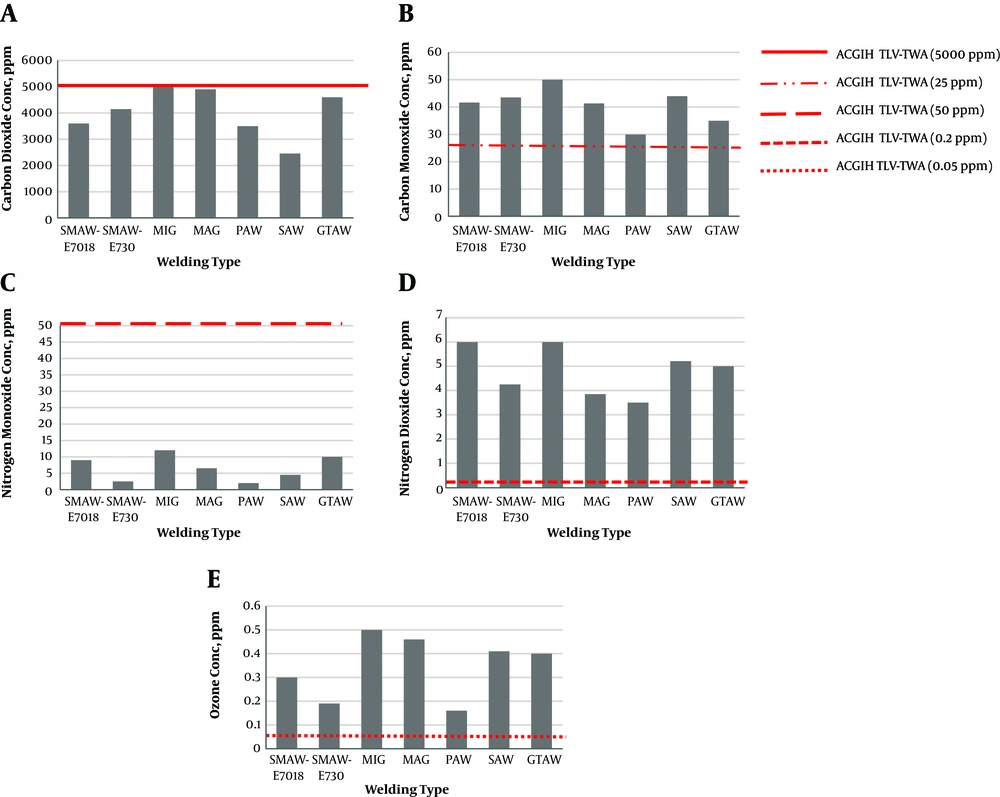
Figure 1.
Average concentration of gas contaminants in various welding processes. A, Average CO2 concentration in ppm; B, Average CO concentration in ppm; C, Average NO concentration in ppm; D, Average concentration of NO2 in ppm; E, Average concentration of O3 in ppm.
The maximum concentrations of exposure to NO, NO2, CO, CO2 and O3 gases were observed in welders of metal arc welding under metal inert gas (MIG). On the other hand, welders in metal plasma arc welding (PAW) had the lowest concentration of exposure to NO2, CO, CO2, and O3 gases among all the welders. The lowest NO concentration was observed in the plasma arc welding (PAW) process.
Table 2 demonstrates hazard rate (HR), exposure rate (ER), quantitative risk rating, and qqualitative risk rating of exposure to gas contaminants in the various welding processes under study.
Table 2.
The Results of Risk Assessment of Gases in a Variety of Welding Processes
| Welding Processes | Gases | |||||||||||||||||||
|---|---|---|---|---|---|---|---|---|---|---|---|---|---|---|---|---|---|---|---|---|
| CO | CO2 | NO | NO2 | O3 | ||||||||||||||||
| HR | ER | RP | R | HR | ER | RP | R | HR | ER | RP | R | HR | ER | RP | R | HR | ER | RP | R | |
| SMAW-E7018 | 4 | 4 | 4 | H | 2 | 3 | 2.4 | L | 1 | 1 | 1 | N | 4 | 5 | 4.47 | VH | 5 | 5 | 5 | VH |
| SMAW-E730 | 4 | 4 | 4 | H | 2 | 3 | 2.4 | L | 1 | 2 | 1.4 | N | 4 | 5 | 4.47 | VH | 5 | 5 | 5 | VH |
| SMAW-E730 | 4 | 4 | 4 | H | 2 | 3 | 2.4 | L | 1 | 2 | 1.4 | N | 4 | 5 | 4.47 | VH | 5 | 5 | 5 | VH |
| MIG | 4 | 4 | 4 | H | 2 | 4 | 2.82 | M | 1 | 3 | 1.73 | L | 4 | 5 | 4.47 | VH | 5 | 5 | 5 | VH |
| MAG | 4 | 4 | 4 | H | 2 | 3 | 2.4 | L | 1 | 1 | 1 | N | 4 | 5 | 4.47 | VH | 5 | 5 | 5 | VH |
| PAW | 4 | 3 | 3.46 | M | 2 | 3 | 2.4 | L | 1 | 1 | 1 | N | 4 | 5 | 4.47 | VH | 5 | 5 | 5 | VH |
| SAW | 4 | 4 | 4 | H | 2 | 3 | 2.4 | L | 1 | 2 | 1.4 | N | 4 | 5 | 4.47 | VH | 5 | 5 | 5 | VH |
| GTAW | 4 | 4 | 4 | H | 2 | 3 | 2.4 | L | 1 | 2 | 1.4 | N | 1 | 2 | 4.47 | VH | 5 | 5 | 5 | VH |
Abbreviations: H, High; L, Low; M, Medium; N, Negligible; VH, Very High.
The highest risk rating in all seven types of welding belonged to ozone and nitrogen dioxide with very high- risk ratings. Among the gases under study, the rating risk of exposure to carbon dioxide was low. In addition, the lowest exposure risk level in all types of welding was related to the monoxide nitrogen, with “negligible” risk rating. Carbon monoxide had high- risk rating in all types of welding except in plasma arc welding (PAW).
5. Discussion
As the number of steel industries is increasing, the risk of exposure to related materials also increase (18). Welding gases can easily enter the respiratory system and harm the health of the welders. Various studies have conducted on the assessment of the risk of chemical contaminants that are generated during the welding process, especially fumes. However, no study has been done to determine the occupational risk of the welders in the steel industry who are exposed to gas contaminants in a variety of welding processes.
Welders in the steel industry are mainly exposed to five gaseous pollutants of NO, NO2, CO, CO2, and O3. After examining the sampling results of a variety of welding processes (seven types), it was found that MIG welding welders had been exposed to a significant concentration of gases in comparison with other welders (Table 1). The reason can be the duration of the work at the welding station, use of protective gas, lack of local ventilation system at the welding station, and the location of the welding site. Findings of the present study indicated that the values of CO, NO2, and O3 gases were higher than TLV-TWA, so that the measured concentrations of NO2 and O3 were, respectively, 24 and 7 times higher than the occupation limit. The reason might be welding in the warm areas of steel industry, the duration of continuous welding, the high electrical voltage in welding operation, the indoor and covered area of welding sites, and lack of local ventilation at the welding site.
In this regard, in 2004, a study was conducted in the Netherlands by Vander et al. on welders welding with MIG and TIG coated electrodes. The results showed that the mean values of the measured NO, NO2, and O3 had higher O3 levels above the TLV-TWA (19). In the present study, the mean value of concentration of exposure to NO and CO2 is less than the TLV-TWA, which is not consistent with the results of Golbababaei et al. (2012). They found that exposure to welding pipelines with above-mentioned gaseous pollutants is lower than the occupational exposure limit (16).
The results of the SQRCA risk assessment method (Table 2) showed that the MIG welders, compared to other types of welding, are highly vulnerable to the gaseous pollutants with very high-risk levels. This is consistent with the values obtained from measuring gases in different welding types under study. NO2 and O3 have very high- risk levels in all other types of welding. In this study, the risk exposure for NO was negligible. Furthermore, it was found that the results of the semi-quantitative risk assessment of exposure to the gases are consistent with the results of gas measurements.
Semi-quantitative risk assessment results of chemical exposure showed that the workplace risks can be favorably prioritized and the necessary control measures can be provided. In this regard, in addition to air sampling and biological monitoring, semi-quantitative risk assessment must also be used for the activities that possibly contaminate the area with high viscosity. Moreover, respiratory protective equipment and amendments of work procedure should be considered to decrease the levels of exposure.
5.1. Conclusion
The present study found that the welders are in direct contact with the produced gases during the welding process, specifically during MIG welding. Results of this semi-quantitative risk assessment also showed that some gases, particularly CO, NO2, and O3, in all types of welding have a very high-risk rating. Therefore, it is essential that periodic monitoring of gaseous pollutants be performed regularly in the ambient air of these welding workshops and also risk assessment be conducted regularly on the welders.