
1. Background
Sedentary behavior is a risk factor for a wide variety of chronic diseases. A sedentary lifestyle is particularly associated with negative health consequences and chronic diseases such as cardiovascular diseases, diabetes, and some cancer types (1). Sedentary behavior refers to any activity characterized by energy expenditure ≤ 1.5 metabolic equivalent of task (MET) and a sitting or reclining posture (2). Studies indicated that sitting at work and spending time at the desk are increasing. Despite a widespread awareness of the health benefits of physical activity (PA), the rates of inactivity and sitting for prolonged periods of time remain high. For the people who sit most of a day, the risk of heart attack is similar to that of smoking (3). Ryan et al., indicated that 25% - 67% of sitting time accumulates in the events take longer than the minimum recommended durations (4). It is evident that office staff spends about 77% of the working time over uninterrupted sedentary behaviors (5). Findings from Iran indicated that the average time of PA among Iranian females was 9.1 hour/week (6).
Work time is an appropriate opportunity for the interventions aiming to reduce sitting time and increase PA. The workplace is considered as a key setting in the promotion of PA (7, 8), since interventions in the workplace facilitate a greater proportion of the population. Also, it provides access to the staff in a controlled environment through online social groups (8). However, the sedentary nature of many jobs and tasks is the feature of the contemporary workplace (9). People who work in a sitting position for prolonged periods are at double risks for the chronic diseases compared with the ones who are physically active at work (10). The need to counteract the changing nature of work and promote PA in the workplace is evident (11).
Teachers are identified as an at risk group since they spend more than 57% of their work time in sitting position; on the other hand, female teachers are a large group with the capacity of influencing their children, parents, and the wider community of students (10).
A study by Evans et al., (5) indicated that installation of Point-of-choice prompting software on computers, which recommends taking a break from sitting, was effective, but not significant in comparison with mere education to reduce uninterrupted sedentary behavior. A review study by Shrestha et al., (12) indicated that the workplace interventions such as walking during breaks, providing information and counseling, sit-stand desks, providing swinging foot pedals under a workstation desk plus information had a small positive effect on the reduction of sitting time at work. However, results of different researches in this area are contradicted. A study showed that the pedometer-based walking program plus consultation can increase the level of PA (13). Also, the role of peers, as a social factor, in commitment to PA program was reported significant, enjoyable, and even motivating for the ones who are engaged in such interventions (6). Perhaps a supportive peer is associated with increased PA (4).
Studies reported lack of appropriate environment, organizational impediments, and lack of promotion and support as the frequently mentioned barriers to PA (14). Since people spend a lot of time sitting at workplace, it is worth focusing on the increase of PA and decrease of sitting time at workplace. On the other hand, in the small cities such as Jolfa the number of gym clubs accessible for females is so small; hence, it is difficult to motivate them for PA in an available and convenient situation. Designing interventional PA programs particularly for females at workplace, as a novel intervention, are expected to keep them most interested in changing the sedentary behavior, and motivate them to decrease sitting time at workplaces. The current study hypothesized that providing an appropriate workplace environment through a social support strategy could help female teachers to improve their PA levels. The present study aimed at promoting PA and decreasing the sitting time at workplace through providing social support as the key strategy (15) among female teachers.
2. Methods
2.1. Study Design
The study was a randomized, controlled trial conducted from September to December 2014 in Jolfa, East-Azerbaijan, Iran. The study was designed to assess the effects of a supportive workplace and peer supports on sitting time among female teachers. The main outcomes were a decrease in sitting time and increase in PA among the subjects. The study was conducted in an 8-week intervention, since the results indicated the early effect of PA intervention on sedentary behaviors (16).
2.2. Participants and Recruitment
A total of 261 female teachers from 16 primary and secondary schools were invited to participate in the study. The schools were randomly assigned to intervention (n = 8) or control (n = 8) groups. All teachers in both schools were informed about the study objectives and those who were interested to participate in the study were given face-to-face information about the study procedure. Participants were the female teachers from schools in Jolf. Based on the inclusion criteria, all the female teachers who signed the informed consent forms and were capable of attending to PA aerobic classes were enrolled in the study. The exclusion criteria were the history of chronic diseases and being pregnant. Participants were assessed twice, at baseline and after an 8-week intervention program.
2.3. Procedures and Intervention
The study flowchart including samples enrollment, data collection, and follow-up assessment are presented in Figure 1. The intervention program was consisted of 2 components: attending aerobic and muscle stretch exercise sessions, and forming social groups to support PA both at school. During the 8-week intervention, teachers voluntarily attended to aerobic or mild stretch exercise sessions twice a week at schools; in addition, participants in intervention group were encouraged to develop social support groups. Teachers in each group participated in formal discussion groups. Knowledge and information about overcoming barriers to exercise and negative perception about PA, health benefits of PA, risks of sedentary lifestyle, the role of peers to decrease sedentary behavior and support PA were discussed every week in the meetings held at schools. Every week participants in the intervention group received information about health and PA with a tip on how to decrease sitting time, increase PA in the daily life, and support each other. A trained research assistant expedited the group performances via guiding and supporting the groups, separately.
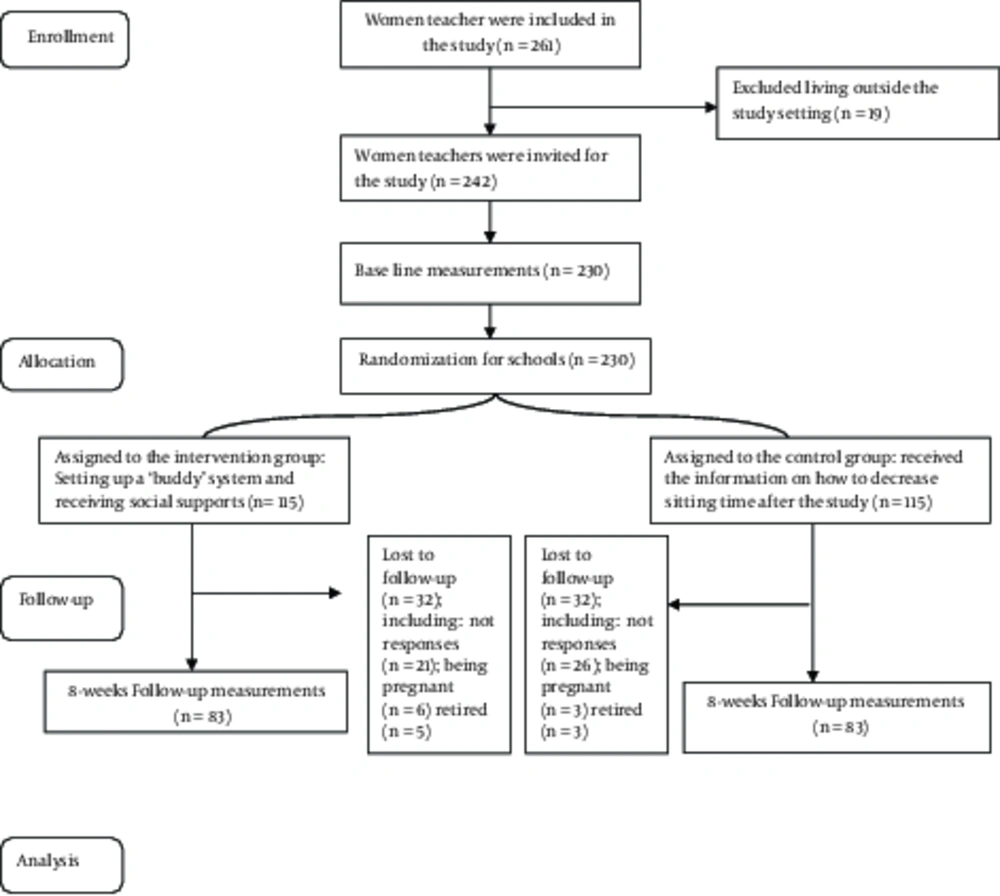
Figure 1.
The Study Flowchart
The social support groups were concentrated on the promotion of PA through creating, strengthening, and maintaining online social groups, which provided supportive relationships to decrease sitting time (e.g., setting up a buddy system, making a contract with each other in order to decrease sedentary time, and participating in the activities, talking about how to decrease sitting time, setting up walking and mountaineering groups to strengthen friendship and supportive behaviors). The promotion was achieved by creating new online social groups or exploiting pre-existing groups in the workplace. Participants in the intervention group were encouraged to support and motivate each other in order to reduce sitting time and talk more about the negative impacts of prolonged sitting. In fact, the PA location was an unused room in the school equipped for aerobic exercise and onsite fitness facilities for the teachers. The control group only received the information about the ways to decrease sitting time after the study, as well as exercise and onsite fitness facilities at work.
2.4. Outcome Measures
The outcomes were change in sitting time and PA. A self-reported questionnaire consists of 3 parts was used at baseline and after the intervention. The long-form of the international PA questionnaire (IPAQ) was used to evaluating sitting time and the level of PA among subjects. Cronbach’s alpha coefficient (0.7) of IPAQ indicated a good internal consistency and the Spearman-Brown correlation coefficient (0.9) showed good test-retest reliability for the instrument (16). The questionnaire evaluates PA at work, during leisure time, transportation, domestic and gardening activities, and also the time spent sitting. Total scores for PA were calculated in MET. Furthermore, the walking, as well as moderate, vigorous, and total PA were measured based on the IPAQ protocol. The self-reported PA level was classified as low (MET ≥ 600), moderate (600 < MET < 3000) and vigorous (MET > 3000) (15). The MET is a physiological measure expresses the energy cost of PA and is defined as the ratio of the work metabolic rate to the resting metabolic rate. The IPAQ was confirmed as a valid and reliable instrument to assess PA. The validity and reliability of the Persian version of the questionnaire was well documented (16-18).
The Sallis social support scale was also used to assess social support for exercise behaviors in the peers as well as the subjects. The scale consists of 5 separated items on the level of support provided by friends and colleagues; the scale was validated and its reliability was confirmed in Iran (19). The internal consistency as well as reliability of the scale was confirmed by Cronbach’s alpha = 0.81. Participants were also asked about demographic variables including age, level of education, marital status, occupational status, and number of children.
2.5. Randomization
Randomization was carried out after baseline measurements. The schools were randomly assigned to 2 trial arms. The study was performed on equal groups formed based on the random allocation (allocation ratio 1:1). All eligible female teachers completed the scale at baseline and then, were allocated to either intervention or control groups.
2.6. Ethics
The study protocol was approved by the ethical committee of Tabriz University of Medical Sciences, Tabriz, Iran.
2.7. Statistical Analysis
Data were expressed as number (%), median (max, min) and mean (standard deviation (SD) for categorical, as well as non-numeric and numeric variables, respectively. The Kolmogorov-Smirnov test was used to assess the normal distribution of the data. To compare the demographic and baseline variables between the 2 groups, the independent samples t test, the Mann-Whitney U and Chi-square tests were used. The paired samples t test and the Wilcoxon signed-rank test were used for the intragroup comparison of pre- and post-intervention measures. Analysis of covariance (ANCOVA) was exploited to compare the main outcomes between the groups by adjusting the effect of demographic variables and baseline measurements. All analyses were performed with SPSS version 15.0. P value < 0.05 was considered as significant level.
3. Results
Participants’ characteristics in the intervention and the control groups are shown in Table 1. The mean age (SD) of the participants was 42 (5.4) years. There were no differences between the intervention and control groups in terms of demographic variables and baseline PA domains (Table 2). The pre- and post-intervention comparisons of PA domains between the intervention and control groups are presented in Table 2.
| Variables | Total (N = 230) | Intervention Group (N = 115) | Control Group (N = 115) | P Value |
|---|---|---|---|---|
| Age, y | 42 ± 5.4 | 42 ± 5.4 | 42.1 ± 5.4 | 0.856 |
| Education | 1.000 | |||
| Diploma | 6 (2.6) | 3 (2.6) | 3 (2.6) | |
| Associated degree | 69 (30) | 35 (30.4) | 34 (29.6) | |
| BSc | 142 (61.7) | 71 (61.7) | 71 (61.7) | |
| MSc and PhD | 13 (5.6) | 6 (5.2) | 7 (6.1) | |
| Marital status | 0.409 | |||
| Single | 14 (6) | 9 (7.8) | 5 (4.3) | |
| Married | 216 (93.9) | 106 (92.2) | 110 (95.7) |
aData are expressed as No. (%) and mean ± SD.
bP value based the paired samples t test.
Table 2.
Comparison of PA Domains and Time Spent Sitting at Pre- and Post-Interventiona
| PA Domain | Pre-Intervention (N = 115) | Post-Intervention (N = 115) | P Valueb |
|---|---|---|---|
| PA at work, Mean MET- minute/week, max, min | |||
| Intervention | 112 (0, 3290) | 399 (56.5, 4929.5) | < 0.001 |
| Control | 153 (0, 4290.5) | 154 (0, 1630) | 0.024 |
| P value | 0.414 | 0.024 | |
| PA during domestic and gardening activities, MET- minute/week, max, min | |||
| Intervention | 935 (0, 13900) | 1014 (55, 7300) | 0.06 |
| Control | 955 (90, 9740) | 1030 (135, 7145) | 0.51 |
| P valuec | 0.732 | 0.380 | |
| PA during leisure time, MET- minute/week, max, min | |||
| Intervention | 231 (0, 3185) | 913 (169.5, 2985) | ≤ 0.001 |
| Control | 226 (135, 7260) | 280 (0, 330) | 0.42 |
| P value | 0.985 | ≤ 0.001 | |
| PA during transport, MET- minute/week, max, min | |||
| Intervention | 165(0, 782) | 293(0, 1980) | ≤ 0.001 |
| Control | 132(0, 2046) | 132(0, 1782) | 0.434 |
| P value | 0.541 | ≤ 0.001 | |
| time spent sitting, hour/week, mean ± SD | |||
| Intervention | 25.84 ± 1.49 | 19.37 ± 1.02 | ≤ 0.001 |
| Control | 25.02 ± 1.34 | 24.37 ± 1.16 | 0.217 |
| P valued | 0.658 | 0.027 |
aP value based on the Wilcoxon test.
bP value based the paired samples t test.
cBased on the Mann-Whitney U test.
dP value based on the independent t test.
A significant increase in PA at work was observed among the participants in both intervention and control groups, however, the results were in favor of the intervention group (at baseline: 112 versus 153 MET-minute/week; after intervention: 399 versus 154 MET-minute/week) (P < 0.05). PA during domestic and gardening activities increased in the intervention group (at baseline: 935 versus 955 MET-minute/week; after intervention: 1014 versus 1030 MET- minute/week). Participants in the intervention group achieved an increase in PA during the leisure time (at baseline: 231 versus 226 ME-minute/week; after intervention: 913 versus 280 MET-minute/week) and transport (at baseline: 165 versus 132 MET-minute/week; after intervention: 293 versus 132 MET-minute/week). Considerable differences between the intervention and control groups were observed in time spent siting (at baseline: 25.8 versus 25 hours/week; after intervention: 19.3 versus 24.3 hours/week). The intragroup differences were reported for all PA domains in the intervention group. Also, there were intergroup differences in all domains of PA after the intervention, except for PA during domestic and gardening activities.
No significant differences were found in the intensity of PA between the 2 groups at baseline (Table 3). There was a significant increase in walking, as well as vigorous and total PA in the intervention group after an 8-week intervention (P < 0.05). Intragroup (the intervention group, at baseline: 12.04 ± 4.8; after intervention: 16.5 ± 2.91) and intergroup differences were significant in terms of the mean score of social support (the intervention group after an 8-week intervention: 16.5 ± 2.91 versus the control group 12.37 ± 4.1).
Table 3.
Comparison of PA Level and Social Support at Pre- and Post-Intervention
| PA Level; MET- minute/week, Max, Min | Pre-Intervention | Post-Intervention | P Valuea |
|---|---|---|---|
| Total PA | |||
| Intervention | 1953 (33, 15500) | 2976.6 (1137, 9525) | ≤ 0.001 |
| Control | 1921 (165, 10700) | 1910.5 (382.5, 8987) | 0.198 |
| P valueb | 0.908 | ≤ 0.001 | |
| Moderate PA | |||
| Intervention | 1067.5 (0, 14080) | 1420 (455, 7683) | 0.089 |
| Control | 1105 (90, 10160) | 1272 (135, 7260) | 0.754 |
| P valueb | 0.721 | 0.1 | |
| Vigorous PA | |||
| Intervention | 80 (0, 2080) | 400 (0, 5520) | ≤ 0.001 |
| Control | 120 (0, 2320) | 152 (0, 2240) | 0.193 |
| P valueb | 0.437 | ≤ 0.001 | |
| Walking | |||
| Intervention | 330 (0, 3399) | 795 (267, 3135) | ≤ 0.001 |
| Control | 313.5 (0, 5247) | 363 (0, 4917) | 0.421 |
| P valueb | 0.847 | ≤ 0.001 | |
| Social support score, Mean ± SD | |||
| Intervention | 12.04 ± 4.8 | 16.5 ± 2.91 | ≤ 0.001 |
| Control | 11.74 ± 4.7 | 12.37 ± 4.1 | 0.005 |
| P valuec | 0.642 | ≤ 0.001 |
aP value based on the Wilcoxon test.
bP value based on the Man-Whitney U test.
cP value based on the independent t test and ANCOVA.
4. Discussion
The findings of the current randomized, controlled trial showed that an 8-week supportive PA intervention positively influenced siting time and PA domains in the studied subjects. In the intervention group, the average social support and median PA showed increase. Social support plays role through the creation and maintenance of online social groups and providing supportive communications for behavior change. Such groups were already available or can be created outside the family; for example, in workplaces where friends and colleagues interact to start a behavior and support each other to achieve their predetermined goal. The progress of each person is monitored by his/her friends and they encouraged each other to continue their healthy behavior. These finding is consistent with those of other studies that showed friends, family, and social support are significantly associated with the increase of PA (20, 21).
In the current study, teachers before intervention spent a mean of 25.8 hour/week sitting. In consistent with the results of previous studies, the average siting time was 6.4 hour/day for the bank employees. The majority of studies estimated 3.5-4 hour/day as the time adult spend sitting (22, 23). The study by Robabi et al., showed that 70.2% of the bank employees had PA during the work time (24).
Studies showed that female teachers experienced lower perceived health and higher occupational stress than their male peers (25). Based on the results, PA at work was low among female teachers (25, 26). Moreover, it is evident that female teachers who worked full-time and the ones with higher experiences sat more at work, compared with their peers who were the part-time teacher and less experienced (27). Therefore, it may be useful to tailor opportunistic PA intervention strategies according to the work schedule and environment of female teachers. A similar study suggested that females spend less time sitting, while doing home duties and the taking care of children compared with the females who have a certain job. It may reflect the fact that siting time as a potential risk factor for chronic diseases seriously threats working females (1).
In the current study, PA during leisure time was low at baseline in the 2 groups, but after 8 weeks supportive intervention, the leisure time PA increased significantly. This is in agreement with the results of other studies shown that PA during leisure time was low for females (24, 27-29). The findings suggested that lower PA during leisure time can be attributed to the different roles of females as an employee, a mother, a wife, etc., which makes them spend most of the time over the tasks and allocate less time to PA at leisure. This lifestyle greatly threats females’ health (28). The result of the current study indicated that the supportive workplace intervention can potentially be effective in reducing the sitting time during leisure and improving PA.
In the present study, lower baseline PA during transport was consistent with those of other studies (29-31). It is recommended that programing to promote and support walking and cycling as daily trips can significantly provide the situation for regular PA (32). Moreover, avoiding use of vehicles has significant impact on the reduction of air pollution and traffic gam (33). The intervention might not be suitable for large cities. Thus, citizens should be persuaded to stop their cars in a far distant instead in order to walk to work (34).
Overall, a significant increase was found in the total PA between the pre- and post-intervention (1953 vs. 2976.6 MET minute/week) in the intervention group, indicating that the peer support and supportive programs at workplace may be effective to increase PA in the female teachers.
In general, Iranian female employees reported moderate level of PA, which is in agreement with the current study findings (26). The study by Joseph M. on a similar population in the US (29) reported higher levels of total PA among the subjects. This might be due to different tasks and working conditions, as well as employment rules and regulations, home responsibilities, different age groups, and the local culture among the studied populations (34-36).
Although the results of the study were promising, there were some limitations; the main limitation was the relatively small sample size, in spite of using census method. The small size of Jolfa city may cause some inevitable familiarity and informal relations, which in turn may have resulted in contamination bias.
This finding could indicate that providing a PA supportive workplace for female teachers may improve several domains of PA and prevent physical and mental problems among the subjects (37-39).
Consequently, more attention should be paid to those who need PA most. Providing a social support and extensive organizational layouts or making supportive policies for the female employees may lead to increase PA and decrease sitting time in the workplace.