
1. Background
Work activity is an important practice for an individual’s mental health, and it forms the basis for individual’s autonomy and self-esteem (1, 2). If internal and external pressures of the workplace are frequent and unrelenting, they eventually lead to burnout and change quality of work (3). Enhancing the quality of work life (QWL) is a comprehensive program, which increases employees’ satisfaction and promotes their learning in the environment and helps them manage their affairs and workloads. Lack of employees’ satisfaction with QWL is a problem, which effects almost all employees regardless of their position or status. Quality of work life is a concept, which was first proposed in the late 60s (4). The phrase ‘QWL’ has rapidly evolved in the recent years, although there is little agreement about the meaning of the phrase. The phrase has, nevertheless, at least 2 common applications: First, QWL refers to a set of outcomes for employees, such as job satisfaction, growth opportunities, psychological issues, job security, human relations of employers with employees, and a low rate of incidents. Second, QWL indicates a series of tasks or organizational functions, such as participatory management, job enrichment, and safe working conditions. In this regard, programs to improve the QWL may be considered as a strategy for human resource management to increase organizational efficiency and productivity (5).
Burnout is a condition for an employed person and is a corollary of a permanent and frequent job stress so that the person experiences energy loss (6). In fact, burnout is a form of emotional exhaustion combined with psychological pressure or stress of job and work environment (7). Nurses play a vital role in the healthcare system of countries (8). They are the largest work group in hospitals that facilitate health care (7). The professional responsibility of nurses, as one of the most important members of the healthcare team, is to maintain and improve the quality of healthcare within standard limits (9). Nurses are among individuals, who have close contact with other medical staff and the patients. They bear a responsibility for people’s health and life. They visit patients every day and help them combat incurable diseases, therefore, they continually experience intense stress (7). Burnout syndrome may result in incidents, the most important being reduction in physical and mental health among nurses, absence from workplace, career move, compromising the quality of patient care, and a decrease in patients’ satisfaction (4, 7, 10). International studies have shown that the prevalence of burnout ranges from 30% to 80% among nurses (11). Needless to say, burnout leads to a decline in the quality and quantity of healthcare services. Therefore, further identification of factors influencing burnout could help promote better health and services in this regard (12).
Since burnout impacts the quality of patient care, better identification of influential factors would be beneficial to enhance the quality of health care and treatment services (13). Besides, achieving organizational goals depends on factors, such as QWL of the workforce. Therefore, one of directors’ duties, to achieve the goals of the organization and to please its members, is to recognize the QWL of the staff and to be cognizant of its impacts on the organization (14). A research conducted by Selahattin Kanten et al. (2012) on the relationship between QWL and individuals’ professional commitment indicated a significant and positive relationship between these 2 variables (15). A research by Kitaoka and Masuda from Japan, conducted during year 2012, for example, showed that approximately 36% of human services professionals, such as nurses, were burned out compared to 18% of civil servants, and 12% of company employees. It was quite obvious that nurses are prone to burnout. Similarly, another research by Hayes et al. conducted during year 2012 on hemodialysis nurses reported an acceptable level of job satisfaction, and that nurses perceived their work environment positively, although high levels of burnout was found. Nurses, who were older and had worked in the hemodialysis unit the longest had higher satisfaction levels, experienced less stress and lower levels of burnout than younger nurses (13).
A plethora of studies has been carried out on burnout as well as QWL among nursing staff. A total of 65 female RNs that participated in discussions reported that QWL for nurses meant keeping a good balance between work and personal life: That is, their free time should not be affected by their work (16). In a study conducted by Ya-Wen Lee et al. (2011) a ‘low’ QWL among nurses was reported (5). Despite several studies on burnout and QWL (1, 17-19), researchers have not found any articles conducted in nursing on the relationship and influence of these 2 variables on each other.
2. Objectives
Several studies have been conducted on burnout in nurses and have found that within the same working condition, people do not necessarily experience burnout to the same extent. In other words, burnout emerges from the interaction of many factors, such as individual, professional, and personality characteristics. Burnout in nurses varies based on their personality traits and their age. No study seems to have been conducted in nursing on the relationship and influence of these 2 variables on each other. This study evaluated the relationship between QWL and burnout among nurses of Shahroud Imam Hossein hospital during year 2015.
3. Methods
3.1. Study Design
This study was a cross-sectional research. The population included nursing staff of various wards at Imam Hossein hospital affiliated with Shahroud University of Medical Sciences. The study used convenient sampling and was conducted according to the specifications of the subjects and their willingness to participate in the study. Inclusion criteria included at least a one-year job experience for participants. In order to collect data, researchers first sought and received permission from university officials and then went to Imam Hossein hospital of Shahroud, during year 2014. Attending the aforementioned hospital in the morning, afternoon, and evening shifts during the weekdays, the researchers distributed questionnaires among nurses, who were willing to participate in the research, and explained the objectives of the study. These questionnaires were completed and returned in the following days. Because of limitations of the sample size for sampling, convenience method was used. Thus, the subjects were given ample opportunity to fill in the questionnaire.
3.2. Measures
Data collection instruments, included a personal demographic and social form, the QWL questionnaire, and burnout inventory. The personal demographic and social form included variables of age, gender, level of education, marital status, number of children, work experience, shift work, number of shifts per month, and type of ward. The questionnaire on the QWL was based on the model developed in 1973 by Richard Walton and had 24 questions on a 5-point Likert scale, which measured eight components of QWL, including fair and adequate income, safe and healthy workplace environment, providing opportunities for growth and job security, adherence to rules and regulations of the organization, social dependence on work life, overall atmosphere of life, social integration, and development of human capacities. Levels of QWL in this scale were identified at low, medium, and high levels (WR 1973). Shakernia et al. (2010) used facial validity to determine the validity of the questionnaire and applied test-re-test to measure the reliability. The correlation coefficient was obtained as 0.9, which showed a desirable correlation of the questions. A preliminary study was conducted to determine the reliability of the QWL questionnaire, by which a Cronbach’s alpha of 0.95 was calculated (20). The third instrument was the Maslach burnout inventory, which was used to evaluate burnout. This inventory had 22 questions. Nine questions assessed emotional exhaustion, 5 questions measured depersonalization, and 8 questions evaluated personal accomplishment (21). Khaghanizade et al. (2008) calculated the burnout internal reliability for each of the subtests and reported the internal reliability of the questionnaire with a Cronbach’s alpha of 0.71 to 0.90 and a test-re-test coefficient of 0.60 to 0.80. In addition, this questionnaire has been frequently used by Iranian researchers and according to the available reports, it has been confirmed with a scientific reliability of more than 0.90. Validity was determined by content and face methods (22). Two scales can be used for this questionnaire, including the frequency scale (number of times in a month) and the intensity scale (intensity each time). The frequency of these feelings ranged from 0 to 6 (never, few times a year, once a month, a few times a month, once a week, several times a week, and every day, respectively) and the emotional intensity ranged from 0 to 7 (never, very low, low, sometimes, often, high and very high, respectively).The sub-score obtained in each of these 3 dimensions (emotional exhaustion, depersonalization and personal accomplishment, respectively) is placed in 3 categories of low, medium or high based on the criterion score. A high mean score for emotional exhaustion and depersonalization and a low mean score for personal accomplishment would indicate a high degree of burnout. In regards to severe, moderate, and mild categories for burnout, Maslach and Jackson performed this test on large groups of occupations, based on which, the following classification was obtained for the subscales of the test.
Emotional exhaustion: High: A score above 30 for frequency and above 40 for intensity. Medium: A score between 18 and 29 for frequency and between 26 and 39 for intensity. Low: A score below 17 for frequency and below 25 for intensity.
Depersonalization: High: A score above 12 for frequency and above 15 for intensity. Medium: A score between 6 and 11 for frequency and a score above 15 for intensity. Low: A score below 5 for frequency and below 6 for intensity.
Personal accomplishment: High: A score below 33 for frequency and below 36 for intensity. Medium: A score between 34 and 39 for frequency and between 37 and 43 for intensity. Low: A score above 40 for frequency and above 44 for intensity (21).
The minimum score of the questionnaire is zero and maximum score is 126.
3.3. Statistical Analysis
To analyze the data, descriptive statistics (absolute and relative frequencies, and mean and standard deviation) and inferential statistical tests were used. To determine the relationship between burnout and QWL, independent t-test and chi-square test were used.
In order to assess the impact of burnout on QWL, the Stata software was used to examine the relationships between variables using the linear regression SEM. Burnout was considered as a latent variable and its dimensions were viewed as observed variables. The relationship between QoL and burnout was assessed with linear regression. The goodness of fit of the SEM model was assessed by the χ2 test.
4. Results
4.1. Patient Characteristics
A total of 134 nursing staff participated in this study. The majority of nursing staff (n = 118) under study were females (88.1%). Most of the nursing staff (n = 89) in this study were married (66.4%). The mean age was 30.48 and the Standard Deviation (SD) was 6.39 years. Among the participants, 128 (95.5%) had an MSc degree, 62 (46.3%) worked in special care units (CCU, ICU, emergency room, and dialysis room), 39 (29.1%) worked in medical wards, and 33 (24.6%) worked in surgical wards. In terms of employment status, most of the staff (87; 64.9%) were tenured or contractual, and almost 102 of these staff (76.1%) showed interest in their jobs. Considering staff’s shift work, 17 (12.7%) performed morning shifts and 117 (87.3%) were on rotation (evening, night, morning, and night). The mean work experience of the staff was 7.7 with an SD of 6.64 years.
4.2. Quality of Work Life
The results showed that the mean score of QWL among the majority of the nurses under the study (n = 121), (90.3%) was moderate.
4.3. Burnout and Dimensions
The mean score of burnout in terms of frequency in emotional exhaustion dimension was moderate (45.5%). In the depersonalization dimension, the majority of participants had a high score (99.3%) and in personal accomplishment dimension, all participants were in the high group (100%). In terms of intensity, in emotional exhaustion dimension, nearly half of participants (42%) were in the Low Group, in depersonalization dimension, nearly all participants (99.3%) were in the high group, and in personal accomplishment dimension, all participants (100%) were in the high group.
4.4. Demographic variables and Quality of Work Life
In examining the relationship between demographic variables and QWL, t-test results indicated a significant difference in the quality of life in nurses in terms of their interest in their job. Nurses, who were interested in their job, had a higher quality-of-work-life mean score. There was no significant association between other variables.
4.5. Demographic Variables and Burnout
Findings of the present study demonstrated that the rate of burnout and its dimensions in terms of demographic variables, including educational level, number of children, and job interest, had a significant difference so that individuals with a higher number of children, less education and less job interest reported a higher burnout. Furthermore, an inverse and significant correlation was found between the overall score of QWL with depersonalization and emotional exhaustion and a positive and significant correlation with personal accomplishment.
4.6. Quality of Work Life and Burnout
The relationship between QWL and burnout was analyzed using linear regression in structural equation model (SEM). In the primary model, burnout (latent variable) was entered as the dependent variable and predictors of the model were QWL, gender, and professional factors. The results of this model showed that gender and professional factors, such as job interest, time-period of employment (years), and number of shift work did not have a significant relationship with burnout. In this model, there were 3 observed variables that recorded the person’s burnout. One was the intensity of personal accomplishment (SBD), another was based on the intensity of emotional exhaustion (SBE), and the last was based on the intensity of depersonalization (SBF). These 3 variables formed the latent variable burnout. The other exogenous variable was the person’s QWL. This variable (QWL) is treated as a predictor of burnout. In the final model, the relationship between burnout, as a latent variable, and QWL, as a predictor, was evaluated with a SEM regression model. The final model is presented in Figure 1. In this model, a negative and significant relationship was observed between QWL and burnout so that with an increase in QWL, burnout decreased. Results of regression and SEM are presented in Table 1.
Table 1.
Linear Regression Coefficients in Structural Equation Model Model (SEM) on the Relationship Between Quality of Work Life and Burnout
| Variable | β | SE | P Value | Standardized β |
|---|---|---|---|---|
| Quality of Work Life | -0.123 | 0.053 | 0.022 | -0.29 |
| Burnout | ||||
| The intensity of personal accomplishment | 1 | - | - | 0.57 |
| The intensity of emotional exhaustion | 2.2 | 1.01 | 0.03 | 0.83 |
| The intensity of depersonalization | 0.34 | 0.2 | 0.08 | 0.19 |
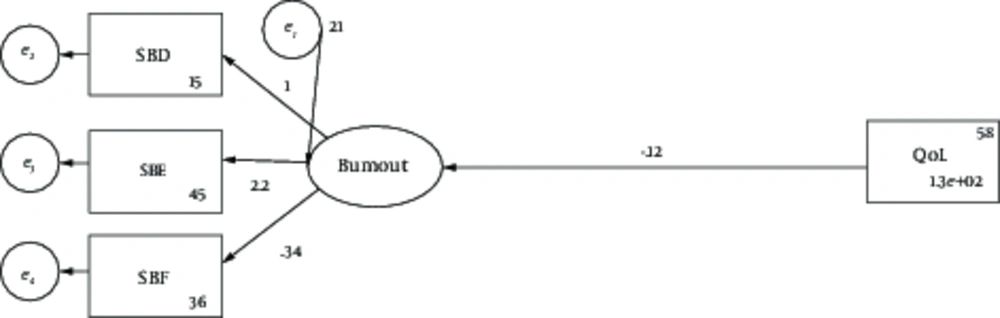
Figure 1.
Structural-Equation Modeling Modeling Regression Diagram of Quality of Life and Burnout as Latent Variables Among the Nurses
5. Discussion
The results showed that the mean score of the QWL among the majority of nurses was moderate. In a study conducted by Ya-Wen Lee et al. (2011), a ‘low’ QWL among nurses was reported (5). Implementing different strategies to improve the QWL based on developing and improving standards of workplace in organizations could bolster employees’ morale and ultimately enhance the quality of care they deliver (19, 23).
In terms of frequency and intensity of burnout in ‘personal accomplishment’ and ‘depersonalization’ dimensions, most participants were placed on a high level. The rate of burnout was reported differently in various studies. Lopez France et al. (2005) reported a low rate of burnout among nursing staff for ‘emotional exhaustion’ and ‘depersonalization’ dimensions and a high rate of burnout for ‘personal accomplishment’ dimension (24). In a study carried out by Gary Morris Lang et al. (2010) on burnout in nurses working at army hospitals, ‘emotional exhaustion’ and ‘depersonalization’ dimensions were reported to be ‘low’, which were different from the results of the present study. It seems that different factors, such as nurses’ salaries and maintaining nurse-to-patient-ratio standard are among the probable causes of this discrepancy (25). In the ‘emotional exhaustion’ dimension, moderate to severe levels of emotional exhaustion could be due to role conflict and role ambiguity, undertaking excessive workloads, intrapersonal and interpersonal conflicts, lack of autonomy and reward. Moreover, as emotional exhaustion continues, mental ability decreases, so that people feign nonchalance combined with extreme indifference towards the client and their careers. Therefore, depersonalization can be seen as a way to cope with emotional exhaustion. Among the consequences of emotional exhaustion and depersonalization, are factors such as reduced self-esteem, low job satisfaction, shirking organizational responsibilities, career move, and giving up the job (17, 24). Burnout leads to many adverse consequences and imposes costs on organizations and staff, such as frequent change of career and workplace, absenteeism, a reduction in quality and quantity of work, which result in adverse effects on proper care of the patient. High prevalence of burnout in personal accomplishment dimension requires special attention and effective interventions. Among such interventions could be institutional interventions, such as encouraging teamwork, asking staff to join decision-making processes, and reduction of job conflicts (17).
In addition, analyzing the relationship between demographic variables and burnout and its dimensions, there was a correlation among the 3 variables of educational level, number of children, and job interest. Burnout was reduced with an increase in educational level. Those with less education were less credible in the workplace than those with higher education. Studies have shown that people with lower credit experienced greater mental stress (15, 26).
Burnout increased with an increase in the number of children. It was also shown that the ability to control job events is among the most important factors affecting personal accomplishment. Problems such as parents’ stress for children and parents’ mental conflicts in dealing with family affairs prevented them from proper control over such events. Therefore, it could be concluded that the majority of nurses would not be able to prove their competence in the workplace and this might be due to the lack of positive working conditions in the work environment (24).
Those interested in their jobs revealed a lower burnout. High levels of burnout could be indicative of a negative attitude towards oneself and one’s job, lack of interest and satisfaction towards the job, and a low self-confidence (17, 24).
A reverse correlation was observed between QWL and burnout so that with an increase in QWL, burnout decreased. A research conducted by Selahattin Kanten et al. (2012) on the relationship between QWL and individuals’ professional commitment indicated a significant and positive relationship between these 2 variables (15). Determining the QWL is one of the most important factors, which helps modify and develop organizations. Today, improving employees’ satisfaction of their QWL is essential for any organization to attract and keep employees. Most people with burnout psychologically experience reticence and organizational isolation. In order to escape the consequences of burnout, these people sought new administrative jobs and roles or looked for a change of career (16). If fact, burnout among nurses is deemed to be malicious and destructive. It damages both physical and mental health systems and prevents the growth of nurses’ profession. According to the items under the study, it could be suggested that nurses’ QWL will be remarkably improved if the behavior of the superiors (head nurses, supervisors, etc.) is fair so that nurses can put forward their ideas and suggestions without a risk of losing their jobs, if they are paid fairly and well for the job they perform, if they are provided with a relatively comfortable and secure workplace environment, and if the number of nursing staff is increased to reduce the heavy workload (13, 27). According to the results of this research, which indicate the impact of QWL on burnout in nurses, interventions to improve the QWL, decrease levels of burnout, increase the level of personal advancement and ultimately provide patients with better services, are advised. The obtained results of this study can help senior managers and decision makers identify the key needs of nurses in their workplace, design strategic plans for improving QWL and reduce burnout in nurses. The main limitation of this study was the limited cooperation of nurses to fill in questionnaires due to their hectic shift work and their heavy workloads. To partially remove this limitation, the nurses were given questionnaires to fill at the right time. In the following days, nurses were asked if they had filled the questionnaires or not and the questionnaires were received this way.