
Hepat Mon

Image Credit:Hepat Mon

Persian Medicine Perspective on the Network Between the Liver and Other Organs

Author(s):
Azadeh ZareiAzadeh Zarei1, Hossein RezaeizadehHossein Rezaeizadeh1,*, Mehrdad KarimiMehrdad KarimiMehrdad Karimi ORCID1
1Department of Traditional Persian Medicine, School of Traditional Medicine, Tehran University of Medical Sciences, Tehran, Iran

Hepatitis Monthly:Vol. 21, issue 11; e123088
Published online:Apr 30, 2022
Article type:Letter
Received:Feb 21, 2022
Accepted:Mar 28, 2022
How to Cite:Zarei A, Rezaeizadeh H, Karimi M. Persian Medicine Perspective on the Network Between the Liver and Other Organs. Hepat Mon. 2021;21(11):e123088. doi: https://doi.org/10.5812/hepatmon-123088

Dear Editor,
The use of network science and graph drawing by making connections between different fields of medicine in the diagnosis and treatment of diseases called network medicine has received much attention in recent years. The relationship between various genes, pathways, and metabolites in different diseases can be determined using network science. It also identified several pathogenic causes and showed their relationship in different organs (1). The use of network medicine was first proposed by Barabási (2). In addition to the establishment of the link between a disease and various genes involved in the disease, Barabási identified the magnitude of these linkages and coined the term diseasome for the human-disease network connections (3). Currently, network medicine is widely used in the diagnosis of the causes, genes, metabolites, and pathways involved and in the next step in choosing the treatment of diseases.
More than 1000 years ago, the Persian physician Avicenna (980 - 1032) explained numerous concepts in the field of communication between organs with diseases and their causes. Although network communication between all organs is important, it is more significant in some organs due to the unique role they play in the life and survival of the individual, including the cardinal organs: the brain, heart, and liver. Therefore, from the perspective of Persian medicine, the liver plays an important role in metabolism and the whole body’s functioning (4-7).
Numerous network connections between the liver and other organs have been mentioned by the scholars of Iranian medicine, including Avicenna, which indicates that liver disorders can cause dysfunction, dystemperament, and disease in other organs of the body. The examination of this network at different levels shows that the causes of these disorders are related to each other. In other words, it can be said that a known material cause from the perspective of Iranian medicine can cause various diseases and disorders in multiple organs. The findings of conventional medicine also show the existence of common pathways, genes, and metabolites between liver diseases and disorders of other organs (8-12). Accordingly, the connections between liver diseases and other organs have been drawn based on the material causes of them from the perspective of Persian medicine. For this purpose, we used R software, which is a software and computer language for statistical data analysis and text mining and data mining capabilities that contain a wide range of statistical techniques that can be displayed with graphical capabilities.
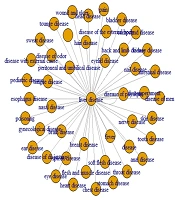
In Figure 1, nodes are different organ diseases that are connected by edges, and the edges are common material causes of organs diseases.
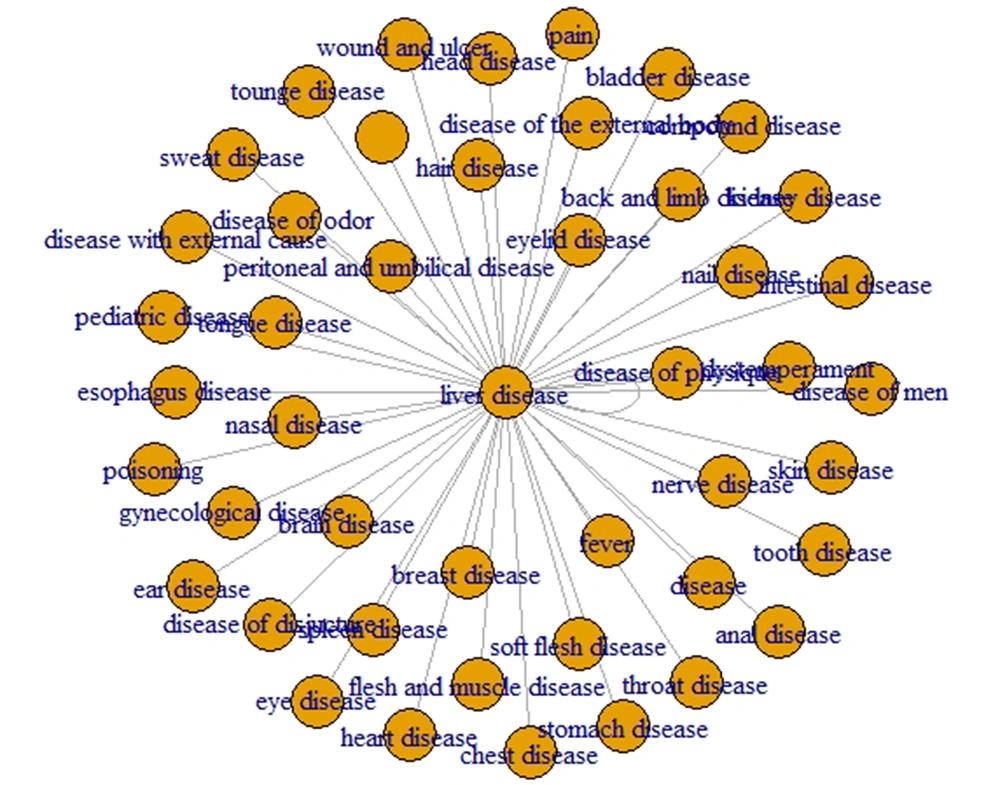
Network of liver diseases and other organs based on material causes
Figure 1.

Network of liver diseases and other organs based on material causes

In addition to the connections between the liver and other organs, there is a significant correlation between them. Because it is possible to identify the most involved organs based on the analysis of the aforementioned relationships, the magnitude of communication is very important in communication networks. For example, a stronger connection between the liver and an organ means more common causes of their diseases. Therefore, the occurrence of disease or dysfunction in the liver can indicate the occurrence of disease or disorder in those organs. This relationship will also occur in reverse. This is also more likely to occur in strong connections between the liver and some organs, such as the heart and brain (Appendix 1 in Supplementary File).
Appendix 1 shows the significance of the relationship between diseases of different organs and liver diseases based on the size and color. Accordingly, the liver is more closely linked to the brain, nervous system, heart and cardiovascular system, chest, and digestive tract. Fever is also significantly associated with liver disease. The connection mentioned in the sources of Persian medicine between the cardinal organs is confirmed by drawing this network. Moreover, in addition to using modern technologies that confirm and draw the points raised in the textbooks of Iranian medicine about the existence of a communication network between the liver and other organs through text mining methods, modern studies discover multiple axes, such as the liver-kidney axis (8), liver- brain axis (11), liver-heart axis (13), and liver-gut axis (9), confirming the theories put forward by Iranian scholars.
Although the scholars of Persian medicine more than a thousand years ago did not have access to any of today’s technologies, they enabled the researchers to currently understand the existence of this communication network based on their accurate observations. This relationship, which from their point of view is defined based on common material causes, is currently confirmed based on common genes, metabolites, and pathways.
Acknowledgments

Footnotes

References

  • 1.
    Barabasi AL, Gulbahce N, Loscalzo J. Network medicine: a network-based approach to human disease. Nat Rev Genet. 2011;12(1):56-68. [PubMed ID: 21164525]. [PubMed Central ID: PMC3140052]. https://doi.org/10.1038/nrg2918.
  • 2.
    Barabasi AL. Network medicine--from obesity to the "diseasome". N Engl J Med. 2007;357(4):404-7. [PubMed ID: 17652657]. https://doi.org/10.1056/NEJMe078114.
  • 3.
    Goh KI, Cusick ME, Valle D, Childs B, Vidal M, Barabasi AL. The human disease network. Proc Natl Acad Sci U S A. 2007;104(21):8685-90. [PubMed ID: 17502601]. [PubMed Central ID: PMC1885563]. https://doi.org/10.1073/pnas.0701361104.
  • 4.
    Avicenna. The canon of medicine. Beirut, Lebanon: Institute Dare Ehya al-Toras; 2005.
  • 5.
    Azam Khan M. [Exir Azam]. Tehran, Iran: Institute of Medical History, Islamic Medicine and Complementary Medicine; 2008. Persian.
  • 6.
    Aghili M. [Kholase al hekmah]. Qom, Iran: Esmailian; 2006. p. 35-42. Persian.
  • 7.
    Kermani NIE. [Sharh-al-Asbab V-al-Alamaat]. Tehran, Iran: Tehran University of Medical Sciences; 2004. Persian.
  • 8.
    Raj D, Tomar B, Lahiri A, Mulay SR. The gut-liver-kidney axis: Novel regulator of fatty liver associated chronic kidney disease. Pharmacol Res. 2020;152:104617. [PubMed ID: 31881272]. https://doi.org/10.1016/j.phrs.2019.104617.
  • 9.
    Tripathi A, Debelius J, Brenner DA, Karin M, Loomba R, Schnabl B, et al. The gut-liver axis and the intersection with the microbiome. Nat Rev Gastroenterol Hepatol. 2018;15(7):397-411. [PubMed ID: 29748586]. [PubMed Central ID: PMC6319369]. https://doi.org/10.1038/s41575-018-0011-z.
  • 10.
    Hernandez-Anzaldo S, Berry E, Brglez V, Leung D, Yun TJ, Lee JS, et al. Identification of a Novel Heart-Liver Axis: Matrix Metalloproteinase-2 Negatively Regulates Cardiac Secreted Phospholipase A2 to Modulate Lipid Metabolism and Inflammation in the Liver. J Am Heart Assoc. 2015;4(11). [PubMed ID: 26567374]. [PubMed Central ID: PMC4845223]. https://doi.org/10.1161/JAHA.115.002553.
  • 11.
    Ahluwalia V, Betrapally NS, Hylemon PB, White MB, Gillevet PM, Unser AB, et al. Impaired Gut-Liver-Brain Axis in Patients with Cirrhosis. Sci Rep. 2016;6:26800. [PubMed ID: 27225869]. [PubMed Central ID: PMC4880966]. https://doi.org/10.1038/srep26800.
  • 12.
    Tang TT, Li YY, Li JJ, Wang K, Han Y, Dong WY, et al. Liver-heart crosstalk controls IL-22 activity in cardiac protection after myocardial infarction. Theranostics. 2018;8(16):4552-62. [PubMed ID: 30214638]. [PubMed Central ID: PMC6134935]. https://doi.org/10.7150/thno.24723.
  • 13.
    Bellentani S, Bedogni G, Tiribelli C. Liver and heart: a new link? J Hepatol. 2008;49(2):300-2. [PubMed ID: 18554746]. https://doi.org/10.1016/j.jhep.2008.05.003.

Similar Articles

24
Jul
2018
Etiology and Therapeutic Approach to Ascites in Iranian Traditional Medicine: The Avicenna’s Perspective

Etiology and Therapeutic Approach to Ascites in Iranian Traditional Medicine: The Avicenna’s Perspective

Mohammadreza Mirzaei,
Mehrdad Karimi

Mirzaei M, Karimi M. Etiology and Therapeutic Approach to Ascites in Iranian Traditional Medicine: The Avicenna’s Perspective. Hepat Mon. 2018;18(8):e74361. doi: https://doi.org/10.5812/hepatmon.74361

13
Mar
2018

A Descriptive Study of Medicinal Plants and Polyherbal Formulation Prescribed for Patients in Persian Medicine Clinic (Salamatkadeh) Affiliated to Tehran University of Medical Sciences (2016)

Mahbubeh Bozorgi,
Elham Madreseh,
Mohammad Hossein Ayati,
Roja Rahimi

Bozorgi M, Madreseh E, Ayati MH, Rahimi R. A Descriptive Study of Medicinal Plants and Polyherbal Formulation Prescribed for Patients in Persian Medicine Clinic (Salamatkadeh) Affiliated to Tehran University of Medical Sciences (2016). J Rep Pharm Sci. 2018;7(2):e147584. doi:

31
Aug
2017

Prevention of Dystocia in Traditional Persian Medicine

Yasaman Vazani,
Fataneh Hashem Dabaghian,
Mansoor Keshavarz

Vazani Y, Hashem Dabaghian F, Keshavarz M. Prevention of Dystocia in Traditional Persian Medicine. Jundishapur J Nat Pharm Prod. 2017;12(3):e63798. doi: https://doi.org/10.5812/jjnpp.63798

19
Jul
2020
Annals of Military and Health Sciences Research

Fighting Fatigue in Military Forces

Babak Daneshfard,
Nafiseh Hosseini Yekta

Daneshfard B, Hosseini Yekta N. Fighting Fatigue in Military Forces. Ann Mil Health Sci Res. 2020;18(2):e104579. doi: https://doi.org/10.5812/amh.104579

11
Oct
2013

From the Persian Ancient Dramas, Jamm and Simurgh Toward the Modern Military Medicine

Ali Reza Khoshdel,
Mohammad Hossein Lashkari

Khoshdel AR, Lashkari MH. From the Persian Ancient Dramas, Jamm and Simurgh Toward the Modern Military Medicine. J Arch Mil Med. 2013;1(1):. doi: https://doi.org/10.5812/jamm.15082


Crossmark
Crossmark
Checking
Share on
Cited by
Metrics

Ordering Reprints

Articles are published under the Creative Commons license stated on each article. No permission or royalty fee is required for uses permitted by that license. CCC handles optional bulk and customized reprint orders. Any quotation covers production and delivery services only, not copyright permission. > Request Reprints from CCC 

Search Relations

Author(s):

Related Articles