1. Background
HCV is a global health problem with an estimated 130 million chronically infected people worldwide (1). The seroprevalence of HCV is near 0.6% in Iran (2). Unfortunately, for unknown reasons, spontaneous clearance is uncommon and most patients (50% - 85%) progress towards chronic infection, based on worldwide reports, and are subsequently at risk for liver diseases including cirrhosis and hepatocellular carcinoma (2, 3). Interferons (IFNs) are key cytokines in establishing a multifaceted antiviral response. Based on their structural features, receptor usage, and biological activities, 3 distinct types of IFNs are now recognized (Type I, II, and III) (4). In humans, Type III IFN group encompasses 3 closely related IFN-λ proteins, IFN-λ1, -λ2, and -λ3 (also known as IL-29, IL-28A, and IL-28B, respectively) that were discovered in 2003 (5). Among them, IL-28B/IFN-λ3 has shown more intensive activity against HCV. Human IL28B lies on the longer arm of Chromosome 19, on 19q13.13, and contains 6 exons (5). Innate antiviral activity induced by IFN-λ has been demonstrated against many viruses including encephalomyocarditis virus, hepatitis B virus (HBV), and vesicular stomatitis virus both in culture and animals (4-6).
There are some polymorphisms in IFN-λ3 gene including rs12980275A/G, rs8099917T/G, rs28416813C/G, and rs12979860C/T. The most important IFN-λ3 gene SNPs that showed a relationship with response to therapy and spontaneous clearance are rs12979860 C and rs8099917 T alleles.
IFN-λ is expressed in virus-infected cells, and it induces remarkable antiviral protection in a wide variety of cells, especially when cooperating with type I IFNs (4). In HCV infection, it seems to exert pivotal antiviral functions because a polymorphism near 3kb upstream of the gene appears to be linked to the outcome of infection although the mode of action is still unknown (7).
It has been reported that a number of factors including age, sex, jaundice, viral genotype, route of transmission, and coinfection with human immunodeficiency virus (HIV) or HBV affect the outcome of HCV infection as spontaneous clearance or chronic state (8, 9). However, recently some studies have confirmed the significant role of heritability and ethnicity in host immune response to HCV infection (10, 11).
Spontaneous viral clearance following acute infection is related to racial differences. Recent studies have found a predictive role for genetic variation in IL28B/IFN-λ3 gene region on Chromosome 19 in response to pegylated interferon (PEG-IFN) plus ribavirin therapy and also in spontaneous clearance of HCV infection (10, 11). This finding has since been confirmed in other independent cohorts (12). Genetic variation in the IL28B/IFN-λ3 gene, the rs12979860 C, and the rs8099917 T allele has been shown to strongly predict viral clearance (12, 13). Spontaneous clearance of HCV infection has also been reported to be associated with HLA class I and II (14, 15), IL-10 (16), IL-4 (17), IFN-γ (18), and PD-1 (17). To the best of our knowledge, few studies have been conducted on the effects of these polymorphisms on spontaneous clearance of HCV infection in Iran. Accordingly, in the present study, we explored the genotypes and allele frequency of IFN-λ3 at rs12979860C/T and the rs8099917T/G SNPs in HCV infected patients in Fars province, in South of Iran. In addition, we investigated whether their genotype and/or allele are significantly associated with HCV infection outcome: spontaneous clearance versus chronic infection.
2. Methods
2.1. Patients
In this case-control study, participants (n = 338) were recruited consecutively from the gastroenterohepatology research center at Nemazee hospital in Shiraz, Iran, from September 2012 to March 2014. In this study, 36 participants had spontaneously resolved HCV infection and 302 patients had chronic HCV infection. All the patients were negative for HBV and HIV infections and the status of HBV and HIV serology was determined based on the medical records. The HIV/HCV and HBV/HCV coinfected patients were excluded from the study. The study was approved by the hospital and the university’s ethics committee, and written informed consent was obtained from each participant before sampling.
2.2. Viral Infection State
Chronic or resolved HCV infection was diagnosed through medical records and was then confirmed by performing ELISA and RT-PCR as described before (18, 19). Briefly, all samples were screened by ELISA assay to confirm serologic state. The presence of virus genome was also evaluated by a gel-based and real-time PCR method. Briefly, a verified in-house Nested-PCR method, which was developed in our lab, was applied as a screening method (18). In addition, a commercial qualitative real-time PCR for virus detection (Amplisens HCV-FRT, Russia) was also employed. The detection limit of this virus detection kit was acclaimed to be near 10 IU/mL. Diagnosis of spontaneous clearance was based on the presence of HCV Ab, normal level of serum ALT/AST, and the negative results of qualitative RT-PCR or real-time PCR for 2 tandem samples with at least 6 months interval.
2.3. Genomic DNA Extraction and Analysis of Cytokine Polymorphisms
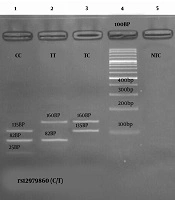
A 5 ml blood sample was drawn from each participant and placed in EDTA anticoagulant. DNA was extracted from peripheral blood leukocytes using the salting out procedure. The quality and quantity of extracted DNA were examined by a Nanodrop instrument. Polymorphism at positions rs12979860 and rs8099917 was identified using polymerase chain reaction-restriction fragment length polymorphisms (PCR-RFLP) as described by Sharafi et al. (20) with some modifications. The sequences of primers were shown at Table 1. The PCR reaction was performed in total volume of 25 μL, containing 1X reaction buffer, 200 μM of each dNTPs (Cinnagene Inc. Iran), 1U Taq DNA polymerase (Cinnagene Inc. Iran), 0.5 μM of each specific primers, 2% DMSO and 1.5 mM MgCl2, while 200 - 300 ng of template was included in each reaction for rs12979860 and rs8099917 SNPs. Then, all samples were introduced into Bsh1236I (BstUI) and BseMI (BsrDI) enzymes digestion to find polymorphisms at rs12979860 and rs8099917, respectively. The digestion pattern of each reaction was developed after the products were run on 2% agarose gel.
Table 1.
Primer Sequences and Enzyme/Methods Used for Detection of IL-28B Gene Polymorphisms by RFLP
| SNP | Primers | Enzyme |
|---|---|---|
| rs12979860 | F5'- GCGGAAGGAGCAGTTGCGCT -3' | BstUI based RFLP |
| R5'- GGGGCTTTGCTGGGGGAGTG -3' | ||
| rs8099917 | F5'-CCCACTTCTGGAACAAATCGTCCC -3' | BseMI based RFLP |
| R5'- TCTCCTCCCCAAGTCAGGCAACC -3' |
Abbreviation: RFLP, restriction fragment length polymorphism.
During the gel analysis of digestion, in the case of rs12979860 polymorphism, the presence of 241, 196, and 45bp bands was demonstrative of heterogeneous CT genotype. Sole presence of 241bp band was indicative of homozygous status for the TT genotype, and appearance of 196 and 45bp bands were demonstrative of CC.
On the other side, presence of 552, 322, and 230 bp bands pattern was an indicator of heterogenous status, GT genotype at rs8099917 SNPs. Sole presence of 552 bp band demonstrated the homozygous state for the T allele, and also the appearance of 322 and 230 bp bands reflected the GG genotype.
2.4. Statistical Method
Data were analyzed by χ2 test using EPI-Info 2000 and SPSS Version 15 softwares. To investigate the statistics of haplotype analysis, data were introduced into specific software (Arlequin 3.1 and EpiInfo). Software package was used for haplotype analysis as well. P values less than 0.05 were considered as significant.
3. Results
A total of 338 participants infected with HCV were enrolled in the present study. Of them, 296 participants (87.5%) were male and 42 (12.5%) were female. Moreover, the male to female ratios in chronic and spontaneous cleared groups were 263/39 and 33/3, respectively, which were not significantly different (P = 0.59). The mean ages of chronic and clearance groups were 39.3 and 36.5 years, respectively, and the difference was not significant (P > 0.05).
Based on the medical records, the more prevalent genotype (only from the major part of chronic cases) revealed to be Genotype 3a (51.5%), 1 (46%) and 2 (< 0.5%) in our population.
The polymorphisms of IL-28B at rs12979860 and rs8099917 SNPs were determined in 232 and 328 individuals infected with HCV, respectively. The employed genotyping method have been shown analytical sensitivity and specificity of 100% for both SNPs genotypes when compared to sequencing results (20) (Table 2).
Table 2.
IL-28B Genotypes Frequency in Chronic and Spontaneously Cleared Groupsa
| IFN-λ Genotype | Chronic | Spontaneous Clearance | P Value |
|---|---|---|---|
| rs12979860 | 0.001b | ||
| CC | 41 (20.8) | 20 (57.1) | |
| CT | 102 (54.9) | 13 (37.9) | |
| TT | 54 (22.3) | 2 (5.7) | |
| Total | 197 (100) | 35 (100) | |
| rs8099917 | 0.17 | ||
| TT | 166 (56.9) | 26 (72.3) | |
| TG | 120 (41.1) | 10 (27.7) | |
| GG | 6 (2) | 0 | |
| Total | 292 (100) | 36 (100) |
aValues are expressed as No. (%).
bWith the statistically significant value.
The distribution of cytokine genotype and allele of rs12979860C/T and rs8099917T/G SNPs in cleared patients and those with chronic infection is shown in Tables 3 and 4. Statistically significant differences in genotype and allele distribution were observed between the 2 clinical groups for IL-28B rs12979860C/T, but not for rs8099917T/G SNP.
Table 3.
IL-28B Allele Frequency in Chronic and Spontaneously Cleared Groupsa
| IFN-λ Allele | Chronic | Spontaneous Clearance | P Value |
|---|---|---|---|
| rs12979860 | 0.0007b | ||
| C | 184 (41.6) | 53 (75.8) | |
| T | 210 (58.4) | 17 (24.2) | |
| Total | 394 (100) | 70 (100) | |
| rs8099917 | 0.12 | ||
| T | 452 (77.4) | 62 (83.2) | |
| G | 132 (22.6) | 10 (13.8) | |
| Total | 584 (100) | 72 (100) |
aValues are expressed as No. (%).
bWith the statistically significant value.
Table 4.
IL-28B Haplotype Frequency in Chronic and Spontaneously Cleared Groupsa
| Haplotype | Chronic | Spontaneous Clearance | P Value |
|---|---|---|---|
| TT | 245 (31.7) | 20 (16.7) | 0.013b |
| TG | 109 (14.1) | 10 (8.3) | 0.16 |
| CT | 342 (44.3) | 80 (66.7) | 0.012b |
| CG | 76 (9.8) | 10 (8.3) | 0.75 |
| Total | 772 (100) | 120 (100) |
Abbreviations: CG, (rs12979860Crs8099917G); CT, (rs12979860Crs8099917T); TG, (rs12979860Trs8099917G); TT, (rs12979860Trs8099917T).
aValues are expressed as No. (%).
bWith the statistically significant value.
The frequency of CC genotype (57.1% vs. 20.8%) and C allele (75.8% vs 41.64%) of IL-28B at rs12979860 SNP was higher in spontaneously cleared patients compared to those with chronic HCV infection. In the case of rs8099917 SNP, no association was observed between frequency of rs8099917TT (72.3% vs 56.9%) genotype and T allele (83.2 % VS 77.4 %) in the 2 groups.
It has been reported that these polymorphisms were under linkage disequilibrium. Distribution of different haplotype frequencies in both groups is demonstrated in Table 4. The presence of CG and TG haplotype was not associated with HCV infection outcome, but the CT haplotype was more frequently present in spontaneous clearance participants than in those with chronic infection (P = 0.012, OR = 1.5 and CI = 1.19 - 2.08). On the other hand, the frequency of TT haplotype was significantly higher in chronic group than in those who spontaneously clear the infection (P = 0.013, OR = 0.53 and CI = 0.31 - 0.88).
4. Discussion
Understanding the factors that predict spontaneous clearance of HCV infection would improve clinical decision-making in the early therapeutic intervention (21). Genome-wide association studies have demonstrated that genetic variations in the region near the IL28B gene are associated with the absence of HCV RNA in anti-HCV antibody-positive individuals: presumed spontaneous HCV clearance (10).
In this study, we found that the frequency of CC genotype and C allele of IL-28B gene at rs12979860 SNP of IL-28B was significantly higher in spontaneously cleared patients compared to those with chronic HCV infection. In agreement with our results, Thomas at al. (10) found that individuals with C/C genotype at rs12979860 have strongly enhanced the resolution of HCV infection among individuals of both European and African ancestry. Moreover, it has been reported that spontaneous HCV clearance was more common in patients with the C/C genotype compared with T/T (64% versus 6%) (12). It was also shown that jaundice during acute infection was more common among patients with C/C genotype compared to non-C/C patients (32.7% versus 16.1%) (12). In addition, Falleti et al. (22) showed that the presence of the T allele was strongly associated with chronic HCV infection in Italian populations. Fabris at al. (23) reported that patients with TT genotype at the IL-28B rs12979860 SNP are more prone to get cirrhosis than those with CC or CT genotype.
Langerhans et al. reported that carriers of rs12979860 C allele constantly tended to have higher IL-29 and IL-28 serum levels than those with a T/T genotype in their study groups (7). They also demonstrated that patients with chronic hepatitis C had significantly lowered IL-29 serum levels than participants who had spontaneously cleared a previous HCV infection, and healthy controls, those with rs12979860TT genotype (7). In Iran, Sharafi et al. (24) showed that the frequency of CC genotype is higher in spontaneously cleared participants than in those with chronic HCV infection. Accordingly, we can conclude that CC genotype at IL-28B gene of rs12979860 SNP, which might be associated with higher IFN--λ level, may predispose patients to spontaneously cleared HCV infection. Many studies have also been done to find the association of this polymorphism with response to therapy (11, 21, 25, 26). In Iran, Mahboobi et al. (27) have reported that individuals with C/C and C/T genotypes of rs12979860 show higher sustained virologic response (SVR) rate compared to those with TT genotype. Rashidi et al. (28) showed that the frequency of CC genotype of rs12979860C/T in individuals with SVR was higher than in those who were unresponsive to therapy. Thompson et al. (29) reported that in Caucasians, the CC IL-28B type was associated with improved early viral kinetics and a greater likelihood of SVR compared with CT and rs12979860TT.
There was no statistically significant difference between the participants with spontaneously cleared HCV infection and those with chronic HCV infection in the frequency of alleles and genotypes at rs8099917T/G SNP of IL-28B gene. Similarly, Liu et al. (30) found no association between this polymorphism and spontaneous clearance of hepatitis C in a Chinese population. Shi et al. (31) also showed no effect of these polymorphisms on spontaneous clearance of HCV in a Chinese group. On the other hand, Rauch et al. (32) found a strong association between HCV chronicity and polymorphism at because TT genotype was associated with clearance, whereas GG was associated with chronic infection. Di Iulio et al. (13) showed a correlation of this SNP with spontaneous HCV clearance. The association of this polymorphism with clearance has been reported in uremic patients (33). According to these reports, we can conclude that in some regions and racial groups including Iran and China, polymorphism at rs8099917T/G was not associated with spontaneous HCV infection clearance, but in other areas such as the United States, Europe (13), Brazil (17), and Morocco (34) this polymorphism affects HCV infection outcome. An association between this polymorphism and response to therapy in patients infected with HCV was reported in some studies (11, 35).
Haplotype analysis based on linkage disequilibrium between SNPs is a useful method for finding predisposing genes in complex diseases. In this study, the results of haplotype analysis showed that those with CT haplotype are more prone to spontaneously clear HCV infection, but those with TT are susceptible to chronic infection after infection with HCV. In agreement with our results, Harrison et al. found that almost all individuals who spontaneously cleared HCV infection have CT haplotype (36).
Although sex has been reported as a factor influencing the outcome of HCV infection, we did not find a significant association between sex and outcome of HCV infection.
Although the study highlighted the association of some SNP of IL28B/IFN-λ3 with clearance/chronicity of HCV infection, some limitations including a retrospective property of the study and small size of cleared individuals as well as uneven amount of females to males should be considered in the future study.
In conclusion, in this study, we found that the frequencies of CC genotype and C allele at rs12979860C/T (but not at rs8099917T/G) as well as CT haplotype are significantly higher in those with spontaneously cleared HCV infection compared to those with chronic HCV infection. Therefore, we suggested that IL-28B gene at rs12979860C/T is a genetic factor, which may influence HCV infection outcome in the Iranian population.