1. Background
Hepatitis C is a global health problem. According to the World Health Organization (WHO) estimation, about 170 million patients with hepatitis C virus (HCV) infection live in the world. Around 70 percent of patients with HCV infection develop chronic hepatitis, which 30% of them progress to end stage liver disease (1). Approximately 30% of HCV-infected individuals resolve infection spontaneously and the remaining progress to chronic hepatitis C (CHC) (2, 3). Acute hepatitis C (AHC) can be presented by acute hepatitis presentation such as jaundice and liver enzymes elevation, but most patients spend this phase without any symptoms and as a result, diagnosis in this phase is difficult. According to different studies, viral and host factors have been associated with HCV spontaneous and treatment-related clearance (4, 5). Several genome-wide association studies (GWAS) demonstrated that rs12979860 single nucleotide polymorphism (SNP) in the intron 1 of Interferon lambda 4 (IFNL4) gene was associated with treatment response in patients with chronic HCV infection (6-8). Previously, rs12979860 SNP was recognized as the polymorphism of IL28B gene (6). Interferon lambda genes located on chromosome 19 belong to the family of type III Interferons. Different interferon lambdas are recognized including IFNL1 (IL29), IFNL2 (IL28A), IFNL3 (IL28B), and IFNL4, which all have been demonstrated to possess antiviral activity in-vivo and in-vitro (9). Different studies showed that the rs12979860 C allele favors response to antiviral treatment of chronic HCV infection (10, 11). Frequency of C allele varies in different ethnicities and it was shown to be higher in Caucasians than Africans (4). There is little data regarding the impact of host genetics on spontaneous clearance (SC) of acute hepatitis C from Iran and the Middle East countries.
2. Objectives
The aim of the present study was to identify the impact of rs12979860 SNP on spontaneous clearance of hepatitis C infection.
3. Materials and Methods
3.1. Study Population
To address directly the role of the rs12979860 SNP on HCV spontaneous clearance (SC), we designed a case-control study on 91 patients with spontaneous HCV clearance and 259 ones with persistent HCV infection as the case and control groups, respectively. The included individuals all had positive result for anti-HCV antibody (anti-HCVAb) and referred to Tehran Blood Transfusion Hepatitis Clinic from 2011 to 2013. All HCV SC and CHC cases did not receive antiviral therapy for hepatitis C infection before including in the study. The case and control groups were matched regarding sex and age. Patients with coinfection of hepatitis B virus and human immunodeficiency virus were excluded from the study. HCV SC condition was confirmed by anti-HCVAb positivity and subsequent two negative HCV RNA tests by a minimum of 6-month interval; whereas, persistence of HCV RNA in serum more than six months in the presence of anti-HCVAb was considered as CHC. A questionnaire consisted of demographic data and HCV-related risk factors were filled for every patient. All study participants provided informed consent and the study design was approved by the Ethics Committee of Iranian Blood Transfusion Organization. The study protocol conforms to the ethical guidelines of the 1975 declaration of Helsinki.
3.2. Virological Assessments
Anti-HCVAb was assessed using Elecsys® Anti-HCV II assay (Roche Diagnostics). Furthermore, HCV RNA in serum was assessed using COBAS® TaqMan® HCV Test v2.0 (Roche Diagnostics) according to the manufacturer’s instructions. For HCV genotyping, the core gene of HCV was amplified by QIAGEN OneStep RT-PCR Kit (Qiagen, Hilden, Germany) followed by direct DNA sequencing procedure and phylogenetic analysis.
3.3. Genotyping of rs12979860 SNP
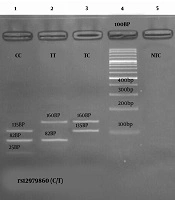
In this study, rs12979860 SNP was assessed as the most common IFNL polymorphism. The detailed protocol of polymerase chain reaction-restriction fragment length polymorphism (PCR-RFLP) method for genotyping of rs12979860 SNP was previously described (12). Genomic DNA was extracted from peripheral blood specimen using QIAamp® DNA Blood Mini Kit (Qiagen, Hilden, Germany) according to the manufacturer’s instructions. The extracted DNA was amplified using following primers for rs12979860 SNP: 5’-GCGGAAGGAGCAGTTGCGCT-3’ and 5’-GGGGCTTTGCTGGGGGAGTG-3’. The temperature profile was consisted of 94°C for five minutes; followed by 35 cycles of 94°C for 20 seconds, 66°C for 20 seconds and 72°C for 20 seconds, followed by 72°C for five minutes. The PCR product of rs12979860 SNP was digested with Bsh1236I (BstUI) restriction endonuclease (Fermentas, Vilnius, Lithuania) which resulted in two 196 and 45 bp fragments in rs12979860 CC genotype, three 241, 196, and 45 bp fragments in rs12979860 CT genotype and a 241 bp fragment in TT genotype.
3.4. Statistical Analysis
Categorical variables were expressed by frequency and percentage. Continuous variables were expressed by mean ± standard deviation (SD). Comparison between categorical variables was performed using Fisher-exact test. P value below 0.05 was considered statistically significant. All statistical analyses were performed using SPSS software for Windows (SPSS, version 17).
4. Results
In this case-control study, 350 patients with positive result for anti-HCVAb were included. The mean ± SD age of the study population was 39.7 ± 10.4. Intravenous drug use (IDU) and non-IDU were the main HCV acquiring risk factors among our patients. We could not identify HCV genotypes in SC group because all of them referred after HCV clearance. HCV genotyping revealed HCV genotype 1 as the predominant genotype in patients with CHC followed by HCV genotype 3. The patients’ characteristics are summarized in Table 1. Among the SC cases, distribution of rs12979860 genotypes was as follows: 64 (70.3%) were CC, 26 (28.6%) were CT and 1 (1.1%) was TT, while among CHC patients, 95 (36.7%) were CC, 134 (51.7%) were CT and 30 (11.6%) were TT (P < 0.001) (Figure 1). In the dominant model (CC vs. CT+TT), the distribution of CC genotype in the SC group was around two folds of its distribution in the CHC group (P < 0.001, OR = 4.09, 95% CI = 2.44-6.86). Moreover, in the allelic model, the frequency of rs12979860 C allele was higher in SC group than the CHC group (P < 0.001) (Table 2).
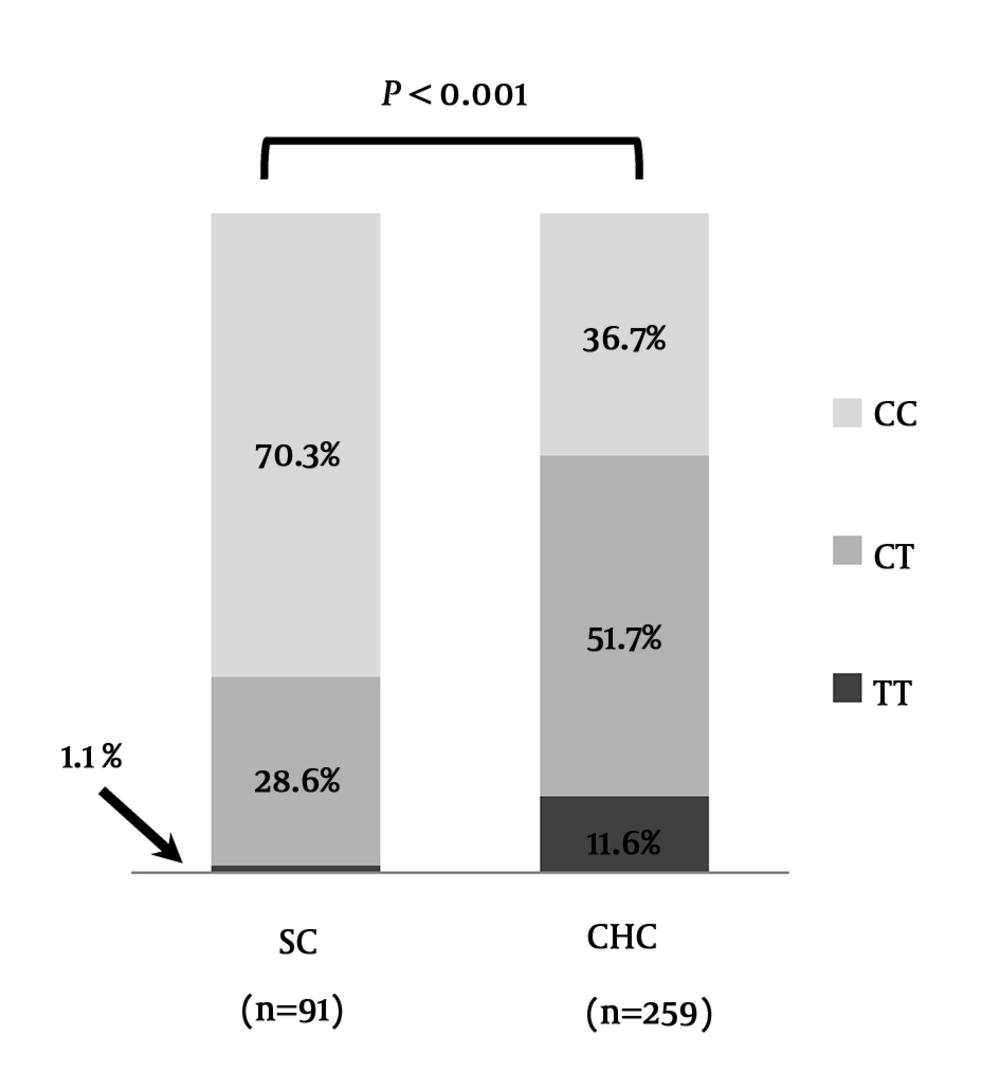
Figure 1.
Distribution of rs12979860 Genotypes in SC and CHC Groups
| SC (n = 91) | CHC (n = 259) | |
|---|---|---|
| Gender | ||
| Male | 87 (95.6) | 246 (95.0) |
| Female | 4 (4.4) | 13 (5.0) |
| Age, y | 39.2 ± 11.1 | 39.8 ± 10.1 |
| HCV genotype | ||
| HCV-1 | NA | 140 (54.1) |
| HCV-3 | NA | 119 (45.9) |
| Suspected source of infection | ||
| History of cupping | 38 (41.8) | 138 (53.3) |
| History of non-IDU | 62 (68.1) | 200 (77.2) |
| History of IDU | 56 (61.5) | 174 (67.2) |
| History of extramarital sex | 31 (34.1) | 91 (35.1) |
| History of imprisonment | 30 (33.0) | 124 (47.9) |
| History of tattooing | 29 (31.9) | 113 (43.6) |
aAbbreviations: SC, spontaneous clearance; CHC, chronic hepatitis C; n, number; NA, not applicable; IDU, intravenous drug use.
bData are presented as No. (%) or Mean ± SD.
| SC (n = 91) | CHC (n = 259) | OR | 95%CI | P Valuec | |
|---|---|---|---|---|---|
| rs12979860 genotypes | |||||
| Non-CC | 27 (29.7) | 164 (63.3) | Reference | ||
| CC | 64 (70.3) | 95 (36.7) | 4.09 | 2.44-6.86 | < 0.001 |
| rs12979860 alleles | |||||
| T | 28 (15.4) | 194 (37.5) | |||
| C | 154 (84.6) | 324 (62.5) | < 0.001 |
aAbbreviations: SC, spontaneous clearance; CHC, chronic hepatitis C; OR, odds ratio; CI, confidence interval; n, number.
bData are presented as No. (%).
cFisher-exact test.
5. Discussion
The present study investigated the impact of a genetic variant (rs12979860) in a gene (IFNL4) involving in host innate immunity on HCV SC. rs12979860 SNP had a significant association with SC of HCV infection in our study. In addition, distribution of rs12979860 genotypes among patients with CHC was 36.7%, 51.7%, and 11.6% for CC, CT, and TT genotypes, respectively, which was similar to the distribution of rs12979860 genotypes investigated in Iranian patients with CHC previously (13). First studies that reported the association between IL28B SNPs and HCV infection obtained from large cohorts of patients with chronic HCV infection who received standard antiviral treatment (7, 8). An Egyptian study found that individuals with HCV SC were about three times more likely to have rs12979860 CC genotype than those with CHC (14). Another study from Egypt reported that the frequency of IL28B CC genotype was significantly higher in the HCV SC group than healthy individuals, CHC patients, and cases with HCV-related liver cirrhosis and hepatocellular carcinoma (15). In the study by Montes-Cano et al. (16) among 352 HCV-infected Spanish cases, rs12979860 CC genotype was associated with a higher rate of HCV SC in both men (72.4% in CC vs. 27.6% in non-CC) and women (72.5% in CC vs. 27.5% in non-CC). In a study from Austria, IL28B rs12979860 CC genotype was more frequent among patients with HCV SC than those with CT and TT genotypes (17). In the study by Grebely et al. (18) among 132 Australians, rs8099917 TT genotype was the only factor predicting HCV SC in multivariate analysis. According to a meta-analysis, IL28B rs12979860 CC and rs8099917 TT genotypes were associated with HCV SC in Caucasians (19). The mechanism in which the IL28B SNPs result in inter-individual differences in HCV SC is not well understood. However, few studies looked for different levels of IFNL3 and interferon-stimulated genes by different IL28B genotypes, but obtained results were inconsistent and affected by different study settings (7, 8, 20-22). Prokunina-Olsson et al. reported the presence and expression of a gene named IFNL4 (23). The exon one of the recently discovered IFNL gene contained a genetic variant (ss469415590), which was associated with expression of the IFNL4 peptide (23). Interestingly, the TT allele of ss469415590 does not express the IFNL4 peptide and was associated with SC of HCV, while the ΔG allele of ss469415590 expresses a functional peptide of IFNL4 and was associated with chronicity of HCV infection (23). Besides, it was observed that ss469415590 is in high linkage disequilibrium (LD) with rs12979860 in Caucasians (24, 25). Discovery of IFNL4 gene and the association of ss469415590 with the outcome of HCV infection has opened new horizons in diagnosis and management of hepatitis C in near future. A recent study recommended that patients with AHC and unfavorable IL28B genotypes should be treated with antiviral drugs rapidly (18). One percent of our study population who cleared HCV had TT genotype, thus antiviral therapy in patients with AHC and rs12979860 TT genotype seems to be advisable. Other studies found that patients with an icteric AHC had a higher chance to clear virus spontaneously (26, 27). Tillman et al. (10) observed that 52% of patients with symptomatic AHC cleared the infection spontaneously, whereas none of the patients with asymptomatic AHC cleared HCV RNA without antiviral treatment, therefore they recommended to treat asymptomatic AHC patients as early as possible. Other finding in AHC was the higher frequency of IL28B rs12979860 CC genotype in patients with icteric AHC than those without AHC symptoms (10). Recently, Interferon gamma inducible protein 10 (IP-10), which is a chemotactic chemokine has been introduced as a pretreatment predictive factor in CHC outcome. Beinhardt et al. (17) observed that combination of serum level of IP-10 and IL28B SNPs can identify patients with AHC who are most likely to undergo HCV SC and those who progress to CHC and need early antiviral treatment. They found that IP-10 level was lower in patients who cleared HCV spontaneously (17). Gender had a great influence among factors affecting AHC outcome, which female patients had more chance for achieving HCV SC than the males (28). The study by van den Berg et al. (29) showed that SC status was more frequent in females with the favorable genotype for rs12979860 (CC) than females with the unfavorable genotypes (CT and TT). Several studies have shown that female gender and symptomatic acute hepatitis C were highly associated with HCV SC (30). A recent study in patients with acute HCV genotype 4 infection identified that IL28B CC genotype, female sex, robust T-cell responses, rapid decline in ALT and HCV RNA levels, and presence of jaundice were predictors of HCV SC (31). HCV genotype was another factor able to predict the outcome of AHC. According to the study by Grebely et al. (32) patients with HCV genotype 1 cleared HCV more frequently than those with other HCV genotypes. The route of HCV transmission may affect AHC outcome as well. A large population cohort study in the northeast of Iran showed that illicit drug use whether intravenous or non-intravenous was significantly correlated with CHC versus HCV SC. The rate of HCV SC in this study was about 38% (33). Grebely et al. (34) found that the rate of HCV SC was lower in illicit drug use and HIV coinfection. Shores et al. (35) observed that the rate of HCV SC in HIV-infected patients who acquired HCV from intravenous drug use was significantly lower than those with sexual transmission as the presumed route of HCV transmission. In addition, it was observed that the rate of HCV SC was up to 50% in children and women infected after RH immunization (28, 36). In the present study, all SC cases were included after HCV clearance, thus determination of HCV RNA level and HCV genotyping were impossible.
In conclusion, the present study confirmed the role of host immunity on outcome of viral infection by investigating the impact of IFNL4 rs12979860 SNP on natural history of HCV infection. More large-scale multicentric longitudinal studies are needed to reliably evaluate the outcome of patients in acute hepatitis C phase regarding different host and viral factors.