
Full Text
Full text is available in PDF
Official Journal of Research Center for Gastroenterology and Liver Diseases
Authors
Percutaneous liver biopsy is one of the most important and widely used methods for diagnosing chronic liver diseases; however, controversies related to the potential risk of complications and patient discomfort still exist.
The objective of this study was to evaluate the safety and success rate of blind percutaneous liver biopsy.
We conducted a retrospective analysis of 1412 blind percutaneous thick-needle liver biopsies performed during 1977-2000 at a single center on 1110 patients, using archived medical data of the center.
The overall success rate of obtaining a liver sample with this method was 95.3%. Of all the samples assessed, 91.7% were determined to be fully representative for an evaluation by the pathologist. Complications occurred in 259 procedures (18.3%). While no fatalities associated with liver biopsy were noted, 9 serious complications (0.64%) directly related to biopsies were reported. Pain was the most common complication (15.3%). Significantly more complications (pain and vasovagal reactions) were reported in females (22.1%) than in males (16.1%) (P = 0.005). The rate of complications was significantly correlated with the stage of fibrosis (P = 0.027), i.e. the higher the fibrosis stage, the higher the complication rate. Previous surgical procedures involving the abdominal cavity or thorax influenced the effectiveness of liver biopsy (P = 0.017). Less operator experience was significantly associated with a higher rate of procedure failure (P = 0.002). Statistical significance of the relationship between individual operator efficiency and complication rate (P = 0.000) and that between individual operator efficiency and biopsy failure rate (P = 0.002) was observed.
Blind percutaneous liver biopsy is a safe and effective invasive procedure, despite the fact that noninvasive fibrosis assessment methods are currently widely available and used instead of histological evaluation. Complications risk and failure rate are low if indications and contraindications are considered carefully and the biopsy is performed by a skilled and experienced operator. Certain groups of patients may benefit from an image-guided procedure to improve its effectiveness.
© 2011, Author(s). This open-access article is available under the Creative Commons Attribution 4.0 (CC BY 4.0) International License (https://creativecommons.org/licenses/by/4.0/), which allows for unrestricted use, distribution, and reproduction in any medium, provided that the original work is properly cited.
Cakmakci E, Caliskan KC, Tabakci ON, Tahtabasi M, Karpat Z. Percutaneous Liver Biopsies Guided with Ultrasonography: A Case Series. I J Radiol. 2013;10(3):182-184. doi: https://doi.org/10.5812/iranjradiol.13184
Hamidian Jahromi A, Ballard DH, Bahrami R, D'Agostino HRV. Comparison of Different Techniques of Ultrasound-Guided Fine Needle Biopsy of Liver in a Swine Model. Hepat Mon. 2015;15(6):e26439. doi: https://doi.org/10.5812/hepatmon.26439v2
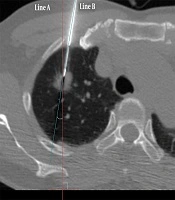
Lee JH, Lee IJ. CT-Guided Percutaneous Core Needle Biopsy for Lung Lesions: A 14-Year Review of Needle Angle and Lesion Depth. I J Radiol. 2020;17(2):e96221. doi: https://doi.org/10.5812/iranjradiol.96221

Hooshyar A, Habibzadeh S, Ghasemi N, Yazdanbod A, Sohrabi S, et al. Females Have a Lower Liver Histopathological Score in HBeAg-Negative Chronic Hepatitis B Than Males. Arch Clin Infect Dis. 2013;8(4):e17972. doi: https://doi.org/10.5812/archcid.17972

Lee H, Lee IJ. Assessment of Independent Risk Factors of Developing Pneumothorax During Percutaneous Core Needle Lung Biopsy: Focus on Lesion Depth. I J Radiol. 2016;13(4):e30929. doi: https://doi.org/10.5812/iranjradiol.30929
More by these authors
Last Update: 2 weeks ago
Last Update: 2 weeks ago
Last Update: 2 weeks ago
Last Update: 5 hours ago
Last Update: 10 hours ago
Last Update: 5 days ago