Full Text
Full text is available in PDF
Official Journal of Research Center for Gastroenterology and Liver Diseases
Authors
 1,*, Afarin Rahimi-Movaghar2,*, Emran M. Razaghi1, Emran M. Razaghi2, Ahmad Reza Baghestani1, Ahmad Reza Baghestani3, Siavash Jafari3, Siavash Jafari4
In Iran, the number of injecting drug users (IDUs) has increased in recent years. The rates of hepatitis C virus (HCV) and hepatitis B virus (HBV) infections among IDUs are reportedly high.
The purpose of this study was to assess factors correlated with HCV and HBV infections among IDUs in Tehran.
A cross-sectional study included 899 IDUs recruited from the community, drug treatment centers, and drop-in-centers. The study involved interviews conducted using an adapted version of the WHO Drug Injection Study Phase II (Version 2b) questionnaire and blood testing for the HCV antibody, hepatitis B surface antigen, and hepatitis B core antibody. A logistic regression model was used to identify independent factors correlated with HCV and HBV infections.
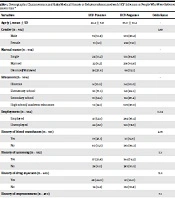
HCV infection was found to be primarily associated with female gender [odds ratio (OR) 5.0, 95% confidence interval (CI) 2.0-10.0)], unmarried status (OR 2.9, 95% CI 1.9-4.4), drug use for more than 10 years (OR 2.7, 95% CI 1.8-3.9), drug injection frequency of more than once per day (OR 2.6, 95% CI 1.6-4.2), history of imprisonment (OR 2.5, 95% CI 1.6-4.0)], and a history of shared injection needles in prison (OR 2.3, 95% CI 1.5-3.6). HBV infection was mainly correlated with a history of imprisonment (OR 1.9, 95% CI 1.4-2.7) and drug use for more than 10 years (OR 1.4, 95% CI 1.1-1.9).
Because a considerable number of IDUs in Iran are receiving reduction services, tailoring services for prevention of hepatitis infection are necessary.
© 2011, Author(s). This open-access article is available under the Creative Commons Attribution 4.0 (CC BY 4.0) International License (https://creativecommons.org/licenses/by/4.0/), which allows for unrestricted use, distribution, and reproduction in any medium, provided that the original work is properly cited.
Tavakkoli H, Mir-Nasseri M, Poustchi H, Afshar P, Motalebi M, et al. Prevalence and Risk Factors of Hepatitis B Infection in Injection Drug Users, Tehran (2001-2002). Hepat Mon. 2008;8(1):. doi:
Alavi S, Behdad F. Seroprevalence Study of Hepatitis C and Hepatitis B Virus among Hospitalized Intravenous Drug Users in Ahvaz, Iran (2002-2006). Hepat Mon. 2010;10(2):. doi:
Sharhani A, Mehrabi Y, Noroozi A, Nasirian M, Higgs P, et al. Hepatitis C Virus Seroprevalence and Associated Risk Factors Among Male Drug Injectors in Kermanshah, Iran. Hepat Mon. 2017;17(10):e58739. doi: https://doi.org/10.5812/hepatmon.58739
Hedayati-Moghaddam MR, Danaee M, Soltanian H, Vahedi SA, Mosavat A, et al. Epidemiology of Hepatitis C Virus Infection Among High-risk Populations in Northeastern Iran. Hepat Mon. 2022;22(1):e127166. doi: https://doi.org/10.5812/hepatmon-127166
Eshraghi Mosa Abadi B, Kandelouei T, Eslami G, Asli M, Vaezjalali M. Prevalence and Risk Factors for Occult Hepatitis B and HIV Infections Among HCV Infected Intravenous Drug Users, Tehran, Iran. Arch Clin Infect Dis. 2018;13(6):e67968. doi: https://doi.org/10.5812/archcid.3075
More by these authors
Last Update: 2 weeks ago
Last Update: 2 weeks ago
Last Update: 2 weeks ago
Last Update: 6 hours ago
Last Update: 11 hours ago
Last Update: 5 days ago