
1. Background
Air pollution is introduced as the fourth risk factor to human health according to the world bank (1). Annually, it causes approximately 7 million deaths all around the world (2, 3). Several air pollutants such as particulate matter, nitrogen dioxide, ozone, sulphur dioxide, etc. are determined to be associated with different health outcomes. Epidemiological studies have been conducted in various countries to investigate this relationship precisely (4-8). Particulate matter of 2.5 micrometers or smaller (PM2.5) is a part of particulate matter, but is able to enter the alveolar lung region, a place to exchange the blood. PM2.5 represents the high-risk breathable component of the particulate matter of 10 micrometers or smaller (PM10) (9).
PM2.5 concentrations have been associated with short- and long-term cause-specific mortality and morbidity incidence. Short-term exposure to high PM2.5 levels has been known as a significant risk factor for patients with chronic obstructive pulmonary diseases (COPDs) or ischemic diseases. In addition, long-term exposure is associated to deaths due to cardiovascular diseases, respiratory diseases, and lung cancer (9). A cohort study showed that the incidence of lung cancer increased by 8% per 10 µg/m3 increase in concentration of PM2.5 (10). A sub-analysis of about 190,000 never-smokers in a cohort study showed a significant effect of long-term exposure to PM2.5, with a 15% - 27% increase in cancer mortality per 10 µg/m3 increase in concentration (11). According to the international agency for research on cancer (IARC), there is sufficient evidence on the relationship between exposure to air pollution and the incidence of lung and bladder cancers. In this context, particulate matter has been classified as Group 1 carcinogen (carcinogenic to humans) (12).
In case of lung cancer, the mechanisms can be related to cellular stress induced by particles and DNA damage. PM2.5 as a mass indicator contains many elements and compounds. The organic fraction of fine particles such as nitrogen compounds or metabolically activated polycyclic aromatic hydrocarbons (PAHs) are capable to form bulky DNA adducts. Furthermore, the PM2.5 mixture contains various components which can increase reactive oxygen species (ROSs). These molecules are implicated in oxidative stress, which is an important toxicological mechanism of particle-induced lung cancer (9, 13). In addition, elemental carbon is recognized as a risk factor of lung cancer (14). However, more studies are needed to determine the exact genes and affecting mechanisms (15, 16).
According to WHO, ambient air pollution has caused about 402,250 deaths due to lung cancer globally in 2012 (17). The world bank has reported that air pollution is responsible for about 24% of lung cancer deaths in the world. While in 1990 the air pollution's outcomes were largely attributable to pneumonia. In 2013 the cause shifted to cardiovascular disease and lung cancer (1). Ministry of health and medical education of Iran has reported that the cancer of lung and bronchus is the fourteenth cause of death in 2011, in which 4,322 related deaths have been registered (except for Tehran province) (18).
According to reports, several cities of Iran are exposed to high concentrations of particulate matter. In case of PM2.5, Zabol is introduced as the most polluted city in the world (19). Southern and Western cities are affected by Middle Eastern dust storm (20-23). In addition, mobile sources are known as the major source of particulate air pollution in other cities (24, 25).
The identification of air pollution’s contribution in health outcomes can be useful in many aspects, including the determination of effectiveness of current air pollution control strategies and plans, economic costs of deaths, hospitalizations, etc. Although many health impact assessments have been performed on air pollution in Iran (26-30), no study has been conducted on the mortality of lung cancer attributed to air pollution.
The aim of this study was to quantify the number of gender-specific lung cancer deaths due to exposure to PM2.5 among individuals over 30 years old AirQ+ model in 10 cities of Iran during March 2013-March 2016.
2. Methods
2.1. Location and Time
Iran with more than 80 million people is located in the Middle East. Ten cities of Iran were chosen to be assessed in case of lung cancer mortality attributed to the PM2.5 ambient air concentrations, including Tehran, Mashhad, Isfahan, Shiraz, Tabriz, Ahvaz, Arak, Sanandaj, Khoram Abad and Ilam. The related populations and locations are presented in Table 1 and Figure 1, respectively. The total population of these 10 cities were more than 20 million in 2015. According to statistical centre of Iran, the number of people with age more than 30 years was about 11 million in the same year, including approximately 50.5% men and 49.5% women.
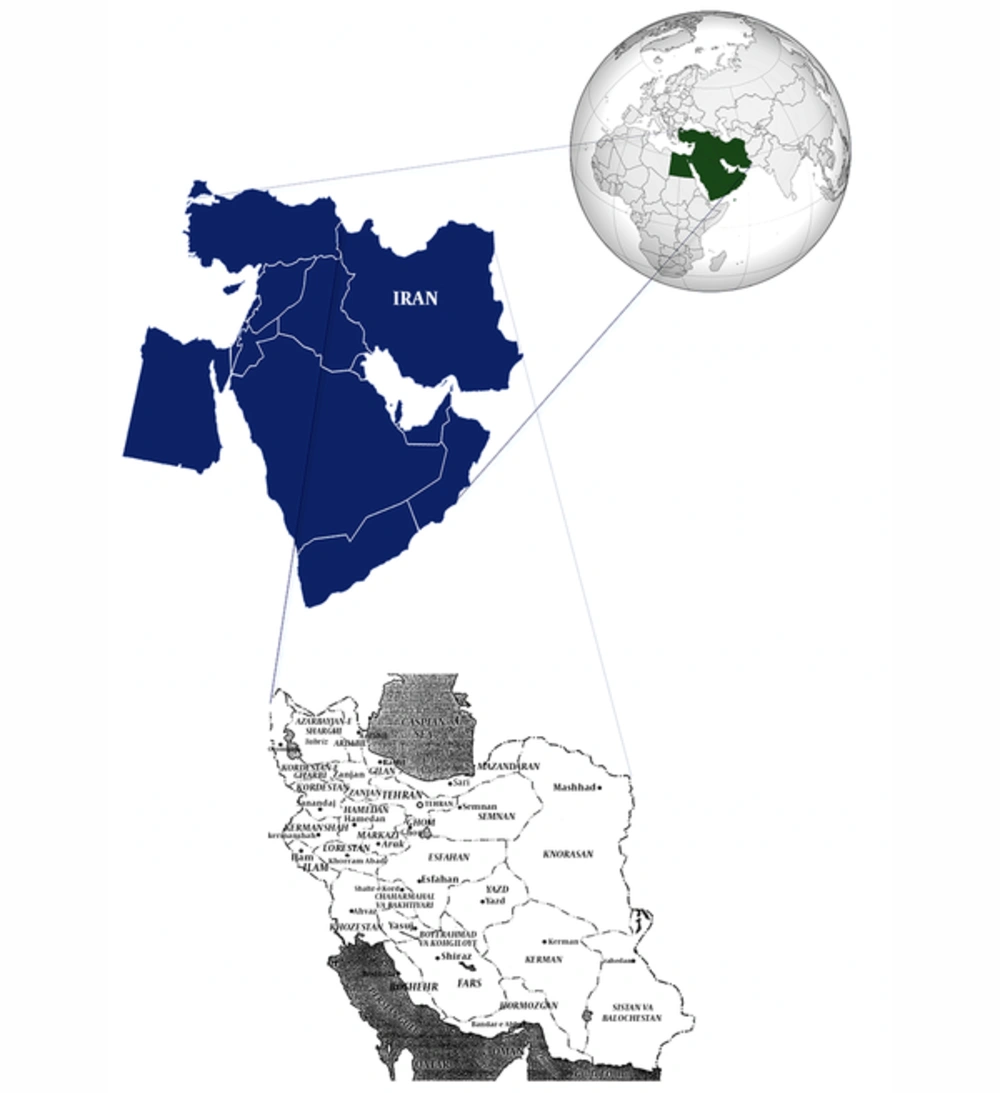
Figure 1.
The Approximate Location of the 10 Cities in Iran
Table 1.
The Approximate Total Population and At-Risk Population of the 10 Cities (2013 - 2016)
| Cities | Gender | 2013 – 2014a | 2014 – 2015b | 2015 – 2016c | |||
|---|---|---|---|---|---|---|---|
| Total | At-Risk | Total | At-Risk | Total | At-Risk | ||
| Tehran | Male | 8672250 | 2318323 | 8769750 | 2403331 | 8866500 | 2488339 |
| Female | 2317766 | 2408939 | 2497099 | ||||
| Mashhad | Male | 2831220 | 659055 | 2982200 | 688604 | 3046550 | 718152 |
| Female | 663687 | 692655 | 722910 | ||||
| Isfahan | Male | 2002670 | 529920 | 2067360 | 550080 | 2222580 | 603840 |
| Female | 514080 | 533280 | 587010 | ||||
| Shiraz | Male | 1578720 | 398528 | 1665500 | 413971 | 1755000 | 450320 |
| Female | 395966 | 412444 | 447720 | ||||
| Tabriz | Male | 1557600 | 410533 | 1602000 | 430660 | 1673380 | 451360 |
| Female | 406193 | 428830 | 449500 | ||||
| Ahvaz | Male | 1256920 | 274398 | 1282058 | 308800 | 1349715 | 322800 |
| Female | 270255 | 283675 | 310440 | ||||
| Arak | Male | 555390 | 139886 | 609400 | 157620 | 632800 | 164835 |
| Female | 135327 | 150700 | 157850 | ||||
| Sanandaj | Male | 387600 | 91342 | 404430 | 98800 | 420000 | 102400 |
| Female | 87573 | 93749 | 98417 | ||||
| Khoram Abad | Male | 352000 | 84566 | 377400 | 89080 | 393050 | 96560 |
| Female | 84952 | 90440 | 95900 | ||||
| Ilam | Male | 177600 | 42425 | 187000 | 44422 | 198640 | 47840 |
| Female | 41357 | 43849 | 46800 | ||||
| Total | 19371970 | 9795073 | 19947098 | 10322111 | 20558215 | 10885305 | |
aMarch 21th, 2013 to March 20th, 2014.
bMarch 21th, 2014 to March 20th, 2015.
cMarch 21th, 2015 to March 19th, 2016.
The study period was between March 21th, 2013 and March 19th, 2016, which is three years on Persian calendar. The first yearly period was from March 21th, 2013 to March 20th, 2014. The second period was from March 21th, 2014 to March 20th, 2015, and the third period was between March 21th, 2015 and March 19th, 2016.
2.2. Data Collection
Hourly concentrations of PM2.5 and PM10 were obtained from department of environment (DOE) of Iran. In addition to DOE monitoring stations, PM2.5 measurements in Tehran are provided by Tehran air quality control company (TAQCC). In cities, where PM2.5 measurements were unavailable, PM2.5 levels were calculated using PM10 levels and the PM2.5/PM10 conversion factor of 0.33 provided by the WHO (31). Demographical information was acquired from statistical center of Iran (32). Baseline incidence (BI) for lung cancer mortality was taken from Ministry of Health and Medical Education (18). In addition, AirQ+ default relative risk (RR) values were used to evaluate the health impacts of PM2.5 (33). The study was approved by the medical ethics committee of the Shahid Beheshti University of Medical Sciences (reference number of research ethics committee: 273)
2.3. Data Validation
Outlier and zero hourly values were omitted from the dataset, and 24-hour averages were calculated. Criteria for validity of stations provided by WHO were used in order to validate PM2.5 measured concentrations (34). The ratio between the number of valid data for the two seasons of each year cannot be greater than 2. To obtain 24-hour average values from data with a smaller averaging time, over 50% of 1-hour valid data should be valid.
2.4. AirQ+
AirQ+ is a software developed by the WHO regional office for Europe in order to quantify the health effects and calculate the burden of disease related to ambient air pollutants, including PM2.5, PM10, NO2, O3 and black carbon (BC). The software takes account of both short- and long-term cause-specific morbidity and mortality of mentioned air pollutants. In addition, it assesses the health impacts of household air pollution related to solid fuel use (SFU) (35).
Running AirQ+ requires some input data such as the mean concentration of the pollutant, total population, at-risk population, baseline incidence, relative risk and area size (km2). All these data were provided as was mentioned before. In addition, no human subjects were used in this modelling study, so there was no need to provide ethical permission.
3. Results
3.1. PM2.5 Concentrations
Table 2 presents the mean concentrations of PM2.5 in the 10 cities in Iran during March 2013 - March 2016.
Table 2.
The Mean Concentrations (± SD) of PM2.5 in the 10 Cities in Iran (2013 - 2016)
| City | Mean Concentration (± SD), µg/m3 | ||
|---|---|---|---|
| 2013 – 2014a | 2014 – 2015b | 2015 – 2016c | |
| Tehran | 39.46 (± 11.42) | 36.42 (± 9.41) | 31.87 (± 13.68) |
| Mashhad | 36.06 (± 26.97) | 27.29 (± 13.24) | 30.60 (± 13.8) |
| Isfahan | 56.15 (± 28.73) | 54.99 (± 25.59) | 37.29 (± 13.72) |
| Shiraz | 32.23 (± 14.93) | 25.00 (± 10.41) | 26.80 (± 15.5) |
| Tabriz | 30.68 (± 22.67) | 17.23 (± 8.36) | 22.72 (± 12.64) |
| Ahvaz | 62.61 (± 71.69) | 53.09 (± 52.58) | 60.88 (± 61.67) |
| Arak | 43.14 (± 34.26) | 32.53 (± 17.72) | 23.63 (± 14.51) |
| Sanandaj | 29.78 (± 18.44) | 29.74 (± 20.12) | 25.02 (± 15.97) |
| Khoram Abad | 32.58 (± 28.08) | 41.02 (± 33.41) | 33.95 (± 38.43) |
| Ilam | 28.78 (± 23.68) | 26.04 (± 27.37) | 28.15 (± 31.94) |
| Average | 39.15 (± 28.09) | 34.34 (± 21.82) | 32.09 (± 23.19) |
aMarch 21th, 2013 to March 20th, 2014.
bMarch 21th, 2014 to March 20th, 2015.
cMarch 21th, 2015 to March 19th, 2016.
Comparison of the average concentration of these 10 cities showed that Ahvaz has been ranked as the most polluted city in the first and third years. The highest PM2.5 concentrations in the second year were observed in Isfahan. As is presented in Table 2, average concentration of PM2.5 in these 10 cities are 39.15, 34.34 and 32.09 for the first to the third periods, respectively. The results in Table 2 reveal that all these 10 cities in all the years have not met WHO guideline value of 10 µg/m3 for PM2.5 concentration in ambient air (36). The quality of ambient air in Tehran, Isfahan, Arak and Sanandaj has been improved constantly during the three-year period.
3.2. Lung Cancer Mortality
Lung cancer mortality in male and female individuals aged over 30 years was estimated, and the results are presented in Table 3.
Table 3.
Number of Lung Cancer Deaths in Male and Female Individuals Over 30 Years Old in the Ten Cities in Iran, (2013 - 2016)z
| City | Gender | 2013 – 2014a | 2014 – 2015b | 2015 – 2016c | ||||
|---|---|---|---|---|---|---|---|---|
| AP (CI 95%) | Deaths (CI 95%) | AP (CI 95%) | Deaths (CI 95%) | AP (CI 95%) | Deaths (CI 95%) | |||
| 1 | Tehran | Male | 19.66 (5.66 - 29.08) | 71 (20 - 105) | 18.24 (4.76 - 27.7) | 68 (18 - 103) | 16.66 (3.85 - 25.37) | 64 (15 - 98) |
| Female | 19.66 (5.66 - 29.08) | 71 (20 - 105) | 18.24 (4.76-27.7) | 68 (18-103) | 16.66 (3.85 - 25.37) | 65 (15 - 99) | ||
| 2 | Mashhad | Male | 18.03 (4.76-27.49) | 18 (5 - 28) | 14.6 (3 - 23.13) | 16 (3 - 25) | 15.97 (3.85 - 25.26) | 18 (4 - 28) |
| Female | 18.03 (4.76 - 27.49) | 19 (5 - 28) | 14.6 (3 - 23.13) | 16 (3 - 25) | 15.97 (3.85 - 25.26) | 18 (4 - 28) | ||
| 3 | Isfahan | Male | 25.37 (8.26 - 35.74) | 21 (7 - 29) | 24.35 (7.57-34.72) | 21 (6 - 30) | 18.7 (4.76 - 28.35) | 18 (4 - 27) |
| Female | 25.37 (8.26 - 35.74) | 21 (7 - 29) | 24.35 (7.57 - 34.72) | 20 (6 - 29) | 18.7 (4.76 - 28.35) | 17 (4 - 26) | ||
| 4 | Shiraz | Male | 16.83 (3.85 - 25.5) | 10 (2 - 16) | 13.79 (2.91 - 21.9) | 9 (2 - 14) | 14.31 (2.91 - 22.9) | 10 (2-16) |
| Female | 16.83 (3.85 - 25.5) | 10 (2 - 16) | 13.79 (2.91-21.9) | 9 (2 - 14) | 14.31 (2.91-22.9) | 10 (2-16) | ||
| 5 | Tabriz | Male | 15.97 (3.85 - 25.17) | 10 (2 - 16) | 10 (1.96 - 16.74) | 7 (1 - 11) | 12.28 (2.91 - 20.22) | 9 (2 - 14) |
| Female | 15.97 (3.85 - 25.17) | 10 (2 - 16) | 10 (1.96 - 16.74) | 7 (1 - 11) | 12.28 (2.91 - 20.22) | 9 (2 - 14) | ||
| 6 | Ahvaz | Male | 26.47 (9.09 - 36.71) | 11 (4 - 16) | 23.66 (7.41 - 33.77) | 11 (4 - 16) | 25.93 (8.26-36.12) | 13 (4 - 18) |
| Female | 26.47 (9.09 - 36.71) | 11 (4 - 15) | 23.66 (7.41 - 33.77) | 10 (3 - 15) | 25.93 (8.26 - 36.12) | 13 (4 - 17) | ||
| 7 | Arak | Male | 20.67 (5.66-30.58) | 4 (1 - 7) | 17.01 (3.85 - 25.65) | 4 (1 - 6) | 12.77 (2.91-21) | 3 (1 - 5) |
| Female | 20.67 (5.66 - 30.58) | 4 (1 - 6) | 17.01 (3.85 - 25.65) | 4 (1 - 6) | 12.77 (2.91-21) | 3 (1 - 5) | ||
| 8 | Sanandaj | Male | 15.95 (3.8 - 24.8) | 2 (1 -4) | 15.61 (3.85 - 14.52) | 2 (1 - 4) | 13.74 (2.9-21.83) | 2 (0.5 - 3) |
| Female | 15.95 (3.8 - 24.8) | 2 (1 - 3) | 15.61 (3.85 - 14.52) | 2 (1 - 4) | 13.74 (2.9-21.83) | 2 (0.5 - 3) | ||
| 9 | Khoram Abad | Male | 17 (3.84 - 25.7) | 2 (1 - 3) | 20.41 (5.6 - 29.89) | 3 (1 - 4) | 17.55 (4.76-26.63) | 3 (1 - 4) |
| Female | 17 (3.84 - 25.7) | 2 (1 - 3) | 20.41 (5.6 - 29.89) | 3 (1 - 4) | 17.55 (4.76-26.63) | 3 (1 - 4) | ||
| 10 | Ilam | Male | 15.25 (3.8 - 24.15) | 1 (0.5 - 2) | 13.79 (2.91 - 22.47) | 1 (0.5 - 2) | 15.25 (3.8 - 23.72) | 1 (0.5 - 2) |
| Female | 15.25 (3.8 - 24.15) | 1 (0.5 - 2) | 13.79 (2.91 - 22.47) | 1 (0.5 - 2) | 15.25 (3.8 - 23.72) | 1 (0.5 - 2) | ||
| Total | - | 300 (87 - 449) | - | 282 (73 - 428) | - | 282 (86 - 429) | ||
zAbbreviation: AP, attributable proportion.
aMarch 21th, 2013 to March 20th, 2014.
bMarch 21th, 2014 to March 20th, 2015.
cMarch 21th, 2015 to March 19th, 2016.
The attributable deaths of lung cancer due to exposure to PM2.5 in Tehran, Mashhad, Isfahan, Shiraz, Tabriz and Ahvaz during the whole period were estimated 407, 105, 118, 58, 52 and 69 cases, respectively. In addition, the attributable cases of lung cancer mortality due to PM2.5 exposure in Arak, Sanandaj, Khoram Abad and Ilam within the 3 years were 22, 12, 16 and 6, respectively.
According to Table 3, the number of deaths in males were slightly greater than females, which is because of higher population of men in the study. The total deaths among men and women in the whole three years were 433 and 431 cases, respectively. On the other hand, the most number of deaths in all the three years have been attributed to Tehran, which reflects its both high concentration and population. The least lung cancer deaths during all the periods have occurred in Ilam. Total cases of PM2.5’s attributable lung cancer deaths in March 2013-March 2014, March 2014-March 2015 and March 2015-March 2016 periods were 300, 282 and 282, respectively. Furthermore, the sum of lung cancer deaths due to PM2.5 in all the 10 cities during the 3-year period was estimated 864 cases.
4. Discussion
4.1. PM2.5 Concentration
Recent studies have proved the association between PM2.5 and lung cancer (37, 38). The urban concentrations of PM2.5 in North America, Europe, Africa and Asia are reported 17, 15 - 20, 15 - 30 and 30 - 60 µg/m3, respectively. About 90% of US monitoring stations records PM2.5 concentrations below 16 µg/m3 (9). However, Iranian cities are among the most polluted cities in the world in case of ambient air particulate pollution. Zabol is known to have the highest PM2.5 concentrations in the world during 2012. Ahvaz, a city investigated in this study, is the 43rd polluted city in the world in terms of PM2.5 (19). Western and Southern cities of Iran such as Ahvaz and Khoram Abad are being affected by the Middle Eastern dust storms, which increase the particulate matter concentrations (20, 21). It is reported that about 70% of particulate air pollutants in Tehran have been emitted from mobile sources during 2015 (39). In addition, about 76% of air pollution in Isfahan is reported to be produced by mobile sources in 2010 (25).
4.2. Lung Cancer Mortality
In order to remove the effect of demographical characteristics, the attributable proportions (APs) are calculated and presented in Table 3. The higher AP means higher number of deaths per unit of population. In March 2013-March 2014 period, the highest APs were those of Ahvaz, Isfahan and Arak. In March 2014-March 2015 period, Isfahan, Ahvaz and Khoram Abad showed higher AP values, compared to other cities. In addition, the same cities had the highest APs in March 2015-March 2016, but in a different order. On the other hand, the trend of AP values in a city over time can be interpreted as a representative of the environmental conditions and effectiveness of air pollution control plans. For instance, the trend of APs in Tehran, Isfahan and Arak shows a constant decline during these three years, which means PM2.5 is becoming a less important risk factor to the public health in case of lung cancer. For other cities, the AP values have been fluctuated through the three-year period.
In a study to determine the spatial and temporal trends in the mortality burden of air pollutants in China, the lung cancer deaths increased from 93 thousand (95% CI: 33 - 127) cases in 2004 to 169 thousand (95% CI: 61 - 227) cases in 2012. In 2012, 27.9% of deaths caused by lung cancer could be attributed to exposure to ambient PM2.5 (40).
It is estimated that particulate matter causes about half of the lung cancer incidence in China and other East Asian countries (41). In a study in China, the authors compared attributable fraction (AF) of lung cancer in cities in order to remove the effects of different populations. The results indicated that except for some cases, most of Chinese provinces showed an increasing trend in AF during 2004 - 2012. All of the provinces with the decreasing trend are located in the Southern China, which is known to have high amount of precipitation, vast forests, lack of winter heating, and the occurrence of sea-land breeze. The combination of these have led to high deposition and dispersion and low production of particulate matter (40). In a study in Poland, the highest attributable fractions were obtained in southern areas, where the emissions originate from municipal and household sources (so-called low-stack emission), road transport and heavy industry. On the other hand, due to lower density of emission sources and better climatic conditions for dispersion of air pollutants, the lowest values were observed in eastern and northern areas (42).
The estimation of lung cancer mortality attributed to PM2.5 in 23 European cities with 36 million people showed that 1296 and 1901 lung cancer deaths could be prevented each year if PM2.5 concentration were reduced to 20 and 15 µg/m3, respectively. The number of deaths per 100,000 people were estimated to be 4 and 5 for the two above mentioned scenarios, respectively (43).
Years of life lost (YLLs) due to exposure to PM2.5 for individuals older than 30 years were estimated using AirQ 2.2.3 in an industrial area in Italy. The results showed that for lung cancer, about 433 and 1204 years of life lost are attributed to the concentrations higher than 10 µg/m3 during the first year and the next 10 years, respectively. The annual average concentration of PM2.5 were calculated to be 42 µg/m3 (44).
WHO has estimated the lung cancer mortality and burden of disease attributed to ambient air pollution in 2012 within the world. However, the related database included the concentrations of particulate matter (PM10 and PM2.5). The report provides the country-specific number of deaths, YLLs and DALYs regarding the lung cancer caused by air pollution. The number of deaths, YLLs and DALYs of lung cancer attributed to air pollution in Iran during 2012 were calculated 1460, 37,894 and 38,258, respectively (17). In addition to WHO, the world bank group has estimated the total deaths from air pollution in Iran, considering the value of 31.89 µg/m3 as the PM2.5 national concentration. About 21680 deaths were attributed to ambient PM2.5 in Iran during 2013 (1).
The mortality and morbidity caused by air pollution impose a financial burden on the countries. The world bank has estimated that the total welfare losses and the total forgone labor output caused by PM2.5 in Iran were about 31 and 1.5 billion USD in 2013, respectively. These values contribute to 2.48% and 0.12% of gross domestic product (GDP) of the country, respectively. In 1990, the total welfare losses and the total forgone labor output caused by PM2.5 are announced 14 and 2.5 billion USD, respectively (1). Therefore, any reduction in air pollutants concentration can decrease the financial burden on the health systems.
In conclusion, AirQ+ model was used to estimate the lung cancer deaths among males and females over 30 years old due to exposure to particulate matter of 2.5 micrometers or smaller (PM2.5) in Tehran, Mashhad, Isfahan, Shiraz, Tabriz, Ahvaz, Arak, Sanandaj, Khoram Abad and Ilam during March 2013-March 2016. Most of lung cancer deaths were observed to be in Tehran, due to both high population and PM2.5 concentrations. However, the comparison between attributable proportion values showed that Ahvaz, Isfahan, Khoram Abad and Arakair pollution is a higher risk factor in case of lung cancer incidence per unit of population. Mobile sources have been introduced as the major source of Tehran and Isfahan air pollution. Ahvaz and Khoram Abad are being influenced by Middle Eastern dust storms. The results of this study could be used by authorities for making air pollution reduction strategies and plans. Furthermore, any reduction in attributed mortality and hospitalization reduces treatment costs in health organizations.