
1. Background
Today, cancer is one of the essential issues of health all around the world. Colorectal cancer (CC) is one of the most important cancers (1-3). Colorectal cancer occurs in the colon or rectum, called colon or rectal cancer, according to the location of the lesion. Still, they are classified into one group due to their common characteristics. The most common type of gastrointestinal cancer in Iran is CC, which ranks third in Iranian men and fourth in women (4-6). The World Health Organization predicts a 77% increase in the diagnosis of new cases and an 80% increase in deaths from CC by 2030 (7). Having a diet without vegetables, excessive consumption of red meat and saturated fats, alcohol, sedentary, smoking, obesity, family background, and the age over 50 years are the risk factors for CC, as it has been estimated that taking a healthy lifestyle can prevent disease about 66% to 75% (8-10).
The distribution of blood group type and antigen type (RH) has been reported differently in different populations. The association of blood group type (ABO) with many diseases such as cancers, diabetes, and hepatitis B and C virus is known worldwide (11-14). Studies have reported inconsistent results about the association of blood groups with CC (15, 16).
2. Objectives
Limited studies have assessed blood groups’ relationship with CC. Also, there is no study to assess the association of blood group type, tumor location, and polyp type in the Iranian population; hence, the present study aims at assessing the association of ABO blood groups with CC, location of cancer, and polyp type in patients with CC.
3. Methods
3.1. Design, Participants, and Setting
This case-control study has been proved by the Ethic Committee of the Iran University of Medical Sciences. The cases were selected from the patients who underwent surgery in the medical centers affiliated with the Iran University of Medical Sciences between Aug 2014 and Aug 2021. The controls were randomly selected from non-cancer patients admitted to the same hospitals at the same time, and their blood bank information was available. The classification and diagnosis of cancer were made according to the international disease guideline (17). Due to the cases and controls being selected from the same cohort, selection bias was approximately controlled. Nonetheless, to control confounders, group matching was done for the variables of age, gender, body mass index (BMI), occupation, and educational level. The definitive diagnosis of CC was made based on the patients’ colonoscopy and pathological findings and with the oncologist’s definitive opinion.
The inclusion criteria were the definitive diagnosis of CC for the case group. Exclusion criteria included incomplete hospital records of patients, patients who had secondary CC (metastasis from other body organs in the colon), patients who had other cancers at the same time, and lack of access to the blood bank information.
3.2. Data Collection
Data collection was done, using the two-part checklist, the first part of which includes demographic information of patients (age, gender, BMI, education, smoking, history background of colorectal in the family). The second part includes clinical and pathological information (the location of the cancer, the stage of disease, tumor size, and polyp type). The blood group type was collected from both groups through the blood bank of patient information.
3.3. Data Analysis
After data collection, the data were analyzed by SPSS 22. Mean, standard deviation and descriptive analyzes were used to report the demographic characteristics of the patients. The Kolmogorov-Smirnov test was used for the normal distribution of continuous variables. Non-normally distributed continuously. Variables were expressed as medians. As the case and control groups were independent, the t-test was used for the normal distribution of variables. The non-parametric Mann-Whitney test was used to compare variables in the two groups. The chi2 test was used to analyze categorical variables. The odds ratio and 95% confidence interval were used to assess the relationship of blood groups with CC, location of cancer, and polyp type. P-values for the remaining variables were < 0.05.
4. Results
In general, 401 patients with CC were in the case group and 401 were included in the control group. The mean age of participants in the case and control groups was 60.5 ± 15.3 and 59.8 ± 18.5 years, respectively; 228 (56.9%) participants from the case group and 242 (60.3%) from the control group were men and 92 (22.9%) patients from the case group and 98 (24.3%) from the control group had the history of smoking. The mean BMI for participants in the case and control group was 24.01 ± 2.1 and 24.7 ± 2.3 kg/m2, respectively; 28 (7%) of patients from the case group and 32 (8%) patients from the control group had a history of cancer in their families. No significant difference was observed between CC and demographic variables in the two groups (P < 0.05) (Table 1).
Table 1.
| Variables | Control Group (N = 400) | Case Group (N = 400) | P-Value |
|---|---|---|---|
| Age (y) | 18.5 ± 59.8 | 15.3 ± 60.5 | 0.58 |
| Gender | 0.21 | ||
| Male | 242 (60.3) | 228 (56.9) | |
| Female | 159 (39.8) | 173 (43.1) | |
| Race | 0.43 | ||
| Fars | 202 (50.4) | 196 (48.9) | |
| Non-Fars | 199 (49.6) | 205 (51.1) | |
| Smoking | 0.22 | ||
| Positive | 98 (24.3) | 92 (22.9) | |
| Negative | 204 (50.9) | 199 (49.6) | |
| Unknown | 99 (24.8) | 110 (27.5) | |
| Family history of cancer | 0.11 | ||
| Positive | 32 (8) | 28 (7) | |
| Negative | 240 (59.9) | 252 (62.8) | |
| Unknown | 129 (32.1) | 121 (30.2) | |
| Blood hemoglobin level (g/dL) | 15.1 ± 2.4 | 14.8 ± 2.4 | 0.088 |
| BMI(Kg/m2) | 24.01 ± 2.1 | 24.7 ± 2.3 | 0.12 |
| Diabetes (positive) | 44 (11) | 49 (12.2) | 0.33 |
a Values are presented as No. (%) or mean ± SD.
b To compare the variables in three groups, the ANOVA test was used if the distribution of the variables was normal. If the variables were not normal, the Kruskal-Wallis test was used.
c P-value less than 0.05 was considered as the significance level of statistical tests.
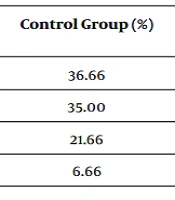
The frequency of blood type A was significantly higher in cases group 147 (36.6%) compared to the control group 114 (28.4%) (P = 0.001). The chance of developing CC was significantly higher among patients with blood type A in the case group compared to the control group (OR: 1.77, 95% CI: 1.14, 2.53, P = 0.001). The frequency of the type O blood group of cases was 111 (27.7%) and it was 142 (35.4%) for the control group; this difference was statistically significant (P = 0.022). The odds of CC in the patient with type O blood group were significantly lower than in the other blood group types (OR: 0.86, 95% CI: 0.75,0.97). There was no significant association between type B and AB blood groups with developing CC (P > 0.05). There was no significant relationship between developing CC with the RH Anti-gene (P = 0.089) (Table 2).
Table 2.
| Blood Group Type | Control Group (N = 401) | Cases Group (N = 401) | P-Value |
|---|---|---|---|
| A | 114 (28.4) | 147 (36.6) | 0.001 |
| O | 142 (35.4) | 111 (27.7) | 0.022 |
| B | 94 (23.5) | 89 (22.2) | 0.16 |
| AB | 51 (12.7) | 54 (13.5) | 0.18 |
| RH antigen | 0.22 | ||
| Positive | 353 (88.3) | 356 (88.8) | |
| Negative | 48 (11.7) | 45 (11.2) |
a Values are presented as No. (%).
b To compare the variables in the three groups, the ANOVA test was used if the distribution of the variables was normal. If the variables were not normal, the Kruskal-Wallis test was used.
c P-value less than 0.05 was considered as the significance level of statistical tests.
4.1. The Relationship Between Blood Group Type and Tumor Location
A total of 226 (56.4%) CC cases occurred in the distal colon (DC), and 134 (33.4%) cases occurred in the proximal colon (PC). The location of 41 (10.2%) was unknown. The frequency of type A blood group for PC and DC was 51 (38.1%) and 79 (35%), respectively, and this difference was not statistically significant (P = 0.26). No significant difference was observed in the frequency of blood types O, B, and AB with the tumor location (P > 0.05). No significant difference was observed for RH type and location of cancer (P = 0.66) (Table 3).
Table 3.
Results of Univariate Analysis Investigating the Relationship Between Blood Type and RH with Colorectal Cancer Based on the Location of Involvement a
| Blood Group Types | Cancer Location | P-Value | ||
|---|---|---|---|---|
| The Distal Colon (N = 226) | The Proximal Colon (N = 134) | Unknown (N = 41) | ||
| A | 79 (35) | 51 (38.1) | 17 (41.6) | 0.26 |
| O | 62 (27.4) | 38 (28.4) | 11 (26.7) | 0.28 |
| B | 51 (22.6) | 31 (23.1) | 7 (17.1) | 0.13 |
| AB | 34 (15) | 14 (10.4) | 6 (14.6) | 0.091 |
| Anti-gene RH | 0.66 | |||
| Positive | 191/365 (52.3) | 174/365 (47.7) | ||
| Negative | 18/36 (50) | 16/35 (45.7) | ||
a Values are presented as No. (%).
4.2. The Association of Blood Group Type with Polyp Type
The type of polyp in 277 (69.1%) patients with CC was known; 143 (51.6%) of the CC were neoplastic, and 134 (48.4%) were non-neoplastic. The chance of developing neoplastic polyps was significantly higher in people with blood type A compared to non-A type (OR: 1.39, 95% CI: 1.05,1.75, P = 0.001) (Table 4).
Table 4.
Results of Univariate Analysis Investigating the Relationship Between Blood Group Type and Colorectal Cancer Based on Polyp Type a
| Variables | Polyp Type | OR | 95% CI | P-Value | |
|---|---|---|---|---|---|
| Non- Neoplastic (N = 134) | Neoplastic (N = 143) | ||||
| ABO blood type | 1.39 | 1.05 - 1.75 | 0.001 | ||
| A | 66 (49.3) | 86 (60.1) | |||
| Non-A | 68 (50.7) | 57 (39.9) | |||
| The number of polyps | 0.89 | 54 - 1.25 | 0.44 | ||
| ≤ 2 | 86 (64.2) | 94 (65.7) | |||
| > 2 | 48 (35.8) | 49 (34.3) | |||
a Values are presented as No. (%).
4.3. Results of Multivariate Logistic Regression Analysis
We conducted an adjusted logistic regression analysis to control confounders to assess the factors associated with CC. We included all the variables that had a P-value less than 0.15 in the unilabiate analysis into the logistic regression multivariate analysis. The results of multivariate analysis showed that blood type A (OR Adju: 1.66, 95 % CI: 1.22, 2.11, P = 0.001) and O (OR Adju: 0.78, 95 % CI: 0.62, 0.95, P = 0.001) and neoplastic polyp’s type (OR Adju: 1.36, 95 % CI: 1.15, 1.57, P = 0.001) were significantly related to CC.
5. Discussion
The number of studies on the relationship between blood groups and CC is very limited. Based on our search, no study has investigated the relationship between blood group type, tumor location, the number of intestinal polyps, and the type of polyps. Retrospective studies in this field have mostly investigated the epidemiology and effective risk factors. The effect of the blood group type of developing CC, the tumor location, and the polyp type was evaluated in the present study. The results revealed a significant relationship between the type A blood group and developing CC. Also, people in the type O blood group showed a significantly lower risk of developing CC. No significant relationship was found for other blood groups (AB and B) and positive and negative RH and CC. These results were consistent with the studies conducted in this field (18-20). This evidence confirmed the results of Zhang et al.’s study (21). Their study was a systematic review and meta-analysis that assessed 89 different studies involving 100 554 patients with CC in 30 countries. They reported that the type A blood group was significantly associated with CC and blood type O was significantly less common in patients with CC, which was in line with the results of our study. In Kahramanca et al.’s study (22), which was conducted retrospectively and on 486 CC patients, there was a significant relationship between CC and blood group A, which was in line with the results of our study. However, Khalili et al.’s study (23) did not report a significant relationship between blood groups and CC, which could be due to the differences in the study populations, study exclusion and inclusion criteria, and study objectives.
Also, Al-Sawat et al. (16) conducted a retrospective study on 199 CC patients aged 22 to 96 years old and showed that blood group O was reported more among patients with CC than other blood groups. Still, this effect was not statistically significant and was contrary to the results of our study, which could be due to the sample size, the age of patients, and the objectives and criteria of the study. The effect of RH anti-gene on developing CC was separately assessed in our study, and there was no significant relationship between RH anti-gene and CC. However, in Gömeç and Özden ‘s study (24), RH- A positive was the most frequent, and RH- AB was the least frequent among patients with CC. In terms of location of involvement, the results of our study did not show a significant relationship between blood group and location of involvement in patients. Based on these results, 51.6% of CC cases were neoplastic, and 48.4% were non-neoplastic. No adequate studies have been conducted to investigate the relationship between the type of polyp and the site of involvement in CC; so, it was impossible to compare with the results of this study.
5.1. Limitations
Our study had strengths and limitations that are worth mentioning. The main limitation of this study was the retrospective study design and the use of patients’ records because we were unable to investigate several important factors that could affect the results of the study. The design of prospective studies can help to evaluate the results more accurately. Since the data were collected over several years, there may be some differences in the data recording due to some changes, such as increasing the accuracy of tests and radiography in diagnosing the tumor’s location. The strengths included (a) the results of our study were relatively persistent due to the large sample size; (b) the control group was selected from the same hospitals as the case group, which could help to control the factors related to the difference in the studied population (such as race, cultural status, and as a result, lifestyle and diet); (c) for the first time in this study, the relationship between blood group type and location of involvement and type of polyp has been investigated.
5.2. Conclusions
The results of this study showed a relationship between the type of blood group and the risk of CC. The chance of developing CC is higher in people with A blood group than in other blood groups. The risk of developing neoplastic polyps was significantly higher in patients with blood type A compared to non-A. Blood type A increases the chance of developing CC and neoplastic polyps, but it did not show a significant relationship between the location of the tumor and the number of polyps. Various and complex factors are related to CC. Prospective studies with a higher and wider volume are recommended for a more accurate assessment of this risk factor for health policy.