Fulltext
Full text is available in PDF.
International Journal of Cancer Management
The Official Journal of Cancer Research Center (CRC), Shahid Beheshti University of Medical Sciences
Authors
Introduction: Currently, cancers are among the important and main problems of health system in Iran and around the world. In young men under 20 to 35 years of age, malignant masses of testis are the most common tumours. The main pathologic feature of these masses is germ cell tumour and about half of them are seminoma. Since seminoma is very prevalent in the forth decade, being affected with this tumour leads to losing many years of healthy life. Method: In a cross sectional study, investigating 139 records of patients with testis tumour revealed 61 patients with stage-1 seminoma. Thirty three patients underwent para-aortic and unilateral pelvic irradiation (54%) while 28 patients only underwent para-aortic irradiation (46%). The administered radiotherapy dosage varied between 25-40 Gy. Results: Mean age of the patients was 37.8 of whom the youngest was 15 and the oldest was 64 years of age. Only one recurrent patient was seen in this cohort who was in para-aortic group. There was no significant difference in recurrence rate between the two radiotherapy methods. (p= 0.7). Conclusion: Considering fewer complications of para-aortic irradiation and the insignificant difference in the recurrence rate between the two methods of radiotherapy, para-aortic method could be more appropriate and acceptable in the treatment of testicular cancer
© 2008, Author(s). This open-access article is available under the Creative Commons Attribution 4.0 (CC BY 4.0) International License (https://creativecommons.org/licenses/by/4.0/), which allows for unrestricted use, distribution, and reproduction in any medium, provided that the original work is properly cited.
Payandeh M, Amirifard N, Sadeghi E, Sadeghi M. Clinicopathology Illustration Treatment Options and Survival in the Patients with Testicular Germ Cell Tumors in Kermanshah Province, Iran. Int J Cancer Manag. 2017;10(5):e4039. doi: https://doi.org/10.5812/ijcm.4039
Nowroozi M, Ayati M, Arbab A, Jamshidian H, Ghorbani H, et al. Postchemotherapy Retroperitoneal Lymph Node Dissection in Patients With Nonseminomatous Testicular Cancer: A Single Center Experiences. Nephro-Urol Mon. 2015;7(5):e27343. doi: https://doi.org/10.5812/numonthly.27343
Khaleghnejad-Tabari A, Mirshemirani A, Rouzrokh M, Mohajerzadeh L, Khaleghnejad-Tabari N, et al. Pediatric Germ Cell Tumors; A 10-year Experience. Inn J Pediatr. 2014;24(4):. doi:
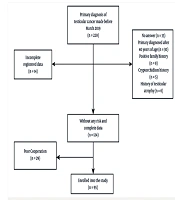
Masoumi N, Hatami A. Investigating the Incidence of Contralateral Metachronous Testicular Cancer Following Radical Orchidectomy. Int J Cancer Manag. 2025;18(1):e161849. doi: https://doi.org/10.5812/ijcm-161849
Mortazavi N, Mahzooni P, Taheri D, Jalilian M, Novin K. Germ Cell Tumor’s Survival Rate in Young Patients. Int J Cancer Manag. 2015;8(4):e3440. doi: https://doi.org/10.17795/ijcp.3440
Last Update: 3 weeks ago
Last Update: 3 weeks ago
Last Update: 3 weeks ago
Last Update: 6 hours ago
Last Update: 1 day ago
Last Update: 4 days ago