Fulltext
Full text is available in PDF.
International Journal of Cancer Management
The Official Journal of Cancer Research Center (CRC), Shahid Beheshti University of Medical Sciences
Authors
Background: Studies show that cancer treatment procedures could increase stress in children and adolescents diagnosed with cancer. This study was conducted to determine the frequency of stressors in children and adolescents with cancer, and to compare it in boys and girls.
Methods: Relevant information was collected via a structured interview with 70 children and their mothers. Subjects were divided into four age groups of 0-3; 4- 7; 8-12; 13-18. Stressors in physical, social and psychological aspects were determined and ranked. The main question asked was: "During the period of your disease, what has caused you the most suffering?" Whilst interviewing the mothers, this question was altered to:" During the period of your child's disease, what caused him/her to suffer the most?" The answers were reflected back to the respondents, and were categorized in a validated check list after their confirmation.
Results: The most stressing items in the 0 to 3 age group were found to be worry, pain due to treatment procedures, and separation from their immediate family. In 4 to 7 age group, they were procedural pain, worry and fatigue. For the 8 to 12 age group, pain, separation from family and worry were the most stressing items. For the 13 to 18 age group, the main stressors were worry, pain, and parting from friends and losing them. Analysis by "Mann-Whitney U test" showed no significant differences in stressors between girls and boys.
Conclusion: Our findings revealed that worry and procedural pain are the most common stressors in children treated for malignancy. Caregivers need to be aware of this fact and should take appropriate steps to relieve these stressors.
© 2012, Author(s). This open-access article is available under the Creative Commons Attribution 4.0 (CC BY 4.0) International License (https://creativecommons.org/licenses/by/4.0/), which allows for unrestricted use, distribution, and reproduction in any medium, provided that the original work is properly cited.
Montaseri S, Sharif F. Investigating the physical and psychosocial problems in children of parents with cancer. J Inflamm Dis. 2024;12(2):e155389. doi:
Firoozi M, Besharat M, Farahani H, Ghaed Rahmat A. “Vitality” a Missing Link in Adjustment to Childhood Cancer. Int J Cancer Manag. 2011;4(3):e80740. doi:
S.AM Moosavi S, Yaghubkhani Ghiasvand M, Pezeshkian F. A survey on stress and ways of coping with stress in 3-year old children in Qazvin. J Inflamm Dis. 2024;10(3):e155241. doi:
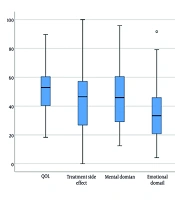
Sahraian L, Fakhar N, Tarrahi MJ, Haghshenas M. Family Functioning and the Quality of Life of Children with Cancer: A Descriptive Cross-Sectional Study. J Compr Ped. 2025;16(2):e157267. doi: https://doi.org/10.5812/jcp-157267
Faranosh M, AliShahbabaieAshtiani M, MehrVar A, HedayatiAsl AA, Tashvighi M, et al. Assessment of health related quality of life in children and adolescents suffering from cancer on chemotherapy and off treatment. koomesh. 2013;14(2):e152569. doi:
Last Update: 2 weeks ago
Last Update: 2 weeks ago
Last Update: 2 weeks ago
Last Update: 4 hours ago
Last Update: 1 day ago
Last Update: 5 days ago