Fulltext
Full-text is available in PDF file.
Authors
Introduction: Use of risk scoring systems in patients with acute coronary syndrome helps with summarizing important prognostic data of the disease and facilitates calculating confidence limits and comparing survival rates between different treatments. In the present study, the researchers first aimed at assessing mid-term outcome of patients with non-ST elevation myocardial infarction (NSTEMI), and then determining main predictors of this outcome to improve definitive criteria for designing a risk scoring system in the population.
Methods: In a prospective cohort study, 124 patients with NSTEMI, diagnosed according to ACC/AHA guidelines and hospitalized in an academic hospital in 2013, were consecutively assessed. Baseline characteristics were collected via interviewing, physical examination, and reviewing the recorded files. All the patients were followed for one and six months to assess mid-term outcomes regarding mortality and major adverse cardiac events (MACE). MACE is defined as the occurrence of at least one of the events of death, myocardial infarction, repeated revascularization, or re-hospitalization.
Results: One-month death occurred in 3.2%, re-hospitalization in 4.0%, and myocardial infarction in none of the patients. In addition, regarding the six-month outcomes status, mortality rate was determined in 6.4%, re-hospitalization in 22.6%, and myocardial infarction in 4.8% of patients. Hence, one- and six-month MACE rates were 7.3% and 27.4%, respectively. Furthermore, three- and six-month survival rates were estimated to be 96.8% and 93.6%, respectively. According to the Cox-proportion hazard modeling, only reduced left ventricular ejection fraction (LVEF) (HR = 0.909, P = 0.017), history of chronic kidney injury (HR = 8.884, P = 0.005), and Inotrope use (HR = 35.759, P = 0.012) could predict the six-month MACE. None of the other indexes including general coronary risk factors, echocardiography parameters, and level of cardiac enzymes could predict mortality rate.
Conclusions: Patients with NSTEMI may face high six-month MACE which can be predicted by low LVEF, history of renal injury and use of inotrope. Therefore, to define risk stratification system, these indicators should be considered as well.
© 2016, International Journal of Cardiovascular Practice. This open-access article is available under the Creative Commons Attribution-NonCommercial 4.0 (CC BY-NC 4.0) International License (https://creativecommons.org/licenses/by-nc/4.0/), which allows for the copying and redistribution of the material only for noncommercial purposes, provided that the original work is properly cited.
Tran DH, Nguyen QT, Cao VP, Hoang TA, Do VC. Prognostic Value of SYNTAX Scores for Predicting Major Cardiac Adverse Events in Patients with Acute Myocardial Infarction Treated with Primary Percutaneous Coronary Intervention. Int Cardiovasc Res J. 2023;17(1):e136694. doi:
Patel C, Prajapati J, Patel I, Singhal R, Mishra A, et al. Predictors of the extent and severity of coronary artery disease for prognosis of patients with non-ST-segment elevation acute coronary syndromes. Int J Cardiovasc Pract. 2018;3(4):e130285. doi: https://doi.org/10.21859/ijcp-03043
RAO MS, Devasia T, Kareem H, Padmakumar R, Jayaram A. Serum Cortisol Level as a Predictor of In-Hospital Mortality in Patients Undergoing Primary Percutaneous Intervention for ST Segment Elevation Myocardial Infarction. Int J Cardiovasc Pract. 2019;4(2):e130550. doi: https://doi.org/10.29252/ijcp-24650
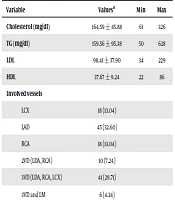
Mirbolouk F, Salari A, Riahini F, Moayerifar M, Norouzi S, et al. Electrocardiographic Changes and Coronary Findings in Patients with Acute non-ST-Elevation Myocardial Infarction: A Cross-Sectional Study. Jundishapur J Chronic Dis Care. 2020;9(4):e103948. doi: https://doi.org/10.5812/jjcdc.103948
Attar A, Zahed M, Hosseinpour A, Azami P, Kamalpour J, et al. Predictive Value of Global Longitudinal Strain on the Recovery of Left Ventricular Function Following ST-Segment Elevation Myocardial Infarction. Shiraz E-Med J. 2024;25(4):e142307. doi: https://doi.org/10.5812/semj-142307
Last Update: 4 days ago
Last Update: 4 days ago
Last Update: 4 days ago
Last Update: 6 days ago
Last Update: 6 hours ago
Last Update: 4 days ago