
Fulltext
Full-text is available in PDF file.
Authors
Introduction: The present study aimed at assessing the role of lesion length in predicting Fractional Flow Reserve (FFR) value for physiological evaluation of intermediate coronary lesions.
Methods: In the current study, 68 patients with 83 coronary lesions were enrolled. All of the patients in this study underwent routine coronary angiography, according to appropriate indications. To evaluate physiologically significant intermediate coronary stenosis (defined between 40% and 70% on visual estimation), the Fractional Flow Reserve (FFR) study was performed and the Quantitative Coronary Angiography (QCA) data were also assessed for measurement of lesion length. The correlation between QCA data and FFR values was also examined.
Results: Eighty-three lesions were evaluated from 68 patients. Stenosis was considered physiologically significant when FFR was lower than 0.75. The FFR was significant in twelve lesions (14.5%). There was a negative correlation between FFR value and lesion length (r = -0.294 and P = 0.013). Moreover, lesion length in physiologically significant FFR group (21.07 ± 6.9) was greater than that of the non-significant FFR group (15.23 ± 6.5) (P value < 0.05). Furthermore, the correlation between QCA data and FFR values was also investigated, yet, there was only a positive correlation between FFR and Minimum Luminal Diameter (MLD) values (r = 0.248 and P value = 0.04). The Receiver Operating Characteristic (ROC) curve analysis for predicting the significant FFR value demonstrated that a lesion length greater than 17.5 mm was the best cut-off point for prediction of the significant FFR value with acceptable sensitivity and specificity of 83.3% and 68.8%, respectively.
Conclusions: There is a negative correlation between lesion length and FFR value in intermediate coronary lesions. In addition, a lesion length greater than 17.5 mm is the best cut- off point for prediction of significant FFR values.
© 2017, International Journal of Cardiovascular Practice. This open-access article is available under the Creative Commons Attribution-NonCommercial 4.0 (CC BY-NC 4.0) International License (https://creativecommons.org/licenses/by-nc/4.0/), which allows for the copying and redistribution of the material only for noncommercial purposes, provided that the original work is properly cited.
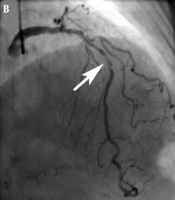
Xiong Q, Wu G, Fu X, Zhou D, Guo S. Evaluation of the Advantages of Myocardial Blood Flow Index in the Diagnosis of Chronic Obstructive Coronary Artery Disease Versus Coronary Computed Tomography Angiography: A Feasibility Study. I J Radiol. 2022;19(3):e123693. doi: https://doi.org/10.5812/iranjradiol-123693
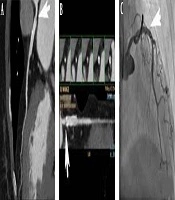
Xiong Q, Fu X, Xu J, Wu G. Analyzing the Application of Myocardial Blood Flow Index in the Diagnosis of In-Stent Stenosis. I J Radiol. 2021;18(1):e107251. doi: https://doi.org/10.5812/iranjradiol.107251

Hajaghaei M, Maleki M, Salehi H, Ojaghi Z, Noohi F. Coronary flow reserve measurement in the coronary sinus in pre and post CABG status. Int Cardiovasc Res J. 2007;1(2):e80490. doi:

Heidari Sarvestani A, Separham A, Khezerloo N. Assessment of Strain and Strain Rate in Patients with Coronary Artery Disease Before and After Percutaneous Intervention on Left Anterior Descending Coronary Artery. Int J Cardiovasc Pract. 2019;4(2):e130548. doi: https://doi.org/10.29252/ijcp-24016

Alemzadeh-Ansari MJ, Abdi S, Mohebbi B, Rostambeigi S, Alizadehasl A, et al. Noninvasive Index of Microvascular Resistance as a Predictor of Left Ventricular Performance Recovery in Patients with STEMI Undergoing Primary PCI. Int Cardiovasc Res J. 2022;16(1):e119268. doi:
Last Update: 1 day ago
Last Update: 1 day ago
Last Update: 1 day ago
Last Update: 6 days ago
Last Update: 6 hours ago
Last Update: 4 days ago