


1. Background
2. Objectives
3. Patients and Methods
3.1. Clinical Protocols
3.1.1. Consecutive Collection of Medical Records
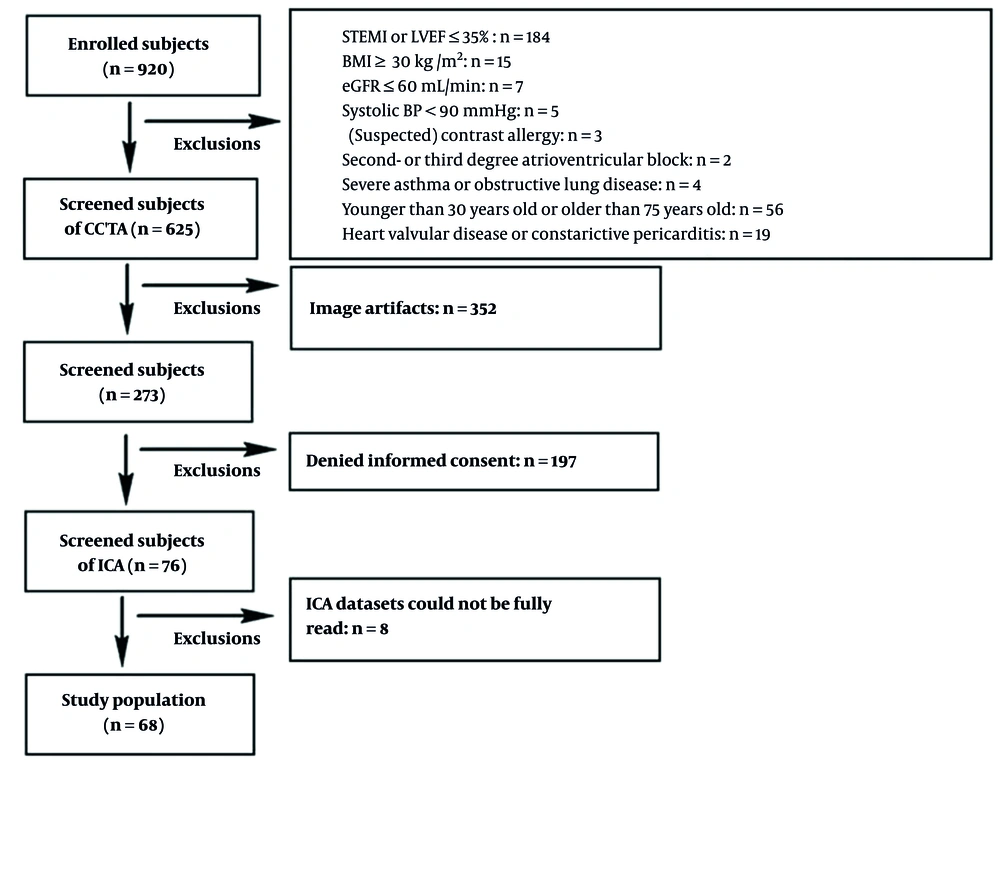
The flowchart of patient enrollment; STEMI, ST segment elevation myocardial infarction; LVEF, left ventricular ejection fraction; BMI, body mass index; eGFR, estimated glomerular filtration rate; BP, blood pressure; CCTA, coronary computed tomography angiography; and ICA, invasive coronary angiography.
3.2. Coronary Computed Tomography Angiography Protocol
3.2.1. Scanning Parameters
3.2.2. Computed Tomography Image Reconstruction
3.2.3. Image Quality Assessment
3.3. Myocardial Blood Flow Index
3.3.1. Myocardial Blood Flow Model
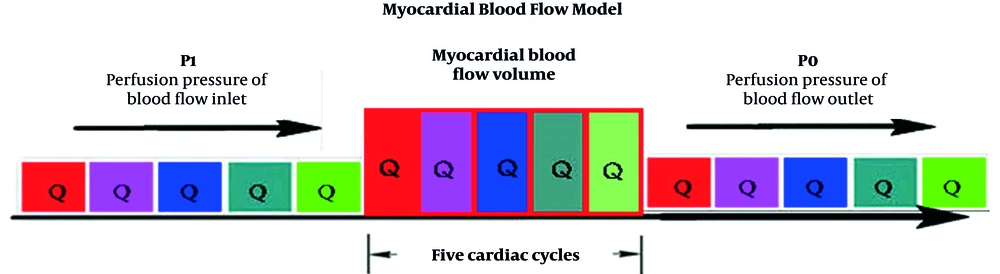
The myocardial blood flow model
3.3.2. Calculation of Myocardial Blood Flow Index
3.4. Invasive Coronary Angiography Protocol
3.5. Diagnostic Analysis
3.6. Statistical Analysis
4. Results
| Characteristics | Total (n = 68) |
|---|---|
| Gender | |
| Male | 39 |
| Female | 29 |
| Age (y) | 57 ± 10.2 |
| History of risk factors | |
| Hypertension b | 21 |
| Diabetes mellitus c | 24 |
| Dyslipidemia d | 38 |
| Smoking (n) | 17 |
| Family history of CAD | 5 |
| Average heart rate (time/min) | 73 ± 11.7 |
| Average diastolic blood pressure (mmHg) | 83 ± 11.9 |
| Average serum creatinine (μmol/L) | 82 |
| Average body mass index (kg/m2) | 23 ± 3.5 |
| Results of ICA | |
| One-vessel stenosis | 33 |
| Two-vessel stenosis | 21 |
| Multi-vessel stenosis | 14 |
| A left main lesion with three-vessel stenosis e | 1 |
| Average radiation dose (mSv) | 3.02 ± 1.15 |
Abbreviations: CAD, coronary artery disease; ICA, invasive coronary angiography; mSV, millisievert.
a Values are presented as mean ± SD or frequency (percentage).
b Blood pressure ≥ 140/90 mmHg or treatment for hypertension.
c Fasting blood glucose is above 7.0 mmol/L, or the glucose tolerance test is above 11.1 mmol/L two hours after a meal.
d Total cholesterol > 180 mg/dL or treatment for hypercholesterolaemia.
e There were only 2 patients with left main coronary artery disease combined with two-vessel stenosis.
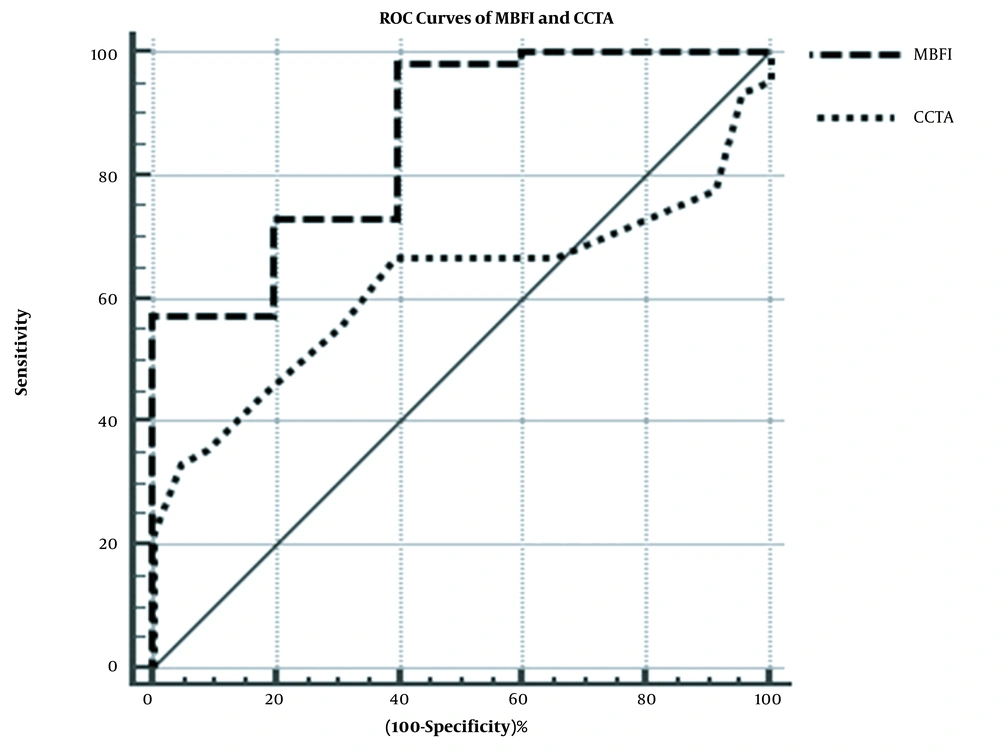
The receiver operating characteristiccurves for the myocardial blood flow index (MBFI) and computed coronary tomography angiography (CCTA)
| Method | COV | Sensibility (95% CI) | Specificity (95% CI) | PPV (95% CI) | NPV (95% CI) | AUC (95% CI) | DA | P Value |
|---|---|---|---|---|---|---|---|---|
| MBFI | 0.111 | 92.31% (0.734 - 0.987) | 92.86% (0.794 - 0.981) | 88.89% (0.697 - 0.971) | 95.12% (0.822 - 0.992) | 0.857 (0.751 - 0.930) | 92.65% | 0.0001 |
| CCTA | 70% | 61.54% (0.407 - 0.791) | 78.57% (0.628 - 0.892) | 64.00% (0.426 - 0.813) | 76.74% (0.610 - 0.877) | 0.621 (0.495 - 0.736) | 72.06% | 0.0710 |
Abbreviations: COV, cutoff value; PPV, positive predictive value; NPV, negative predictive value; AUC, area under the curve; DA, diagnostic accuracy; CI, confidence interval; MBFI, myocardial blood flow index; CCTA, coronary computed tomography angiography.
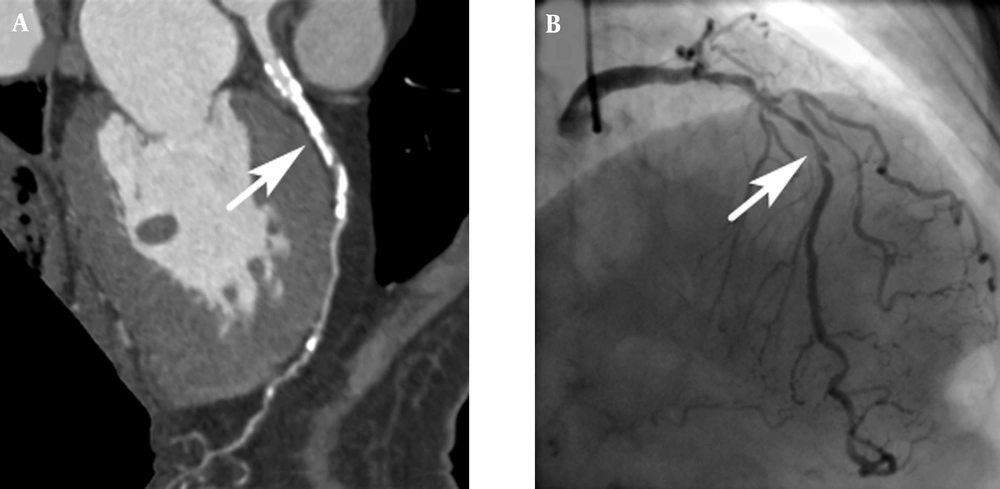
A 68-year-old male patient with unstable angina. The imaging findings of the left anterior descending (LAD) artery. A, The computed coronary tomography angiography (CCTA) image shows suspected stenosis in the LAD (arrow). The myocardial blood flow index (MBFI) is 0.082, which indicates a suspected lesion with severe stenosis; B, The invasive coronary angiography (ICA) image shows the severe lesion with 95% stenosis (arrow).
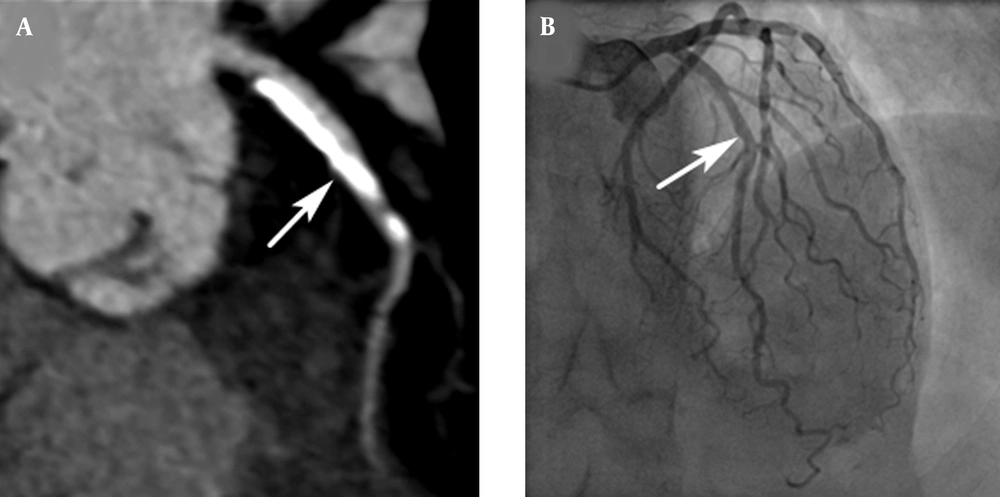
The imaging findings of the left anterior descending (LAD) artery in a 71-year-old male patient with unstable angina. A, Computed coronary tomography angiography (CCTA) image shows a suspected severe stenosis (arrow) in the LAD (arrow); B, The invasive coronary angiography images show a gentle lesion with 10% stenosis. Myocardial blood flow index is 0.128, which suggests a lesion with no severe stenosis.



