Fulltext
Full-text is available in PDF file.
Authors
Introduction: Serum lipoprotein levels change during hospitalization and effect patient’s outcome in case of sepsis. The aim of this study was to investigate the prognostic values of the serum levels of lipids in Intensive Care Unit (ICU) admitted patients.
Methods: Intensive Care Unit admitted patients with various etiologies were enrolled in this study. Serum lipid level was collected on the first and seventh day of admission. Clinical outcome and baseline characteristics, including age, gender, cause of admission, length of ICU stay, and discharge or death were monitored prospectively in a short cohort.
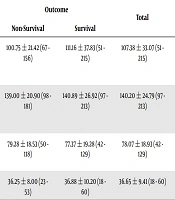
Results: A total of 108 patients were enrolled in this study. The overall mortality rate was 45%. The average duration of hospitalization at the ICU was significantly lengthier in the un-survived group. Lipid profile had a similar pattern in both genders. Triglyceride level seemed to increase from Day one to Day seven. These changes were observed in both unsurvived and survived group and were not significantly different. A considerable decline of 24% in High Density Lipoprotein (HDL) was detected among unsurvived patients. The mean value of TG on day seven among unsurvived patients was significantly higher than that of the survived group. Receiver Operating Characteristic (ROC) curve illustrated the higher diagnostic ability of HDL level in comparison with other parameters. On day seven, serum HDL cutoff value of 32 (sensitivity 75%; specificity 60%) was observed for predicting the mortality.
Conclusions: Cholesterol is essential for integrity as well as the function of the cell membrane, therefore, dyslipidemia occurring during hospitalization may negatively influence the outcome. Consequently, changes in lipid profile could be a prognostic biomarker for predicting mortality in ICU-admitted patients.
© 2018, International Journal of Cardiovascular Practice. This open-access article is available under the Creative Commons Attribution-NonCommercial 4.0 (CC BY-NC 4.0) International License (https://creativecommons.org/licenses/by-nc/4.0/), which allows for the copying and redistribution of the material only for noncommercial purposes, provided that the original work is properly cited.
Delirrad M, Gharebaghi N, Mobarhan S, Nejadrahim R. Relationship Between Lipid Profile and Sepsis Outcome in Intensive Care Unit. Arch Clin Infect Dis. 2020;15(2):e93533. doi: https://doi.org/10.5812/archcid.93533
Barati M, Nazari MR, TalebiTaher M, Farhadi N. Comparison of Lipid Profile in Septic and Non-Septic Patients. Arch Clin Infect Dis. 2011;6(4):. doi:
Hashemi pour S, Azizi F, Mehrtash B, Mohammadi N, Sarreshtehdari M, et al. Association of serum cortisol with critical illness scoring and prognosis in intensive care unit. J Inflamm Dis. 2024;16(2):e155690. doi:
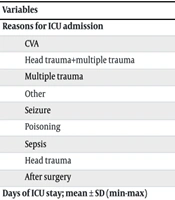
Habibi MR, Kanafi Vahed L, Rimaz S, Shahnavazi S. Characteristics and Outcomes of Patients Admitted to Intensive Care Units in an Academic Hospital Northern Iran. Zahedan J Res Med Sci. 2024;26(4):e151648. doi: https://doi.org/10.5812/zjrms-151648
Yaqubi S, Ghasemi J, Karimzadeh T, Mohammadi N, Arfaee E, et al. Comparison of acute physiology and chronic health evaluation II and simplified acute physiology score II in predicting mortality in intensive care unit. J Inflamm Dis. 2024;17(5):e155781. doi:
Last Update: 1 month ago
Last Update: 1 month ago
Last Update: 1 month ago
Last Update: 6 days ago
Last Update: 6 hours ago
Last Update: 4 days ago