Fulltext
Full-text is available in the PDF file.
Authors
 5, Zahra Amirajam6, Malek Abazari7, Mohsen Abbasnezhad8, Negin Zamani9
Introduction: Door to balloon time is a marker of primary Percutaneous Coronary Intervention (PCI) timeliness. Door to balloon time duration, associated factors and it's relation to outcomes are not similar in various centers. Herein we aimed to define these issues in our region.
Methods: In this study, 188 patients with ST-Elevation Myocardial infarction (STEMI) diagnosis eligible for primary PCI were included. Demographic, clinical, and time intervals from arrival in the hospital to patients' catheterization data were recorded. Patients were followed for six-month in terms of mortality and admission.
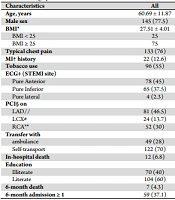
Results: After excluding patients with missed data, 174 patients were entered into the study. The mean age of patients was 60.8 ± 11.81 years, and 78% of patients were male. Median DBT was 70 minutes (IQR 25-75: 55-97 minute). One hundred and twentythree patients (71%) had a timely door to balloon time. Patients with delayed door to balloon time had lower age, lower prevalence of typical chest pain, and higher prevalence of PCI on Left Circumflex Artery (LCX) than the timely group, but these differences were not significant. (P-values were 0.068, 0.074 and 0.070 respectively). Delayed DBT was evident in three segments of the door to ECG, ECG to code, and code to cath times (P-values were < 0.0001, 0.009, and < 0.0001, respectively), but the cath to balloon time was not significantly different between the two groups (P-value: 0.159). Although in-hospital mortality was higher in the delayed group than the timely group, the difference was not meaningful. (11.7% vs 4.9%, P-value: 0.103). Six-month mortality and admission rate were not different between the two groups.
Conclusions: Door to balloon time was acceptable in this study and was comparable to developed countries. Albeit there is room for improvement due to modifiable delayed parts.
© 2021, International Journal of Cardiovascular Practice. This open-access article is available under the Creative Commons Attribution 4.0 (CC BY 4.0) International License (https://creativecommons.org/licenses/by/4.0/), which allows for the copying and redistribution of the material only for noncommercial purposes, provided that the original work is properly cited.
Golami Garab S, Abdolhay MJ, Gandomi-Mohammadabadi A, Balasi J, Abbasi MA. Associated factors with delayed door to balloon time in STEMI patients. Int J Cardiovasc Pract. 2021;6(1):e131478. doi:

Mihnea-Traian N, Popa V, Polojintef-Corbu D, Popescu M. Immediate versus Staged Complete Revascularization in Multi-Vessel Coronary Artery Disease Patients with ST-Elevation Myocardial Infarction Uncomplicated by Cardiogenic Shock. Int Cardiovasc Res J. 2021;15(3):e116878. doi:

Basiri H, Kiani R, Abdi S, Zahedmehr A, Sanati H, et al. A Comparison of Outcomes of Routine Early Angiography versus Delayed Ischemia-Guided Angiography after Thrombolytic Therapy in ST Segment-Elevation Myocardial Infarction. Int Cardiovasc Res J. 2017;5(2):e13996. doi:

Rezaie S, Gharanjici N, Ebrahimi H. Prehospital and interhospital delay in the treatment of patients with acute myocardial infarction with ST segment elevation and strategies to improve it from the perspective of the process owners: The importance of time. koomesh. 2019;21(3):e153092. doi:
Namdar P, yekefallah L, jalalian F. The Role of Pre-hospital and Hospital Emergency Staff in Time Management of Acute Myocardial Infarction. J Inflamm Dis. 2024;24(4):e156238. doi:
More by these authors
Last Update: 1 month ago
Last Update: 1 month ago
Last Update: 1 month ago
Last Update: 6 days ago
Last Update: 6 hours ago
Last Update: 4 days ago